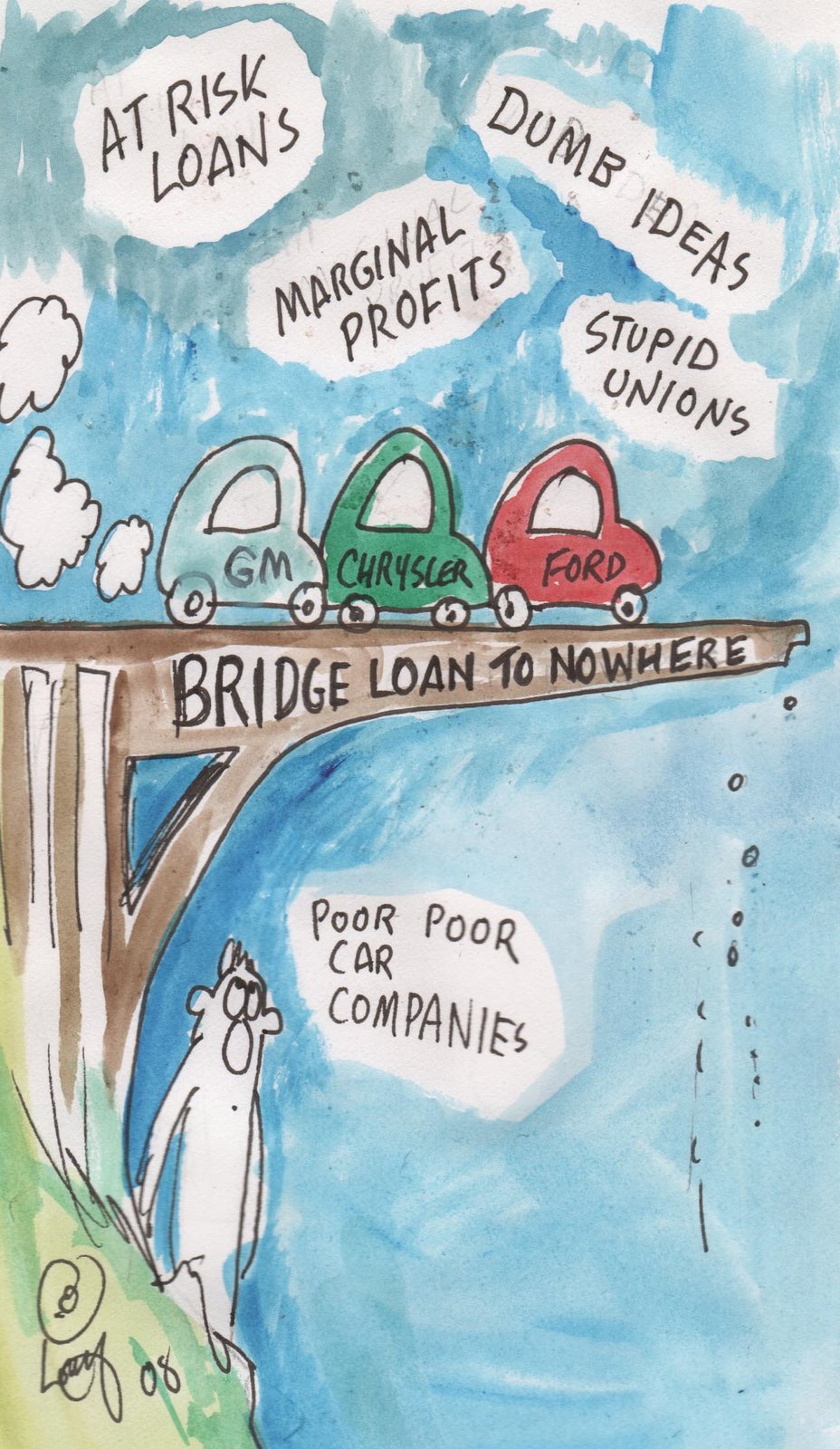
The Bridge Loan to Nowhere


Cartoon by Charlie Loving / The Rag Blog

Posted in RagBlog | Tagged , | 3 Comments

Massive Baghdad Protest Against the SOFA*

An effigy of President Bush hangs on the pedestal where a famous statue of Saddam Hussein once stood in central Baghdad. It was burned after a rally for followers of anti-American cleric Muqtuda al-Sadr Friday, November 21, 2008. Photo: Caesar Ahmed.

Sadr followers protest Iraqi-U.S. pact in huge rally
By Adam Ashton / November 21, 2008

BAGHDAD — Tens of thousands of followers of radical Shiite cleric Muqtada al Sadr packed a central Baghdad square Friday, where they protested a U.S.-Iraq security agreement and likened Prime Minister Nouri al Maliki to fallen dictator Saddam Hussein.

Sheik Abdul Hadi al Mohammadawi read a nationalistic speech on behalf of Sadr urging a rejection of any pacts with the U.S., charging that approving one would infringe on Iraqi sovereignty.

The crowd chanted back, “Leave, leave, occupier.”

The rally took place in Firdous Square, the site of an iconic image of the Iraq war’s early days. It’s the spot where U.S. Marines toppled a statue of Saddam Hussein in April 2003 when they took control of Baghdad.

Sadr’s supporters on Friday hung an effigy of President George W. Bush from the statue’s pedestal during the protest. A crowd gathered around the effigy after Mohammadawi’s speech, hurling garbage at it and then pulling it down and burning it.

Otherwise, the rally was peaceful, guarded by the Iraqi military and Sadrists. Prayers encouraging unity among Iraqis followed the speeches.

Men crowded every inch of the street, sitting on colorful prayer rugs. They carried Iraqi flags and portraits of Sadr.

Mohammadawi targeted part of his speech at Iraqi members of parliament, who are considering the security agreement. He said the U.S. should leave unconditionally and hand over the country to Iraq’s military.

“Our safety cannot be solved by the occupation,” he said. “Iraqis are able to protect their country. They will take responsibility by themselves.”

The security agreement has cleared Iraq’s Cabinet and is awaiting a vote in parliament. It calls for the U.S. to leave Iraq by Dec. 31, 2011, and it gives Iraq much more control over U.S. military operations in the meantime.

Sadr’s political party has tried to derail the pact in parliament, shouting down readings of the bill over the past two days and pledging to fight it.

“History will record the honorable position of the Sadrists and those who join together to reject the humiliation” of the agreement, Mohammadawi said.

An alliance of Shiite and Kurdish parties led by Maliki backs the agreement, contending that it’s the best deal they can reach to end the American occupation. They make up a majority of the 275 seats in parliament.

The Sadr party has made its opposition to the agreement known from the outset. The pact’s supporters are concentrating on drawing Sunni Muslim parties to their side, which would enable them to claim a national accordance backing the pact.

Building that support would meet the direction of the Grand Ayatollah Ali al Sistani, who’s advised that the pact gain a consensus for the benefit of Iraq. He’s the leading religious authority among Iraq’s Shiites, and his support often is considered crucial for the success of political decisions.

Hadi al Ameri, the head of the Badr Organization, said Friday’s march wouldn’t disrupt parliament’s vote on the pact. The organization is a member of the Shiite alliance, which also includes Maliki’s party.

“With all our respect for the demonstrators, it is not a demonstration that will stop the agreement, just as it would not be a demonstration that will get it signed,” Ameri said.

The status of forces agreement was a prominent topic Friday at mosques throughout the country.

Hashim al Tai, a Sunni cleric and a member of parliament, issued a moderate appeal, encouraging parliament to consider amendments to the security pact submitted by his Tawafuq alliance. Tawafuq wants compensation for war victims and assurances that many detainees will be released instead of turned over to the Iraqi government.

Iraqi law prohibits amending the agreement, however. The Iraqi Cabinet approved the agreement Sunday, and that made it a final treaty between two states. Parliament can approve or reject it, but lawmakers can’t modify it.

Shiite cleric Nael al Moussawi told his following at al Khalani mosque that the parliament debate was a sign of democracy.

“What happened in parliament is happening a lot in other parliaments,” he said. “Everyone has the right to voice his opinion.”

Men who attended the rally in Firdous Square echoed the Sadrist line, charging that the treaty was an infringement on Iraqi authority. They contended that the exit of American forces would ease tensions among Iraqis rather than inflame them.

“By God, the violence will not come back, because Iraqis are a united people,” said Jasim Kadhim, 35.

Sadr’s militia, the Mahdi Army, was blamed for some of the sectarian violence that gripped Iraq in 2006 and 2007. It’s been on a cease-fire, but Sadr has suggested that it will rise up if the security agreement passes.

Many at the rally were skeptical about the prime minister’s motives. They sang, “Maliki is the new Saddam,” as they marched away from the rally up Saadoun Street.

“The agreement on the status of forces doesn’t help Iraq,” said Halim Hafidh, 31. “They will not give us our full rights.”

[Ashton reports for The Modesto (Calif.) Bee. McClatchy special correspondents Laith Hammoudi and Sahar Issa contributed to this report.]

Source / McClatchy

The Rag Blog

* SOFA = Status of Forces Agreement

Posted in RagBlog | Tagged , , | Leave a comment

We’ve No Business Allowing War Criminals to Walk

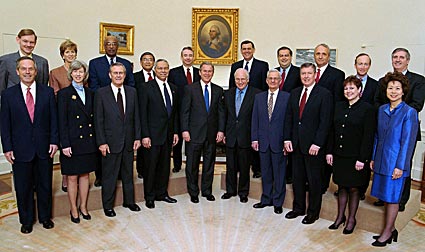
Just a few war criminals here … Bush Cabinet, 2001.

Moderation in the pursuit of justice is no virtue
By Joseph L. Galloway / November 18, 2008

With two months still to go before his inauguration as the 44th President of the United States, Barack Obama and his transition team are already getting off on the wrong foot, signaling that they have no intention of investigating anyone in the Bush administration for possible war crimes.

What we’re talking about here is the torture of detained terrorist suspects in American custody in a grotesque violation of both our treaty obligations under the Geneva Conventions and our historic principles as a democratic nation.

By their own machinations and attempts to redefine and pervert both treaties and our own laws, President Bush, Vice President Dick Cheney, former Defense Secretary Donald H. Rumsfeld, Attorneys General John Ashcroft and Alberto Gonzales, Cheney’s chief of staff David Addington and any number of lesser suspects sought to shield themselves from, or put themselves above, justice.

They did so knowing full well that what they were doing — clearing the way for interrogators at Guantanamo and in the Central Intelligence Agency’s secret dungeons around the world to do anything it took, short of murder, to extract information from terror suspects.

The “harsh interrogation methods” included water-boarding, stripping and humiliating prisoners, subjecting them to extremes of temperature, putting them into stressful physical positions for hours, the use of psychotropic drugs and doubtless other equally uncivilized practices.

Water boarding has always been treated as a criminal act in this country. Military officers were court-martialed at the turn of the last century for water boarding Filipino guerrillas. More recently, an East Texas sheriff was sentenced to 10 years in federal prison for water boarding a suspect and extracting a confession from him.

Moderation in the pursuit of justice is no virtue, and its no way to begin an administration that was elected on promises of change. What it says is that if you’re one of the elite and powerful, your violations of the law will be overlooked, no matter how much damage you did to our country’s standing in the world.

What signal does it send to Mr. Bush’s gang of unindicted co-conspirators, who’ve unwrapped a Pandora’s boxful of other offenses — from perverting the administration of justice, to illegally eavesdropping on the phone conversations and e-mails of ordinary Americans, to salting the stream of intelligence with bogus material, to inviting their cronies to loot the Treasury with no-bid military contracts, to lying under oath to congressional oversight committees, to applying political litmus tests to the hiring of civil service employees to the wholesale destruction of White House e-mails and records? Etcetera. Etcetera.

This nation was founded on the principle of equal justice under the law. No one — no one — ought to be able to skate or hold a get-out-of-jail-free card by virtue of having been the most powerful felon in the land, or of working for him.

This signal on torture investigations says that Sen. Obama wants to start his administration as a uniter, not a divider, trying to untangle the unholy mess that the Decider and Co. are leaving behind them in the economy, in our military, in virtually every walk of our national life. It speaks to his desire to reach across the aisle to the defeated Republicans and try to bring them back into the fold as Americans.

That’s all well and good, but not if it comes at the cost of lifting the blindfold off Justice’s eyes and letting her pick and choose who’ll pay for criminal acts and who won’t. That’s no way to begin, and no way to continue.

Out in West Texas, crusty old ranchers plagued by coyotes killing their calves and baby sheep shoot the offending beasts and hang their carcasses on the nearest barbed wire fence as an object lesson to the rest of the pack.

Unless the newly empowered Democrats in the White House and on Capitol Hill hang a few coyotes on some fences in Washington, D.C., they’re making a huge mistake that will come back to haunt them, and all the rest of us, too.

Unless the truth, the whole truth, is unearthed, justice is done and the Republican closet is emptied of festering transgressions, the next pack will do it again, secure in the knowledge that their positions will protect them from the penalties that more ordinary citizens must pay for the same crimes.

The people of this nation have spoken loudly. They voted to throw the rascals out. They voted for a different way of governing, a different way of law making. They voted for equal rights under the law.

If their desires aren’t satisfied — if the new broom sweeps no cleaner than the old one — the next time around they may move things up a notch and throw all the bastards out — and they’d be fully justified in doing so.

Source / McClatchy

The Rag Blog

Posted in RagBlog | Tagged , , | 6 Comments

National Intelligence Council : Sun Setting on The American Century

The report said that global warming will aggravate the scarcity of water, food and energy resources. Graphic: 20th Century Fox.

‘The world of the near future will be subject to an increased likelihood of conflict over resources, including food and water, and will be haunted by the persistence of rogue states and terrorist groups with greater access to nuclear weapons.’
By Tim Reid / November 21, 2008

WASHINGTON — The next two decades will see a world living with the daily threat of nuclear war, environmental catastrophe and the decline of America as the dominant global power, according to a frighteningly bleak assessment by the US intelligence community.

“The world of the near future will be subject to an increased likelihood of conflict over resources, including food and water, and will be haunted by the persistence of rogue states and terrorist groups with greater access to nuclear weapons,” said the report by the National Intelligence Council, a body of analysts from across the US intelligence community.

The analysts said that the report had been prepared in time for Barack Obama’s entry into the Oval office on January 20, where he will be faced with some of the greatest challenges of any newly elected US president.

“The likelihood that nuclear weapons will be used will increase with expanded access to technology and a widening range of options for limited strikes,” the 121-page assessment said.

The analysts draw attention to an already escalating nuclear arms race in the Middle East and anticipate that a growing number of rogue states will be prepared to share their destructive technology with terror groups. “Over the next 15-20 years reactions to the decisions Iran makes about its nuclear programme could cause a number of regional states to intensify these efforts and consider actively pursuing nuclear weapons,” the report Global Trends 2025 said. “This will add a new and more dangerous dimension to what is likely to be increasing competition for influence within the region,” it said.

The spread of nuclear capabilities will raise questions about the ability of weak states to safeguard them, it added. “If the number of nuclear-capable states increases, so will the number of countries potentially willing to provide nuclear assistance to other countries or to terrorists.”

The report said that global warming will aggravate the scarcity of water, food and energy resources. Citing a British study, it said that climate change could force up to 200 million people to migrate to more temperate zones. “Widening gaps in birth rates and wealth-to-poverty ratios, and the impact of climate change, could further exacerbate tensions,” it said.

“The international system will be almost unrecognisable by 2025, owing to the rise of emerging powers, a globalising economy, a transfer of wealth from West to East, and the growing influence of nonstate actors. Although the United States is likely to remain the single most powerful actor, the United States’ relative strength – even in the military realm – will decline and US leverage will become more strained.”

Global power will be multipolar with the rise of India and China, and the Korean peninsula will be unified in some form. Turning to the current financial situation, the analysts say that the financial crisis on Wall Street is the beginning of a global economic rebalancing.

The US dollar’s role as the major world currency will weaken to the point where it becomes a “first among equals”.

“Strategic rivalries are most likely to revolve around trade, investments and technological innovation, but we cannot rule out a 19th-century-like scenario of arms races, territorial expansion and military rivalries.” The report, based on a global survey of experts and trends, was more pessimistic about America’s global status than previous outlooks prepared every four years. It said that outcomes will depend in part on the actions of political leaders. “The next 20 years of transition to a new system are fraught with risks,” it said.

The analysts also give warning that the kind of organised crime plaguing Russia could eventually take over the government of an Eastern or Central European country, and that countries in Africa and South Asia may find themselves ungoverned, as states wither away under pressure from security threats and diminishing resources..

The US intelligence community expects that terrorism would survive until 2025, but in slightly different form, suggesting that alQaeda’s “terrorist wave” might be breaking up. “AlQaeda’s inability to attract broad-based support might cause it to decay sooner than people think,” it said.

On a positive note it added that an alternative to oil might be in place by 2025.

Source / The Times, U.K.

Read the report in full.

The Rag Blog

Posted in RagBlog | Tagged , , , | 1 Comment

Preparing for Office : Obama’s Studying Vlad the Impaler

Obama getting some tips on Capitol Hill “vlad-handing” from the master?

Obama reading biography of Vlad but spokesman quickly dismisses any plans to impale.
By Jerry and Joe Long / November 26, 2008

Also see ‘Past Legends Pass on Past Lessons’ by Rod Reyes, below.

WASHINGTON — In what could signal a major departure from the conciliatory tone of Doris Kearns Goodwin’s Team Of Rivals, aides to President-elect Obama today confirmed that he is reading a biography of 15th century Balkan ruler Vlad Tepes. Vlad, who on St. Bartholomew’s Day 1459, impaled 30,000 citizens of Brasov for corruption, dined beneath their corpses, then left the putrefying cadavers hanging outside the city walls as a warning, is considered by many Progressives to have provided the only workable model for how to deal with K Street.

An Obama spokesperson was quick to dismiss any thoughts of impaling. Though, off the record, expressed a wish that at some point in the next four to eight years they might come upon Joe Lieberman in the act of bending over.

Beltway pundits had been speculating that because Obama has read biographies of both Andrew Jackson and Aaron Burr he might withdraw the offer of Secretary of State from Hillary Clinton and fire a pistol ball at her. Though David Broder cites Obama’s reading of Julia Child’s The French Chef Cookbook as evidence that Obama will be more inclined to demonstrate to the junior senator from New York how to prevent egg yolks in hollandaise sauce from scrambling.

Source / 23/6

Past Legends Pass on Past Lessons
By Rod Reyes / November 18, 2008

What is on Barack Obama’s reading list? This is among the three most commonly asked questions during this historic transition period, right behind “what kind of dog are you buying” and “didya ask Hillary to be Secretary of State? Didya? C’mon didya”? At least, unlike the Governor of Alaska, he didn’t say “everything, you know, whatever they put in front of me.” Honestly, did she think we’d believe she just devoured the latest issue of Wired, just because someone slipped it onto the coffee table? Obama dexterously confessed to reading The Defining Moment, a retrospective of the first 100 days of the F.D.R. administration, and Team of Rivals, a book devoted to the astute choices of political adversaries for his cabinet by Abraham Lincoln. Nothing like being able to reach for one of these to show that our President-elect is doing his homework.

Certainly, there are few better role models to choose from, although there were some holes in both stories. I for one am curious why Lincoln didn’t include the one enemy who ultimately did him the most harm, John Wilkes Booth. Having him in the cabinet would have at least forced him to sit in front of Lincoln, giving the President a decent chance to duck. Okay, that’s just dumb, but, so is front loading your chief advisory board with too many people who don’t have your best interests at heart. If Obama should happen to include the John Adams biography in his list of “must reads”, he will learn that one of our second President’s gravest errors was in keeping intact the cabinet of his predecessor, George Washington. For the sake of what he believed would be a smooth transition, he surrounded himself with a scorpion’s nest that would bring about his political ruin, in spite of his keeping the nation out of a further war with England.

I don’t believe Barack Obama will be quite so accommodating of the opposition. He is said to be a proponent of dissenting opinion, but I don’t imagine that means taking a kick in the keister every time his back is turned. He will balance his cabinet with a liberal sprinkling of conservatives (there, I got both words into the same sentence), and look to place strong rivals within his own party such as Clinton and Richardson into prominent positions. This shouldn’t be as much of a risk as those Lincoln took. The great dividing issue of his time was slavery. Racism is not the flaming, passion inspiring political plank that slavery was in 1860. For Lincoln to appoint Seward, Chase, and Bates to be his closest advisers took a courage as well as political acumen rarely seen in our history. Surely racism is still a concern, but in fact, it is more of a coffee table issue for Sunday morning news shows to discuss. Bill O’Reilly can debate Rush Limbaugh and Pat Buchanan on how racism is why Republicans didn’t get the black and Latino votes.

The lessons from Roosevelt are even greater, and more appropriate to our present situation (although personally, the lesson I take from F.D.R. is that a cigarette holder makes cancer less menacing). When Joe Biden said that Obama would be tested, the Republicans quickly jumped on this as an indictment of Obama’s inexperience creating an opportunity for the villains of the world to wreak havoc in the U.S.A. The Democrats responded that every new President is tested. Imagine my surprise when I learned that Roosevelt narrowly escaped an assassination attempt less than a month before taking office. Small wonder that he felt obligated to situate several machine gun emplacements throughout the periphery of the inauguration venue. Well, it isn’t as if Roosevelt could have run away from another gunman.

Is that mean? I don’t think so, because history teaches us that perhaps the greatest accomplishment of Roosevelt’s astonishing three terms is his never letting the American public know that he couldn’t fly, much less walk. His successes were as much due to the ebullience of his character, his indomitable cheer and positive attitude as through any of his early policies, many of which failed dismally. There is a generous amount of good will being given to Obama, but it is a double edged sword.

Roosevelt took office when the nation was at rock bottom. There wasn’t anywhere else to go but up. There are even some who suggested that he refused to cooperate with Hoover in trying to do something to make the situation better just so that he could come in and start cleaning things up from scratch. Sounds familiar, but hey, Hoover had years to work on the economy after the crash, much as G.W. Bush had years to ruin the economy before our current situation exploded. I am happy to know that our new President is eager to learn the lessons of the past. Ultimately, it is the history he will help write himself that will be his own, as well as our nation’s new defining moment.

Source / 23/6

The Rag Blog

Posted in RagBlog | Tagged , , , | Leave a comment

Promoting Diplomacy with Iran

The Rag Blog has long advocated diplomacy over aggression with respect to relations with Iran. More than a year ago, we posted about the Iran Pledge of Resistance. We maintain a link to the pledge in our sidebar. The Rag Blog’s David Hamilton has written several pieces on the blog that maintain a consistent approach to diplomacy over violence. We strongly urge our readers to sign these petitions that call for a measured, diplomatic approach to Tehran, and demand the rule of international law over naked aggression.

Richard Jehn / The Rag Blog


Joint Experts’ Statement on Iran
By Juan Cole / November 21, 2008

Below is a statement on Iran that I and others are hoping will be adopted in Washington as a way forward. Any of my readers who has a way of getting this statement to decision-makers in Washington should please do so. Just Foreign Policy is doing it as a petition. Also, my blogger colleagues should please comment widely on it.

It was carried by wire services such as Reuters and also the Associated Press.

Gary Kamiya at Salon pointed to it.

Michael Theodolu covered the statement in the Gulf.

Jim Lobe has written about it, under the rubric “Obama urged to forego Iran threats.”

The statement follows:

Among the many challenges that will greet President-elect Obama when he takes office, there are few, if any, more urgent and complex than the question of Iran. There are also few issues more clouded by myths and misconceptions. In this Joint Experts’ Statement on Iran, a group of top scholars, experts and diplomats – with years of experience studying and dealing with Iran – have come together to clear away some of the myths that have driven the failed policies of the past and to outline a factually-grounded, five-step strategy for dealing successfully with Iran in the future.

Joint Experts’ Statement on Iran

Despite recent glimmers of diplomacy, the United States and Iran remain locked in a cycle of threats and defiance that destabilizes the Middle East and weakens U.S. national security.

Today, Iran and the United States are unable to coordinate campaigns against the Taliban and al-Qaeda, their common enemies. Iran is either withholding help or acting to thwart U.S. interests in Iraq, Afghanistan, Lebanon, and Gaza. Within Iran, a looming sense of external threat has empowered hard-liners and given them both motive and pretext to curb civil liberties and further restrict democracy. On the nuclear front, Iran continues to enrich uranium in spite of binding U.N. resolutions, backed by economic sanctions, calling for it to suspend enrichment.

U.S. efforts to manage Iran through isolation, threats and sanctions have been tried intermittently for more than two decades. In that time they have not solved any major problem in U.S.-Iran relations, and have made most of them worse. Faced with the manifest failure of past efforts to isolate or economically coerce Iran, some now advocate escalation of sanctions or even military attack. But dispassionate analysis shows that an attack would almost certainly backfire, wasting lives, fomenting extremism and damaging the long-term security interests of both the U.S and Israel. And long experience has shown that prospects for successfully coercing Iran through achievable economic sanctions are remote at best.

Fortunately, we are not forced to choose between a coercive strategy that has clearly failed and a military option that has very little chance of success. There is another way, one far more likely to succeed: Open the door to direct, unconditional and comprehensive negotiations at the senior diplomatic level where personal contacts can be developed, intentions tested, and possibilities explored on both sides. Adopt policies to facilitate unofficial contacts between scholars, professionals, religious leaders, lawmakers and ordinary citizens. Paradoxical as it may seem amid all the heated media rhetoric, sustained engagement is far more likely to strengthen United States national security at this stage than either escalation to war or continued efforts to threaten, intimidate or coerce Iran.

Here are five key steps the United States should take to implement an effective diplomatic strategy with Iran:

1. Replace calls for regime change with a long-term strategy

Threats are not cowing Iran and the current regime in Tehran is not in imminent peril. But few leaders will negotiate in good faith with a government they think is trying to subvert them, and that perception may well be the single greatest barrier under U.S. control to meaningful dialogue with Iran. The United States needs to stop the provocations and take a long-term view with this regime, as it did with the Soviet Union and China. We might begin by facilitating broad-ranging people-to-people contacts, opening a U.S. interest section in Tehran, and promoting cultural exchanges.

2. Support human rights through effective, international means

While the United States is rightly concerned with Iran’s worsening record of human rights violations, the best way to address that concern is through supporting recognized international efforts. Iranian human rights and democracy advocates confirm that American political interference masquerading as “democracy promotion” is harming, not helping, the cause of democracy in Iran.

3. Allow Iran a place at the table – alongside other key states – in shaping the future of Iraq, Afghanistan and the region.

This was the recommendation of the bipartisan Iraq Study Group with regard to Iraq. It may be counter-intuitive in today’s political climate – but it is sound policy. Iran has a long-term interest in the stability of its neighbors. Moreover, the United States and Iran support the same government in Iraq and face common enemies (the Taliban and al-Qaeda) in Afghanistan. Iran has shown it can be a valuable ally when included as a partner, and a troublesome thorn when not. Offering Iran a place at the table cannot assure cooperation, but it will greatly increase the likelihood of cooperation by giving Iran something it highly values that it can lose by non-cooperation. The United States might start by appointing a special envoy with broad authority to deal comprehensively and constructively with Iran (as opposed to trading accusations) and explore its willingness to work with the United States on issues of common concern.

4. Address the nuclear issue within the context of a broader U.S.-Iran opening

Nothing is gained by imposing peremptory preconditions on dialogue. The United States should take an active leadership role in ongoing multilateral talks to resolve the nuclear impasse in the context of wide-ranging dialogue with Iran. Negotiators should give the nuclear talks a reasonable deadline, and retain the threat of tougher sanctions if negotiations fail. They should also, however, offer the credible prospect of security assurances and specific, tangible benefits such as the easing of U.S. sanctions in response to positive policy shifts in Iran. Active U.S. involvement may not cure all, but it certainly will change the equation, particularly if it is part of a broader opening.

5. Re-energize the Arab-Israeli peace process and act as an honest broker in that process

Israel’s security lies in making peace with its neighbors. Any U.S. moves towards mediating the Arab-Israeli crisis in a balanced way would ease tensions in the region, and would be positively received as a step forward for peace. As a practical matter, however, experience has shown that any long-term solution to Israel’s problems with the Palestinians and Lebanon probably will require dealing, directly or indirectly, with Hamas and Hezbollah. Iran supports these organizations, and thus has influence with them. If properly managed, a U.S. rapprochement with Iran, even an opening of talks, could help in dealing with Arab-Israeli issues, benefiting Israel as well as its neighbors.

*****

Long-standing diplomatic practice makes clear that talking directly to a foreign government in no way signals approval of the government, its policies or its actions. Indeed, there are numerous instances in our history when clear-eyed U.S. diplomacy with regimes we deemed objectionable – e.g., Soviet Union, China, North Korea, Libya and Iran itself (cooperating in Afghanistan to topple the Taliban after 9/11) – produced positive results in difficult situations.

After many years of mutual hostility, no one should expect that engaging Iran will be easy. It may prove impossible. But past policies have not worked, and what has been largely missing from U.S. policy for most of the past three decades is a sustained commitment to real diplomacy with Iran. The time has come to see what true diplomacy can accomplish.

Annex: Basic Misconceptions about Iran

U.S. policies towards Iran have failed to achieve their objectives. A key reason for their failure is that they are rooted in fundamental misconceptions about Iran. This annex addresses eight key misconceptions that have driven U.S. policy in the wrong direction.

Myth # 1. President Ahmadinejad calls the shots on nuclear and foreign policy.

President Mahmoud Ahmadinejad has grabbed the world’s attention with his inflammatory and sometimes offensive statements. But he does not call the shots on Iran’s nuclear and foreign policy. The ultimate decision-maker is Supreme Leader Ali Khamenei, the commander-in-chief of Iran’s forces. Despite his frequently hostile rhetoric aimed at Israel and the West, Khamenei’s track record reveals a cautious decision-maker who acts after consulting advisors holding a range of views, including views sharply critical of Ahmadinejad. That said, it is clear that U.S. policies and rhetoric have bolstered hard-liners in Iran, just as Ahmadinejad’s confrontational rhetoric has bolstered hard-liners here.

Myth # 2. The political system of the Islamic Republic is frail and ripe for regime change.

In fact, there is currently no significant support within Iran for extra-constitutional regime change. Yes, there is popular dissatisfaction, but Iranians also recall the aftermath of their own revolution in 1979: lawlessness, mass executions, and the emigration of over half a million people, followed by a costly war. They have seen the outcome of U.S.-sponsored regime change in Afghanistan and in Iraq. They want no part of it. Regime change may come to Iran, but it would be folly to bet on it happening soon.

Myth # 3. The Iranian leadership’s religious beliefs render them undeterrable.

The recent history of Iran makes crystal clear that national self-preservation and regional influence – not some quest for martyrdom in the service of Islam – is Iran’s main foreign policy goal. For example:

• In the 1990s, Iran chose a closer relationship with Russia over support for rebellious Chechen Muslims.

• Iran actively supported and helped to finance the U.S. invasion of Afghanistan.

• Iran has ceased its efforts to export the Islamic revolution to other Persian Gulf states, in favor of developing good relations with the governments of those states.

• During the Iran-Iraq War, Iran took the pragmatic step of developing secret ties and trading arms with Israel, even as Iran and Israel denounced each other in public.

Myth # 4. Iran’s current leadership is implacably opposed to the United States.

Iran will not accept preconditions for dialogue with the United States, any more than the United States would accept preconditions for talking to Iran. But Iran is clearly open to broad-ranging dialogue with the United States. In fact, it has made multiple peace overtures that the United States has rebuffed. Right after 9/11, Iran worked with the United States to get rid of the Taliban in Afghanistan, including paying for the Afghan troops serving under U.S. command. Iran helped establish the U.S.-backed government and then contributed more than $750 million to the reconstruction of Afghanistan. Iran expressed interest in a broader dialogue in 2002 and 2003. Instead, it was labeled part of an “axis of evil.”

In 2005, reform-minded President Khatami was replaced by the hardliner, Mahmoud Ahmadinejad. But the same Supreme Leader who authorized earlier overtures is still in office today and he acknowledged, as recently as January 2008, that “the day that relations with America prove beneficial for the Iranian nation, I will be the first one to approve of that.” All this does not prove that Iran will bargain in good faith with us. But it does disprove the claim that we know for sure they will not.

Myth # 5. Iran has declared its intention to attack Israel in order to “wipe Israel off the map.”

This claim is based largely on a speech by President Ahmadinejad on Oct. 26, 2005, quoting a remark by Ayatollah Khomeini made decades ago: “This regime that is occupying Qods [Jerusalem] must be wiped off/eliminated from the pages of history/our times.” Both before and since, Ahmadinejad has made numerous other, offensive, insulting and threatening remarks about Israel and other nations – most notably his indefensible denial of the Holocaust.

However, he has been criticized within Iran for these remarks. Supreme Leader Khamenei himself has “clarified” that “the Islamic Republic has never threatened and will never threaten any country” and specifically that Iran will not attack Israel unless Iran is attacked first. Ahmadinejad also has made clear, or been forced to clarify, that he was referring to regime change through demographics (giving the Palestinians a vote in a unitary state), not war.

What we know is that Ahmadinejad’s recent statements do not appear to have materially altered Iran’s long-standing policy – which, for decades, has been to deny the legitimacy of Israel; to arm and aid groups opposing Israel in Lebanon, Gaza and the West Bank; but also, to promise to accept any deal with Israel that the Palestinians accept.

Myth # 6. U.S.-sponsored “democracy promotion” can help bring about true democracy in Iran.

Instead of fostering democratic elements inside Iran, U.S.-backed “democracy promotion” has provided an excuse to stifle them. That is why champions of human rights and democracy in Iran agree with the dissident who said, “The best thing the Americans can do for democracy in Iran is not to support it.”

Myth # 7. Iran is clearly and firmly committed to developing nuclear weapons.

If Iraq teaches anything, it is the need to be both rigorous and honest when confronted with ambiguous evidence about WMDs. Yet once again we find proponents of conflict over-stating their case, this time by claiming that Iran has declared an intention to acquire nuclear weapons. In fact, Iranian leaders have consistently denied any such intention and even said that such weapons are “against Islam.”

The issue is not what Iran is saying, but what it is doing, and here the facts are murky. We know that Iran is openly enriching uranium and learning to do it more efficiently, but claims this is only for peaceful use. There are detailed but disputed allegations that Iran secretly worked on nuclear weapons design before Ahmadinejad came to power, concerns that such work continues, and certainty that Iran is not cooperating fully with efforts to resolve the allegations. We also know that Iran has said it will negotiate on its enrichment program – without preconditions – and submit to intrusive inspections as part of a final deal. Past negotiations between Iran and a group of three European countries plus China and Russia have not gone anywhere, but the United States, Iran’s chief nemesis, has not been active in those talks.

The facts viewed as a whole give cause for deep concern, but they are not unambiguous and in fact support a variety of interpretations: that Iran views enrichment chiefly as a source of national pride (akin to our moon landing); that Iran is advancing towards weapons capability but sees this as a bargaining chip to use in broader negotiations with the United States; that Iran is intent on achieving the capability to build a weapon on short notice as a deterrent to feared U.S. or Israeli attack; or that Iran is seeking nuclear weapons to support aggressive goals. The only effective way to illuminate – and constructively alter – Iran’s intentions is through skillful and careful diplomacy. History shows that sanctions alone are unlikely to succeed, and a strategy limited to escalating threats or attacking Iran is likely to backfire – creating or hardening a resolve to acquire nuclear weapons while inciting a backlash against us throughout the region.

Myth # 8. Iran and the United States have no basis for dialogue.

Those who favored refusing Iran’s offers of dialogue in 2002 and 2003 – when they thought the U.S. position so strong there was no need to talk – now assert that our position is so weak we cannot afford to talk. Wrong in both cases. Iran is eager for an end to sanctions and isolation, and needs access to world-class technology to bring new supplies of oil and gas online. Both countries share an interest in stabilizing Iraq and Afghanistan, which border Iran. Both support the Maliki government in Iraq, and face common enemies (the Taliban and al-Qaeda) in Afghanistan. Both countries share the goal of combating narco-trafficking in the region. These opportunities exist, and the two governments have pursued them very occasionally in the past, but they have mostly been obscured in the belligerent rhetoric from both sides.

About the Experts

* Ambassador Thomas Pickering (Co-chair)
* Ambassador James F. Dobbins (Co-chair)
* Gary G. Sick (Co-chair)
* Ali Banuazizi
* Mehrzad Boroujerdi
* Juan R.I. Cole
* Rola el-Husseini
* Farideh Farhi
* Geoffrey E. Forden
* Hadi Ghaemi
* Philip Giraldi
* Farhad Kazemi
* Stephen Kinzer
* Ambassador William G. Miller
* Emile A. Nakhleh
* Augustus Richard Norton
* Trita Parsi
* Barnett R. Rubin
* John Tirman
* James Walsh

For more about the experts see the bottom of this page.

Disclaimer

This statement is the product of a large group of experts with diverse knowledge, experience and affiliations. While all members strongly support the general policy thrust and judgments reflected in this statement, they may not necessarily all concur with every specific assertion or recommendation contained therein.

Source / Informed Comment

The Rag Blog

Posted in RagBlog | Tagged , | Leave a comment

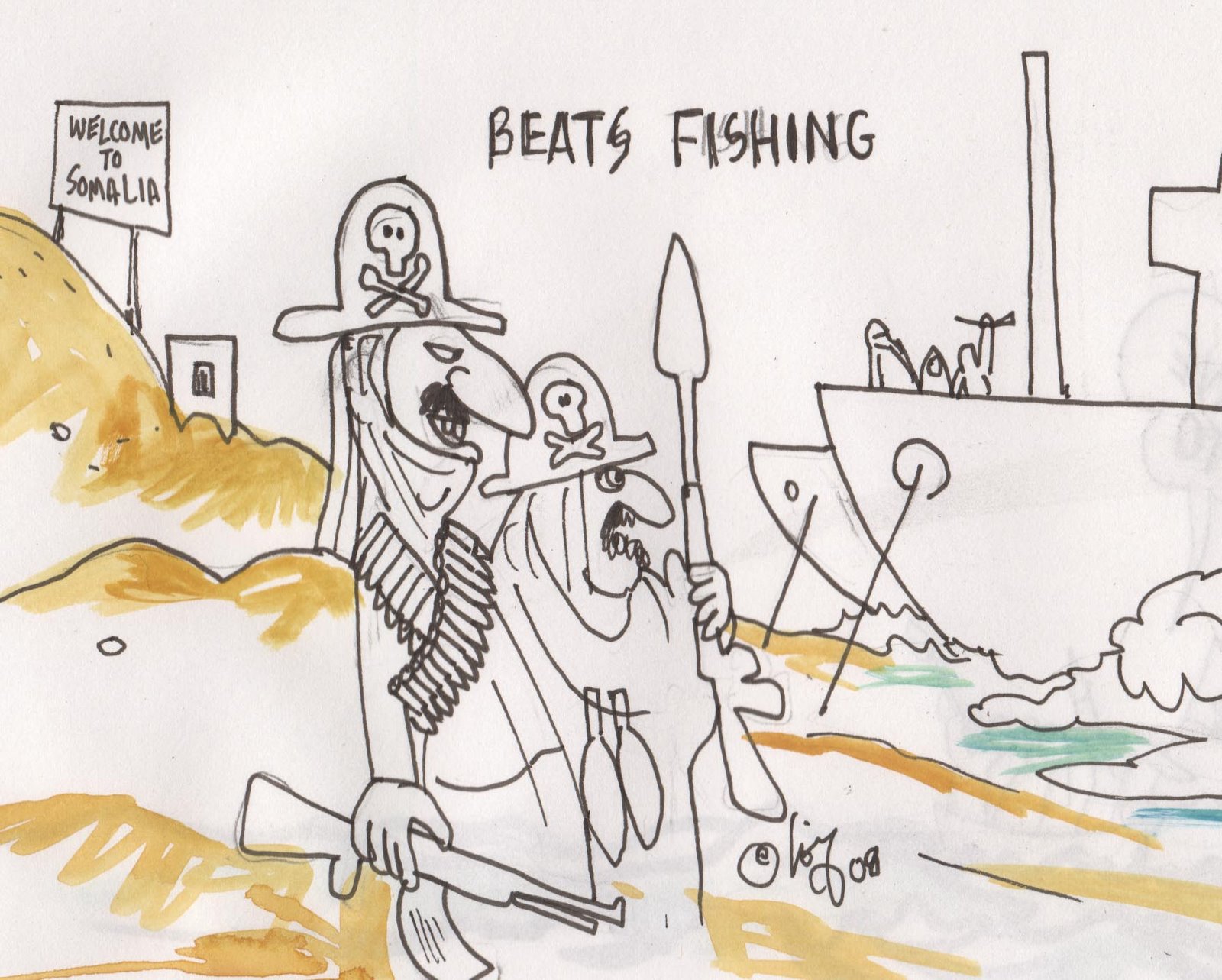
Beats Fishing


Cartoon by Charlie Loving / The Rag Blog

Posted in RagBlog | Tagged | Leave a comment

World Willing to Pay More for Alternative Energy

These wind turbines at a USDA research lab in Texas generate power for submersible electric water pumps. Photo credit:US Department of Agriculture

CLIMATE CHANGE: World Willing to Pay More for Green Energy
By Wolfgang Kerler / November 19, 2008

NEW YORK – A new poll by WorldPublicOpinion.org, a global network of research centres, finds that a majority of people in 21 nations support greater use of alternative energies like wind and solar and modifications to make buildings more energy efficient, even if costs more in the short term.

“People perceive that oil is running out and that it is necessary to take steps right away to replace it as a source of energy,” Steven Kull, director of WorldPublicOpinion.org, told IPS. “They really think in the long run.”

An average of 77 percent of respondents thought policy-makers should require utilities to invest more in alternative energy, with country results ranging from 50 percent support in Russia to 89 percent in South Korea.

With an average agreement of 74 percent, almost the same enthusiasm was shown for greater efforts to make buildings more energy efficient. The lowest support, 54 percent, was found in the Palestinian Territories, while an overwhelming 89 percent of French and British want to see stronger commitments by their governments.

In contrast, fewer than half of the nations polled favour more emphasis on nuclear energy, coal or oil to meet energy demands in the future. Only in Kenya, Argentina, Jordan and Nigeria did researchers find more than 50-percent support for building new coal- and oil-fired power plants.

However, the average support for new coal and oil-fired plans lies at 40 percent, while only 33 percent say coal and oil should be deemphasised. With 40 to 30 percent, a question on the construction of new nuclear power plants found very similar results. Still, overall support for alternative energies is much higher.

“It is quite remarkable that there is such unanimity around the world that governments should address the problem of energy by emphasising alternative energy sources and greater efficiency,” Kull said. “Equally remarkable is how little the governments around the world are following the public’s lead.”

Confronted with a possible short-run cost increase for greener energy, an average of 69 percent of respondents still thought their governments should take this step.

Asking businesses to use energy more efficiently found an average agreement of 58 percent — compared to 38 percent against it — even if it leads to higher product prices.

An extra charge to buy models of appliances and cars that are not energy efficient also found majority support, with 48 percent in favour to 39 percent against on average.

“It is striking that support for alternative energies and energy efficiency slips only modestly when the cost is highlighted,” Kull commented. “People are definitely willing to do more than they are doing right now.”

In all participating nations, more people share the opinion that the shift towards alternative sources of energy would save money in the long run, resulting in an average support of 66 percent for this position. Only 21 percent expect a lasting economic decline because of the high costs an energy shift may bring.

However, Kull warned against overly high expectations by stressing that “support is not limitless”.

In countries where governments had already taken action against climate change and for energy efficiency — such as Germany and Italy — the number of people willing to pay more for renewable energy was slightly lower than in countries where such measures have not been high on the government’s agenda so far.

Another finding of the poll is that people in oil-exporting countries like Russia, Azerbaijan and Indonesia are more critical of alternative energies than people from oil-importing countries.

As a possible explanation, Kull mentioned that “these countries of course benefit from the use of oil and might be afraid that alternative energies could lead to devaluation of their product.” Besides, “the energy problem is less pressuring” in oil-producing countries, he said.

Some 20,790 respondents from 21 nations were interviewed by researchers participating in the WorldPuplicOpinion.org project between Jul. 15 and Nov. 4. The list of countries included some of the largest nations like China, India, the United States, Indonesia, Nigeria and Russia.

Interviews were also conducted in Argentina, Azerbaijan, France, Germany, Great Britain, Italy, Jordan, Kenya, Mexico, the Palestinian Territories, Poland, South Korea, Thailand, Turkey, and Ukraine. Furthermore, research centres talked to respondents in Taiwan, Hong Kong, and Macau.

Source / IPS News

The Rag Blog

Posted in RagBlog | Tagged , | Leave a comment

Richard C. Cook :
Financial Crime Scene: Fingering the Perps

Photo of Richard C. Cook

Richard C. Cook, a former federal analyst, is an advocate for economic democracy.

This is a very well-written and provocative article by a longtime Treasury Department analyst. It was originally delivered as a speech on Nov. 15, 2008, the first day of the G20 economic summit, at George Mason University in Fairfax, Virginia.

Read it and get the rope.

James Retherford | The Rag Blog | November 20, 2008

To try to fix the crisis through bailing out the system, we are now seeing in the U.S. and Europe levels of government borrowing that have not been experienced since World War II. The purpose is to recapitalize a financial system that has destroyed itself through its own greed and folly.’
By Richard C. Cook

The G20 is meeting today in Washington , D.C. , to discuss the world financial crisis, its causes, and what can be done about it. But this won’t help the people of the U.S. who have been victimized by their own financial system.

The stated objectives are to find ways to stabilize and reduce speculation in the financial markets and make financial transactions more transparent, more efficient, and more international in scope. But this is also a revolt by the nations of the world against over-reliance on the U.S. dollar as the world’s reserve currency. What we are likely to see over time is a multi-currency regime that includes the Euro and one or more Asian currencies as well.

But the conference will not address the real causes of why the world is heading into a global recession or why the U.S. economy in particular is in such dire straits.

Nor will the meeting result in redress of the staggering level of bankers’ criminality abetted by the U.S. government in the creation of the financial bubbles whose collapse is underway.

The real problem is that the world is locked into a debt-based financial system run by the world’s banks, where the only way currency can be entered into circulation is through lending. It’s been massive amounts of completely irresponsible lending which have leveraged the bubbles against much smaller amounts of tangible value.

The GDP of the entire world is $55 trillion. This is dwarfed by speculative lending in the derivatives markets of ten times that amount–$525-$550 trillion. No nation has clean hands in this travesty. The governments of the world and the central banks have allowed it to come into being.

Within the U.S., reliance on money-creation through bank lending has been the problem since the creation of the Federal Reserve System in 1913. At that point the U.S. monetary system was privatized. The case has been the same with all the other nations which have private banking systems that control their central banks. The granddaddy is the Bank of England which dates from 1694.

The creation of the Federal Reserve System marked the start of a century of world war. This is hardly a coincidence. Indeed, the central banking system encourages wars and lives off them, because it is war and the threat of war that is most profitable to a system where the more money governments borrow the more profits the banks make.

All this started with World War I, which was largely financed by the British, French, German, and the U.S. banks. Events have continued in that vein through today, where the nations of the world are armed to the teeth and global finance capitalism tries to increase its control everywhere to the detriment of workers, national economies, and the environment.

To try to fix the crisis through bailing out the system, we are now seeing in the U.S. and Europe levels of government borrowing that have not been experienced since World War II. The purpose is to recapitalize a financial system that has destroyed itself through its own greed and folly. But all this does is defer the bill to future generations who have to pay the enormous compounded interest charges this borrowing entails. Interest on the national debt in the 2009 federal budget is over $500 billion. Every man, woman, and child in the nation is a victim of this crime.

The situation is so bad that many people believe the U.S. may even be in danger of defaulting on its gigantic national debt sometime in 2009.

Meanwhile, the failed financial system is dragging down the world’s producing economy with it, and the bailouts won’t change that situation. Combined with the financial crash has been a collapse in consumer “demand.” In other words, consumers, who are maxed out on their credit, no longer can borrow enough to keep the wheels of the economy turning.

But the reason they must borrow for consumption is that earnings are not sufficient for people to buy what they need to live. This is why in the U.S. there has been an outcry, including with the Obama campaign, for new government job-creation programs. Every day there is another proposal by progressives for new government spending, which, of course, will have to be financed by even more government debt.

So when are we going to learn how to introduce purchasing power without debt? How did we ever come to believe that the only way to create money is through a bank inventing it out of thin air? In the past few weeks we have had a number of Nobel-prize winning economists chip in with their suggestions of what to do, but none have addressed the obvious question of what the alternatives may be to bankers’ debt-based currency.

If we look at history, we see other ways governments have used their powers to create money. Indeed, until the Federal Reserve Act of 1913, the U.S. was a kind of laboratory of alternative methods of money-creation.

If we go back to colonial days, the American colonies used a variety of means to introduce currency into circulation. In Virginia , plantation owners received tobacco certificates when they deposited their product at public warehouses. The certificates then circulated as currency.

In Pennsylvania the government ran a land bank which paid cash to land-owners for liens on property. The interest paid for the costs of government without any taxation of citizens.

In Massachusetts, Pennsylvania, and elsewhere, governments spent paper money directly into circulation. The money received value by then being accepted by those governments, after it circulated within the economy, in payment of taxes.

Other forms of currency were Spanish dollars, Indian wampum, and IOUs. There was also a flourishing barter trade.

The system worked. By 1764, the American colonies formed one of the most prosperous trading regions on the planet. When asked why, Benjamin Franklin said it was because of colonial scrip—i.e., their paper money. When the British Parliament outlawed it through the Currency Act of 1764, an economic depression followed. It was the underlying cause of the Revolutionary War.

During that war, the Continental Congress issued the famous Continental Currency. What likely caused that money to inflate was extensive British counterfeiting, not being used to excess by our national government.

Once the nation became independent, a U.S. mint was founded so individuals could bring in gold or silver and have it stamped into coinage free of charge. New discoveries as with the California and Yukon gold rushes or better methods of extraction from ores resulted in economic booms. From then until coinage lost its value after the Federal Reserve System was established, precious metals were a major part of the U.S. monetary system that included not only coinage but also gold and silver certificates.

In 1791 and again in 1816 Congress passed legislation for the First and Second Banks of the United States . These banks were dupicates of the Bank of England whose purposes were to fasten on the U.S. the same type of debt-based monetary system that was the driving force for the British Empire . Presidents Thomas Jefferson, James Madison, Andrew Jackson, and Martin van Buren were among those who saw these banks as a Trojan Horse for financier tyranny. The split between pro- and anti-bank forces was the origin of the two-party system within the United States .

When Jefferson became president in 1800 he refused to borrow from the bank and balanced the federal budget for eight consecutive years by cutting military expenditures. Andrew Jackson took similar action in 1833 when he withdrew federal funds from the bank and paid off the entire national debt. It was recognized back then that fiscal responsibility was an effective means for keeping the government out of the control of the bankers and their political friends.

When the Civil War broke out in 1861, President Abraham Lincoln refused to borrow from the banks. Instead he financed the war through income and excise taxes, sale of war bonds directly to citizens, and issuance of the famous Greenbacks. This came about in 1862 when Congress authorized the government to spend $450 million in paper Greenbacks directly into circulation. Congress also introduced tangible value into the economy by what was then the very wise policy of transferring huge amounts of public land to the railroads and to citizens under the Homestead Act.

During the late 19th century, ordinary citizens were not so stunningly ignorant of the politics of money as they are today. People recognized the Greenbacks for having saved the union. A Greenback Party was formed that elected representatives to Congress and ran candidates for president.

Greenbacks remained in circulation, and as late as 1900 still made up a third of the nation’s monetary supply, along with coinage, gold and silver certificates, and national bank notes. Also, many other business entities, including the “company stores” owned by mining companies, issued their own paper scrip that was part of the circulating currency. For example, in a pamphlet on monetary reform written by American poet Ezra Pound in the 1930s was an illustration of paper money his grandfather issued from his lumberyard in Michigan in the late 1800s backed by board-feet of lumber payable on demand! Of course barter trade continued and still exists today among industrial firms.

But the bankers were on the move. In 1863 and 1864 Congress passed the National Banking Acts which drove the extensive system of state-chartered banks, including some owned by state governments, out of existence. By the early 1900s, the power of the bankers had coalesced under the New York banking trust led by the J.P. Morgan and Rockefeller financial interests.

The bakers struck in 1913 just before the Christmas recess when many Congressmen had already left Washington for the holidays. The Federal Reserve Act had actually been written by bankers from Europe who were allied with the Rothschild interests. Congressman Charles Lindbergh, Sr., father of the aviator, called the Act “the legislative crime of the ages.” Later President Woodrow Wilson, who signed the Act, said he had “unwittingly ruined my nation.”

But the deed was done. The Federal Reserve System created the first major financial bubble through World War I spending, followed by a depression, then created and burst the stock market bubble whose collapse started the Great Depression in 1929. President Franklin D. Roosevelt took over credit creation through low-cost government lending in the 1930s but had to use World War II to achieve full employment because by then the government was totally locked into the Keynesian tax-and-borrow credo of public finance.

The bankers began their comeback in the 1950s and consolidated their power in the 1970s under the heading of “monetarism,” which is the philosophy of trying to control the economy through raising and lowering of interest rates. This travesty—which is really institutionalized usury—is as familiar to us today as the water a fish swims in. We don’t even notice it. Yet it’s this system that has ruined the world. Ever since the 1970s, every period of economic growth in the U.S. has been a bank-created bubble followed by a crash and a recession.

We had the inflation of the 1970s created by the government-induced oil prices shocks, followed by the Paul Volcker crash of 1979-83 when the Federal Reserve raised interest rates above twenty percent and caused the biggest downturn since the Great Depression.

During the later Reagan years we had the merger-acquisition bubble followed by the recession that brought Bill Clinton to office in 1992. Then we had the dot.com bubble of the mid- to late-1990s that ended with the crash of 2000-2001.

Next, instead, of rebuilding an economy that had been devastated by export of our best manufacturing jobs to China and other cheap-labor countries, the Federal Reserve under chairman Alan Greenspan, with assistance from the George W. Bush administration, created the biggest bubble economy in history, with the housing, commercial real estate, equity, hedge fund, derivatives, and commodities bubbles all blowing up at the same time and leaving us with the mess we are in today.

What has happened during the Bush administration has been the greatest crime against the public interest in U.S. history. Its effects are only starting to be evident.

Of course in the face of so many disasters, the credit markets have imploded, and governments don’t know what to do except recapitalize and restructure them but without taking action to address the deep systemic problems with the producing economy. And while the Europeans may have blown the whistle on U.S. excesses through the G20 meeting, this country still faces disaster.

Yes, Wall Street is killing Main Street , and no one has come up with an answer except suggestions for the bailouts and some New Deal-type programs in an environment that is much worse even than in the 1930s. For one thing, most of what we consume today is produced abroad. For another, family farming has been ruined. In a pinch, our nation could no longer even feed itself.

But the amazing thing is how easy it would be to salvage the situation if the government took the simple step of treating credit as what it really is—a public utility like clean air, water, or electricity, not the private property of the banking system. In fact the banking system and the politicians they own have stolen and abused this fundamental piece of the social commons.

Banks have no legal right to work against the public interest. Every single bank that has ever existed has operated under a public charter. The Constitution gives Congress—i.e., the people’s representative government—authority to regulate interstate commerce. It also gives Congress the right and responsibility to control the monetary system.

So why doesn’t Congress do it? Why does Congress sit passively and stare when Federal Reserve chairmen such as Alan Greenspan or Ben Bernanke sit before them and mumble nonsense about markets and interest rates and inflation and the rest of a made-up system whose main result is to funnel the wealth of the economy upwards into the hands of the financial elite?

In my writings I have advocated several measures Congress could take immediately to remedy the catastrophe we are facing:

1) Congress could authorize direct expenditure of government funds for legitimate public expenses, as was done with the Civil War-era Greenbacks. Contrary to bankers’ propaganda, the Greenbacks were not inflationary then and would not be inflationary now, because they would be backed by tangible economic production of goods and services. What has been inflationary has been the debt-based currency which, since it was introduced in 1913, has caused the dollar to lose 95 percent of its value. Greenback-type spending is contained in the proposed American Monetary Act, developed by the American Monetary Institute.

2) Congress could authorize a national infrastructure bank that would be self-capitalized and would lend money into existence to state and local governments at zero percent interest. Legislation for such a bank has been introduced by Congressman Dennis Kucinich.

3) Congress could authorize dividend payments to citizens as advocated by the Social Credit movement founded by Major C.H. Douglas of Great Britain decades ago as a means of monetizing the net appreciation of the producing economy. Dividends exceeding $1,000 a month could be issued from a national dividend account without recourse to taxation or borrowing. Such a concept is related to the Alaska Permanent Fund which paid over $3,200 to each state resident in 2008 and to the concept of a basic income guarantee advocated by proponents of the negative income tax in years past.

4) Congress could utilize dividend payments once they were spent, possibly in the form of vouchers for necessities of life like food and housing, to capitalize a new network of community savings banks that would provide low-cost credit to home purchasers, students, small business people, and local farms.

I worked in the U.S. Treasury Department for 21 years and learned first-hand the history and operations of public finance in the U.S. I have seen the disastrous results of the debt-based financial system and how it has driven our nation, government, and people into bankruptcy. I have also seen how these simple measures of monetary reform would be easy to implement and would begin to turn the situation around within weeks or months.

All it takes is political will and a determination to challenge the death-grip the financial elite has had on our economy for a century.

We can be quite certain that these vital issues will not be addressed by the summit of the G20 meeting in Washington today. If anything, these meetings are likely to render the grip of private finance on the peoples of the world even tighter than before.

But sooner or later change must come. For the immediate future people could fight back by doing everything possible to get out of debt, convert their cash reserves to tangible holdings, and start their own local currency and barter systems. But for real change, a monetary revolution is required.

[Richard C. Cook is a former U.S. federal government analyst and an advocate for economic democracy and sustainability. His new book, We Hold These Truths: The Hope of Monetary Reform, can now be ordered for $19.95 from www.tendrilpress.com.]

Source / Global Research

Posted in RagBlog | Tagged , , , , , , , | 1 Comment

Speculating About Barack’s Cabinet Choices

Perhaps some readers will recall one of my headlines several days ago: Obama: It’s (Partly) About Surviving Pundit-Palaver. We’re reasonably sure it won’t be slowing down anytime soon.

Richard Jehn / The Rag Blog

This is Change? 20 Hawks, Clintonites and Neocons to Watch for in Obama’s White House
By Jeremy Scahill / November 20, 2008

U.S. policy is not about one individual, and no matter how much faith people place in President-elect Barack Obama, the policies he enacts will be fruit of a tree with many roots. Among them: his personal politics and views, the disastrous realities his administration will inherit, and, of course, unpredictable future crises. But the best immediate indicator of what an Obama administration might look like can be found in the people he surrounds himself with and who he appoints to his Cabinet. And, frankly, when it comes to foreign policy, it is not looking good.

Obama has a momentous opportunity to do what he repeatedly promised over the course of his campaign: bring actual change. But the more we learn about who Obama is considering for top positions in his administration, the more his inner circle resembles a staff reunion of President Bill Clinton’s White House. Although Obama brought some progressives on board early in his campaign, his foreign policy team is now dominated by the hawkish, old-guard Democrats of the 1990s. This has been particularly true since Hillary Clinton conceded defeat in the Democratic primary, freeing many of her top advisors to join Obama’s team.

“What happened to all this talk about change?” a member of the Clinton foreign policy team recently asked the Washington Post. “This isn’t lightly flavored with Clintons. This is all Clintons, all the time.”

Amid the euphoria over Obama’s election and the end of the Bush era, it is critical to recall what 1990s U.S. foreign policy actually looked like. Bill Clinton’s boiled down to a one-two punch from the hidden hand of the free market, backed up by the iron fist of U.S. militarism. Clinton took office and almost immediately bombed Iraq (ostensibly in retaliation for an alleged plot by Saddam Hussein to assassinate former President George H.W. Bush). He presided over a ruthless regime of economic sanctions that killed hundreds of thousands of Iraqis, and under the guise of the so-called No-Fly Zones in northern and southern Iraq, authorized the longest sustained U.S. bombing campaign since Vietnam.

Under Clinton, Yugoslavia was bombed and dismantled as part of what Noam Chomsky described as the “New Military Humanism.” Sudan and Afghanistan were attacked, Haiti was destabilized and “free trade” deals like the North America Free Trade Agreement and the General Agreement on Tariffs and Trade radically escalated the spread of corporate-dominated globalization that hurt U.S. workers and devastated developing countries. Clinton accelerated the militarization of the so-called War on Drugs in Central and Latin America and supported privatization of U.S. military operations, giving lucrative contracts to Halliburton and other war contractors. Meanwhile, U.S. weapons sales to countries like Turkey and Indonesia aided genocidal campaigns against the Kurds and the East Timorese.

The prospect of Obama’s foreign policy being, at least in part, an extension of the Clinton Doctrine is real. Even more disturbing, several of the individuals at the center of Obama’s transition and emerging foreign policy teams were top players in creating and implementing foreign policies that would pave the way for projects eventually carried out under the Bush/Cheney administration. With their assistance, Obama has already charted out several hawkish stances. Among them:

— His plan to escalate the war in Afghanistan;

— An Iraq plan that could turn into a downsized and rebranded occupation that keeps U.S. forces in Iraq for the foreseeable future;

— His labeling of Iran’s Revolutionary Guard as a “terrorist organization;”

— His pledge to use unilateral force inside of Pakistan to defend U.S. interests;

— His position, presented before the American Israel Public Affairs Committee (AIPAC), that Jerusalem “must remain undivided” — a remark that infuriated Palestinian officials and which he later attempted to reframe;

— His plan to continue the War on Drugs, a backdoor U.S. counterinsurgency campaign in Central and Latin America;

— His refusal to “rule out” using Blackwater and other armed private forces in U.S. war zones, despite previously introducing legislation to regulate these companies and bring them under U.S. law.

Obama did not arrive at these positions in a vacuum. They were carefully crafted in consultation with his foreign policy team. While the verdict is still out on a few people, many members of his inner foreign policy circle — including some who have received or are bound to receive Cabinet posts — supported the invasion and occupation of Iraq. Some promoted the myth that Saddam had weapons of mass destruction. A few have worked with the neoconservative Project for the New American Century, whose radical agenda was adopted by the Bush/Cheney administration. And most have proven track records of supporting or implementing militaristic, offensive U.S. foreign policy. “After a masterful campaign, Barack Obama seems headed toward some fateful mistakes as he assembles his administration by heeding the advice of Washington’s Democratic insider community, a collective group that represents little ‘change you can believe in,'” notes veteran journalist Robert Parry, the former Associated Press and Newsweek reporter who broke many of the stories in the Iran-Contra scandal in the 1980s.

As news breaks and speculation abounds about cabinet appointments, here are 20 people to watch as Obama builds the team who will shape U.S. foreign policy for at least four years:

Joe Biden

There was no stronger sign that Obama’s foreign policy would follow the hawkish tradition of the Democratic foreign policy establishment than his selection of Sen. Joe Biden as his running mate. Much has been written on Biden’s tenure as head of the Senate Foreign Relations Committee, but his role in the invasion and occupation of Iraq stands out. Biden is not just one more Democratic lawmaker who now calls his vote to authorize the use of force in Iraq “mistaken;” Biden was actually an important facilitator of the war.

In the summer of 2002, when the United States was “debating” a potential attack on Iraq, Biden presided over hearings whose ostensible purpose was to weigh all existing options. But instead of calling on experts whose testimony could challenge the case for war — Iraq’s alleged WMD possession and its supposed ties to al-Qaida — Biden’s hearings treated the invasion as a foregone conclusion. His refusal to call on two individuals in particular ensured that testimony that could have proven invaluable to an actual debate was never heard: Former Chief United Nations Weapons Inspector Scott Ritter and Hans von Sponeck, a 32-year veteran diplomat and the former head of the U.N.’s Iraq program.

Both men say they made it clear to Biden’s office that they were ready and willing to testify; Ritter knew more about the dismantling of Iraq’s WMD program than perhaps any other U.S. citizen and would have been in prime position to debunk the misinformation and outright lies being peddled by the White House. Meanwhile, von Sponeck had just returned from Iraq, where he had observed Ansar al Islam rebels in the north of Iraq — the so-called al-Qaida connection — and could have testified that, rather than colluding with Saddam’s regime, they were in a battle against it. Moreover, he would have pointed out that they were operating in the U.S.-enforced safe haven of Iraqi Kurdistan. “Evidence of al-Qaida/lraq collaboration does not exist, neither in the training of operatives nor in support to Ansar-al-Islam,” von Sponeck wrote in an Op-Ed published shortly before the July 2002 hearings. “The U.S. Department of Defense and the CIA know perfectly well that today’s Iraq poses no threat to anyone in the region, let alone in the United States. To argue otherwise is dishonest.”

With both men barred from testifying, rather than eliciting an array of informed opinions, Biden’s committee whitewashed Bush’s lies and helped lead the country to war. Biden himself promoted the administration’s false claims that were used to justify the invasion of Iraq, declaring on the Senate floor, “[Saddam Hussein] possesses chemical and biological weapons and is seeking nuclear weapons.”

With the war underway, Biden was then the genius who passionately promoted the ridiculous plan to partition Iraq into three areas based on religion and ethnicity, attempting to Balkanize one of the strongest Arab states in the world.

“He’s a part of the old Democratic establishment,” says retired Army Col. Ann Wright, the State Department diplomat who reopened the U.S. embassy in Kabul in 2002. Biden, she says, has “had a long history with foreign affairs, [but] it’s not the type of foreign affairs that I want.”

Rahm Emanuel

Obama’s appointment of Illinois Congressman Rahm Emanuel as Chief of Staff is a clear sign that Clinton-era neoliberal hawks will be well-represented at 1600 Pennsylvania Ave. A former senior Clinton advisor, Emanuel is a hard-line supporter of Israel’s “targeted assassination” policy and actually volunteered to work with the Israeli Army during the 1991 Gulf War. He is close to the right-wing Democratic Leadership Council and was the only member of the Illinois Democratic delegation in the Congress to vote for the invasion of Iraq. Unlike many of his colleagues, Emanuel still defends his vote. As chair of the Democratic Congressional Campaign Committee in 2006, Emanuel promoted the campaigns of 22 candidates, only one of who supported a swift withdrawal from Iraq, and denied crucial Party funding to anti-war candidates. “As for Iraq policy, at the right time, we will have a position,” he said in December 2005. As Philip Giraldi recently pointed out on Antiwar.com, Emanuel “advocates increasing the size of the U.S. Army by 100,000 soldiers and creating a domestic spying organization like Britain’s MI5. More recently, he has supported mandatory paramilitary national service for all Americans between the ages of 18 and 25.”

While Obama has at times been critical of Clinton-era free trade agreements, Emanuel was one of the key people in the Clinton White House who brokered the successful passage of NAFTA.

Hillary Rodham Clinton

For all the buzz and speculation about the possibility that Sen. Clinton may be named Secretary of State, most media coverage has focused on her rivalry with Obama during the primary, along with the prospect of her husband having to face the intense personal, financial and political vetting process required to secure a job in the new administration. But the question of how Clinton would lead the operations at Foggy Bottom calls for scrutiny of her positions vis-a-vis Obama’s stated foreign-policy goals.

Clinton was an ardent defender of her husband’s economic and military war against Iraq throughout the 1990s, including the Iraq Liberation Act of 1998, which ultimately laid the path for President George W. Bush’s invasion. Later, as a U.S. senator, she not only voted to authorize the war, but aided the Bush administration’s propaganda campaign in the lead-up to the invasion. “Saddam Hussein has worked to rebuild his chemical and biological weapons stock, his missile-delivery capability and his nuclear program,” Clinton said when rising to support the measure in October 2002. “He has also given aid, comfort and sanctuary to terrorists, including al-Qaida members … I want to insure that Saddam Hussein makes no mistake about our national unity and for our support for the president’s efforts to wage America’s war against terrorists and weapons of mass destruction.”

“The man who vowed to deliver us from 28 years of Bushes and Clintons has been stocking up on Clintonites,” New York Times columnist Maureen Dowd recently wrote. “How, one may ask, can he put Hillary — who voted to authorize the Iraq war without even reading the intelligence assessment — in charge of patching up a foreign policy and a world riven by that war?”

Beyond Iraq, Clinton shocked many and sparked official protests by Tehran at the United Nations when asked during the presidential campaign what she would do as president if Iran attacked Israel with nuclear weapons. “I want the Iranians to know that if I’m the president, we will attack Iran,” she declared. “In the next 10 years, during which they might foolishly consider launching an attack on Israel, we would be able to totally obliterate them.”

Clinton has not shied away from supporting offensive foreign policy tactics in the past. Recalling her husband’s weighing the decision of whether to attack Yugoslavia, she said in 1999, “I urged him to bomb. … You cannot let this go on at the end of a century that has seen the major holocaust of our time. What do we have NATO for if not to defend our way of life?”

Madeleine Albright

While Obama’s house is flush with Clintonian officials like former Secretary of State Warren Christopher, Defense Secretary William Perry, Director of the State Department Office of Policy Planning Greg Craig (who was officially named Obama’s White House Counsel) and Navy Secretary Richard Danzig, perhaps most influential is Madeleine Albright, Bill Clinton’s former Secretary of State and U.N. ambassador. Albright recently served as a proxy for Obama, representing him at the G-20 summit earlier this month. Whether or not she is awarded an official role in the administration, Albright will be a major force in shaping Obama’s foreign policy.

“It will take time to convince skeptics that the promotion of democracy is not a mask for imperialism or a recipe for the kind of chaos we have seen in the Persian Gulf,” Albright recently wrote. “And it will take time to establish the right identity for America in a world that has grown suspicious of all who claim a monopoly on virtue and that has become reluctant to follow the lead of any one country.”

Albright should know. She was one of the key architects in the dismantling of Yugoslavia during the 1990s. In the lead-up to the 1999 “Kosovo war,” she oversaw the U.S. attempt to coerce the Yugoslav government to deny its own sovereignty in return for not being bombed. Albright demanded that the Yugoslav government sign a document that would have been unacceptable to any sovereign nation. Known as the Rambouillet Accord, it included a provision that would have guaranteed U.S. and NATO forces “free and unrestricted passage and unimpeded access throughout” all of Yugoslavia — not just Kosovo — while also seeking to immunize those occupation forces “from any form of arrest, investigation or detention by the authorities in [Yugoslavia].” Moreover, it would have granted the occupiers “the use of airports, roads, rails and ports without payment.” Similar to Bush’s Iraq plan years later, the Rambouillet Accord mandated that the economy of Kosovo “shall function in accordance with free-market principles.”

When Yugoslavia refused to sign the document, Albright and others in the Clinton administration unleashed the 78-day NATO bombing of Serbia, which targeted civilian infrastructure. (Prior to the attack, Albright said the U.S. government felt “the Serbs need a little bombing.”) She and the Clinton administration also supported the rise to power in Kosovo of a terrorist mafia that carried out its own ethnic-cleansing campaign against the province’s minorities.

Perhaps Albright’s most notorious moment came with her enthusiastic support of the economic war against the civilian population of Iraq. When confronted by Lesley Stahl of “60 Minutes” that the sanctions were responsible for the deaths of “a half-million children … more children than died in Hiroshima,” Albright responded, “I think this is a very hard choice, but the price — we think the price is worth it.” (While defending the policy, Albright later called her choice of words “a terrible mistake, hasty, clumsy, and wrong.”)

Richard Holbrooke

Like Albright, Holbrooke will have major sway over U.S. policy, whether or not he gets an official job. A career diplomat since the Vietnam War, Holbrooke’s most recent government post was as President Clinton’s ambassador to the U.N. Among the many violent policies he helped implement and enforce was the U.S.-backed Indonesian genocide in East Timor. Holbrooke was an Assistant Secretary of State in the late 1970s at the height of the slaughter and was the point man on East Timor for the Carter Administration.

According to Brad Simpson, director of the Indonesia and East Timor Documentation Project at the National Security Archive at George Washington University, “It was Holbrooke and Zbigniew Brzezinski [another top Obama advisor], both now leading lights in the Democratic Party, who played point in trying to frustrate the efforts of congressional human-rights activists to try and condition or stop U.S. military assistance to Indonesia, and in fact accelerated the flow of weapons to Indonesia at the height of the genocide.”

Holbrooke, too, was a major player in the dismantling of Yugoslavia and praised the bombing of Serb Television, which killed 16 media workers, as a significant victory. (The man who ordered that bombing, now-retired Army Gen. Wesley Clark, is another Obama foreign policy insider who could end up in his cabinet. While Clark is known for being relatively progressive on social issues, as Supreme Allied Commander of NATO, he ordered bombings and attacks that Amnesty International labeled war crimes.)

Like many in Obama’s foreign policy circle, Holbrooke also supported the Iraq war. In early 2003, shortly after then-Secretary of State Colin Powell’s speech to the UN, where he presented the administration’s fraud-laden case for war to the UN (a speech Powell has since called a “blot” on his reputation), Holbrooke said: “It was a masterful job of diplomacy by Colin Powell and his colleagues, and it does not require a second vote to go to war. … Saddam is the most dangerous government leader in the world today, he poses a threat to the region, he could pose a larger threat if he got weapons of mass destruction deployed, and we have a legitimate right to take action.”

Dennis Ross

Middle East envoy for both George H.W. Bush and Bill Clinton, Ross was one of the primary authors of Obama’s aforementioned speech before AIPAC this summer. He cut his teeth working under famed neoconservative Paul Wolfowitz at the Pentagon in the 1970s and worked closely with the Project for the New American Century. Ross has been a staunch supporter of Israel and has fanned the flames for a more hostile stance toward Iran. As the lead U.S. negotiator between Israel and numerous Arab nations under Clinton, Ross’ team acted, in the words of one U.S. official who worked under him, as “Israel’s lawyer.”

“The ‘no surprises’ policy, under which we had to run everything by Israel first, stripped our policy of the independence and flexibility required for serious peacemaking,” wrote U.S. diplomat Aaron David Miller in 2005. “If we couldn’t put proposals on the table without checking with the Israelis first, and refused to push back when they said no, how effective could our mediation be? Far too often, particularly when it came to Israeli-Palestinian diplomacy, our departure point was not what was needed to reach an agreement acceptable to both sides but what would pass with only one — Israel.” After the Clinton White House, Ross worked for the Washington Institute for Near East Policy, a hawkish pro-Israel think tank, and for FOX News, where he repeatedly pressed for war against Iraq.

Martin Indyk

Founder of the Washington Institute for Near East Policy, Indyk spent years working for AIPAC and served as Clinton’s ambassador to Israel and Assistant Secretary of State for Near East Affairs, while also playing a major role in developing U.S. policy toward Iraq and Iran. In addition to his work for the U.S. government, he has worked for the Israeli government and with PNAC.

“Barack Obama has painted himself into a corner by appealing to the most hard-line, pro-Israel elements in this country,” Ali Abunimah, founder of ElectronicInifada.net, recently told Amy Goodman of Democracy Now!, describing Indyk and Dennis Ross as “two of the most pro-Israel officials from the Clinton era, who are totally distrusted by Palestinians and others across the Middle East, because they’re seen as lifelong advocates for Israeli positions.”

Anthony Lake

Clinton’s former National Security Advisor was an early supporter of Obama and one of the few top Clintonites to initially back the president-elect. Lake began his foreign policy work in the U.S. Foreign Service during Vietnam, working with Henry Kissinger on the “September Group,” a secret team tasked with developing a military strategy to deliver a “savage, decisive blow against North Vietnam.”

Decades later, after working for various administrations, Lake “was the main force behind the U.S. invasion of Haiti in the mid-Clinton years,” according to veteran journalist Allan Nairn, whose groundbreaking reporting revealed U.S. support for Haitian death squads in the 1990s. “They brought back Aristide essentially in political chains, pledged to support a World Bank/IMF overhaul of the economy, which resulted in an increase in malnutrition deaths among Haitians, and set the stage for the current ongoing political disaster in Haiti.” Clinton nominated Lake as CIA Director, but he failed to win Senate confirmation.

Lee Hamilton

Hamilton is a former chairman of the House Foreign Affairs Committee and was co-chairman of both the Iraq Study Group and 9/11 Commission. Robert Parry, who has covered Hamilton’s career extensively, recently ran a piece on Consortium News that characterized him this way: “Whenever the Republicans have a touchy national-security scandal to put to rest, their favorite Democratic investigator is Lee Hamilton. … Hamilton’s carefully honed skill for balancing truth against political comity has elevated him to the status of a Washington Wise Man.”

Susan Rice

Former Assistant Secretary of State Susan Rice, who served on Bill Clinton’s National Security Council, is a potential candidate for the post of ambassador to the U.N. or as a deputy national security advisor. She, too, promoted the myth that Saddam had WMDs. “It’s clear that Iraq poses a major threat,” she said in 2002. “It’s clear that its weapons of mass destruction need to be dealt with forcefully, and that’s the path we’re on.” (After the invasion, discussing Saddam’s alleged possession of WMDs, she said, “I don’t think many informed people doubted that.”)

Rice has also been a passionate advocate for a U.S. military attack against Sudan over the Darfur crisis. In an op-ed co-authored with Anthony Lake, she wrote, “The United States, preferably with NATO involvement and African political support, would strike Sudanese airfields, aircraft and other military assets. It could blockade Port Sudan, through which Sudan’s oil exports flow. Then U.N. troops would deploy — by force, if necessary, with U.S. and NATO backing.”

John Brennan

A longtime CIA official and former head of the National Counterterrorism Center, Brennan is one of the coordinators of Obama’s intelligence transition team and a top contender for either CIA Director or Director of National Intelligence. He was also recently described by Glenn Greenwald as “an ardent supporter of torture and one of the most emphatic advocates of FISA expansions and telecom immunity.” While claiming to oppose waterboarding, labeling it “inconsistent with American values” and “something that should be prohibited,” Brennan has simultaneously praised the results achieved by “enhanced interrogation” techniques. “There has been a lot of information that has come out from these interrogation procedures that the agency has, in fact, used against the real hard-core terrorists,” Brennan said in a 2007 interview. “It has saved lives. And let’s not forget, these are hardened terrorists who have been responsible for 9/11, who have shown no remorse at all for the death of 3,000 innocents.”

Brennan has described the CIA’s extraordinary rendition program — the government-run kidnap-and-torture program enacted under Clinton — as an absolutely vital tool. “I have been intimately familiar now over the past decade with the cases of rendition that the U.S. Government has been involved in,” he said in a December 2005 interview. “And I can say without a doubt that it has been very successful as far as producing intelligence that has saved lives.”

Brennan is currently the head of Analysis Corporation, a private intelligence company that was recently implicated in the breach of Obama and Sen. John McCain’s passport records. He is also the current chairman of the Intelligence and National Security Alliance (INSA), a trade association of private intelligence contractors who have dramatically increased their role in sensitive U.S. national security operations. (Current Director of National Intelligence Mike McConnell is former chairman of the INSA.)

Jami Miscik

Miscik, who works alongside Brennan on Obama’s transitional team, was the CIA’s Deputy Director for Intelligence in the run-up to the Iraq war. She was one of the key officials responsible for sidelining intel that contradicted the official line on WMD, while promoting intel that backed it up.

“When the administration insisted on an intelligence assessment of Saddam Hussein’s relationship to al-Qaida, Miscik blocked the skeptics (who were later vindicated) within the CIA’s Mideast analytical directorate and instructed the less-skeptical counterterrorism analysts to ‘stretch to the maximum the evidence you had,’ ” journalist Spencer Ackerman recently wrote in the Washington Independent. “It’s hard to think of a more egregious case of sacrificing sound intelligence analysis in order to accommodate the strategic fantasies of an administration. … The idea that Miscik is helping staff Obama’s top intelligence picks is most certainly not change we can believe in.” What’s more, she went on to a lucrative post as the Global Head of Sovereign Risk for the now-bankrupt Lehman Brothers.

John Kerry and Bill Richardson

Both Sen. Kerry and Gov. Richardson have been identified as possible contenders for Secretary of State. While neither is likely to be as hawkish as Hillary Clinton, both have taken pro-war positions. Kerry promoted the WMD lie and voted to invade Iraq. “Why is Saddam Hussein attempting to develop nuclear weapons when most nations don’t even try?” Kerry asked on the Senate floor in October 2002. “According to intelligence, Iraq has chemical and biological weapons … Iraq is developing unmanned aerial vehicles capable of delivering chemical and biological warfare agents.”

Richardson, whose Iraq plan during his 2008 presidential campaign was more progressive and far-reaching than Obama’s, served as Bill Clinton’s ambassador to the UN. In this capacity, he supported Clinton’s December 1998 bombing of Baghdad and the U.S.-led sanctions against Iraq. “We think this man is a threat to the international community, and he threatens a lot of the neighbors in his region and future generations there with anthrax and VX,” Richardson told an interviewer in February 1998.

While Clinton’s Secretary of Energy, Richardson publicly named Wen Ho Lee, a scientist at the Los Alamos National Laboratory, as a target in an espionage investigation. Lee was accused of passing nuclear secrets to the Chinese government. Lee was later cleared of those charges and won a settlement against the U.S. government.

Robert Gates

Washington consensus is that Obama will likely keep Robert Gates, George W. Bush’s Defense Secretary, as his own Secretary of Defense. While Gates has occasionally proved to be a stark contrast to former Secretary of Defense Donald Rumsfeld, he would hardly represent a break from the policies of the Bush administration. Quite the opposite; according to the Washington Post, in the interest of a “smooth transition,” Gates “has ordered hundreds of political appointees at the Pentagon canvassed to see whether they wish to stay on in the new administration, has streamlined policy briefings and has set up suites for President-elect Barack Obama’s transition team just down the hall from his own E-ring office.” The Post reports that Gates could stay on for a brief period and then be replaced by Richard Danzig, who was Clinton’s Secretary of the Navy. Other names currently being tossed around are Democratic Sen. Jack Reed, Republican Sen. Chuck Hagel (a critic of the Iraq occupation) and Republican Sen. Richard Lugar, who served alongside Biden on the Senate Foreign Relations Committee.

Ivo H. Daalder

Daalder was National Security Council Director for European Affairs under President Clinton. Like other Obama advisors, he has worked with the Project for the New American Century and signed a 2005 letter from PNAC to Congressional leaders, calling for an increase in U.S. ground troops in Iraq and beyond.

Sarah Sewall

Former Deputy Assistant Secretary of Defense for Peacekeeping and Humanitarian Assistance during the Clinton administration, Sewall served as a top advisor to Obama during the campaign and is almost certain to be selected for a post in his administration. In 2007, Sewall worked with the U.S. military and Army Gen. David Petraeus, writing the introduction to the University of Chicago edition of the Army/Marine Corps Counterinsurgency Field Manual. She was criticized for this collaboration by Tom Hayden, who wrote, “the Petraeus plan draws intellectual legitimacy from Harvard’s Carr Center for Human Rights Policy, whose director, Sarah Sewall, proudly embraces an ‘unprecedented collaboration [as] a human rights center partnered with the armed forces.'”

“Humanitarians often avoid wading into the conduct of war for fear of becoming complicit in its purpose,” she wrote in the introduction. “‘The field manual requires engagement precisely from those who fear that its words lack meaning.”

Michele Flournoy

Flournoy and former Clinton Deputy Defense Secretary John White are co-heading Obama’s defense transition team. Flournoy was a senior Clinton appointee at the Pentagon. She currently runs the Center for a New American Security, a center-right think-tank. There is speculation that Obama could eventually name her as the first woman to serve as defense secretary. As the Wall Street Journal recently reported: “While at CNAS, Flournoy helped to write a report that called for reducing the open-ended American military commitment in Iraq and replacing it with a policy of ‘conditional engagement’ there. Significantly, the paper rejected the idea of withdrawing troops according to the sort of a fixed timeline that Obama espoused during the presidential campaign. Obama has in recent weeks signaled that he was willing to shelve the idea, bringing him more in line with Flournoy’s thinking.” Flournoy has also worked with the neoconservative Project for the New American Century.

Wendy Sherman and Tom Donilon

Currently employed at Madeline Albright’s consulting firm, the Albright Group, Sherman worked under Albright at the State Department, coordinating U.S. policy on North Korea. She is now coordinating the State Department transition team for Obama. Tom Donilon, her co-coordinator, was Assistant Secretary of State for Public Affairs and Chief of Staff at the State Department under Clinton. Interestingly, Sherman and Donilon both have ties to Fannie Mae that didn’t make it onto their official bios on Obama’s change.gov Web site. “Donilon was Fannie’s general counsel and executive vice president for law and policy from 1999 until the spring of 2005, a period during which the company was rocked by accounting problems,” reports the Wall Street Journal.

*****

While many of the figures at the center of Obama’s foreign policy team are well-known, two of its most important members have never held national elected office or a high-profile government position. While they cannot be characterized as Clinton-era hawks, it will be important to watch Denis McDonough and Mark Lippert, co-coordinators of the Obama foreign policy team. From 2000 to 2005, McDonough served as foreign policy advisor to Senate Democratic Leader Tom Daschle and worked extensively on the use-of-force authorizations for the attacks on Afghanistan and Iraq, both of which Daschle supported. From 1996 to 1999, McDonough was a professional staff member of the House International Relations Committee during the debate over the bombing of Yugoslavia. More recently, he was at the Center for American Progress working under John Podesta, Clinton’s former chief of staff and the current head of the Obama transition.

Mark Lippert is a close personal friend of Obama’s. He has worked for Vermont Sen. Patrick Leahy, as well as the Senate Appropriations Committee and the Democratic Policy Committee. He is a lieutenant in the Navy Reserve and spent a year in Iraq working intelligence for the Navy SEALs. “According to those who’ve worked closely with Lippert,” Robert Dreyfuss recently wrote in The Nation, “he is a conservative, cautious centrist who often pulled Obama to the right on Iraq, Iran and the Middle East and who has been a consistent advocate for increased military spending. ‘Even before Obama announced for the presidency, Lippert wanted Obama to be seen as tough on Iran,’ says a lobbyist who’s worked the Iran issue on Capitol Hill, ‘He’s clearly more hawkish than the senator.’ “

*****

Barack Obama campaigned on a pledge to bring change to Washington. “I don’t want to just end the war,” he said early this year. “I want to end the mindset that got us into war.” That is going to be very difficult if Obama employs a foreign policy team that was central to creating that mindset, before and during the presidency of George W. Bush.

“Twenty-three senators and 133 House members who voted against the war — and countless other notable individuals who spoke out against it and the dubious claims leading to war — are apparently not even being considered for these crucial positions,” observes Sam Husseini of the Institute for Public Accuracy. This includes dozens of former military and intelligence officials who spoke out forcefully against the war and continue to oppose militaristic policy, as well as credible national security experts who have articulated their visions for a foreign policy based on justice.

Obama does have a chance to change the mindset that got us into war. More significantly, he has a popular mandate to forcefully challenge the militaristic, hawkish tradition of modern U.S. foreign policy. But that work would begin by bringing on board people who would challenge this tradition, not those who have been complicit in creating it and are bound to continue advancing it.

[Jeremy Scahill pledges to be the same journalist under an Obama administration that he was during Bill Clinton and George Bush’s presidencies. He is the author of Blackwater: The Rise of the World’s Most Powerful Mercenary Army and is a frequent contributor to The Nation and Democracy Now! He is a Puffin Foundation Writing Fellow at the Nation Institute.]

Source / AlterNet

The Rag Blog

Posted in RagBlog | Tagged , , | 2 Comments

Christian : Turn the Other Cheek? Not on Your Ass!

God.

‘I may be a Christian, but it’s not like I’m one of those wacko “love your neighbor as yourself” types.’
By Janet Cosgrove / November 19, 2008

Everybody has this image of “crazy Christians” based on what they hear in the media, but it’s just not true. Most Christians are normal, decent folks. We don’t all blindly follow a bunch of outdated biblical tenets or go all fanatical about every bit of dogma. What I’m trying to say is, don’t let the actions of a vocal few color your perceptions about what the majority of us are like.

Like me. I may be a Christian, but it’s not like I’m one of those wacko “love your neighbor as yourself” types.

God forbid!

I’m here to tell you there are lots of Christians who aren’t anything like the preconceived notions you may have. We’re not all into “turning the other cheek.” We don’t spend our days committing random acts of kindness for no credit. And although we believe that the moral precepts in the Book of Leviticus are the infallible word of God, it doesn’t mean we’re all obsessed with extremist notions like “righteousness” and “justice.”

My faith in the Lord is about the pure, simple values: raising children right, saying grace at the table, strictly forbidding those who are Methodists or Presbyterians from receiving communion because their beliefs are heresies, and curing homosexuals. That’s all. Just the core beliefs. You won’t see me going on some frothy-mouthed tirade about being a comfort to the downtrodden.

I’m a normal Midwestern housewife. I believe in the basic teachings of the Bible and the church. Divorce is forbidden. A woman is to be an obedient subordinate to the male head of the household. If a man lieth down with another man, they shall be taken out and killed. Things everybody can agree on, like the miracle of glossolalia that occurred during Pentecost, when the Apostles were visited by the Holy Spirit, who took the form of cloven tongues of fire hovering just above their heads. You know, basic common sense stuff.

But that doesn’t mean I think people should, like, forgive the sins of those who trespass against them or anything weird like that.

We’re not all “Jesus Freaks” who run around screaming about how everyone should “Judge not lest ye be judged,” whine “Blessed are the meek” all the time, or drone on and on about how we’re all equal in the eyes of God! Some of us are just trying to be good, honest folks who believe the unbaptized will roam the Earth for ages without the comfort of God’s love when Jesus Christ our Lord and Savior returns on Judgment Day to whisk the righteous off to heaven.

Now, granted, there are some Christians on the lunatic fringe who take their beliefs a little too far. Take my coworker Karen, for example. She’s way off the deep end when it comes to religion: going down to the homeless shelter to volunteer once a month, donating money to the poor, visiting elderly shut-ins with the Meals on Wheels program—you name it!

But believe me, we’re not all that way. The people in my church, for the most part, are perfectly ordinary Americans like you and me. They believe in the simple old-fashioned traditions—Christmas, Easter, the slow and deliberate takeover of more and more county school boards to get the political power necessary to ban evolution from textbooks statewide. That sort of thing.

We oppose gay marriage as an abomination against the laws of God and America, we’re against gun control, and we fervently and unwaveringly believe that the Jews, Muslims, and all on earth who are not born-again Pentecostalists are possessed by Satan and should be treated as such.

When it comes down to it, all we want is to see every single member of the human race convert to our religion or else be condemned by a jealous and wrathful God to suffer an eternity of agony and torture in the Lake of Fire!

I hope I’ve helped set the record straight, and I wish you all a very nice day! God bless you!

Source / The Onion

The Rag Blog

Posted in RagBlog | Tagged , , , | 1 Comment

Schwarzeneggar : Time to Show Some Muscle on Prop. 8


Douglas Kmeic: ‘Gov. Arnold Schwarzenegger may well be a proximate cause of this breakdown … the Prop. 8 case should be settled, and there’s no one better to do it than our governor.’
By Jon Ponder / November 20, 2008

Douglas Kmeic says the Prop. 8 debacle could be resolved by limiting the state of California prospectively to the issuance of civil unions for all couples, rather than marriage licenses, leaving marriage to the churches.

The California Supreme court announced yesterday that it will hear arguments challenging the constitutionality of Proposition 8, the anti-gay amendment that overturned the right of gay people to marry in the state.

The Prop 8 debacle could be resolved by limiting the state of California prospectively to the issuance of civil unions for all couples, rather than marriage licenses, leaving marriage to the churches.

In May, the same court, which is composed of seven Republicans and one Democrat — who are all elected for 12-year terms — decided 4-3 to strike down a law banning same-sex marriage.

The judges are being asked now to decide whether the constitution can be amended to make discrimination against a minority group legal, a move that directly violates the constitution’s foundational principle of providing protection of rights equally to all residents — or whether a change of that magnitude should have been made through the constitutional “revision” process instead. A revision to the constitution would have required a two-thirds vote by both houses of the legislature before going before the electorate as a ballot initiative.

In a recent San Francisco Chronicle op-ed, Douglas Kmeic Pepperdine law professor , who served as a high official in the Reagan and Bush I Justice departments but who supported Barack Obama this year, laid out a compromise to the constitutional debacle brought on by the passage of Proposition 8 that puts the solution in the hands of California’s governor:

Gov. Arnold Schwarzenegger may well be a proximate cause of this breakdown … the Prop. 8 case should be settled, and there’s no one better to do it than our governor.

After all, the governor has been on both sides of the same-sex marriage issue. Twice the governor was against gay marriage and twice the governor was for it.

The governor told CNN that he hoped the state Supreme Court would overturn the people and Prop. 8. While there are some respectable legal arguments that the initiative does not meet the requirements of Article 18 of the state constitution, asking the court to invalidate Prop. 8 is a tall order. Properly, judges look for ways to avoid holding laws unconstitutional, and that is especially so when the law comes directly from the people.

All that said, the case is too close to call because Prop. 8 did not directly address the portion of the state Supreme Court decision that declared sexual orientation to be a suspect classification requiring compelling justification and because there is federal precedent that decries singling out any vulnerable group for legal disadvantage. In short, neither side can be confident of victory, and that is the best kind of case for settlement.

The governor should break the tie and free the judges from having to either set aside democracy or to uphold the decision of the people in a way that the governor and others would perceive as unequal treatment among his fellow Californians.

The governor has administrative authority to have regulations issued interpreting family law, and nothing in Prop. 8 precludes him from ensuring that homosexual and heterosexual couples are treated equally under state law so long as he stays clear of “marriage.” This could be accomplished by limiting the state of California prospectively to the issuance of civil unions for all couples, rather than marriage licenses, leaving marriage, which in origin is predominantly a religious concept and not the real business of the state, to religion.

To convince both sides to come to the table, the governor’s ruling should:

– Eliminate any doubt as to the validity of same-sex marriages undertaken between the time of the Supreme Court’s judgment and the effective date of Prop. 8. This is only fair because the proposition did not clearly state that it would be retroactive. People are entitled to have confidence in the law as it exists today without having to anticipate how it might change.

– Reaffirm the unfettered freedom of religions (not the state) to be either in favor or opposition to same-sex marriage as their doctrine teaches.

Is this perfect? No. Better than waiting for the outcome of an uncertain case? Yes.

Respectful of the dignity and equality of gay and straight citizen alike? It is intended to be so.

Mindful of the tradition of religious freedom? I think it is.

As Kmeic noted, Schwarzenegger could have prevented this entire debacle by not vetoing the legislation passed twice by both houses of the legislature that made gay marriage legal.

But what are the chances Schwarzenegger would take charge of this contentious issue? Politically, he is quite likely looking at the end of his political career. His approval ratings now are back down into George Bush territory, around 34 percent. He is term-limited out from running for re-election in 2010, and it is doubtful he’ll run against Sen. Barbara Boxer that year, if for no other reason than the fact that he is temperamentally unsuited for the U.S. Senate. In short, Schwarzenegger has nothing to lose, and could well burnish his legacy with a landmark resolution to this civil rights case.

And yet, despite his on-screen superhero persona and his bluster, nothing in Schwarzenegger’s record indicates he’ll make a bold move on this case along the lines Kmeic suggests.

Meanwhile, homophobe activists are threatening to recall the California Supreme Court justices who vote to overturn Proposition 8. But that could be a risky scheme. They might want to look at the recall in 2003 of Gov. Gray Davis, in which the extreme right attempted a legislative coup to replace Davis with an arch-conservative — at first it was Rep. Darrell Issa from San Diego County — but ended up with a liberal Republican Hollywood actor instead.

Given the decidedly leftward trend among the California electorate since 1992, a recall vote on these Republican Supreme Court justices could lead to their replacement by truly liberal Democratic justices.

Even without the Kmeic compromise, California gays and their supporters have reason to be cautiously optimistic. It appears the law is on their side — and a right-wing recall of GOP Supreme Court justices is as likely as not to backfire on the right.

Source / Pensito Review

The Rag Blog

Posted in RagBlog | Tagged , , , , , , , , , | Leave a comment