Dying Over the American Housing Crisis

Let’s be clear about the facts here: it’s okay to bail out the lenders who are in trouble, but we will ignore the home-buyers who cannot meet their mortgage payments.

Just another example of BushCo’s “we-don’t-give-a-flying-fuck” approach to America. “If you aren’t in my circle of corporate buddies, we don’t care.”

Richard Jehn / The Rag Blog


Foreclosures take an emotional toll on homeowners
By Stephanie Armour / May 15, 2008

On a brisk day last fall in Prineville, Ore., Raymond and Deanna Donaca faced the unthinkable: They were losing their home to foreclosure and had days to move out.

For more than two decades, the couple had lived in their three-level house, where the elms outside blazed with yellow shades of fall and their four golden retrievers slept in the yard. The town had always been home, with a lazy river and rolling hills dotted by gnarled juniper trees.

Yet just before lunch on Oct. 23, the Donacas closed all their home’s doors except the one to the garage and left their 1981 Cadillac Eldorado running. Toxic fumes filled the home. When sheriff’s deputies arrived at about 1 p.m., they found the body of Raymond, 71, on the second floor along with three dead dogs. The body of Deanna, 69, was in an upstairs bedroom, close to another dead retriever.

“It is believed that the Donacas committed suicide after attempts to save their home following a foreclosure notice left them believing they had few options,” the Crook County Sheriff’s Office said in a report.
FIND MORE STORIES IN: Florida Oregon Midwest South East Office Sarasota ATMs Raymond Psychological Association Apache Corp. Finance RealtyTrac Prineville Associated Press-AOL Money Cadillac Eldorado

Their suicides were a tragic extreme, but the Donacas’ case symbolizes how the housing crisis is wrenching the emotional lives of legions of homeowners. The escalating pace of foreclosures and rising fears among some homeowners about keeping up with their mortgages are creating a range of emotional problems, mental-health specialists say. Those include anxiety disorders, depression and addictive behaviors such as alcoholism and gambling. And, in a few cases, suicide.
Crisis hotlines are reporting a surge in calls from frantic homeowners. The American Psychological Association (APA) and other mental-health groups are publishing tips on how to handle the emotional stress triggered by the real estate meltdown. Psychologists say they’re seeing more drinking, domestic violence and marital problems linked to mortgage concerns — as well as children trying to cope with extreme anxiety when their families are forced to move.

“They’re depressed, anxious. It’s affected marriages, relationships,” says Richard Chaifetz, CEO of ComPsych, a Chicago-based employee-assistance firm that is counseling homeowners over mortgage fears. “People tend to catastrophize, and that leads to depression. Suicide rates go up. We see an increase in drinking, outbursts at work, violence toward kids. Before, their houses were like ATMs,” as they rose in value. “Now, they feel trapped like a rat in a corner.”

Foreclosure filings surged 65% in April compared with the same month last year, according to a report Wednesday by RealtyTrac. One in every 519 households received a foreclosure filing last month, and the number of homes with foreclosure activity in April was the highest monthly total since RealtyTrac began issuing the report in January 2005.

Don Donaca, Raymond’s brother, says it’s hard to understand the suicide, but he thinks the pending foreclosure led to their deaths.

“He got so deep in debt he couldn’t figure out what else to do,” says Don, 74, a retired sawmill worker in Prineville. “I guess a guy would have to walk a few miles in his shoes to understand.”

Financial concerns at the top

Many other homeowners are at risk of less-severe, but still significant, psychological distress: One in seven homeowners worry that they won’t be able to make their mortgage payments on time over the next six months, according to an April Associated Press-AOL Money & Finance poll, and more than one-quarter fear their home will decline in value during the next two years.

ComPsych says financial concerns are now the top issue the firm’s counselors are hearing in calls from clients. Calls about financial worries have surged 20% over last year; those related to mortgage problems have doubled.

“It’s escalated to the No. 1 issue because of the housing crisis,” Chaifetz says.

Read all of it here. / USA Today

The Rag Blog

Posted in RagBlog | Tagged , | Leave a comment

Protesters converge on Houston to say "No New Coal"

Environmental activists from Arkansas, Michigan, Nevada, Georgia, Texas, and Iowa converged on Houston May 14, 2008,to urge the Houston-based Dynegy corporation to halt construction on its six proposed coal plants.

The protest targeted Dynegy’s annual shareholders meeting. Activists gathered outside the meeting to protest and hand out information detailing the dangers of coal and then held a rally nearby featuring short remarks from community activists representing each state. Coal-fired power plants produce around 40% of the U.S.’s CO2 emissions which fuel global warming; and cause 24,000 deaths, 1,000 hospitalizations, and 38,000 heart attacks each year in the U.S. due to the harmful chemicals released.

Supporters of clean energy held a die-in during Dynegy’s annual shareholder meeting on May 14 to protest the company’s plans to construct six new coal-fired energy plants. Photo by HIMC/Southern Energy Network

Source. / Houston Indymedia
Photos from the event.

The Rag Blog

Posted in RagBlog | Tagged , , , , , , | Leave a comment

Big Win for Gay Rights

John Lewis, right, hugs his partner, Stuart Gaffney, left, outside of the California State Supreme Court building in San Francisco, Thursday, May 15, 2008, after the California Supreme Court overturned a voter-approved ban on gay marriage in a ruling that allows same-sex couples in the nation’s biggest state to tie the knot. Gaffney and Lewis are one of the main plaintiffs in the case. Photo by Paul Sakuma / AP.

All of you were warned by the religious right it would come to this: if Queers got domestic partnership benefits or civil unions, demands for same sex marriage would be next. The amazing thing about this decision is that it is about equality, which is what the “gay agenda” has been about for the past 25 years. Mayor Gavin Newsom is salivating–he hopes this state referendum will be his ticket to victory in the 2010 Governors race.

Schwarzenegger is also hoping this issue will propel him into the US Senate when he runs against Barbara Boxer–that’s why he’s opposing the referendum. Meanwhile, here in Kook City we can’t help noticing that on the same day equality for Queers became law in CA, Nancy Pelosi blocked war funds in the House of Representatives. It was a good day for the Fox News Networks’ “extreme radical left.”

Jeff Jones / The Rag Blog / posted May 17, 2008

Gay Marriage Ban Overturned By California Supreme Court
By Lisa Leff / May 15, 2008

Today the California Supreme Court took a giant leap to ensure that everybody _ not just in the state of California, but throughout the country _ will have equal treatment under the law,” said City Attorney Dennis Herrera, who argued the case for San Francisco.

The challenge for gay rights advocates, however, is not over.

A coalition of religious and social conservative groups is attempting to put a measure on the November ballot that would enshrine laws banning gay marriage in the state constitution.

The Secretary of State is expected to rule by the end of June whether the sponsors gathered enough signatures to qualify the marriage amendment, similar to ones enacted in 26 other states.

If voters pass the measure in November, it would trump the court’s decision.

California already offers same-sex couples who register as domestic partners the same legal rights and responsibilities as married spouses, including the right to divorce and to sue for child support.

But, “Our state now recognizes that an individual’s capacity to establish a loving and long-term committed relationship with another person and responsibly to care for and raise children does not depend upon the individual’s sexual orientation,” Chief Justice Ron George wrote for the court’s majority.

In a dissenting opinion, Justice Marvin Baxter agreed with many arguments of the majority but said the court overstepped its authority. Changes to marriage laws should be decided by the voters, Baxter wrote.

Source. The Huffington Post

The Rag Blog

Posted in RagBlog | Tagged , , | Leave a comment

US Arms Accusations Against Iran? …Never Mind

The Iranian arms justification for bombing Iran is holding up no better than Bush’s justification for invading Iraq, based on Saddam’s supposed weapons of mass destruction.

Roger Baker / The Rag Blog

US claims on Iranian arms proove bogus
By Gareth Porter / May 14, 2008

WASHINGTON — Early this month, the George W. Bush administration’s plan to create a new crescendo of accusations against Iran for allegedly smuggling arms to Shiite militias in Iraq encountered not just one but two setbacks.

The government of Prime Minister Nouri al-Maliki refused to endorse U.S. charges of Iranian involvement in arms smuggling to the Mahdi Army, and a plan to show off a huge collection of Iranian arms captured in and around Karbala had to be called off after it was discovered that none of the arms were of Iranian origin.

The news media’s failure to report that the arms captured from Shiite militiamen in Karbala did not include a single Iranian weapon shielded the U.S. military from a much bigger blow to its anti-Iran strategy.

The Bush administration and top Iraq commander Gen. David Petraeus had plotted a sequence of events that would build domestic U.S. political support for a possible strike against Iran over its “meddling” in Iraq and especially its alleged export of arms to Shiite militias.

The plan was keyed to a briefing document to be prepared by Petraeus on the alleged Iranian role in arming and training Shiite militias that would be surfaced publicly after the al-Maliki government had endorsed it and it used to accuse Iran publicly.

Chairman of the Joint Chiefs of Staff, Adm. Mike Mullen, told reporters on Apr. 25 that Petraeus was preparing a briefing to be given “in the next couple of weeks” that would provide detailed evidence of “just how far Iran is reaching into Iraq to foment instability”. The centrepiece of the Petraeus document, completed in late April, was the claim that arms captured in Basra bore 2008 manufacture dates on them.

U.S. officials also planned to display Iranian weapons captured in both Basra and Karbala to reporters. That sequence of media events would fill the airwaves with spectacular news framing Iran as the culprit in Iraq for several days, aimed at breaking down Congressional and public resistance to the idea that Iranian bases supporting the meddling would have to be attacked.

But events in Iraq diverged from the plan. On May 4, after an Iraqi delegation had returned from meetings in Iran, al-Maliki’s spokesman, Ali al-Dabbagh, said in a news conference that al-Maliki was forming his own Cabinet committee to investigate the U.S. claims. “We want to find tangible information and not information based on speculation,” he said.

Another adviser to al-Maliki, Haider Abadi, told the Los Angeles Times’ Alexandra Zavis that Iranian officials had given the delegation evidence disproving the charges. “For us to be impartial, we have to investigate,” Abadi said.

Al-Dabbagh made it clear that the government considered the U.S. evidence of Iranian government arms smuggling insufficient. “The proof we have is weapons which are shown to have been made in Iran,” al-Dabbagh said in a separate interview with Reuters. “We want to trace back how they reached [Iraq], who is using them, where are they getting it.”

Senior U.S. military officials were clearly furious with al-Maliki for backtracking on the issue. “We were blindsided by this,” one of them told Zavis.

Then the Bush administration’s campaign on Iranian arms encountered another serious problem. The Iraqi commander in Karbala had announced on May 3 that he had captured a large quantity of Iranian arms in and around that city.

Earlier the U.S. military had said that it was up to the Iraqi government to display captured Iranian weapons, but now an Iraqi commander was eager to show off such weapons. Petraeus’ staff alerted U.S. media to a major news event in which the captured Iranian arms in Karbala would be displayed and then destroyed.

But when U.S. munitions experts went to Karbala to see the alleged cache of Iranian weapons, they found nothing that they could credibly link to Iran.

The U.S. command had to inform reporters that the event had been cancelled, explaining that it had all been a “misunderstanding”. In his press briefing May 7, Brig. Gen. Kevin Bergner gave some details of the captured weapons in Karbala but refrained from charging any Iranian role.

The cancellation of the planned display was a significant story, in light of the well-known intention of the U.S. command to convict Iran on the arms smuggling charge. Nevertheless, it went completely unreported in the world’s news media.

A report on the Los Angeles Times’ Blog “Babylon & Beyond” by Baghdad correspondent Tina Susman was the only small crack in the media blackout. The story was not carried in the Times itself, however.

The real significance of the captured weapons collected in Karbala was not the obvious U.S. political embarrassment over an Iraqi claim of captured Iranian arms that turned out to be false. It was the deeper implication of the arms that were captured.

Karbala is one of Iraq’s eight largest cities, and it has long been the focus of major fighting between the Mahdi Army and its Shiite foes. Moqtada al-Sadr declared his ceasefire last August after a major battle there, and fighting had resumed there with the government operation in Basra in March. Thousands of Mahdi Army fighters have fought there over the past year.

The official list of weapons captured in Karbala includes nine mortars, four anti-aircraft missiles, 45, RPGs and 800 RPG missiles and 570 roadside explosive devices. The failure to find a single item of Iranian origin among these heavier weapons, despite the deeply entrenched Mahdi Army presence over many months, suggests that the dependence of the Mahdi Army on arms manufactured in Iran is actually quite insignificant.

The Karbala weapons cache also raises new questions about the official U.S. narrative about the Shiite militia’s use of explosively formed penetrators (EFPs) as an Iranian phenomenon. Among the captured weapons mentioned by Gen. Jawdat were what he called “150 anti-tank bombs”, as distinguished from ordinary roadside explosive devices.

An “anti-tank bomb” is a device that is capable of penetrating armour, which has been introduced to the U.S. public as the EFP. The U.S. claim that Iran was behind their growing use in Iraq was the centrepiece of the Bush administration’s case for an Iranian “proxy war” against the U.S. in early 2007.

Soon after that, however, senior U.S. military officials conceded that EFPs were in fact being manufactured in Iraq itself, although they insisted that EFPs alleged exported by Iran were superior to the home-made version.

The large cache of EFPs in Karbala which are admitted to be non-Iranian in origin underlines the reality that the Mahdi Army procures its EFPs from a variety of sources.

But for the media blackout of the story, the large EFP discovery in Karbala would have further undermined the credibility of the U.S. military’s line on Iran’s export of the EFPs to Iraqi fighters.

Apparently understanding the potential political difficulties that the Karbala EFP find could present, Gen. Bergner omitted any reference to them in his otherwise accurate accounting of the Karbala weapons.

[Gareth Porter is an historian and national security policy analyst. The paperback edition of his latest book, “Perils of Dominance: Imbalance of Power and the Road to War in Vietnam”, was published in 2006.]

Source. / Inter Press Service

The Rag Blog

Posted in RagBlog | Leave a comment

Austin Vets for Peace Fete Folk Legend Utah Philips

Utah Philips performs in Milwaukee on May Day, 2006.

Austin salutes ailing folk great and freedom fighter Utah Philips
By Doug Zachary / The Rag Blog

Austin Vets For Peace is raising money for our fellow Peace veteran and VFP member, the folk singer Utah Phillips. Utah has been grounded by congestive heart failure. There will be a benefit Sunday, May 18, at 5 pm, at Jovita’s in Austin.

He is very grateful that we are doing this; his family is in a pinch and needs the support. He is sending us some CDs to sell at the event

Utah was denied the opportunity for a heart transplant. It was determined that his body was too weak to survive the operation. He has congestive heart failure and will grow progressively weaker until he dies of it. In the meantime, he is fighting back. He stayed in the hospital for over a month, as they determined a good medical regimen for him. He now wears a shoulder bag filled with his medications and a computerized pump, from which runs a permanent IV directly into his heart. He has had to “give up the trade,” as he put it very sadly.

Utah told me about the first time he came to Austin, shivering in his boots because he had heard of the Texas habit of throwing beer, and beer bottles, at the performers. Imagine his pleasure when he showed up at the club, Emma and Joe’s, to find photos of Emma Goldman and Joe Hill on the wall.

He was especially pleased that Veterans for Peace is supporting this event. He is a Korean War veteran and a VFP member in good standing. He said, “If there is an organization in the US with the moral authority to turn things around, it would be Veterans For Peace.” Later in the conversation, he said that the most important movement on the planet is feminism and that only feminist men would be able to change the habit of old men ordering young men to take weapons and kill other people, and young men seeking thrills and gender identity through obedience.

The schedule for entertainers at the benefit is as follows:

5:50-6:00 Bill Johns VFP Chapter 66 Member
6-6:15, Bill Passalacqua
6:20-6:40, Jim Patton and Sherry Brokus
6:45-7:05, Steve Brooks
7:10-7:40, The Ginn Sisters
7:45-8:15, Michael Fracasso
8:20-9:00, Shelley King Band
Also appearing: Tim Henderson and Bob Cheevers

U. Utah Phillips — Funniest Story Ever!!

About Utah Phillips

Bruce “Utah” Phillips (born May 15, 1935 in Cleveland, Ohio) is a labor organizer, folk singer, storyteller, poet and self-described “Golden Voice of the Great Southwest”. He describes the struggles of labor unions and the power of direct action. He often promotes the Industrial Workers of the World in his music, actions, and words.

A fan of T. Texas Tyler, Phillips adopted the stage name U. Utah Phillips.

Phillips served the United States Army for three years beginning in 1956. Witnessing the devastation of post-war Korea greatly influenced his social and political thinking. Following service, he returned to Salt Lake City, Utah and joined Ammon Hennacy from the Catholic Worker Movement in establishing a mission house of hospitality named after the activist Joe Hill. [1] [2]Phillips worked at the Joe Hill House for the next eight years, then ran for the U.S. Senate as a candidate of Utah’s Peace and Freedom Party in 1968. He received 2,019 votes (0.5%) in an election won byRepublican Wallace F. Bennett.

Phillips met folk singer Rosalie Sorrels in the early 1950s, and has remained a close friend of hers ever since. It was Sorrels who started playing the songs that Phillipswrote, and through her his music began to spread. After leaving Utah in the late ’60s, he went to Saratoga Springs, New York, where he was befriended by the folk community at the Caffé Lena coffee house, where he became a staple performer throughout that decade.

An avid rail fan, Phillips has recorded several albums of music related to the railroads, especially the era of steam locomotives. His first recorded album, Good Though!, is an example, and contains such songs as ” Daddy, What’s a Train?” and “Queen of the Rails” as well as what may be his most famous composition, “Moose Turd Pie” [3]wherein he tells a tall tale of his work as a gandy dancer repairing track in the Southwestern United States desert.

In 1991 Phillips recorded an album of song, poetry and short stories entitled I’ve Got To Know in one take, inspired by his anger at the first Gulf War. The album includes “Enola Gay,” his first composition written about the United States’ atomic attack onHiroshima and Nagasaki.

Phillips was a mentor to Kate Wolf. He has recorded songs and stories with Rosalie Sorrels on a CD called The Long Memory (1996), originally a college project fromMontana. Ani DiFranco has recorded two CDs, The Past Didn’t Go Anywhere (1996) and Fellow Workers (1999), with him. He was nominated for a Grammy Award for his work with Ani DiFranco. His “Green Rolling Hills” was made into a country hit byEmmylou Harris, and ” The Goodnight-Loving Trail” has become a classic as well, being recorded by Ian Tyson, Tom Waits, and others.

Phillips has become an elder statesman for the folk music community, and a keeper of stories and songs that might otherwise have passed into obscurity. He is also a member of the great Traveling Nation, the community of hobos and railroad bums that populates the midwest United States along the rail lines, and is an important keeper of their history and culture.

When Kate Wolf grew ill and was forced to cancel concerts, she asked Phillips to fill in. Suffering from an ailment which makes it more difficult to play guitar, Phillips hesitated, citing his declining guitar ability. “Nobody ever came just to hear you play,” she said. Phillips tells this story as a way of explaining how his style over the years has become increasingly based on storytelling instead of just songs. He is a gifted storyteller and monologist, and his concerts generally have an even mix of spoken word and sung content. He attributes much of his success to his personality. “It is better to be likeable than talented,” he often says, self-deprecatingly.

Until it lost its funding, Phillips hosted his own weekly radio show, Loafer’s Glory: The Hobo Jungle of the Mind.

In August 2007, Phillips announced that he would undergo catheter ablation to address his heart problems. Later that autumn Phillips announced that due to health problems he could no longer tour.

Source. / Wikipedia,

Utah Philips website.

The Rag Blog

Posted in Rag Bloggers | Tagged , , , , , , , | Leave a comment

Gulp!

The Onion.

Posted in RagBlog | Tagged , , | Leave a comment

A Really Low-Budget Horror Flick: Crazy Ants Hit Houston

Exterminator Tom Rasberry lets the creatures named for him, “crazy rasberry ants,” crawl on his arm Tuesday.

‘Crazy’ Ants Swarm Over Houston Area
By Linda Stewart Ball / May 14, 2008

In what sounds like a really low-budget horror film, voracious swarming ants that apparently arrived in Texas aboard a cargo ship are invading homes and yards across the Houston area, shorting out electrical boxes and messing up computers.

The hairy, reddish-brown creatures are known as “crazy rasberry ants” — crazy, because they wander erratically instead of marching in regimented lines, and “rasberry” after Tom Rasberry, an exterminator who did battle against them early on.

“They’re itty-bitty things about the size of fleas, and they’re just running everywhere,” said Patsy Morphew of Pearland, who is constantly sweeping them off her patio and scooping them out of her pool by the cupful. “There’s just thousands and thousands of them. If you’ve seen a car racing, that’s how they are. They’re going fast, fast, fast. They’re crazy.”

The ants — formally known as “paratrenicha species near pubens” — have spread to five Houston-area counties since they were first spotted in Texas in 2002.

The newly recognized species is believed to have arrived in a cargo shipment through the port of Houston. Scientists are not sure exactly where the ants came from, but their cousins, commonly called crazy ants, are found in the Southeast and the Caribbean.

“At this point, it would be nearly impossible to eradicate the ant because it is so widely dispersed,” said Roger Gold, a Texas A&M University entomologist.

The good news? They eat fire ants, the stinging red terrors of Texas summers.

But the ants also like to suck the sweet juices from plants, feed on such beneficial insects as ladybugs, and eat the hatchlings of a small, endangered type of grouse known as the Attwater prairie chicken.

They also bite humans, though not with a stinger like fire ants.

Worse, they, like some other species of ants, are attracted to electrical equipment, for reasons that are not well understood by scientists.

They have ruined pumps at sewage pumping stations, fouled computers and at least one homeowner’s gas meter, and caused fire alarms to malfunction. They have been spotted at NASA’s Johnson Space Center and close to Hobby Airport, though they haven’t caused any major problems there yet.

Exterminators say calls from frustrated homeowners and businesses are increasing because the ants — which are starting to emerge by the billions with the onset of the warm, humid season — appear to be resistant to over-the-counter ant killers.

“The population built up so high that typical ant controls simply did no good,” said Jason Meyers, an A&M doctoral student who is writing his dissertation on the one-eighth-inch-long ant.

It’s not enough just to kill the queen. Experts say each colony has multiple queens that have to be taken out.

At the same time, the ants aren’t taking the bait usually left out in traps, according to exterminators, who want the Environmental Protection Agency to loosen restrictions on the use of more powerful pesticides.

And when you do kill these ants, the survivors turn it to their advantage: They pile up the dead, sometimes using them as a bridge to cross safely over surfaces treated with pesticide.

“It looked like someone had come along and poured coffee granules all around the perimeter of the rooms,” said Lisa Calhoun, who paid exterminators $1,200 to treat an infestation of her parents’ home in the Houston suburb of Pearland.

The Texas Department of Agriculture is working with A&M researchers and the EPA on how to stop the ants.

“This one seems to be like lava flowing and filling an entire area, getting bigger and bigger,” said Ron Harrison, director of training for the big pest-control company Orkin Inc.

Copyright 2008 The Associated Press.

Source / AP

Thanks to Mariann Wizard / The Rag Blog

Posted in RagBlog | Tagged , , | Leave a comment

Sign of the Times!


Thanks to Deborah Osborne / The Rag Blog

Posted in RagBlog | Tagged , , , | Leave a comment

Giving Up Something in Solidarity with Their Kids

Perhaps we can convince George W. Bush to show a little solidarity with some of these folks by giving up something near and dear to his heart, just the way golf was before he so generously ditched it to show solidarity with the American families who were losing sons and daughters in Iraq.

What a guy !! I spit on your shadow, Junior, you fuckin’ hypocrite.

Richard Jehn / The Rag Blog


Kidney for Bread in oil-rich Iraq
By Afif Sarhan / May 13, 2008

BAGHDAD — Iraq, which has the world’s third-biggest oil reserves, is making billions of dollars in oil exerts thanks to record-setting prices. Still, many of its citizens sell parts of their own bodies just to survive.

“I couldn’t see my children crying for food and I can not get them at even bread,” Ali Hassnawi, a 34-year-old Baghdad resident, told IslamOnline.net.

“One day a friend of mine told me he had sold his kidney and I decided to do the same,” he recalled.

“I got $1,500 dollars for it, two months later my wife got a better payment for hers. She got $3,000 because the man who bought it was nearly dying.”

Abject poverty in oil-rich Iraq has driven many like Hassnawi and his wife to a growing organs black market, where kidney is the most sought-after.

Prices vary between $500 to $5,000 dollars depending on and urgent the kidney is needed.

According to the Health Ministry, renal disease is common in the country and more than 7,000 Iraqis currently need urgent kidney transplants.

“The lives of many Iraqis are threatened because haemodialysis machine are old and many aren’t working properly,” stressed Taha Abdel-Rahman, a ministry media officer.

“We have a long list of patients requesting kidneys and in many times when they can get the organ, they are already dead.”

Iraq, which is a member of OPEC and has the world’s third-biggest oil reserves, earned $38 billion in oil export revenue last year.

For 2008, the country has already raked in $20 billion from oil shipments just through April, according to the US Energy Department.

Read all of it here. / Axis of Logic / Uruknet

The Rag Blog

Posted in RagBlog | Tagged , | Leave a comment

Keith Olbermann : Special Comment on Bush’s Great Sacrifice

Keith Olbermann’s Special Comment, May 14, 2008

Which includes, in part, the following:

“Mr. President,” he was asked, “you haven’t been golfing in recent years. Is that related to Iraq?

“Yes,” began perhaps the most startling reply of this nightmarish blight on our lives as Americans — on our history.

“It really is. I don’t want some mom whose son may have recently died to see the Commander-in-Chief playing golf. I feel I owe it to the families to be as — to be in solidarity as best as I can with them. And I think playing golf during a war just sends the wrong signal.”

Golf, Sir?

Golf sends the wrong signal to the grieving families of our men and women butchered in Iraq?

Do you think these families, Mr. Bush – their lives blighted forever — care about you playing golf?

Do you think, Sir, they care about you?

You, Mr. Bush, let their sons and daughters be killed.

Sir, to show your solidarity with them – you gave up golf?

Sir, to show your solidarity with them – you didn’t give up your pursuit of this insurance-scam, profiteering, morally and financially bankrupting war.

Sir, to show your solidarity with them – you didn’t even give up talking about Iraq -a subject about which you have incessantly proved without pause or backwards glance, that you may literally be the least informed person in the world?

Sir, to show your solidarity with them, you didn’t give up… your 4,000 dead Americans and your response… was to stop playing golf!

Golf. Not “gulf” – golf.

Source. / The News Hole
Also see The Compassionate Conservative Rides Again! / The Rag Blog

The Rag Blog

Posted in RagBlog | Tagged , , , | Leave a comment

Edwards Endorses Obama — Video

Breaking News: Edwards Endorses Obama Pt.1

Breaking News: Edwards Endorses Obama Pt.2

Posted May 14, 2008 / The Rag Blog

Posted in RagBlog | Tagged , , , | Leave a comment

The Earth : Love it or Lose it, Part II

Wind turbine at the Horns Reef wind farm in Denmark

Before it’s too late…
Support rapid development of “alternative”, renewable energy sources (solar, wind, wave, geothermal…)
by Paul Spencer
/ The Rag Blog

[This is the second in a series on The Rag Blog by Paul Spencer and others that will take a serious look at the threatened ecology of the earth and explore ways to address the problem. Paul Spencer is a former Austin activist and staff member of sixties/seventies underground newsppaper The Rag, who has been running for president as a way of addressing the serious issues facing our society and the world. Paul’s first piece was To reinvigorate the quest for clean air.]

By the most generous interpretation of the federal Department of Energy budget, in the terms that most of us understand under the rubric of “renewable energy sources”, the U.S. is spending substantially less than $1 billion per year on related research and implementation. The U.S. government also supports related development via a modest income tax credit that depends on the level of the taxpayer’s investment in the installation of covered devices.

China is spending more than $10 billion per year on wind- and solar-based energy for the next 12 years. (Interesting comparison: China spends less than 10% of the amount that the U.S. spends per year for “defense”, but spends more than 10 times as much on renewable energy. I know – “go back to China”. No thanks; I have lived here for my whole life, and I think that I will stay.) Japan and Germany and Taiwan and Spain and India and New Jersey and California offer billions of dollars in incentives per year for private industry to develop, manufacture, and install such systems (primarily solar-based). Now the other four far-west U.S. states are joining California in government-supported development of both the industries per se and applications of their products.

Ten years ago GE was the premier photovoltaic cell manufacturer in the world in terms of total power-generating capability manufactured per year. Today, GE is not close to the top 10. Four manufacturers in this group are Japanese companies, three are German, one is Chinese, and one is Taiwanese. The remaining company in the top 10is BP Solar, son of B(ritish) P(etroleum). Chinese manufacturers were virtually non-existent three years ago, but they have already passed U.S. manufacturing capacity and will – in fact – soon dominate the field.

By far the largest wind-power system manufacturer is Danish with a large – and growing – number of competitors from all over the globe. With respect to this segment of the renewable-energy-generation industry, we are primarily consumers. Some of our utilities – mostly private, for-profit utilities – are buying and installing these machines. A northwestern utility (PGE) is developing a “wind farm” in north-central Oregon that is projected to supply 10% of their electrical energy sales at completion. Huge cylinders and blades are being trucked along Interstate 84 to a huge wind-generation project in Wyoming. There are plans for massive developments in California and Arizona. West Texas is the current wind-generation capital of the country; the big towers sit out there in the mesquite and sage where the oil-drilling derricks were once ubiquitous.

The upshot of the level of national government support and investment is that the U.S.A. is currently the bobbed tail of the dog; and we are not wagging that dog, either. As the current occupation of Iraq attests, the Bush administration is almost exclusively focussed on petroleum-based energy production to the near-exclusion of renewable resources. In the face of intelligent and increasing interest and support from many state governments, the federal government offers a piddling tax credit to consumers, melded with more breaks for the fossil-fuel-related industries.

The good news is that there is apparently a large contingent of U.S. companies – plus some cases of university-supported research partnerships – that are pursuing improved-conversion-efficiency, lower cost, more versatile photovoltaic devices. Even in the wind-power industry, which is generally considered a fairly mature field, there is an interesting development that tries to use the aerodynamics of roof configurations to power a vertical-axis generating system. Four advantages that are immediately apparent are: 1) no tower; 2) more visibility for birds; 3) less structural-integrity issues; and 4) small-scale, localized deployment.

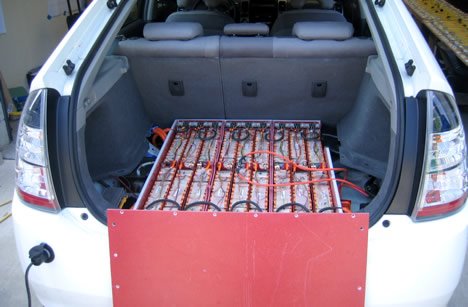
Nissan with a lithiam-ion battery.

Another related field that shows rapid and promising technological development is energy storage. There are several recent patents which cover what some call “hyper capacitors”. This is a kind of mechanical storage of electrons, rather than the chemical storage that we associate with batteries. And in the battery arena lithium-ion batteries are now in production for many applications with further development – especially in terms of safety – proceeding quickly. At least one of the solar-based heat-to-steam-to-turbine-to-electricity systems uses a fluid that is heated to a temperature well above the boiling point of water, so that sufficient fluid, plus insulated storage for that fluid, allows electrical generation to occur after the sun sets for the day.

Conservation of energy is not considered a renewable resource, but it is an essential component of energy policy, so I’m going to blend it into this paper. The largest effect in the shortest time interval can be obtained by: 1) increasing fuel efficiency standards of motor vehicles; 2) insulating and weather-proofing older houses; 3) exchanging incandescent and halogen types of lighting for fluorescent (and soon, LED) “bulbs”; 4) increasing the use of car pools and mass transportation…. Of course, conservation is a mature policy, and it has already been proven to have good effect in the 1970s and 1980s. Seems like a good time to re-enlist in these programs in a serious and comprehensive manner.

There are some relatively new developments in energy efficiency (a form of conservation) to discuss, too. The technology is not new in the case of ground-source-heat-pumps (water-to-air), but improved system designs and the relevant support data are relatively recent. Essentially, the average efficiency improvement for GSHP is on the order of 30% against air-to-air (standard) heat pumps and 70% vs. electric resistance heating. New residential and commercial construction are the best applications in the short run, because the infrastructure (wells or trenches) costs can easily be accomodated in the construction process. The actual dollar savings on energy consumption typically run higher than the additional mortgage costs for the system, to the extent that the return-on-investment for the system per se runs between 2 to 10 years.

Another “old” solar-based energy system is water heating via rooftop collection. The news here is that we don’t need the heavy, clumsy, material-intensive systems that proliferated in the 1970s. The latest approach is black plastic mats of built-in, small-diameter tubes that are freeze-resistant, light in weight, low in cost, and easy to install. This is actually one of the most efficient forms of heat-energy capture from any source.

Some of the other technologies, such as wave-based generation of electricity, hydrogen-based fuel systems, Stirling-type heat engines, solar concentrator, and unknown inventions of the future, may be pie-in-the-sky-bye-and-bye; but we should be funding research if for no other reason than “it looks good on paper”. How else does new technology develop? Somebody dedicates time and money to an idea.

So – we have a lot of invention and a fair amount of implementation. But we lack the focus and commitment that will get us out of our “petroleum addiction”. How come? I read a recent poll that said to me that 80% of our adult population supports kicking the oil habit and deploying many of the systems described above. As the situation in Iraq implies, however, we are governed by a group that wants to control and sell as many gallons of petroleum as possible. For the petro-pushers any gallons sold by Iraq to the French (pre-invasion situation) are dollars lost to Exxon, Chevron, and BP. Any gallons sold by Iran to the Chinese (current situation) are, also, dollars lost to the Anglo-American oil oligopoly. If renewables become the salient energy source, there is an automatic delay in the wealth transfer to the oligarchs – which is a good thing in my opinion.

Of course, the only domestic solution to this problem – i.e., the greed of our oligarchs – is political. Electoral politics is the solution of choice. We need to: 1) promote renewable energy systems; 2) finance system implementation; 3) support related research; and 4) eliminate tax and other government-sponsored advantages enjoyed by the petroleum and coal industries. The world – the U.S.A. in particular – will be a better place when the Sun’s radiation and related terrestrial phenomena warm us, cool us, and transport us to a major degree. It’s within reach and just needs our political will to be a congenial destiny.

Part I of The Earth : Love it or Lose it.

Paul Spencer for President.

The Rag Blog

Posted in Rag Bloggers | Tagged , , , , | 1 Comment