Harry Targ : Hoosier Teach-In and the Question of Historical Narratives

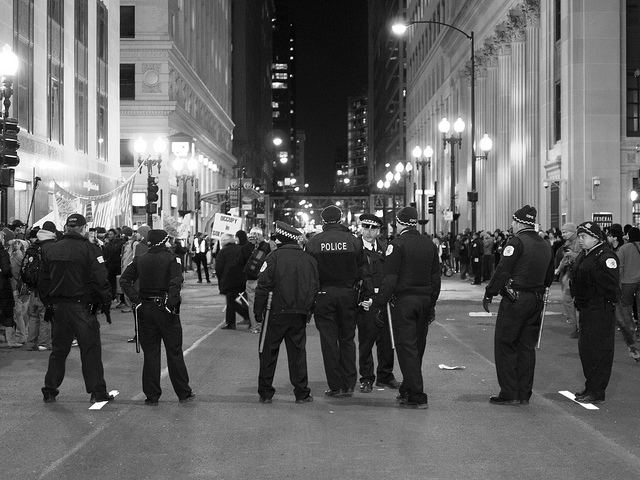
Members of Occupy Purdue demonstrate on Dec. 11, 2011. Photo by Steven Yang / The Exponent.

Hoosier teach-in:
Narratives of labor and elections pose
big questions for Occupy movement

By Harry Targ | The Rag Blog | February 22, 2012

WEST LAFAYETTE, Indiana — Last week a group of Hoosier Occupiers met in a “teach-in” format to discuss how movements for change can and should relate to the labor movement and the working class at large.

The event, hosted by Occupy Purdue, was held in a community center in West Lafayette, Indiana. An extended panel included a faculty member from African American Studies on campus, a Unite-Here organizer, an activist from the International Brotherhood of Electrical Workers, and representatives from the International Socialist Organization and the Committees of Correspondence for Democracy and Socialism.

The panel moderator skillfully questioned panelists and encouraged what became rich and thorough discussion and debate with attendees who were not designated panel speakers but shared the interest and much of the experience of those who were the panelists.

Virtually everyone recognized the problems and strengths of the movements that sprung up last summer, saw the necessity to move ahead with new ideas about organizing and educating many publics, and believed in the necessity of building a broad working class movement. Most felt that the working class constitutes the vast majority of people, whether they are in unions or not.

The knowledge, experience, and passion of all who attended this event were palpable and gave reason to be hopeful about the possibilities for progressive change in the months and years ahead. While teach-in participants agreed on most things, tensions were noted in at least three areas that so often surface as progressive movements are launched. While these tensions may not be easily resolvable, they need to be part of the consciousness of participants as they develop their day-to-day programs.

The first issue has to do with historical narratives. Many participants told historical stories that justified advocacy for particular strategies for building a mass movement. These narratives were stories about the origins of political movements, their participants, the issues they engaged in, the outcomes of their activities, and their connection to the projects that contemporary activists are pursuing.

Teach-in narratives addressed class, race, and gender. Some emphasized workers and class struggle, others talked about labor militancy and the construction of labor unions, and still others emphasized the deleterious consequences of racism and sexism in the labor movement.

There was also a current among the story-tellers about how organized labor had betrayed the working class with the implication that the movements of the 21st century must distinguish between workers in general and workers in unions.

One narrative addressed the issue of race and the organized labor movement in the United States. Historical examples of organized labor’s racist practices included reference to exclusionary clauses requiring that Black and white union locals be segregated or that only limited numbers of African-Americans ever became labor movement leaders.

Beginning a narrative of class and race by identifying certain key dates, for example, the founding of the American Federation of Labor, the rejection by white workers of integrated unions in the packinghouses of Chicago in 1919, or the racism that impaired the campaign to organize the South in “Operation Dixie,” can make this point.

On the other hand, if the class and race narrative begins with the anti-racism of the Knights of Labor and the Industrial Workers of the World in the 1880s, or the struggles around slogans of “Black-White Unite and Fight” in CIO organizing drives of industrial workers in the 1930s, or left unions going South after World War II to organize integrated unions, or the significant support given the foundation of the Southern Christian Leadership Council (SCLC) by the United Auto Workers and the United Packinghouse Workers of America (both affiliated with the new AFL-CIO), then the story is different.

The point here is that the adoption of one or another narrative of the past has consequences for political activism today and tomorrow. Activists today do not need to accept one narrative over another. They just must recognize that each narrative tells part of the story that is critical for today’s work.

To some degree the discussion on race and class at the teach-in reflected the recognition that in this case, there are different narratives about class, race, and labor. Maybe in the end activists are best served by learning the lessons from very different narratives.

A second issue that inevitably comes up at every movement-building discussion has to do with relations between the left and elections. On the one hand, electoral work is taxing, absorbing time and money. Passions are energized by electoral work and oftentimes the candidates selected only minimally satisfy the goals electoral activists are seeking. Sometimes compromises are carried out by candidates progressives support that are on balance net losses for the people.

In the history of the two-party system of the United States, there usually has been limited ability for progressive voices to be heard. Progressives are mired in the classic “lesser of two evils,” conundrum. This problem is exacerbated by the transformation of the electoral system into a sports contest. The media identifies certain “stars” who become the subject of 24/7 news coverage as personalities with little or no attention to political issues.

However, elections, at state and local as well as national levels, do matter to large portions of the working class. For example, as a result of the 2010 elections, union rights have been reduced through passage of Right-to-Work and anti-collective bargaining laws. The loss of Medicaid coverage for women who seek reproductive health services from Planned Parenthood will have disastrous consequences for large numbers of customers. Defunding of public institutions and services — education, libraries, transportation — hit working people the hardest.

And elected officials get to appoint full-time judges from district courts to the Supreme Court. It is clear that one of the least observed outcomes of the “Reagan Revolution” is the life-time appointments of federal judges that have ruled in ways that have destroyed worker, citizen, and women’s rights. The criminal “justice” system has qualitatively advanced the prison-industrial complex during the last decade.

The contradictory character of elections suggests that the left may need a variegated strategy that addresses participation or non-participation at state and local levels as well as at the national level; that works for and against key critical candidates; that campaigns around issues relevant to class, race, and gender; and that uses the electoral arena to politicize and mobilize the vast majority.

Of course, in certain political and geographic spaces, organizing third parties might serve many of these purposes.

The final issue that activists struggle over has to do with who they are. It is often the case that activists have developed an intellectual pedigree. They have read theory and history, and many come out of movements that provide important experiences.

At the same time, there are much larger numbers of workers and others who share the basic values of the most active and who have an experiential pedigree. For a variety of reasons, large numbers of politically alert and conscious workers have not engaged in political struggles on a regular basis. But many of these workers are members of organizations that in the main have articulated progressive agendas: from the National Association for the Advancement of Colored People, to the American Federation of Labor and Congress of Industrial Organizations, to the National Organization of Women, to the Sierra Club.

In the end activists, who are the most committed in the sense of time and resources, should be sympathetic to the existing mass organizations. In other words, activists need to work with their brothers and sisters in a whole array of organizational contexts to build networks and break down barriers between different political voices.

Activists need to shed their own sense of superiority while they work with non-movement activists to reduce broad stereotypes and forms of suspiciousness among those in the popular organizations.

So this wonderful encounter in West Lafayette brought together activists from around the state; people of different ages and backgrounds; reflected class, race and gender; and raised directly and by inattention issues critical to building a progressive future. It was clear from the dialogue that narratives, elections, and political identities, in one way or another, constitute continuing hurdles which may be difficult to resolve but should be critically examined.

[Harry Targ is a professor of political science at Purdue University who lives in West Lafayette, Indiana. He blogs at Diary of a Heartland Radical — and that’s also the name of his new book which can be found at Lulu.com. Read more of Harry Targ’s articles on The Rag Blog.]

The Rag Blog

Posted in Rag Bloggers | Tagged , , , , , , | 1 Comment

Danny Schechter : We Are Drowning Here

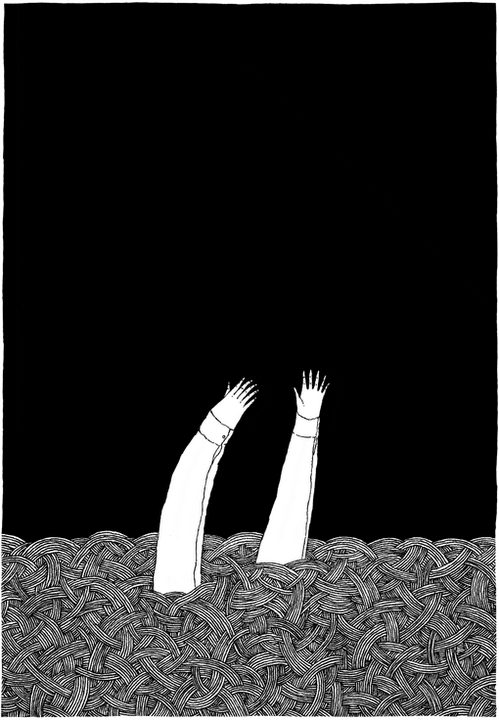
“Drowning Man,” by David Galletly / 2headedsnake.

We are drowning here:
War, banks, and dumbed-down media

“At a time like this, scorching irony, not convincing argument, is needed. Oh had I the ability, and could reach the nation’s ear, I would, pour out a fiery stream of biting ridicule, blasting reproach, withering sarcasm, and stern rebuke.” — Frederick Douglass, 1852

By Danny Schechter / The Rag Blog / February 21, 2012

Oil prices are rocketing. Iranian warships are moving into the Mediterranean to shadow the U.S. warships already there. Propaganda news is growing with rumors of Al Qaeda links with Iran, and, then, less speculative news about real links between the terror groups and the armed opposition in Syria.

As Rolling Stone’s Matt Taibbi puts it, the smell of war is in the air and on the air, “You can just feel it: many of the same newspapers and TV stations we saw leading the charge in the Bush years have gone back to the attic and are dusting off their war pom-poms.”

CLG adds: “Officials in key parts of the Obama administration are increasingly convinced that sanctions will not deter Tehran from pursuing its [alleged] nuclear program, and believe that the U.S. will be left with no option but to launch an attack on Iran or watch Israel do so.”

The timing now seems to be for war in October, just before the next presidential election. Does that mean that the White House believes that war fever will generate more support for an embattled Commander in Chief? Orwell was right in his classic 1984: “The object of the war is not to make or prevent conquests of territory, but to keep the structure of society intact.”

Here in the “homeland,” the FBI busts a “terrorist” on his way, we are told, to blow up the Congress. Turns out he was supplied with phony weapons by the FBI itself, a specialist in entrapment. The G-Men supposedly became suspicious when they heard that this young Moroccan, living illegally in Virginia, told someone who told someone that the war on terror was a war on Muslims. That’s probably a majority view in the Middle East, but to them it was menacing and proof of evil intent.

After their puppet “suspect” was in custody, they reassured one and all that the Congress was never at risk. (Nor, now, is the FBI’s next appropriation!)

What a relief! Congress has survived to fight another day in its own war — a partisan war without end. For the most part, the political logjam continues and not just because of warring ideologies.

Unseen and only rarely commented upon by pundits who know how to cover political horse races but not political skullduggery is the role that big money plays behind the scenes. That is kept out of sight and out of mind.

Bill Moyers and Michael Winship write:

Watching what’s happening to our democracy is like watching the cruise ship Costa Concordia founder and sink slowly into the sea off the coast of Italy, as the passengers, shorn of life vests, scramble for safety as best they can, while the captain trips and falls conveniently into a waiting life boat.

We are drowning here, with gaping holes torn into the hull of the ship of state from charges detonated by the owners and manipulators of capital. Their wealth has become a demonic force in politics. Nothing can stop them. Not the law, which has been written to accommodate them. Not scrutiny — they have no shame. Not a decent respect for the welfare of others — the people without means, their safety net shredded, left helpless before events beyond their control.

Yes, “we are downing here.”

But it is not just money per se that is the problem, but those one-percenters that are manipulating it as a weapon to drive our democracy into the dumper.

Charles Pierce names and shames them in the pages of Esquire, writing about

the undeniable fact that, over the course of a decade, a bunch of cheats, thieves, and suited mountebanks stole most of the national economy and then wrecked whatever was left of it. But what’s most extraordinary about the whole thing is that, after they swindled their swindles and heisted their heists, and got paid off by the rest of us for having looted our national economy, they all kept doing the same things they were doing before. These included extravagant bonuses and, of course, continued crimes of capital that ought to be capital crimes.

Wow!

On the same day I read, Joe Nocera in The New York Times saying it’s not important to punish the banks. So clearly the liberal media is in large part in cahoots with the right wing message points, avoiding any structural analysis, while pushing for mild “reforms” unlikely to reform anything.

One consequence of our corporate news system, according to Richard Flanders in The Atlantic is that Americans are being steered into becoming even more conservative.

Even with the president’s approval rating showing signs of life and the Republicans busily bashing themselves over the head — “one is a practicing polygamist and he’s not even the Mormon,” retired Supreme Court Justice Sandra Day O’Connor recently quipped about her party’s two frontrunners — America continues to track right, according to polling data released by the Gallop Organization this week.

Americans at this political moment are significantly more likely to identify as conservative than as liberal: conservatives outnumber liberals by nearly two to one. Forty percent identify as conservative, 36 percent as moderate, and 21 percent liberal.

Most upsetting is that the people who are suffering the most are stuck in the Alice in Wonderland world of conservative ideology.

This study concludes. “The ongoing economic crisis only appears to have deepened America’s conservative drift — a trend which is most pronounced in its least well off, least educated, most blue collar, most economically hard-hit states.”

The public becomes dumber in part because our media is a dumbing-down machine. No wonder, alternative voices are brushed to the margins by our not-so-free press. This past week, I was interviewed by RT and Al Jazeera, but none of the U.S. TV news networks I used to work for will have me on. It’s not a personal thing: I am not alone.

Yes, MSNBC has added two progressive hosts, but in the morning, on weekends, when viewing is lowest. Fox, meanwhile, dumped Judge Napolitano and his sometime sensible and outspoken libertarian show. Can’t have that, can we?

It’s time for Occupy Wall Street to add media reform to its emerging agenda. The media war is as real as any other, and unless we fight that one, we will lose all the others. Politics is a war of ideas, of different narratives in collision.

It’s not enough to chant, “We are the 99%.” We have to explain who rules America and how to change it.

One way to do it is educate the country about how many of the same interests that own the banks own the media. Perhaps that’s why most media outlets are not reporting that unemployment increased this month and that underemployment is up to 19%.

Writes Rex Nutting on Market Watch:

Everyone knows that the Great Recession has inflicted tremendous damage to the lives and fortunes of millions of Americans. But what you may not know is that most of the suffering is still to come.

We’re not even halfway done with this mess.

A mess it is, a “mistake” it isn’t.

That’s why activists can’t give up.

If there was ever a time for progressives to unite around some coherent 10-point plan that can be used to reach potential supporters and broaden the movement for change, this is it. The aspiration should be to build a coalition that can win, to “occupy the mainstream.” Sadly, here as in Greece, where the economic crisis is at a boiling point, a headline in the Financial Times sums up a key obstacle to fighting back:

Greek Left Has Most Support But is Fragmented

What say you, unions, churches, minorities, students, workers, activists, feminists, and occupiers? Do we work together or lose apart? Assuming that the GOP self-destructs, do we really think that more ‘Bama can make the difference that needs making?

[News Dissector Danny Schechter writes the News Dissector blog and edits the new Mediachannel1.org. His new book is Occupy: Dissecting Occupy Wall Street. (ColdType.net). Email Danny at dissector@mediachannel.org. Read more by Danny Schechter on The Rag Blog.]

The Rag Blog
Posted in Rag Bloggers | Tagged , , , , , | Leave a comment

Ian Buruma : Is the U.S. in a ‘Dangerous State of Funk’?

Graphic from Progressive America Rising.

Is the U.S. in a ‘Dangerous State of Funk’?

Much political rhetoric, and a spate of new books, would have us believe that the U.S. is in a dangerous state of funk.

By Ian Buruma / Progressive America Rising / February 21, 2012

NEW YORK — The eccentric Bengali intellectual Nirad C. Chaudhuri once explained the end of the British Raj in India as a case of “funk,” or loss of nerve. The British had stopped believing in their own empire. They simply lost the will, in Rudyard Kipling’s famous words, to fight “the savage wars of peace.”

In fact, Kipling’s poem, “The White Man’s Burden,” which exhorted the white race to spread its values to the “new-caught sullen peoples, half devil and half child,” was not about the British empire at all, but about the United States. Subtitled “The United States and the Philippine Islands,” it was published in 1899, just as the U.S. was waging a “savage war of peace” of its own.

Chaudhuri had a point. It is difficult to sustain an empire without the will to use force when necessary. Much political rhetoric, and a spate of new books, would have us believe that the U.S. is now in a dangerous state of funk.

Fresh debate over U.S. mission in Afghanistan

For example, Republican presidential candidate Mitt Romney likes to castigate President Barack Obama for “apologizing for America’s international power,” for daring to suggest that the U.S. is not “the greatest country on earth,” and for being “pessimistic.” By contrast, Romney promises to “restore” the greatness and international power of the United States, which he proposes to do by boosting its military force.

Romney’s Kipling is the neoconservative intellectual, Robert Kagan, whose new book, The World America Made, argues against “the myth of American decline.” Yes, he admits, China is growing in strength, but U.S. dominance is still overwhelming; The U.S. military might can still “make right” against any challenger. The only real danger to U.S. power is “declinism”: the loss of self-belief, the temptation to “escape from the moral and material burdens that have weighed on [the U.S.] since World War II.” In a word, funk.

Like Chaudhuri, Kagan is an engaging writer. His arguments sound reasonable. And his assessment of U.S. firepower is no doubt correct. True, he has little time for domestic problems such as antiquated infrastructure, failing public schools, an appalling healthcare system, and grotesque disparities in income and wealth. But he is surely right to observe that no other power is threatening to usurp the U.S. role as the world’s military policeman.

Less certain, however, is the premise that the world order would collapse without “American leadership.” France’s King Louis XV allegedly declared on his deathbed: Après moi, le déluge. [“After me, the flood.”] This is the conceit of all great powers.

‘Pax Americana’

Even as the British were dismantling their empire after World War II, the French and Dutch still believed that parting with their Asian possessions would result in chaos. And it is still common to hear autocratic leaders who inherited parts of the Western empire’s claim that democracy is all well and good, but the people are not yet ready for it. Those who monopolize power cannot imagine a world released from their grip as anything but a catastrophe.

In Europe after World War II, Pax Americana, guaranteed by U.S. military power, was designed “to keep the Russians out and Germany down.” In Asia, it was meant to contain communism, while allowing allies, from Japan to Indonesia, to build up economic strength. Spreading democracy was not the main concern; stopping communism — in Asia, Europe, Africa, the Middle East, and the Americas — was. In this respect, it succeeded, though at great human cost.

But, now that the specter of global communist domination has joined other fears — real and imagined — in the dustbin of history, it is surely time for countries to start handling their own affairs. Japan, in alliance with other Asian democracies, should be able to counterbalance China’s growing power. Similarly, Europeans are rich enough to manage their own security.

But neither Japan nor the European Union seems ready to pull its own weight, owing in part to decades of dependency on U.S. security. As long as Uncle Sam continues to police the world, his children won’t grow up.

In any case, as we have seen in Iraq and Afghanistan, “savage wars of peace” are not always the most effective way to conduct foreign policy. Old-fashioned military dominance is no longer adequate to promote U.S. interests. The Chinese are steadily gaining influence in Africa, not with bombers, but with money. Meanwhile, propping up secular dictators in the Middle East with U.S. arms has helped to create Islamist extremism, which cannot be defeated by simply sending more drones.

The notion promoted by Romney and his boosters that only U.S. military power can preserve world order is deeply reactionary. It is a form of Cold War nostalgia — a dream of returning to a time when much of the globe was recovering from a ruinous world war and living in fear of communism.

Obama’s recognition of U.S. limitations is not a sign of cowardly pessimism, but of realistic wisdom. His relative discretion in the Middle East has allowed people there to act for themselves. We do not yet know what the outcome there will be, but “the greatest country on earth” cannot impose a solution. Nor should it.

[Ian Buruma is Professor of Democracy and Human Rights at Bard College, and the author most recently of Taming the Gods: Religion and Democracy on Three Continents. This article was published by Aljazeera and was distributed by Progressive America Rising. A version was first published on Project Syndicate.]

The Rag Blog

Posted in RagBlog | Tagged , , , | Leave a comment

Lamar W. Hankins : Jessica Ahlquist and the Modern Day Puritans

Sixteen-year-old Jessica Ahlquist sued Cranston High School in Cranston, Rhode Island, for displaying an eight-foot tall prayer banner in the school gym. Photo by Gretchen Ertl / NYT / Facebook.

‘City upon a hill’:
Our modern-day Puritans and
the saga of Jessica Ahlquist

By Lamar W. Hankins / The Rag Blog / February 21, 2012

For those who don’t remember their grade school history lessons, during the 1600s, the Puritans were persecuted in England for trying to purify the Church of England according to their standards. King Charles I didn’t agree with the dissidents and 20,000 of them headed to the New World to found the Massachusetts Bay Colony to create an example for all. As John Winthrop, one of the colony’s governors, explained, echoing the words of Jesus in his Sermon on the Mount: “We must consider that we shall be as a city upon a hill. The eyes of all people are upon us.”

The problem with that “city upon a hill” was that the people would not tolerate other religions. They believed in freedom of religion only for themselves. The Pequot Indians were seen as heathens, so it was no big deal to massacre 600 of them in 1637, including burning alive many of them. The Puritans’ Rev. John Cotton believed it wrong to practice any religion other than Puritanism. To do so would be helping the devil. The only tolerance Cotton was interested in he defined as “the liberty … to tell lies in the name of the Lord.” I guess he wanted God and his fellow citizens to tolerate his lies.

But the Puritan minister Roger Williams had other ideas. He said, “Forced worship stinks in God’s nostrils.” He was against churches taking money from the government, forcibly taking Indians’ land, being intolerant of the religious views of others, and using the power of the government to compel obeisance to a particular religion: “[It is] against the testimony of Christ Jesus for the civil state to impose upon the souls of the people a religion . . . . Jesus never called for the sword of steel to help the sword of spirit.”

Of course, most Puritans couldn’t tolerate such views. Williams was banished and fled to what became Rhode Island to found a refuge for people of all religions and of none. So, long before anyone declared irony dead, we have in our own history a quintessential bit of double irony – a persecuted religious group flees its country to set up shop, where the group proceeds to persecute others for their religious beliefs, forcing one of their own flock to flee, seeking actual religious freedom elsewhere.

Now, we have another irony arising from Rhode Island, once the land of religious tolerance. A 16-year old girl, Jessica Ahlquist, represented by attorneys from the ACLU of Rhode Island, sued the Cranston High School in Cranston, Rhode Island, for continually displaying an 8-foot tall prayer banner in the school’s gymnasium. A federal judge held against the school in January and the school board decided a few days ago not to appeal.

Perhaps they were visited by the ghost of Roger Williams, who explained the state’s history to them. Because the question of prayer in public schools has been settled law for nearly 50 years, the school board made a wise decision. An appeal would have been a waste of taxpayer money with costs estimated by the school’s attorney at $500,000. As it is, the school may have to pay $173,000 in court costs and legal fees to Ahlquist’s attorneys for the initial litigation.

Though Ahlquist is only 16, she has an engaging intellect. Asked how she felt about those who disagree with her, she responded, “It’s almost like making a child get a shot even though they don’t want to. It’s for their own good. I feel like they might see it as a very negative thing right now, but I’m defending their Constitution, too.” The federal judge noted in his decision that Ahlquist “is clearly an articulate and courageous young woman, who took a brave stand, particularly in light of the hostile response she has received from her community.”

The judge appeared to have no doubts about the correctness of Ahlquist’s legal position, and ended his opinion with some historical observations:

Over the many years of its history, the Supreme Court has turned to the words of the Founding Fathers and the framers of the Constitution to support varying interpretations of the Establishment Clause. Many chapters have been devoted to Thomas Jefferson, James Madison, George Washington and even Abraham Lincoln, and what their expectations were for the public religious practices of this nation. This Court has tried to resist the temptation of injecting lofty rhetoric into this opinion, but nonetheless was moved by the words, as quoted in Schempp [the 1963 U.S. Supreme Court decision that declared school-sponsored Bible reading unconstitutional], of Roger Williams, the founder of our state, who left the Massachusetts Bay Colony in pursuit of religious liberty:

There goes many a ship to sea, with many hundred souls in one ship, whose weal and woe is common, and is a true picture of a commonwealth, or human combination, or society. It hath fallen out sometimes, that both Papists and Protestants, Jews and Turks, may be embarked on one ship; upon which supposal, I affirm that all the liberty of conscience I ever pleaded for, turns upon these two hinges, that none of the Papists, Protestants, Jews, or Turks be forced to come to the ship’s prayers or worship, nor compelled from their own particular prayers or worship, if they practice any.

In addition to unconstitutional discrimination by the school, Ahlquist has been subjected to the most extreme vituperation by adults and fellow students alike. She has been called crude and offensive names for standing up for the constitutional rights guaranteed to all. She has been ridiculed and threatened to the point that extra security has been required to protect her during the school day.

Even her own Congressman, Rep. Peter Palumbo, D-R.I., called the 16-year old an “evil little thing” in an interview on an East Providence, Rhode Island radio show. And Palumbo’s castigation of the teenager continued as he referred to her as a pawn, saying “I think she is being coerced by evil people… she’s being trained to do this.”

Ahlquist’s case has been followed closely by the Freedom From Religion Foundation (FFRF), whose Co-Presidents Dan Barker and Annie Laurie Gaylor called Palumbo’s attack “vicious, unwarranted, and irresponsible.” They wrote in a letter to Palumbo,

If anything is “evil” it is your inflammatory words contributing to a situation in which an entire community, if not state, appears to be arrayed against one young, brave and diminutive teenager. Your reckless and unprofessional words as an elected state official endanger Jessica’s standing and her security in the community.

I don’t know that all the invective and threats directed at Ahlquist have been perpetrated by Christians, but it is hard to imagine the members of any other group who would be so outraged by Ahlquist’s actions. To their credit, members of several religious groups appealed for “tolerance and civility” in responding to the court decision.

More than a dozen Rhode Island religious leaders spoke about the importance of people of all faiths, as well as non-believers, being able to live free from coercion. Rabbi Peter Stein of Cranston’s Temple Sinai and president of the Board of Rabbis said, “This is not about agreement or disagreement. This is about how we treat one another. The personal attacks must stop.”

The clergy members included the Rev. William Zelazny of the Ballou Channing District Unitarian Universalist congregation; Imam Farid Ansari of the Muslim American Dawah Center; the Rev. Israel Mercedes of the Providence Bible Institute; and the Rev. Betsy Garland of the Rhode Island Council of Churches.

Now, a complaint has been filed against several floral shops with the State of Rhode Island Commission for Human Rights for their refusal to deliver flowers to Ahlquist sent by the FFRF. The complaint alleges “illegal discrimination based on religion” against the florists. Under Rhode Island law it is unlawful for a place of public accommodation to deny services “on account of religion.”

Altogether four florists refused to deliver flowers to Ahlquist. The FFRF found a florist in Putnam, Connecticut, who would fill the order. To date, that florist has delivered over two dozen orders to Ahlquist and to other organizations in the Cranston area in honor of Ahlquist.

It is unfortunate that some Christians believe their own rectitude gives them the right to foist their religious beliefs on others, treat those with different beliefs with contempt, discriminate against others based on religious belief, and compel the government to promote their version of religious truth. But this is the case throughout the country, not just among the historically confused residents of Rhode Island, but here in Texas as well.

One of my religious correspondents has communicated with me about prayer sponsored by the government at official meetings, writing that “I want prayer at the meetings… Christian prayer… Wiccan prayer, I believe, would bring a spiritual curse on this city… [T]his government was founded by Christians for Christians. It was not for religious tolerance of all religions… I actually believe this nation should be Christian and only Christian.”

There you have it — an example of our modern-day Puritans. This kind of Christian will be happy only when we are all her kind of Christian. As long as we have this kind of religious intolerance, and the kind displayed in Rhode Island toward a 16-year old girl, this society will never achieve the vision of this country articulated by Ronald Reagan, who was evidently inspired by John Winthrop’s words (though not his actions) when he referred to his hope that America would become “a shining city (on a hill… teeming with people of all kinds living in harmony and peace…”

[Lamar W. Hankins, a former San Marcos, Texas, city attorney, is also a columnist for the San Marcos Mercury. This article © Freethought San Marcos, Lamar W. Hankins. Read more articles by Lamar W. Hankins on The Rag Blog.]

The Rag Blog

Posted in Rag Bloggers | Tagged , , , , , , , , | Leave a comment

Our modern-day Puritans

By Lamar W. Hankins / The Rag Blog / February 20, 2012

For those who don’t remember their grade school history lessons, during the 1600s the Puritans were persecuted in England for trying to purify the Church of England according to their standards.

King Charles I didn’t agree with the dissidents and 20,000 of them headed to the New World to found the Massachusetts Bay Colony to create an example for all. As John Winthrop, one of the colony’s governors, explained, echoing the words of Jesus in his Sermon on the Mount: “We must consider that we shall be as a city upon a hill. The eyes of all people are upon us.”

The problem with that “city upon a hill” was that the people would not tolerate other religions. They believed in freedom of religion only for themselves. The Pequot Indians were seen as heathens, so it was no big deal to massacre 600 of them in 1637, including burning many of them alive.

The Puritans’ Rev. John Cotton believed it wrong to practice any religion other than Puritanism. To do so would be helping the devil. The only tolerance Cotton was interested in he defined as “the liberty… to tell lies in the name of the Lord.” I guess he wanted God and his fellow citizens to tolerate his lies.

But the Puritan minister Roger Williams had other ideas. He said, “Forced worship stinks in God’s nostrils.” He was against churches taking money from the government, forcibly taking Indians’ land, being intolerant of the religious views of others, and using the power of the government to compel obeisance to a particular religion: “[It is] against the testimony of Christ Jesus for the civil state to impose upon the souls of the people a religion … Jesus never called for the sword of steel to help the sword of spirit.”

Of course, most Puritans couldn’t tolerate such views. Williams was banished and fled to what became Rhode Island to found a refuge for people of all religions and of none. So, long before anyone declared irony dead, we have in our own history a quintessential bit of double irony — a persecuted religious group flees its country to set up shop, where the group proceeds to persecute others for their religious beliefs, forcing one of their own flock to flee, seeking actual religious freedom elsewhere.

Now, we have another irony arising from Rhode Island, once the land of religious tolerance. A 16-year old girl, Jessica Ahlquist, represented by attorneys from the ACLU of Rhode Island, sued the Cranston High School in Cranston, Rhode Island, for continually displaying an eight-foot tall prayer banner in the school’s gymnasium. A federal judge held against the school in January and the school board decided a few days ago not to appeal.

Perhaps they were visited by the ghost of Roger Williams, who explained the state’s history to them. Because the question of prayer in public schools has been settled law for nearly 50 years, the school board made a wise decision. An appeal would have been a waste of taxpayer money with costs estimated by the school’s attorney at $500,000. As it is, the school may have to pay $173,000 in court costs and legal fees to Ahlquist’s attorneys for the initial litigation.

Though Ahlquist is only 16, she has an engaging intellect. Asked how she felt about those who disagree with her, she responded, “It’s almost like making a child get a shot even though they don’t want to. It’s for their own good. I feel like they might see it as a very negative thing right now, but I’m defending their Constitution, too.”

The federal judge noted in his decision that Ahlquist “is clearly an articulate and courageous young woman, who took a brave stand, particularly in light of the hostile response she has received from her community.”

The judge appeared to have no doubts about the correctness of Ahlquist’s legal position, and ended his opinion with some historical observations:

“Over the many years of its history, the Supreme Court has turned to the words of the Founding Fathers and the framers of the Constitution to support varying interpretations of the Establishment Clause. Many chapters have been devoted to Thomas Jefferson, James Madison, George Washington and even Abraham Lincoln, and what their expectations were for the public religious practices of this nation. This Court has tried to resist the temptation of injecting lofty rhetoric into this opinion, but nonetheless was moved by the words, as quoted in Schempp [the 1963 US Supreme Court decision that declared school-sponsored Bible reading unconstitutional], of Roger Williams, the founder of our state, who left the Massachusetts Bay Colony in pursuit of religious liberty”:

There goes many a ship to sea, with many hundred souls in one ship, whose weal and woe is common, and is a true picture of a commonwealth, or human combination, or society. It hath fallen out sometimes, that both Papists and Protestants, Jews and Turks, may be embarked on one ship; upon which supposal, I affirm that all the liberty of conscience I ever pleaded for, turns upon these two hinges, that none of the Papists, Protestants, Jews, or Turks be forced to come to the ship’s prayers or worship, nor compelled from their own particular prayers or worship, if they practice any.
In addition to unconstitutional discrimination by the school, Ahlquist has been subjected to the most extreme vituperation by adults and fellow students alike. She has been called crude and offensive names for standing up for the constitutional rights guaranteed to all. She has been ridiculed and threatened to the point that extra security has been required to protect her during the school day. Even her own Congressman, Rep. Peter Palumbo, D-R.I., called the 16-year old an “evil little thing” in an interview on an East Providence, Rhode Island radio show. And Palumbo’s castigation of the teenager continued as he referred to her as a pawn, saying “I think she is being coerced by evil people . . . she’s being trained to do this.”

Ahlquist’s case has been followed closely by the Freedom From Religion Foundation (FFRF), whose Co-Presidents Dan Barker and Annie Laurie Gaylor called Palumbo’s attack “vicious, unwarranted, and irresponsible.” They wrote in a letter to Palumbo, “If anything is ‘evil’ it is your inflammatory words contributing to a situation in which an entire community, if not state, appears to be arrayed against one young, brave and diminutive teenager. Your reckless and unprofessional words as an elected state official endanger Jessica’s standing and her security in the community.”
I don’t know that all the invective and threats directed at Ahlquist have been perpetrated by Christians, but it is hard to imagine the members of any other group who would be so outraged by Ahlquist’s actions. To their credit, members of several religious groups appealed for “tolerance and civility” in responding to the court decision.

More than a dozen Rhode Island religious leaders spoke about the importance of people of all faiths, as well as non-believers, being able to live free from coercion. Rabbi Peter Stein of Cranston’s Temple Sinai and president of the Board of Rabbis said, “This is not about agreement or disagreement. This is about how we treat one another. The personal attacks must stop.” The clergy members included the Rev. William Zelazny of the Ballou Channing District Unitarian Universalist congregation; Imam Farid Ansari of the Muslim American Dawah Center; the Rev. Israel Mercedes of the Providence Bible Institute; and the Rev. Betsy Garland of the Rhode Island Council of Churches.

Now, a complaint has been filed against several floral shops with the State of Rhode Island Commission for Human Rights for their refusal to deliver flowers to Ahlquist sent by the FFRF. The complaint alleges “illegal discrimination based on religion” against the florists. Under Rhode Island law it is unlawful for a place of public accommodation to deny services “on account of religion.” Altogether four florists refused to deliver flowers to Ahlquist. The FFRF found a florist in Putnam, Connecticut, who would fill the order. To date, that florist has delivered over two dozen orders to Ahlquist and to other organizations in the Cranston area in honor of Ahlquist.

It is unfortunate that some Christians believe their own rectitude gives them the right to foist their religious beliefs on others, treat those with different beliefs with contempt, discriminate against others based on religious belief, and compel the government to promote their version of religious truth. But this is the case throughout the country, not just among the historically confused residents of Rhode Island, but here in Texas as well.

One of my religious correspondents has communicated with me about prayer sponsored by the government at official meetings, writing that “I want prayer at the meetings. . . Christian prayer. . . . Wiccan prayer, I believe, would bring a spiritual curse on this city. . . . [T]his government was founded by Christians for Christians. It was not for religious tolerance of all religions. . . . I actually believe this nation should be Christian and only Christian.”

There you have it – an example of our modern-day Puritans. This kind of Christian will be happy only when we are all her kind of Christian. As long as we have this kind of religious intolerance, and the kind displayed in Rhode Island toward a 16-year old girl, this society will never achieve the vision of this country articulated by Ronald Reagan, who was evidently inspired by John Winthrop’s words (though not his actions) when he referred to his hope that America would become “a shining city (on a hill… teeming with people of all kinds living in harmony and peace…”

[Lamar W. Hankins, a former San Marcos, Texas, city attorney, is also a columnist for the San Marcos Mercury. This article © Freethought San Marcos, Lamar W. Hankins. Read more articles by Lamar W. Hankins on The Rag Blog.]

Type rest of the post here

Source /

The Rag Blog

Posted in RagBlog | Leave a comment

Bruce Melton : Climate Change Texas: The Worst-Case Scenario is Happening

Austin, Texas, Late Summer 2011: This is not autumn in Central Texas. These are cedar trees (juniperus Asheii). The fall leaf drop does not begin here until about mid-October and extends through the first of the year. These cedar trees are dead as are countless others in the region. This photo was taken in the Barton Creek Greenbelt in South Austin. Photo by Bruce Melton / The Rag Blog.

CLICK ON IMAGES TO ENLARGE

Climate change Texas:
The worst-case scenario is happening now

An evaluation of recent academic work on ongoing and regional climate change impacts and the latest future projections.

By Bruce Melton | The Rag Blog | February 16, 2012

(This article is an expansion of and provides technical backup for Bruce Melton’s three-part series, “Welcome to Climate Change in Texas,” published in December 2011 and January 2012 on The Rag Blog.)

AUSTIN, Texas — If this is not dangerous climate change, then this is exactly what dangerous climate change will be like in as little as a decade. What has been happening in Texas, with its unprecedented (in time frames that matter) droughts and wildfires, is exactly what the climate scientists have been warning us about for over 20 years. We have been building up to this point since about the turn of the century, and now ecosystems have tipped over the edge. Climate feedbacks have kicked in hard.

The Texas Forest Service tells us that a half billion trees have died. The first of this series of droughts in 2005/6 was just classified as extreme. The last two have been one category worse than extreme — the exceptional category. The last 12 months were drier than the worst 12 months of the great drought of the 1950s. This has been a $10 billion drought, with another $1 billion in damages from the fires.

Worse, it’s hotter now. This past summer was 5.4 degrees warmer than average. This may not seem like a lot, but think how sick you would be if you had a 104 degree temperature.

The reason that increased heat makes such a big difference in a drought is that extra heat greatly increases evaporation. Four percent more water evaporates for every degree of temperature increase. With 5.4 degrees of warming above average, summertime evaporation in Austin was more than 22 percent greater than normal. In other words, the same drought is much worse if it is only a little hotter.

In the same breath, even with normal rainfall, because of warmer temperatures, drought can persist because of much greater evaporation. The warmer temperatures are easy to see looking at the average August temperature for the period of record.

It is important to talk about the urban heat island effect here too. The chaos of information presented by our media today does little to shed light on the latest climate science. An evaluation of regional temperature departure from normal for 2011 shows the exceptional nature of this most recent in a string of droughts.

Urban heat island signatures are easily evaluated and constant correction is an integral part of climate work on global land/ocean temperatures. Corrections are made through the comparison of individually impacted weather stations and their normal neighboring rural weather stations.

Published work on the heat island effect shows that even without correction, the heat island’s influence on global temperatures is as yet inconsequential because of the relative size of the heat islands compared to the global surface.

The evaluations can also be visually confirmed looking at the temperature departure from normal for the region during the 2011 drought. Where the heat island effect looks to be dramatically visible in the Austin and San Antonio metropolitan areas, it is dramatically absent from the Houston and Dallas metro areas.

The total number of fires in Texas since November 2010 (through September 20, 2011) is 22,790, totaling 3,759,331 acres. This exceeds the previous record of 2.1 million acres, set in just 2005/6, by 80 percent. We almost doubled the last record, set just five years ago.

Thirty-three percent of U.S. wildland fires in 2011 were in Texas. This number is 61 percent greater (as of September 2011) than the 10-year national average for the entire United States. Six of the 10 largest wildfires in Texas history occurred in 2011.

Sure, there have been bigger droughts and bigger fires in the early 1900s or the 1800s or the 1300s, or 3,000 year BC, but our complicated society did not evolve back then. We do not have the water to support our region today. This is why we have water use restriction in effect now, and last summer and every summer since the turn of the 21st century.

It cannot be emphasized more that this is exactly what our climate scientists have been warning us would happen for the last 20 or 30 years. Only their warnings were generations distant from actual impacts happening today. The impacts happening now are far ahead of the projected schedule. The reason is that the projected future climate changes have always been based on the middle of the road “Kyoto” suggested emissions behaviors.

Our society has not limited our emissions as was suggested by climate scientists to be a prudent way of avoiding dangerous climate change. What should have been a global emissions path reduction to a few percentage points less than the emissions made in 1990 has instead seen emissions grow to 50 percent greater than they were in 1990.

Climate scientists warned us that if we did not significantly limit our emissions, our climate would change much faster, with much greater risks of even larger changes duo to positive feedbacks that we were just beginning to understand.

Since the IPCCC stopped taking papers for the 2007 report in 2005, we have learned a lot about these feedbacks. We have also been able to document changes to our climate happening much faster than previously projected and these two things are, as suggested by our climate scientists for a generation or more, intimately related.

In June 2009, the U.S. Global Change Research Program (USGCRP), founded by Ronald Reagan, published a report that tells us that by 2080, Austin will see an average of 90 to 120 days of 100 degree weather every year — 10 times more than today’s average of 12 days per year.


Look Closely at Arizona. The area of the map with 100 degree day data from the 1961-1979 data can be considered to be representative of the average for the 20th century. What the USGCRP tells us is that enormous areas of the North American continent will see the same climate that has seen the evolution of the Saguaro Cactus, in the Sonoran desert of South Central Arizona or in many cases, a climate that is up to 50 percent more extreme than that of the Sonoran Desert today.

But the most mind-boggling part of this future projection is that it is based on the IPCC A1B scenario. This is one of the middle of the road emissions scenario families where our society makes a modest effort to reign in greenhouse gas emissions. It is loosely based on a path that could be represented by efforts with the Kyoto protocol where new efficient technologies are rapidly put into use and there is a balanced emphasis on all energy sources. For decades it has been considered to be the most likely scenario of actual emissions.

But this thinking is enormously dated. We are currently smack-dab in the middle of the worst-case scenario considered by climate models. Even with the economic recession, global carbon emissions in 2010 were double the recent average and as high as anything seen since the late 1970s/early 1980s.

Let me repeat one more time: The USGCRP projections are based on the middle of the road scenario. We are currently on the worst-case scenario path. This means that temperature change will be more to significantly more than we have been expecting for decades. And this is one of the main reasons why our climate has already changed so much, so rapidly and why future change will be even faster than projected.

This middle of the road scenario is also considered in the next two examples of climate projections as well. It is very clear from discussions of these results by the principal investigators in their research papers that these results are conservative and the future is very likely to see changes that are greater than what are indicated.

A paper in Geophysical Research Letters in July 2010 by two researchers from Stanford and Purdue (Diffenbaugh and Ashfaq) tells us that climate conditions will continue to rapidly worsen in the interior of North America and especially the West. The worsening will be so rapid that in Central Texas the current decade of 2010 to 2019 will see two to three droughts as bad as or worse than the drought of the 1950s.

Beginning in just 8 years, in the decade 2020 to 2029, Central Texas will see four to five droughts as bad as or more extreme than the drought of the 1950s. The implications of these projections are staggering. And remember, these projections are based on the middle of the road scenario. It is quite likely that changes will be even greater than what these Stanford researchers suggest.


A report out of the National Climatic Data Center in February 2011 (Dia) tells us that beginning in just 19 years (2030) Dust Bowl conditions will be the average climate condition across much of the interior of the U.S. By 2060, much of the interior of the nation will be two to three times as bad as the Dust Bowl with some areas four to five times more extreme than the Dust Bowl.

The 20-year projection is sobering. What is depicted here is the average condition. Across much of the United States, the average drought condition will be similar to that of the Dust Bowl. It is very important to understand that these findings indicate the average condition. Some years will be worse, but on average, it will be as bad as the Dust Bowl — continually — and in some areas four to five times as bad as the Dust Bowl.

What is most important to remember about exceptionally extreme events such as these is that it is the most extreme events that do the most damage. Climate change increases the occurrence of these most catastrophic of events. As the temperature increases, the number of extreme events disproportionately increases too. What this means is that a little warming increases the number of extreme events a lot, not a little.

By mid-century however, we reach completely catastrophic levels of continuous drought several times more extreme than the Dust Bowl. Implication of this type of non-stop drought and adaptation strategies for these extreme conditions have simply not been contemplated in the literature. Significant work is underway to gain insight into these situations that seemed so improbable just a few years ago.

Again, I must insist on repeating that this research, like that from Stanford and the USGCRP, looks at the A1B scenario or a middle of the road climate emissions projection. In reality we are now on the worst-case path. Climate changes are almost certain to be more extreme than these studies have shown.

This is no longer business as usual. Water use restrictions will not meet this challenge alone. We must act now to convince our leaders that this is not just another in a long string of extraordinary weather events that we cannot yet blame on climate change.

If we do not immediately change our habits and lifestyles, we will run out of water. Our forests are already dying because they have run out of water. The evidence supporting the relationship between this string of unprecedented droughts and climate change is overwhelming.

A paper by Kevin Trenberth and colleagues from the National Center for Atmospheric Research, Scripps Institute, and The Weather Underground has summarized 61 different findings concerning climate changes already occurring and dating back to 1998. An example of these findings includes the Moscow Heat Wave of 2010 where over 60,000 died. The findings show that this heat wave was 80 percent likely to have been caused by climate change.

A draft paper by James Hansen, Director of the NASA Goddard Institute for Space Studies (the main U.S. climate modeling agency) tells us that the Texas drought in 2011 is significantly similar to the Moscow heat wave (only we have a lot more air conditioning in Texas, contributing to far fewer deaths). The Hansen paper speaks to the issue that, because our climate has so significantly changed, all weather now must be considered to have been caused by climate change.

Many of us have heard by now that it was much drier during the droughts of the 1600s, 1700s, and 1800s before reliable record keeping began in Texas. These droughts however, do not hold a candle to what scientists have discovered to be true “megadroughts.” Two of them happened between the 900s and about 1350. These droughts saw rainfall drop to 25 percent of normal and they lasted for centuries — hundreds of years!

Water level changes of hundreds of feet in closed basin lakes of the Great Basin show that these droughts were widespread. Hundred-year old trees growing a hundred feet or more below the current water level attest to that.

The climate also likely changed quite rapidly when rain did begin to fall again because many of these trees remain intact with their branches, submerged and semi-preserved in the cold waters. One tree in Jenny Lake at the foot of the Grand Tetons in Wyoming still has a raptor nest in it, now about a thousand years old.

There is also evidence that large portions of the Great Plains desertified during these droughts. This is one of those big things the climate scientists have been warning us about now for decades. During these desertification events, much of the Great Plains actually changed to a sea of shifting sand. This desertification was much larger than that at the turn of the 19th century that fostered the term “Great American Desert.”

Sure, there have been bigger droughts and bigger fires in the past, but our complicated society did not have 1.7 million people in the Austin/Round Rock Metropolitan Area then.

Projections of climate changes from a few decades ago have been shattered. Future projections are exceedingly stark, and these projections are based on the middle of the road scenario — far, far from where our emissions are today. Now the climate scientists are warning us of upcoming weather far more extreme than our civilization has ever experienced and to which our society will have difficulty adapting.

We must prioritize our actions towards immediate action and adaptation strategies far more rigorous than anything yet contemplated. Climate scientists continue to warn us, and their warnings continue to worsen.

Our State Climatologists has attributed only a small portion of our 2011 event to climate change. I have amassed a very large amount of data over the years looking at this issue in Central Texas and specifically the validity of the previous heat wave of record in the mid 1920s. The culmination of this work can be seen in a three part series published on an investigative internet journal the Rag Blog.

A summary of my reporting shows that the heat records of the mid 1920s are likely to be in error. This means that the 2011 heat wave was not an event that shattered the previous record by more than 30 percent. It means that the 2011 event likely obliterated the previous record event by over 100 percent. This of course means that our State Climatologists opinion of the science is significantly dated.

Even with the erroneous 1923 and 1925 heat records intact in the data, what we have just seen in Central Texas — in combination with the warnings we have been given for over two decades and the evidence showing the global trend of climate change is much faster than previously assumed — tells us that, scientifically and morally, there is no reason to doubt that climate change is not the cause.

The solutions however, will be nowhere near as expensive or “ruinous to our economies” as have been suggested by many voices reported by the media. The most recent academic evaluations of the solutions to the cleaning up climate change pollution have shown that costs will be exceedingly non-ruinous.

Many non-academic sources are also claiming that this “new energy economy” that we are embarking upon will not only be highly prosperous for humankind, but it will also be highly profitable for humankind as well. Historically, this kind of fundamental societal change is very well correlated with highly prosperous and highly profitable historic changes to our civilization. Much more on this topic is also included in the three part series mentioned above.

[Bruce Melton is a professional engineer, environmental researcher, filmmaker, writer, and front man for the band Climate Change. Information on Melton’s new book, Climate Discovery Chronicles, can be found, along with more climate change writing and outreach, critical environmental issue films, and the band’s original blues, rock, and folk music tuned to climate change lyrics at his website. Read more articles by Bruce Melton on The Rag Blog.]

References

A half billion trees:
Preliminary estimates show hundreds of millions of trees killed by 2011 drought, Texas Forest Service, December 19, 2011.
http://txforestservice.tamu.edu/main/default.aspx?dept=news
Urban Heat Island:
Hansen et al., Global Surface Temperature Change (heat island), Reviews of Geophysics, December 2010.
http://pubs.giss.nasa.gov/docs/2010/2010_Hansen_etal.pdf
Jones and Wigley, Estimation of global temperature trends, whats imnportant and what isn’t, Climatic Change, May 2010.
http://www.springerlink.com/content/74731m62483l72m7/
Menne et al., Homogenization of Temperature Series bia pairwise comparison, Journal of Climate, 2011.
http://journals.ametsoc.org/doi/full/10.1175/2008JCLI2263.1
Menne at.a l., The US Historical Climatology Network Monthly Temperature Data version 2, Bias Adjustment, 2011.
http://www.ncdc.noaa.gov/oa/climate/research/ushcn/
Deceitful propaganda campaigns similar to acid rain, smoking, pesticides and ozone depleting chemicals…
Oreskes and Conway, Merchants of Doubt, Bloomsbury 2010.
Billion dollar U.S. weather disasters 2011, National Climatic Data Center:
http://www.ncdc.noaa.gov/oa/reports/billionz.html
The Texas drought and future of drought in Texas:
Snapshot of the Texas Drought: Near-term and long-term, projections include more dry conditions in Texas, Texas Climate News, Houston Advanced Research Center, November 2011.
http://texasclimatenews.org/wp/?p=3548
Drought in Texas: Status, Future, Reinsurance, Willis Re, 2011.
http://www.willisre.com/documents/publications/Risk_Financing_Structuring/Resource/Property/TexasDrought_2011.pdf
August 2011 Weather Summary: National Climatic Data Center, National Oceanic and Atmospheric Administration:
http://www.ncdc.noaa.gov/sotc/national/2011/8
Worst-case scenario:
Synthesis Report, Climate Change, Global Risks, Challenges and Decisions, Climate Change Congress, International Alliance of Research Universities, University of Copenhagen, March 2009. http://climatecongress.ku.dk/pdf/synthesisreport
Raupach, et. al., Global and regional drivers of accelrating CO2 emissions, PNAS, April 2007.
http://www.pnas.org/content/104/24/10288.full.pdf+html
IPCC Special Report on Emissions Scenarios, http://www.ipcc.ch/ipccreports/sres/emission/index.htm
100 degree days:
USGCRP, Global Climate Change Impacts in the United States, Thomas R. Karl, Jerry M. Melillo, and Thomas C. Peterson,
(eds.). Cambridge University Press, 2009.Complete report available online:
http://downloads.globalchange.gov/usimpacts/pdfs/climate-impacts-report.pdf
2020 to 2029 will include three to five droughts as bad as or worse than the worst drought that we have seen since 1951:
Diffenbaugh and Ashfaq, Intensification of hot extremes in the United States, Geophysical Research Letters, August 2010. http://www.stanford.edu/~omramom/Diffenbaugh_GRL_10.pdf
Sixty-one examples of climate changes already happening:
Trenberth et al., Current Extreme Weather and Climate Change, Climate Communication.org, Science and Outreach, September 2011. http://climatecommunication.org/new/articles/extreme-weather/overview/
Hansen, Ruet and Sato, Perceptions of Climate Change: The New Climate Dice, in-press Jan 2012.
http://www.columbia.edu/~jeh1/mailings/2012/20120105_PerceptionsAndDice.pdf
Dust Bowl conditions will be the average condition beginning in 2020:
Dai, Drought under global warming – a review, Wiley Interdisciplinary Reviews – Climate Change, p 45-65, January-February 2011.
http://onlinelibrary.wiley.com/doi/10.1002/wcc.81/pdf
Megadroughts of the last 10,000 years:
Cleveland, Extended Chronology of Drought in the San Antonio Area, 2006. Tree-Ring Laboratory, Geosciences Department, University of Arkansas.
http://www.gbra.org/documents/studies/treering/TreeRingStudy.pdf
Cook, et. al., Long Term Aridity Changes in the Western United States, Science 306, 1015, 2004.
http://www.sciencemag.org/content/306/5698/1015.short
deMenocal, et. al., Coherent high and low latitude variability during the Holocene warm period, Science, June 2000.
http://www.ncdc.noaa.gov/paleo/pubs/demenocal2000/demenocal2000.html
Miao, et. al., High resolution proxy record of Holocene climate from a loess section in Southwest Nebraska, Paleoclimatology, September 2006.
http://snr.unl.edu/sandhills-biocomplexity/download/miaopalaeo2007.pdf
USGCRP History of drought variability in the central United States – implications for the future, 1999.
http://www.usgcrp.gov/usgcrp/seminars/990120FO.html

The Rag Blog

Posted in Rag Bloggers | Tagged , , , , , , | 4 Comments

Jane Ayers : Willie Nelson and 300,000 Others Sue Monsanto

Willie Nelson. Image from OTRC.

Occupy the Food System:
Willie Nelson and 300,000
other activists sue Monsanto

By Jane Ayers / Reader Supported News / February 16, 2012

Little did Willie Nelson know when he recorded “Crazy” years ago just how crazy it would become for our cherished family farmers in America.

Nelson, president of Farm Aid, recently called for the national Occupy movement to declare an “Occupy the Food System” action. Nelson said that, “Corporate control of our food system has led to the loss of millions of family farmers, destruction of our soil,” and much more.

Hundreds of citizens, including New York City chefs in their white chef hats, joined Occupy the Food System groups and Food Democracy Now, and gathered outside the Federal Courts in Manhattan on January 31, to support organic family farmers in their landmark lawsuit against Big Agribusiness giant Monsanto (Organic Seed Growers & Trade Association v. Monsanto).

Oral arguments were heard that day by 83 plaintiffs representing over 300,000 organic farmers, organic seed growers, and organic seed businesses.

The lawsuit addresses the bizarre and shocking issue of Monsanto’s harassing and threatening organic farmers with lawsuits for “patent infringement” if any organic farmer ends up with any trace amount of GM seeds on their organic farmland.

Judge Naomi Buckwald heard the oral arguments on Monsanto’s “motion to dismiss,” and the legal team from Public Patent Foundation represented the rights of American organic farmers against Monsanto, maker of GM seeds (as well as Agent Orange, dioxin, etc.).

After hearing the arguments, Judge Buckwald stated that on March 31 she will hand down her decision on whether the lawsuit will move forward to trial.

Not only does this lawsuit raise the issue of Monsanto’s potentially ruining the organic farmers’ pure seeds and crops with the introduction of Monsanto’s genetically modified (GM) seeds anywhere near the organic farms, but additionally any nearby GM fields that can withstand Monsanto’s Roundup herbicides, thus possibly further contaminating the organic farms nearby if Roundup is used.

Of course, the organic farmers don’t want anything to do with that ol’ contaminated GM seed in the first place. In fact, that is why they are certified organic farmers. Hello? But now they have to worry about getting sued by the very monster they abhor, and even have to spend extra money and land (for buffers which only sometimes deter the contaminated seed from being swept by the wind into their crop land).

At this point, they are even having to resort to not growing at all the following organic plants: soybeans, corn, cotton, sugar beets, and canola… just to protect themselves from having any (unwanted) plant that Monsanto could possibly sue them over.

“Crazy, crazy for feeling so…..”

The farmers are suffering the threat of possible loss of “right livelihood.” They are creating good jobs for Americans, and supplying our purest foods. These organic farmers are bringing Americans healthy food so we can be a healthy nation, instead of the undernourished and obese kids and adults that President Obama worries so much about us becoming.

So what was President Obama doing when he appointed Michael Taylor, a former VP of Monsanto, as senior advisor to the commissioner at the FDA? The FDA is responsible for “label requirements” and recently ruled during Michael Taylor’s time as FDA Food Czar that GMO products did not need to be labeled as such, even though national consumer groups loudly professed the public’s right to know what is genetically modified in the food system.

Sad to remember: President Obama promised in campaign speeches that he would “let folks know what foods are genetically modified.” These are the conflicts of interest that lead to the 99% movement standing up for the family farmers.

Just look at the confusing headlines lately that have revealed that Midwestern farms of GM corn will be sprayed with 2,4-D toxins found in the deadly Agent Orange. Just refer to the previous lawsuits taken all the way to the U.S. Supreme Court by U.S. Veterans who tried to argue the dangers of Monsanto’s Agent Orange, and high rates of cancers in our soldiers who had to suffer the side effects from their wartime exposure in Vietnam.

In 1980 alone, when all this mess started with corporations wiping out the livelihoods of family farmers, the National Farm Medicine Center reported that 900 male farmers in the Upper Midwest committed suicide. That was nearly double the national average for white men. Even sadder is the fact that some of the farmers’ children also committed suicide. Studies show that when one generation of family farmers lose their farms, then the next generation usually can’t revive the family business and traditions later.

Jim Gerritsen, president of the Organic Seed Growers and Trade Association, has pointed out that there are fifth- and sixth-generation family farmers being pushed off their farms today, and because of a “climate of fear” (from possible lawsuits from Monsanto), they can’t grow some of the food they want to grow.

These farmers are the ones who have been able to survive the changes over the past 20 years by choosing to go into the budding niche of organic farming. Now look at what they have to deal with while trying to grow successful businesses: Monsanto’s threats.

Even organic dairy farmers have had to suffer lawsuits (from Monsanto) when they labeled their organic milk “non-BGH” referring to Monsanto’s bovine growth hormone used by conventional dairies.

Consumers want organic food, and they want America’s pure food source to stay protected in America. Made in America, organically, is the way of the future, and family farmers and seed businesses should be free to maintain their high standards for organic foods. They deserve protection from Big Agribusiness’ dangerous seeds trespassing on their croplands, not to mention the use of pesticides and herbicides on GM crops.

The organic industry has an “organic seal” which is also important to the success of family businesses, and even that stamp of quality is threatened by the spread of Monsanto’s GM seed contaminating their pure seed banks.

The banking industry is also partly to blame. Years before the mortgage crisis and homes fiasco we have now, the farmers were the first to feel the squeeze. I interviewed Willie Nelson in the 1980’s, and he mentioned even then the high rates of farmer suicides, and that Farm Aid was receiving letters from family farmers saying the banks had “called in their loans,” even though “we had never missed a payment.”

Was this just a veiled land grab for fertile lands, or an attempt to intentionally bankrupt independent family farmers?

It was so inspiring years ago when Michelle Obama planted an organic garden at the White House. It was a great precedent for the future, but what happened? It was ruined when they discovered sewer sludge from previous administrations had contaminated their beautiful soil where the organic vegetables were planted. Just one small upset but it was remedied for future plantings.

What about our whole country’s organic food supply being contaminated by previous adminstrations’ bad choices? Why did they ever allow Monsanto to introduce genetically engineered seeds into our pure, organic, and heirloom stockpiles across America in the first place?

Recently, the Obama Administration, in an effort to boost food exports, signed joint agreements with agricultural biotechnology industry giants, including Monsanto, to remove the last barriers for the spread of more genetically modified crops.

But in this recent lawsuit filed by the Organic Seed Growers & Trade Association, it was argued that a previous contamination of a “genetically engineered variety of rice,” named Liberty Link 601, in 2006, before it was approved for human consumption, “extensively contaminated the commercial rice supply, resulting in multiple countries banning the import of U.S. rice.” The worldwide economic loss was “upward to $1.285 billion dollars” due to the presence of GMOs.

What are everyday Americans going to do to turn it around, to get rid of Monsanto’s genetically modified seeds and the threat they pose to America’s heirloom and organic seed caches?

There is a high rate of cancer in America, and eating healthier, especially organic foods, has been shown to have great benefits in beating cancer and other diseases. When we have agribusiness threatening independent family farmers, which leads to the farmers feeling so scared that they don’t even plant their organic crops that Americans need, then perhaps we can all see what the 99% Occupy movement is trying to say about their conflict of interest and seemingly abuse of powers.

Willie Nelson just released a new poem on You Tube: “We stand with Humanity, against the Insanity, We’re the ones we’ve been waiting for… We’re the Seeds and we’re the Core, We’re the ones we’ve been waiting for; We’re the ones with the 99%.”

Monsanto’s practices are a clear example of the direction that the 99% don’t want our country to go in. How about shining some light on Monsanto, and before it is too late, realizing the dangers of genetically modified seeds which are contaminating the world’s food supply.

“Crazy, crazy for feeling so…… 99% .”

[Jane Ayers is an independent journalist (USA Today, Los Angeles Times, The Nation, SF Chronicle, Truthout) and is director of Jane Ayers Media. She can be reached at ladywriterjane@gmail.com. This article was published by Nation of Change and distributed by Reader Supported News.]

The Rag Blog

Posted in RagBlog | Tagged , , , , , , , , , , | 1 Comment

IDEAS / Bill Meacham : The Good

In The Republic, Plato, through the character of Socrates, likens the Good to the sun. Image from Dover Public Library.

The Good

The Good resides in the natural world, in the web of relations among things and people. It does not lie in some transcendent realm, accessible only to an unverifiable faculty of intuition.

By Bill Meacham | The Rag Blog | February 15, 2012

A pernicious notion has plagued Western philosophy ever since Plato and perhaps earlier: that the Good is something that somehow transcends the ordinary world, something that has some reality over and above the physical reality we all live in. It is pernicious because (a) there is no such thing and (b) thinking there is confuses all sorts of moral and ethical issues.

Plato (through the character of Socrates) in The Republic likens the Good to the sun. As the sun provides light so that we can see, the Good provides the medium whereby we have knowledge. The Good is not knowledge and is not truth but is something higher than both. The good is a Form, indeed the highest Form. It is something of “inconceivable beauty” that “transcends essence in dignity and power.”(1)

The Forms, according to Plato, are something immaterial but nevertheless most fundamentally real. They can be apprehended only by pure intellect. They are unchanging and give reality to all the changing things with which we are acquainted. (The Greek word is eidos, from which we get our word “eidetic.” Someone with eidetic memory remembers precisely the physical form of what they have seen or heard.)

The concept of unchanging form underlying changing reality makes some sense in mathematics. We have all seen groups of, say, four things, but we have never seen the number four or fourness itself. We have all seen triangles, but they are imperfect; if you look closely, you can see flaws in the lines. Nevertheless, we know the mathematical concept of triangularity, with its absolutely straight lines and perfect angles, and we can use that concept in geometrical proofs.

Plato says that the Good is something like that. You don’t find the Good itself in the world of the senses, only good things, which are reflections, as it were, of the Form of the Good. You need an almost mystical vision to see the Good.

Much more recently the analytical philosopher G. E. Moore, in his Principia Ethica, asserts that “good” is a primary and indefinable term. When we say something is good, we mean, according to Moore, that “it ought to exist for its own sake,” that it “has intrinsic value.”(2) It does not consist in a relationship between things. The Good is simple and has no parts, and is thus a kind of ultimate concept: “‘good’ denotes a simple and indefinable quality.”(3) It is “not to be considered a natural object.”(4) If so, then how do we know what it is? Moore’s answer is that we have a kind of moral intuition such that our knowledge of the good is “self-evident.”(5)

Both Plato and Moore assert forms of ethical intuitionism, the idea that we know ethical concepts via some sort of non-sensory insight. The problem with such theories is that they are unverifiable; there is no way to adjudicate competing insights. Here is Alasdair MacIntyre on the subject, speaking of the group of intellectuals surrounding Moore:

[The question was] “If A was in love with B under a misapprehension of B’s qualities, was this better or worse than A’s not being in love at all?” How were such questions to be answered? By following Moore’s prescriptions in precise fashion. Do you or do you not discern the presence or absence of the non-natural property of good in greater or lesser degree? And what if two observers disagree? Then… either the two were focusing on different subject matters, without recognizing this, or one had perceptions superior to the other.

But… what was really happening was quite other [according to John Maynard Keynes, who was there]: “In practice, victory was with those who could speak with the greatest appearance of clear, undoubting conviction and who could best use the accents of infallibility” and Keynes goes on to describe the effectiveness of Moore’s gasps of incredulity and head-shaking, of Strachey’s grim silences and of Lowes Dickinson’s shrugs.(6)

In other words, there is no rational way to tell what is good by appealing to intuition. So we will have to appeal to something else: careful observation of objective reality.

Far from being transcendent or perceivable only by some kind of special intuition, the good is a feature of the natural world; it has to do with benefits, which are publicly observable. Something that benefits something or someone else we call good for that thing or person. Such goodness may be instrumental or biological. Instrumentally, a hammer is good for pounding nails, and what is good for the hammer is what enables it to do so well. Biologically, air, water, and food are good for living beings.

To make sense, an instrumental usage requires reference to somebody’s purpose or intention. Thus, a hammer is good for pounding nails, and you pound nails in order to build things such as furniture or housing. Your intention is to acquire the comfort and utility these things afford you. That is your goal, or end, and the good is what helps bring it about.

The biological usage does not require reference to purpose or intention. It is expressed in terms of health and well-being. That which nourishes a living thing is good for it. The good, in this sense, is that which enables a thing to function well.

The instrumental usage intersects the biological when we consider what is good for something that is itself good for a purpose or intention. For instance, keeping a hammer clean and sheltered from the elements is good for the hammer and enables the hammer to fulfill its instrumental function. In the instrumental sense as well, the good is that which enables a thing to function well.

Just as good is defined in relation to an end (the proper functioning of a tool, the health of an organism), the value of the end is defined in relation to another end. For instance, a hammer is good for driving nails. Driving nails is good for building houses. We build houses to have shelter and warmth. And we desire shelter and warmth because they sustain our life.

This chain of goods and ends stretches in both directions from wherever we arbitrarily start looking. A hammer is good for driving nails. So what is good for the hammer? Whatever enables it to perform its function. It’s not good to leave it out in the rain; it is good to handle it carefully, swing it accurately with grace and force, and put it away safely.

Both the instrumental and the biological usage give meaning to the term “good” by referring to the consequences or effects of an action or event. That fresh vegetables are good for humans means that the effect of eating them is healthful. That a hammer is good for pounding nails means that using it for that purpose is likely to have the effect you want, namely that the nails go in easily and straight. Some synonyms for “good” are “helpful,” “nourishing,” “beneficial,” “useful” and “effective.” Some synonyms for “bad” are their opposites: “unhelpful,” “unhealthy,” “damaging,” “useless” and “ineffective.”

There are degrees of goodness and its opposite, badness. That some plants need full sunlight to thrive and others need shade means that full sunlight is good for the former and not so good for the latter.

There is no end to the chains of goods and ends, no summum bonum (highest good) in which all chains culminate or from which all goods are derived. The world is a web, not a hierarchy. The only ultimate good would be the good of the entire universe and all that is within it, not an abstract entity or concept apart from it.

And all this is publicly observable. Last summer Texas experienced extreme drought and days on end of blisteringly hot weather. Lots of plants were withered and dried out. But not the Texas Mountain Laurels. They were big, full-bodied and blooming in profusion. Anybody could see that the hot, dry weather was good for them, although not good for many other plants. But if you were to plant Texas Mountain Laurel in some other bioregion, say the East Coast or the Pacific Northwest, they would do poorly there. And anybody could see that as well.

So is hot, dry weather good? In the abstract, apart from context, the question makes no sense. It is good for Texas Mountain Laurels and not good for many other plants.

Is it good to be honest? Again, we cannot answer out of context. If you are compassionately hiding a Jewish family from the Nazis, then it is not good to be honest, for you or for your hidden guests. If you are a merchant and you want repeat business, or if you just want self-respect and friends, then it is good to be honest.

There is nothing that is good in itself. When you are asking about goodness, you must always ask “Good for whom? Good for what and under what circumstances?” If not, you risk mystification.

Confusion about this topic is rampant. The great philosopher Hans Jonas seeks “knowledge of the Good, of what man ought to be.”(7) What man (meaning human beings generally) ought to be is not at all the same as what nourishes or benefits us. Jonas is importing concepts of duty and obligation from the Rightness paradigm, a whole different way of speaking about ethics, but using the term “good” to do so.(8)

He speaks of “what the human Good is, what human beings should be, what we are all about, and what is advantageous for us.”(9) Of these three things the first, “what human beings should be,” has nothing to do with goodness as I am defining it; the last, “what is advantageous for us,” has everything to do with it; and the second, “what we are all about,” is a factual inquiry, the results of which would have great bearing on what is advantageous for us.

A reader complains that I am “naturalizing the Good.” Of course I am. That’s where the Good resides, in the natural world, in the web of relations among things and people. It does not lie in some transcendent realm, accessible only to an unverifiable faculty of intuition. Many of those who believe it does have an unfortunate habit of trying to impose their view of morality on the rest of us. It would be better for all concerned if we got over this philosophical muddle and started paying attention to the real world.

[Bill Meacham is an independent scholar in philosophy. A former staffer at Austin’s 60s underground paper, The Rag, Bill received his Ph.D. in philosophy from the University of Texas at Austin. Meacham spent many years working as a computer programmer, systems analyst, and project manager. He posts at Philosophy for Real Life, where this article also appears. Read more articles by Bill Meacham on The Rag Blog.]

Notes

(1) Plato, Republic, 509a – 509b, in Hamilton and Cairns, p. 744.
(2) Moore, Principia Ethica, Preface, ¶2.
(3) Moore, Principia Ethica, §10, ¶1.
(4) Moore, Principia Ethica, §12, ¶1.
(5) Moore, Principia Ethica, Preface, ¶3.
(6) MacIntyre, After Virtue, p. 17.
(7) Jonas, “Toward an Ontological Grounding of an Ethics for the Future.” p. 104. Emphasis in original.
(8) See my “The Good and the Right” for a discussion of the Rightness paradigm.
(9) Jonas, “Toward an Ontological Grounding of an Ethics for the Future.” p. 104. Emphasis in original.

References

Jonas, Hans. “Toward an Ontological Grounding of an Ethics for the Future.” In Mortality and Morality: A Search of the Good after Auschwitz, ed. Vogel, Lawrence. Evanston, IL: Northwestern University Press, 1996.
MacIntye, Alasdair. After Virtue, Third Edition. Notre Dame, IN: University of Notre Dame Press, 2007.
Meacham, Bill. “The Good and the Right.” On-line publication, URL = http://www.bmeacham.com/whatswhat/GoodAndRight.html.
Moore, G. E. Principia Ethica. Online publication, URL = http://fair-use.org/g-e-moore/principia-ethica as of 7 February 2012.
Plato, Collected Dialogues. Ed. Hamilton, Edith and Cairns, Huntington. New York: Pantheon Books, Bollingen Foundation, 1963.
Rodriguez, David. “Texas Mountain Laurel.” Online publication, URL = http://bexar-tx.tamu.edu/HomeHort/F1Column/2007%20Articles/Plant%20of%20the%20Week/MAR17TexasMountainLaurel.htm as of 7 February 2012.
Wikipedia, “Form of the Good.” Online publication, URL = http://en.wikipedia.org/wiki/Form_of_the_good as of 7 February 2012.Wikipedia, “G. E. Moore.” Online publication, URL = http://en.wikipedia.org/wiki/G._E._Moore as of 7 February 2012.
Wikipedia, “Theory of Forms.” Online publication, URL = http://en.wikipedia.org/wiki/Theory_of_Forms as of 7 February 2012.

The Rag Blog

Posted in Rag Bloggers | Tagged , , , | Leave a comment

IDEAS / Bill Meacham : The Good

In The Republic, Plato, through the character of Socrates, likens the Good to the sun. Image from Dover Public Library.

The Good

The Good resides in the natural world, in the web of relations among things and people. It does not lie in some transcendent realm, accessible only to an unverifiable faculty of intuition.

By Bill Meacham | The Rag Blog | February 15, 2012

A pernicious notion has plagued Western philosophy ever since Plato and perhaps earlier: that the Good is something that somehow transcends the ordinary world, something that has some reality over and above the physical reality we all live in. It is pernicious because (a) there is no such thing and (b) thinking there is confuses all sorts of moral and ethical issues.

Plato (through the character of Socrates) in The Republic likens the Good to the sun. As the sun provides light so that we can see, the Good provides the medium whereby we have knowledge. The Good is not knowledge and is not truth but is something higher than both. The good is a Form, indeed the highest Form. It is something of “inconceivable beauty” that “transcends essence in dignity and power.”(1)

The Forms, according to Plato, are something immaterial but nevertheless most fundamentally real. They can be apprehended only by pure intellect. They are unchanging and give reality to all the changing things with which we are acquainted. (The Greek word is eidos, from which we get our word “eidetic.” Someone with eidetic memory remembers precisely the physical form of what they have seen or heard.)

The concept of unchanging form underlying changing reality makes some sense in mathematics. We have all seen groups of, say, four things, but we have never seen the number four or fourness itself. We have all seen triangles, but they are imperfect; if you look closely, you can see flaws in the lines. Nevertheless, we know the mathematical concept of triangularity, with its absolutely straight lines and perfect angles, and we can use that concept in geometrical proofs.

Plato says that the Good is something like that. You don’t find the Good itself in the world of the senses, only good things, which are reflections, as it were, of the Form of the Good. You need an almost mystical vision to see the Good.

Much more recently the analytical philosopher G. E. Moore, in his Principia Ethica, asserts that “good” is a primary and indefinable term. When we say something is good, we mean, according to Moore, that “it ought to exist for its own sake,” that it “has intrinsic value.”(2) It does not consist in a relationship between things. The Good is simple and has no parts, and is thus a kind of ultimate concept: “‘good’ denotes a simple and indefinable quality.”(3) It is “not to be considered a natural object.”(4) If so, then how do we know what it is? Moore’s answer is that we have a kind of moral intuition such that our knowledge of the good is “self-evident.”(5)

Both Plato and Moore assert forms of ethical intuitionism, the idea that we know ethical concepts via some sort of non-sensory insight. The problem with such theories is that they are unverifiable; there is no way to adjudicate competing insights. Here is Alasdair MacIntyre on the subject, speaking of the group of intellectuals surrounding Moore:

[The question was] “If A was in love with B under a misapprehension of B’s qualities, was this better or worse than A’s not being in love at all?” How were such questions to be answered? By following Moore’s prescriptions in precise fashion. Do you or do you not discern the presence or absence of the non-natural property of good in greater or lesser degree? And what if two observers disagree? Then… either the two were focusing on different subject matters, without recognizing this, or one had perceptions superior to the other.

But… what was really happening was quite other [according to John Maynard Keynes, who was there]: “In practice, victory was with those who could speak with the greatest appearance of clear, undoubting conviction and who could best use the accents of infallibility” and Keynes goes on to describe the effectiveness of Moore’s gasps of incredulity and head-shaking, of Strachey’s grim silences and of Lowes Dickinson’s shrugs.(6)

In other words, there is no rational way to tell what is good by appealing to intuition. So we will have to appeal to something else: careful observation of objective reality.

Far from being transcendent or perceivable only by some kind of special intuition, the good is a feature of the natural world; it has to do with benefits, which are publicly observable. Something that benefits something or someone else we call good for that thing or person. Such goodness may be instrumental or biological. Instrumentally, a hammer is good for pounding nails, and what is good for the hammer is what enables it to do so well. Biologically, air, water, and food are good for living beings.

To make sense, an instrumental usage requires reference to somebody’s purpose or intention. Thus, a hammer is good for pounding nails, and you pound nails in order to build things such as furniture or housing. Your intention is to acquire the comfort and utility these things afford you. That is your goal, or end, and the good is what helps bring it about.

The biological usage does not require reference to purpose or intention. It is expressed in terms of health and well-being. That which nourishes a living thing is good for it. The good, in this sense, is that which enables a thing to function well.

The instrumental usage intersects the biological when we consider what is good for something that is itself good for a purpose or intention. For instance, keeping a hammer clean and sheltered from the elements is good for the hammer and enables the hammer to fulfill its instrumental function. In the instrumental sense as well, the good is that which enables a thing to function well.

Just as good is defined in relation to an end (the proper functioning of a tool, the health of an organism), the value of the end is defined in relation to another end. For instance, a hammer is good for driving nails. Driving nails is good for building houses. We build houses to have shelter and warmth. And we desire shelter and warmth because they sustain our life.

This chain of goods and ends stretches in both directions from wherever we arbitrarily start looking. A hammer is good for driving nails. So what is good for the hammer? Whatever enables it to perform its function. It’s not good to leave it out in the rain; it is good to handle it carefully, swing it accurately with grace and force, and put it away safely.

Both the instrumental and the biological usage give meaning to the term “good” by referring to the consequences or effects of an action or event. That fresh vegetables are good for humans means that the effect of eating them is healthful. That a hammer is good for pounding nails means that using it for that purpose is likely to have the effect you want, namely that the nails go in easily and straight. Some synonyms for “good” are “helpful,” “nourishing,” “beneficial,” “useful” and “effective.” Some synonyms for “bad” are their opposites: “unhelpful,” “unhealthy,” “damaging,” “useless” and “ineffective.”

There are degrees of goodness and its opposite, badness. That some plants need full sunlight to thrive and others need shade means that full sunlight is good for the former and not so good for the latter.

There is no end to the chains of goods and ends, no summum bonum (highest good) in which all chains culminate or from which all goods are derived. The world is a web, not a hierarchy. The only ultimate good would be the good of the entire universe and all that is within it, not an abstract entity or concept apart from it.

And all this is publicly observable. Last summer Texas experienced extreme drought and days on end of blisteringly hot weather. Lots of plants were withered and dried out. But not the Texas Mountain Laurels. They were big, full-bodied and blooming in profusion. Anybody could see that the hot, dry weather was good for them, although not good for many other plants. But if you were to plant Texas Mountain Laurel in some other bioregion, say the East Coast or the Pacific Northwest, they would do poorly there. And anybody could see that as well.

So is hot, dry weather good? In the abstract, apart from context, the question makes no sense. It is good for Texas Mountain Laurels and not good for many other plants.

Is it good to be honest? Again, we cannot answer out of context. If you are compassionately hiding a Jewish family from the Nazis, then it is not good to be honest, for you or for your hidden guests. If you are a merchant and you want repeat business, or if you just want self-respect and friends, then it is good to be honest.

There is nothing that is good in itself. When you are asking about goodness, you must always ask “Good for whom? Good for what and under what circumstances?” If not, you risk mystification.

Confusion about this topic is rampant. The great philosopher Hans Jonas seeks “knowledge of the Good, of what man ought to be.”(7) What man (meaning human beings generally) ought to be is not at all the same as what nourishes or benefits us. Jonas is importing concepts of duty and obligation from the articles by Bill Meacham Rightness paradigm, a whole different way of speaking about ethics, but using the term “good” to do so.(8)

He speaks of “what the human Good is, what human beings should be, what we are all about, and what is advantageous for us.”(9) Of these three things the first, “what human beings should be,” has nothing to do with goodness as I am defining it; the last, “what is advantageous for us,” has everything to do with it; and the second, “what we are all about,” is a factual inquiry, the results of which would have great bearing on what is advantageous for us.

A reader complains that I am “naturalizing the Good.” Of course I am. That’s where the Good resides, in the natural world, in the web of relations among things and people. It does not lie in some transcendent realm, accessible only to an unverifiable faculty of intuition. Many of those who believe it does have an unfortunate habit of trying to impose their view of morality on the rest of us. It would be better for all concerned if we got over this philosophical muddle and started paying attention to the real world.

[Bill Meacham is an independent scholar in philosophy. A former staffer at Austin’s 60s underground paper, The Rag, Bill received his Ph.D. in philosophy from the University of Texas at Austin. Meacham spent many years working as a computer programmer, systems analyst, and project manager. He posts at Philosophy for Real Life, where this article also appears. Read more articles by Bill Meacham on The Rag Blog.]

Notes

(1) Plato, Republic, 509a – 509b, in Hamilton and Cairns, p. 744.

(2) Moore, Principia Ethica, Preface, ¶2.

(3) Moore, Principia Ethica, §10, ¶1.

(4) Moore, Principia Ethica, §12, ¶1.

(5) Moore, Principia Ethica, Preface, ¶3.

(6) MacIntyre, After Virtue, p. 17.

(7) Jonas, “Toward an Ontological Grounding of an Ethics for the Future.” p. 104. Emphasis in original.

(8) See my “The Good and the Right” for a discussion of the Rightness paradigm.

(9) Jonas, “Toward an Ontological Grounding of an Ethics for the Future.” p. 104. Emphasis in original.

References

Jonas, Hans. “Toward an Ontological Grounding of an Ethics for the Future.” In Mortality and Morality: A Search of the Good after Auschwitz, ed. Vogel, Lawrence. Evanston, IL: Northwestern University Press, 1996.

MacIntye, Alasdair. After Virtue, Third Edition. Notre Dame, IN: University of Notre Dame Press, 2007.

Meacham, Bill. “The Good and the Right.” On-line publication, URL = http://www.bmeacham.com/whatswhat/GoodAndRight.html.

Moore, G. E. Principia Ethica. Online publication, URL = http://fair-use.org/g-e-moore/principia-ethica as of 7 February 2012.

Plato, Collected Dialogues. Ed. Hamilton, Edith and Cairns, Huntington. New York: Pantheon Books, Bollingen Foundation, 1963.

Rodriguez, David. “Texas Mountain Laurel.” Online publication, URL = http://bexar-tx.tamu.edu/HomeHort/F1Column/2007%20Articles/Plant%20of%20the%20Week/MAR17TexasMountainLaurel.htm as of 7 February 2012.

Wikipedia, “Form of the Good.” Online publication, URL = http://en.wikipedia.org/wiki/Form_of_the_good as of 7 February 2012.

Wikipedia, “G. E. Moore.” Online publication, URL = http://en.wikipedia.org/wiki/G._E._Moore as of 7 February 2012.

Wikipedia, “Theory of Forms.” Online publication, URL = http://en.wikipedia.org/wiki/Theory_of_Forms as of 7 February 2012.

The Rag Blog

Posted in Rag Bloggers | Tagged , , , | Leave a comment

Jane Ayers : Willie Nelson and 300,000 Others Sue Monsanto

Farm aid president Willie Nelson. Photo by Ed Reinke / AP.

Occupy the Food System:
Willie Nelson and 300,000
other activists sue Monsanto

By Jane Ayers / Reader Supported News / February 15, 2012

Little did Willie Nelson know when he recorded “Crazy” years ago just how crazy it would become for our cherished family farmers in America.

Nelson, president of Farm Aid, recently called for the national Occupy movement to declare an “Occupy the Food System” action. Nelson said that, “Corporate control of our food system has led to the loss of millions of family farmers, destruction of our soil,” and much more.

Hundreds of citizens, (even including New York City chefs in their white chef hats) joined Occupy the Food System groups, including Food Democracy Now, and gathered outside the Federal Courts in Manhattan on January 31, to support organic family farmers in their landmark lawsuit against Big Agribusiness giant Monsanto. (Organic Seed Growers & Trade Association v. Monsanto)

Oral arguments were heard that day by 83 plaintiffs representing over 300,000 organic farmers, organic seed growers, and organic seed businesses.

The lawsuit addresses the bizarre and shocking issue of Monsanto’s harassing and threatening organic farmers with lawsuits for “patent infringement” if any organic farmer ends up with any trace amount of GM seeds on their organic farmland.

Judge Naomi Buckwald heard the oral arguments on Monsanto’s “motion to dismiss,” and the legal team from Public Patent Foundation represented the rights of American organic farmers against Monsanto, maker of GM seeds (as well as Agent Orange, dioxin, etc.).

After hearing the arguments, Judge Buckwald stated that on March 31 she will hand down her decision on whether the lawsuit will move forward to trial.

Not only does this lawsuit raise the issue of Monsanto’s potentially ruining the organic farmers’ pure seeds and crops with the introduction of Monsanto’s genetically modified (GM) seeds anywhere near the organic farms, but additionally any nearby GM fields that can withstand Monsanto’s Roundup herbicides, thus possibly further contaminating the organic farms nearby if Roundup is used.

Of course, the organic farmers don’t want anything to do with that ol’ contaminated GM seed in the first place. In fact, that is why they are certified organic farmers. Hello? But now they have to worry about getting sued by the very monster they abhor, and even have to spend extra money and land (for buffers which only sometimes deter the contaminated seed from being swept by the wind into their crop land).

At this point, they are even having to resort to not growing at all the following organic plants: soybeans, corn, cotton, sugar beets, and canola… just to protect themselves from having any (unwanted) plant that Monsanto could possibly sue them over.

“Crazy, crazy for feeling so…..”

The farmers are suffering the threat of possible loss of “right livelihood.” They are creating good jobs for Americans, and supplying our purest foods. These organic farmers are bringing Americans healthy food so we can be a healthy Nation, instead of the undernourished and obese kids and adults that President Obama worries so much about us becoming.

So what was President Obama doing when he appointed Michael Taylor, a former VP of Monsanto, as senior advisor to the commissioner at the FDA? The FDA is responsible for “label requirements” and recently ruled under Michael Taylor’s time as FDA Food Czar that GMO products did not need to be labeled as such, even though national consumer groups loudly professed the public’s right to know what is genetically modified in the food system.

Sad to remember: President Obama promised in campaign speeches that he would “let folks know what foods are genetically modified.” These are the conflict of interests that lead to the 99% movement standing up for the family farmers.

Just look at the confusing headlines lately that have revealed that Midwestern farms of GM corn will be sprayed with 2,4-D toxins found in the deadly Agent Orange. Just refer to the previous lawsuits taken all the way to the U.S. Supreme Court by U.S. Veterans who tried to argue the dangers of Monsanto’s Agent Orange, and high rates of cancers in our soldiers who had to suffer the side effects from their wartime exposure in Vietnam.

In 1980 alone, when all this mess started with corporations wiping out the livelihoods of family farmers, the National Farm Medicine Center reported that 900 male farmers in the Upper Midwest committed suicide. That was nearly double the national average for white men. Even sadder is the fact that some of the farmers’ children also committed suicide. Studies show that when one generation of family farmers lose their farms, then the next generation usually can’t revive the family business and traditions later.

Jim Gerritsen, president of the Organic Seed Growers and Trade Association, has pointed out that there are fifth and sixth generation family farmers being pushed off their farms today, and because of a “climate of fear” (from possible lawsuits from Monsanto), they can’t grow some of the food they want to grow.

These farmers are the ones who have been able to survive the changes over the past 20 years by choosing to go into the budding niche of organic farming. Now look at what they have to deal with while trying to grow successful businesses: Monsanto’s threats.

Even organic dairy farmers have had to suffer lawsuits ( from Monsanto) when they labeled their organic milk “non-BGH” referring to Monsanto’s bovine growth hormone used by conventional dairies.

Consumers want organic food, and they want America’s pure food source to stay protected in America. Made in America, organically, is the way of the future, and family farmers and seed businesses should be free to maintain their high standards for organic foods. They deserve protection from Big Agribusiness’ dangerous seeds trespassing on their croplands, not to mention the use of pesticides and herbicides on GM crops.

The organic industry has an “organic seal” which is also important to the success of family businesses, and even that stamp of quality is threatened by the spread of Monsanto’s GM seed contaminating their pure seed banks.

The banking industry is also partly to blame. Years before the mortgage crisis and homes fiasco we have now, the farmers were the first to feel the squeeze. I interviewed Willie Nelson in the 1980’s, and he mentioned even then the high rates of farmer suicides, and that Farm Aid was receiving letters from family farmers saying the banks had “called in their loans,” even though “we had never missed a payment.”

Was this just a veiled land grab for fertile lands, or an attempt to intentionally bankrupt independent family farmers?

It was so inspiring years ago when Michelle Obama planted an organic garden at the White House. It was a great precedent for the future, but what happened? It was ruined when they discovered sewer sludge from previous administrations had contaminated their beautiful soil where the organic vegetables were planted. Just one small upset but it was remedied for future plantings.

What about our whole country’s organic food supply being contaminated by previous adminstrations’ bad choices? Why did they ever allow Monsanto to introduce genetically engineered seeds into our pure, organic, and heirloom stockpiles across America in the first place?

Recently, the Obama Administration, in an effort to boost food exports, signed joint agreements with agricultural biotechnology industry giants, including Monsanto, to remove the last barriers for the spread of more genetically modified crops.

But in this recent lawsuit filed by the Organic Seed Growers & Trade Association, it was argued that a previous contamination of a “genetically engineered variety of rice,” named Liberty Link 601, in 2006, before it was approved for human consumption, “extensively contaminated the commercial rice supply, resulting in multiple countries banning the import of U.S. rice.” The worldwide economic loss was “upward to $1.285 billion dollars” due to the presence of GMOs.

What are everyday Americans going to do to turn it around, to get rid of Monsanto’s genetically modified seeds and the threat they pose to America’s heirloom and organic seed caches?

There is high rate of cancer in America, and eating healthier, especially organic foods, has been shown to have great benefits in beating cancer and other diseases. When we have agribusiness threatening independent family farmers, which leads to the farmers feeling so scared that they don’t even plant their organic crops that Americans need, then perhaps we can all see what the 99% Occupy movement is trying to say about their conflict of interest and seemingly abuse of powers.

Willie Nelson just released a new poem on You Tube: “We stand with Humanity, against the Insanity, We’re the ones we’ve been waiting for… We’re the Seeds and we’re the Core, We’re the ones we’ve been waiting for; We’re the ones with the 99%.”

Monsanto’s practices are a clear example of the direction that the 99% don’t want our country to go in. How about shining some light on Monsanto, and before it is too late, realizing the dangers of genetically modified seeds which are contaminating the world’s food supply.

“Crazy, crazy for feeling so…… 99% .

[Jane Ayers is an independent journalist (USA Today, Los Angeles Times, The Nation, SF Chronicle, Truthout) and is director of Jane Ayers Media. She can be reached at ladywriterjane@gmail.com. This article was published by Nation of Change and distributed by Reader Supported News.]

The Rag Blog

Posted in RagBlog | Tagged , , , , , , , , , | Leave a comment

Danny Schechter : Special Ops Now Define Expanding Wars

Special Ops warrior. Image from Military Pictures.

Special Ops now define
the Pentagon’s expanding wars

These Special Ops units often operate outside the chain of command and, as they become institutionally stronger, tend to dominate military decision making.

By Danny Schechter | The Rag Blog | February 15, 2012

NEW YORK — William H. McRaven is an admiral in Obama’s Navy. He was a member of Seal Team 3, and oversaw the killing of Osama bin Laden.

He’s the consummate Special Ops warrior and wants more Special Ops forces, more drones and, most significantly, more “autonomy” (read, “power”) to position “his” troops in more places. He is now lobbying to expand his “freedom” by building a bigger personal arsenal of undercover operatives under his command.

The New York Times refers to his guys somewhat vaguely as “elite units” that “have traditionally operated in the dark corners of American foreign policy.”

That shines light on it, doesn’t it? What it says is: forget transparency and accountability. The hidden government is always hiding

These Special Ops units (like Special Forces, Rangers, Delta Force, and Navy SEALs) often operate outside the chain of command and, as they become institutionally stronger, tend to dominate military decision making.

McRaven’s ambition represents a takeover of the military by more and more clandestine killer units. They are deceptive, secretive, and are growing in influence. There are no cuts planned in this realm.

Under military governments, these are the units that support the secret police, often engaging in torture and murder with impunity.

They are given a sense of being our supermen, the real chosen people; ordinary rules don’t apply to them.

Democracy is not their “thing.”

At the same time, they operate in a climate of high stress, prone to mistakes, as the military newspaper Stars And Stripes points out:

The families of all troop operations live with fear, craving every crumb of information they can find about their deployed servicemembers, whether through military channels, Facebook, email or other outlets. Special operations families get less information.

For special operations forces, ranging from Army Special Forces and Rangers to Marine Force Recon to Air Force Pararescue to Navy SEALs, there are no public welcome home ceremonies, no crowds to sing their praises. Even if their missions, such as the raid in which bin Laden was killed, become public, the troops and their families remain anonymous.

Since most of those in special operations forces are recruited from within the services, the average member is older and has a larger family unit than those in other military occupations, according to Special Operations Command Europe commander Maj. Gen. Michael S. Repass.

Officials are attracted to these well-trained, real-life “action figures.” They like the idea of having “badasses” at their beck and call. Like New York’s Mayor Bloomberg, they see special units as their “private army,” but, unlike Mayor Mike, usually don’t say so.

JFK gave us the “Green Berets” who were glamorized in movies and with their own pop song, only to be later ground up in the Vietnam War like our other forces.

There is a growing fusion between intelligence ops and the military. To watch how this works, just follow Leon Panetta’s career from CIA to The Pentagon.

This command is an army within the army. It has doubled in size since 2001 with an official budget of $10.5 billion that is probably understated. They have at least 12,000 operatives in the field with 66,000 in the command itself and operate in more than 70 countries.

Can you name them? I didn’t think so.

The new Denzel Washington flick Safe House, shot in Cape Town, South Africa, takes us into the nether world of assassins and secret jails at the heart of the Special Ops mission. It’s not pretty.

McRaven is very media savvy with a degree, no less, in journalism. He was the go-to guy Obama used to put bin Laden on ice through an extrajudicial killing. They don’t call it assassination or liquidation, but that’s what it was.

According to The New York Times,

In February, Mr. Panetta called Vice Adm. William H. McRaven, commander of the Pentagon’s Joint Special Operations Command, to CIA headquarters in Langley, Virginia, to give him details about the compound and to begin planning a military strike.

Admiral McRaven, a veteran of the covert world who had written a book on American Special Operations, spent weeks working with the C.I.A. on the operation, and came up with three options: a helicopter assault using U.S. Navy SEALs, a strike with B-2 bombers that would obliterate the compound, or a joint raid with Pakistani intelligence operatives who would be told about the mission hours before the launch.

Wikipedia reports, “the day before the assault, “Mr. Obama took a break from rehearsing for the White House Correspondents Dinner that night to call Admiral McRaven, to wish him luck.” Thus blessed, he became a runner-up for Time’s Man of the year. He even played football in the NFL.

What a perfect resume to get the full General Petraeus treatment, our latest “hero” in the making

In the media world, including in many Hollywood films and the latest video games, Special Ops gets the “full monte” treatment, despite their well-cultivated mad dog, wild man image. Many of these “counterterrorists” become, in fact, terrorists.

President Obama with Admiral William H. McRaven. Image from The Obama Diary.

This idealization of killer commandos is nothing new. Back in 1910, Theodore Roosevelt, known for his exploits as a “rough rider” in the Spanish American War, was ecstatic about their role:

It is not the critic who counts, not the man who points out how the strong man stumbled, or where the doer of deeds could have done better. The credit belongs to the man who is actually in the arena; whose face is marred by the dust and sweat and blood; who strives valiantly; who errs and comes short again and again; who knows the great enthusiasms, the great devotions and spends himself in a worthy course; who at the best, knows in the end the triumph of high achievement, and who, at worst, if he fails, at least fails while daring greatly; so that his place shall never be with those cold and timid souls who know neither victory nor defe

While The New York Times reports the Admiral wants a freer hand, Fox reports it is already happening with the Pentagon’s Afghan role likely to be expanded with more Special Ops warriors. (Even, as we are told that troops there are being “drawn down.”)

With the passage of the NDAA Defense Authorization act, how soon will it be before these tactics come home? We are already seeing the militarization of the police in the “homeland” or “battlefield” or whatever the hell we are living in.

The use of sophisticated sound weapons and infiltration against Occupy protesters is a sign that they are already being targeted as terrorists.

A commitment to more special forces is a commitment to more imperial intervention, and specialized units operating above the law and beyond the law. It’s more secrecy in government with a constant danger of abuse. It promises more secrecy and manipulation.

Our President, as a candidate, opposed bad wars. Now, he hasn’t seen many wars he doesn’t want to get involved in — as long as they can be fought in the shadows.

Who’s going to tell his (Mc)Raven: “Never More.”

[News Dissector Danny Schechter writes the News Dissector blog and edits the new Mediachannel1.org. His new book is Occupy: Dissecting Occupy Wall Street. (ColdType.net). Email Danny at dissector@mediachannel.org. Read more by Danny Schechter on The Rag Blog.]

The Rag Blog

Posted in Rag Bloggers | Tagged , , , , , | 2 Comments

Harry Targ : ‘Plausible Deniability’ Since the Eisenhower Years

President Eisenhower (shown here as Supreme Allied Commander, Dec., 28, 1944) projected competing images of Imperial America. Photo from AP.

On plausible deniability:
U.S. foreign policy since the Eisenhower years

By Harry Targ / The Rag Blog / February 15, 2012

I teach about United States foreign policy from the 1940s until the Obama Administration. I do briefly discuss the emergence of the United States as a world power in the 1890s, the so-called Spanish American War and the crushing of liberation forces in both Cuba and the Philippines, and date the onset of the Cold War with the Russian Revolution and Western intervention of military forces to overthrow the new Bolshevik regime in 1917.

But my narrative is largely about the period of the Cold War and its implications for United States foreign policy since 1991.

This week I just began to discuss the foreign policy of the Eisenhower Administration. I tell the students that the trajectory of United States policy throughout much of its history is imperial but that within that general characterization different administrations have varied in their approach to the world.

What is interesting about the Eisenhower era is that the president projected competing images of imperial America. He did say upon assuming office that “every warship launched, every rocket fired signifies… a theft from those who hunger and are not fed, those who are cold and are not clothed.”

This speech made in the spring of 1953, included a plea for East-West dialogue and a diminution of the escalating tensions between the two powers, the Soviet Union and the United States. Of course, many of us remember with fondness Eisenhower’s “farewell address” warning of the encroachment of a “military-industrial complex” on American life.

But as historian Blanche Wiesen Cook pointed out in her important book, The Declassified Eisenhower (1984), the president, while passionate about avoiding a third world war, articulated and authorized very contradictory policies. Wiesen Cook reports on a document, National Security Council Document 5412, that led to policies the president adopted (they were foreshadowed by the interventionism and covert operations launched by the Truman administration in the late 1940s). The language of NSC 5412 is as contemporary as today’s news.

NSC 5412 recommended that the Eisenhower Administration continue its “overt” diplomacy, including calls for peace with the former Soviet Union. In addition, however, diplomacy should be supplemented, it suggested, by “covert operations.” Central Intelligence Agency activities should be authorized to “create and exploit troublesome problems for International Communism.”

Activities should be approved to further induce suspicion and conflict between the Soviet Union and the People’s Republic of China, exacerbate tensions inside Eastern Europe, and impair the image of the Soviet Union and “International Communism” every place in the world, including inside non-Communist nations where left political movements may hold some legitimacy.

In short, every effort should be made to develop underground resistance and facilitate covert and guerrilla operations and ensure availability of those forces in the event of war.” Specifically NSC 5412 asserted such operations should include

…propaganda, political action; economic warfare; preventive direct action, including sabotage, anti-sabotage, demolition; escape and evasion and evacuation measures; subversion against hostile states or groups including assistance to underground resistance movements, guerrillas and refugee liberation groups, support of indigenous and anti-Communist elements ….and deception plans and operations. (Wiesen Cook, 183).

As I was lecturing on this material, I was most taken by the recommendation that U.S. covert operations should be carried out in such a way that “U.S. government responsibility for them is not evident and if uncovered the U.S. government can plausibly disclaim any responsibility for them.”

At the time that NSC 5412 was still secret, Eisenhower’s Secretary of State, John Foster Dulles, was proclaiming a policy of “liberation” which promised to “rollback” Communist regimes we abhorred. In addition, he made it clear that we might use “massive retaliation,” or nuclear weapons, to defend against the scourge of “International Communism.”

The rest of my course will describe United States policies in Iran, Guatemala, Hungary, and Cuba in the 1950s; the continuation of militarism on the Korean Peninsula; the escalating war in Vietnam; and U.S. policies toward Brazil, the Dominican Republic, and Chile.

When we get to the 1980s and beyond materials will be presented about Afghanistan, Iraq, Venezuela, and, in our own day, ongoing support for repression of the Palestinian people, a NATO war on Libya, and claims about Iran producing nuclear weapons. Attention will be given to the U.S. global presence reflected in 700 bases in 38 countries supplemented by private contract armies everywhere and a military budget that is half that of the world.

In a recent example of media complicity with government distortion, Howard Kurtz, a television pundit who moderates a show critiquing the media, reported that a West Coast radio station played a narrative by a man claiming to have been a soldier in Iraq who killed numerous innocent civilians.

The soldier’s background was checked with the Pentagon. The Army declared it had no record that a person with the soldier’s name had been in Iraq. For Kurtz, the case was closed. If the Pentagon declares it has no record of the soldier in question, the media report of atrocities committed by the soldier must have been false.

So I have to conclude from my own lectures that the historical record of United States foreign policy is defended by repeated lies; for example about who we were protecting in Korea and if two U.S. vessels in Vietnamese waters were attacked by North Vietnamese PT boats.

In addition, the foreign policy establishment, both government and media, claimed that Juan Bosch and Salvador Allende were agents of International Communism, that Palestinians had no claim to the land from which they were ejected, and anti-government rebels in Afghanistan were freedom fighters. Both government spokespersons and the media communicated uncritically the claim that Iraq had weapons of mass destruction.

To assist misrepresentations organizations funded by the National Endowment for Democracy proclaim that they in fact represent the interests of the people in countries in which they covertly operate.

Therefore, ever since the onset of the Cold War, as NSC 5412 codified in 1954, United States foreign policy decision-makers authorized covert operations, which if uncovered would allow them to “plausibly disclaim any responsibility.” The Kurtz example suggests that the media will
readily collaborate with such government misrepresentations.

Documents such as NSC 5412, the historical record of United States foreign policy, and news information about it, leaves little reason to believe what the American people are told by their government about its role in the world.

[Harry Targ is a professor of political science at Purdue University who lives in West Lafayette, Indiana. He blogs at Diary of a Heartland Radical — and that’s also the name of his new book which can be found at Lulu.com. Read more of Harry Targ’s articles on The Rag Blog.]

The Rag Blog

Posted in Rag Bloggers | Tagged , , , , , | Leave a comment