Antibiotic Abuse : Controlling the Super Bug

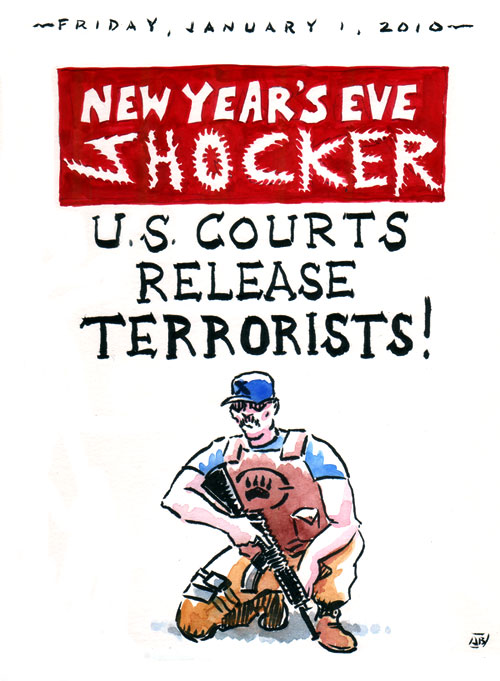
Cartoon by Nick Kim.

(Hint: Chill with the antibiotics)
Controlling MRSA, the Super Bug

By Ted McLaughlin / The Rag Blog / January 2, 2010

There is a very scary bacteria called Methicillin-resistant Staphylococcus aureus (MRSA). It is scary because the nasty Staph infection is resistant to virtually all the antibiotics that would be used to treat bacterial infections. Back in October of 2007, I wrote a post about MRSA being found here in Texas. In the slightly more than two years since that post, the incidence of MRSA has virtually exploded and is now found all over the world.

Whereas the percentage of Staph infections caused by MRSA used to be small (1% or 2%), it now makes up a majority of Staph infections in many countries. Here are some representative countries with the percentage of their Staph infections caused by the drug-resistant MRSA:

United States   63%
United Kingdom     45%
Greece 38%
Israel 44%
Japan 80%
Norway 1%

Please note the last country — Norway. That figure of only 1% is for real, and is the lowest percentage of MRSA-caused Staph infections in any country. How have the Norwegians been able to control the spread of MRSA and keep it to such a tiny percentage (and that tiny percentage is mostly made up of cases imported from other countries)?

Jan Hendrick-Binder, Oslo’s MRSA medical advisor, says, “It’s a very sad situation that in some places so many are dying from this, because we have shown here in Norway that Methicillin-resistant Staphylococcus aureus (MRSA) can be controlled, and with not too much effort. But you have to take it seriously, you have to give it attention, and you must not give up.”

How did they do it? Most notably by changing the way they use (or don’t misuse) antibiotics. Here in the United States, if you get a sniffle you’ll probably go to the doctor and ask for an antibiotic, and that doctor will most likely prescribe one for you. While it may help you get rid of that cold or minor infection, it also does a couple of other things. It will cause you to become resistant to that antibiotic eventually, and it will cause bacteria to mutate and become resistant to the antibiotic.

You won’t be prescribed that antibiotic for a minor infection in Norway. A doctor will refuse to prescribe it. Instead, they will tell you to take some over-the-counter drugs like aspirin or tylenol, cough syrup or antihistamines. These will help you to be more comfortable while your body fights off the infection (as the body can and will do most of the time). The antibiotics are saved for only the most serious infections, and because of this they work better when they are needed.

This is the Norwegian way of dealing with MRSA (which is reaching epidemic proportions in most other countries):

Norway’s model is surprisingly straightforward.

Norwegian doctors prescribe fewer antibiotics than any other country, so people do not have a chance to develop resistance to them.

Patients with MRSA are isolated and medical staff who test positive stay at home.

Doctors track each case of MRSA by its individual strain, interviewing patients about where they’ve been and who they’ve been with, testing anyone who has been in contact with them.

The truth is that any country could do what the Norwegians have done. But they must first stop misusing antibiotics. Antibiotics are truly miracle drugs, but we are destroying their effectiveness by abusing them — using them for infections that the body can easily fight off without their help.

Can we change the way we use antibiotics in the United States? I don’t know. I’m afraid that too many patients (and doctors) are locked-in to the wasteful and ultimately hurtful way we use the gift of antibiotics. I’m afraid most people would be very resistant to change. And after viewing the reaction of many to reforming health care reform, I doubt that many would be receptive to legislation to fix the problem.

We can expect Big Pharma to fight this change tooth-and-nail, because they are making tons of money off the misuse of antibiotics (if you’ve paid for a prescription of antibiotics recently, then you know that). Don’t think they will act in the best interest of patients. Like most huge corporations, their only concern is today’s profits — not the future problems this is going to cause for all of us.

We must begin a dialogue in this country — with an eye to changing the public’s (and the doctors’) perception of how antibiotics should be used. And this dialogue must happen now, because we are running out of time.

I do know one thing. If we don’t change this soon, it won’t be too far in the future before we’ll wish that we had.

[Rag Blog contributor Ted McLaughlin also posts at jobsanger.]

The Rag Blog

Posted in Rag Bloggers | Tagged , , | 1 Comment

MUSIC / Dynamic Compression : Yes, It Really is Too Loud!

Christopher Clark graphed the peak levels of and RMS levels of three hit songs a year over the past three decades. Here is a link to a PDF of his full poster, “A Visual History Of Loudness.”

The loudness wars:
Why music sounds worse

By Carrie Brownstein / January 2, 2010

As we have come to the end of the decade, we turn to one of the more dramatic changes we’ve heard in music over those 10 years: It seems to have gotten louder.

We’re talking about compression here, the dynamic compression that’s used a lot in popular music. There’s actually another kind of compression going on today — one that allows us to carry hundreds of songs in our iPods. More on that in a minute.

But first, host Robert Siegel talked to Bob Ludwig, a record mastering engineer. For more than 40 years, he’s been the final ear in the audio chain for albums running from Jimi Hendrix to Radiohead, from Tony Bennett to Kronos Quartet.

Bob pointed to a YouTube video titled The Loudness War. The video uses Paul McCartney’s 1989 song “Figure of Eight” as an example, comparing its original recording with what a modern engineer might do with it.

“It really no longer sounds like a snare drum with a very sharp attack,” Ludwig says. “It sounds more like somebody padding on a piece of leather or something like that,” Ludwig says. He’s referring to the practice of using compressors to squash the music, making the quiet parts louder and the loud parts a little quieter, so it jumps out of your radio or iPod.

Ludwig says the “Loudness War” came to a head last year with the release of Metallica’s album Death Magnetic.

“It came out simultaneously to the fans as [a version on] Guitar Hero and the final CD,” Ludwig says. “And the Guitar Hero doesn’t have all the digital domain compression that the CD had. So the fans were able to hear what it could have been before this compression.”

According to Ludwig, 10,000 or more fans signed an online petition to get the band to remix the record.

“That record is so loud that there is an outfit in Europe called ITU [International Telecommunication Union] that now has standardization measurements for long-term loudness,” he says. “And that Metallica record is one of the loudest records ever produced.”

Old news

“The ‘Loudness Wars’ have gone back to the days of 45s,” Ludwig says. “When I first got into the business and was doing a lot of vinyl disc cutting, one producer after another just wanted to have his 45 sound louder than the next guy’s so that when the program director at the Top 40 radio station was going through his stack of 45s to decide which two or three he was going to add that week, that the record would kind of jump out to the program director, aurally at least.”

That’s still a motivation for some producers. If their record jumps out of your iPod compared with the song that preceded it, then they’ve accomplished their goal.

Bob Ludwig thinks that’s an unfortunate development.

“People talk about downloads hurting record sales,” Ludwig says. “I and some other people would submit that another thing that is hurting record sales these days is the fact that they are so compressed that the ear just gets tired of it. When you’re through listening to a whole album of this highly compressed music, your ear is fatigued. You may have enjoyed the music but you don’t really feel like going back and listening to it again.”

Ludwig’s final assessment of the decade in music?

“It’s been really rough, folks,” he says. “But it can get better and I think it will get better. I’m glad it’s going to be over.”

Digital compression

Digital compression is the process that allows a song to go from being a very big sound file in its natural state to a very small file in your iPod — so you can carry your entire record library in your pocket. But at what cost?

Dr. Andrew Oxenham is a professor in the psychology department at the University of Minnesota. His specialty is auditory perception — how our brains and ears interact. He also started out as a recording engineer.

Robert Siegel asked him to explain digital compression.

“Really, the challenge is to maintain the quality of a CD, but to stuff it into a much smaller space,” Oxenham says. “Let’s think about how digital recording works. You start out with a very smooth sound wave and we’re trying to store that in digital form. So we’re really trying to reproduce a smooth curve [with] these square blocks, which are the digital numbers [the 1s and 0s that are used to encode sound digitally].

“Now, the only way you can make square blocks look like a smooth curve is by using very, very small blocks so it ends up looking as if it’s smooth. Now using lots and lots of blocks means lots of storage, so we end up using [fewer] bigger blocks. Which means we end up not representing that curve very smoothly at all.”

Lost? Go back and re-read it — you’ll get it.

“The difference between the smooth curve and the rough edges you end up with in the digital recording, you can think of as noise because that is perceived as noise,” Oxenham says. “It’s perceived as an error, something that wasn’t there in the original recording. The trick is to take the noise — which is the loss of fidelity — and just make it so you can’t hear it anymore.”

In hiding

It’s called “masking.” Think of it this way: You’re having a conversation in a quiet room, and you can hear every word, every mouth noise, every stomach rumble. But if you were having that same conversation outside on a busy street, you’d get the gist of what was said, but you’d probably miss a few words. The traffic noise would mask them.

So let’s say you’re listening to a Brahms symphony.

“[The loud parts of the music are] giving the coding system a lot of leeway to code things not quite as accurately as it would have to,” Oxenham says, “because the ear is being stimulated so much by the loud sound it won’t pick up very small variations produced by the coding errors.”

In other words, the loud parts of a recording are used to “mask,” or hide that noise produced by the rough-edged squares of those digital 1s and 0s.

But are we missing something?

“There are really different levels of MP3 coding,” Oxenham says. “You can go from much less data — which people can hear the difference — to higher levels of coding which take up more space on your MP3 player but sound better and are basically indistinguishable from a CD. And I would argue that under proper listening conditions — if it’s really indistinguishable from the CD as far as your ear is concerned — then you really haven’t lost anything perceptually.”

Oxenham likes the convenience of portable MP3 players. But ultimately, he says, he prefers going to concerts.

Source / National Public Radio

The Rag Blog

Posted in RagBlog | Tagged , , , | 2 Comments

Harvey Wasserman : A Blue-Mooning, Baby-Booming New Year

The second full moon in a single month is commonly known as a ‘blue moon,’ and that’s what we saw on New Year’s Eve.Photo by Vatsyayana / Getty.

Our blue-mooned, baby-boomed 64th birthday baptism…

When we believed ourselves immortal, as all young people do, there was nothing we could not do. Now we count the victories, and assess what we might win in the time left us.

By Harvey Wasserman / The Rag Blog / January 2, 2010

‘Will you still need me? Will you still feed me…?’ — The Beatles

The moment has come. The first Baby Boomer cohort has turned 64.

It officially happened on midnight December 31-January 1, 2009-10.

I celebrated the moment seven hours and 24 minutes early by jumping into a tiny cove in the Florida Bay.

The chilly but exhilarating water demanded an answer: Will we green the Earth? Will we win social justice? Will we get to Solartopia?

Unlike so many of you reading this, I am not a Boomer. The demographic officially extends from January 1, 1946 to December 31, 1964. It is a giant elephant of a population explosion swallowed by a decades-long python of a population decline.

The soldiers coming back from World War II multiplied like rabbits. The Boom was worldwide. In the U.S. it birthed some 76 million children.

My dad was a submarine welder in Boston’s shipyards, so I came early: at 4:36 p.m., December 31, 1945. Thus the leap into the Bay, which is in desperate need of protection from the ravages of agricultural monsters who are destroying the Everglades on which this fragile but irreplaceable eco-system depends for a clean, steady flow of water.

Those of us who took that astonishing tour through the 1960s have to think of ourselves as “forever young.”

But 64 is a big number. It means many of us have lost one or both of our parents, or are taking care of them as they become increasingly infirm.

It also means WE are meeting such ailments. “Parts wear out,” my mother said.

And we’re “at that age” when we lose friends and lovers, spouses and siblings, and sometimes, worst of all, even children.

“Learning experience” can never fully cover the losses of loved ones. But they do remind us our own days are numbered.

When we believed ourselves immortal, as all young people do, there was nothing we could not do.

Now we count the victories, and assess what we might win in the time left us.

In our lifetimes, undeniable strides have been made in civil rights — for African-Americans and, in tandem, for women, for GLBT and for other national and ethnic minorities, as well as for those with special challenges.

Social justice is another story. Since the end of the New Frontier/Great Society, with the horror of the Vietnam War, income disparities have worsened. Those social programs did work. Now the gap between rich and poor, a downfall of all great nations, is escalating, with no end in sight. We have long had the means to end poverty and hunger, and have chosen simply not to do it.

The root of that choice is war. The Vietnam assault was the biggest blunder of our lifetime. Everything is worse because of it, from homelessness and poverty to the decline of our educational and health systems. That successive Boomer presidents have chosen to repeat the error in Iraq and Afghanistan is beyond tragic.

Likewise the environment. The green movement has many roots. But the fight against nuclear power was the first to put thousands of Americans onto the streets and into the jail cells, and must be ready to do so again. Talk of reviving this failed technology is beyond lunatic.

Above all, in our lifetime, the globalized corporation has metastasized into the most powerful institution in human history. A cancerous beast that has usurped human rights without human responsibilities, the trans-planetary corporation is now beyond the reach of the nation-state. Only a global green movement, tied through the internet and whatever else we can contrive, can overcome the sinister power of these interlinked financial machines, whose only goal is profit.

To fight back, we need a vision, a Solartopian greenprint.

We need to attack the corporation at its root, in its legal charter and wherever we can find a foothold.

To kill the cancer, we must eliminate waste and its worst expression, war, the ultimate breeding ground of illegitimate power.

Only with peace can we win a true democracy, based on social justice. All humans have the right to food, shelter, clothing, medicine, educatio, and dignity. In tandem must come the paper ballot, hand counted, with universal automatic voter registration.

Our food needs to be organically raised, with sustainable agricultural practices.

The question of how many humans our planet can sustain will be answered with the empowerment of women. With equal access to education, employment and reproductive rights, the mothers of our species will bring us a sustainable number of children.

As that happens we can eliminate fossil and nuclear fuels, replacing them with the Solartopian technologies that really work, including solar, wind, sustainable biofuels, geothermal, ocean thermal, tidal, wave, current and other forms of renewables not yet conceived. In a maximally efficient world, with revived mass transit, the green transition we must win to survive does become doable.

So this Blue-Mooned New Year’s Eve, with my growing-up-all-too-fast daughter on my back, we jumped into the Barley Basin to commemorate that moment 64 years ago when my saintly mother gave her final push to get me into this world. The demographic deluge would boom in less than eight hours.

With Bonnie Raitt’s “Nick of Time” running through our brains, the equation simplified:

“With justice comes peace… with peace comes freedom… with freedom, all is possible… even Solartopia.”

That should keep us busy for a while, yes?

The next blue mooned New Year’s Eve is scheduled for 2028. See you then… on a green-powered Earth.

[Harvey Wasserman’s Solartopia! Our Green-Powered Earth is at www.harveywasserman.com, along with A Glipmse of the Big Light: Losing Parents, Finding Spirit, and Harvey Wasserman’s History of the United States]

The Rag Blog

Posted in Rag Bloggers | Tagged , , , , , , , , , | 2 Comments

Bill Ayers and Bernardine Dohrn : Gaza Freedom Marchers Clubbed by Cairo Cops

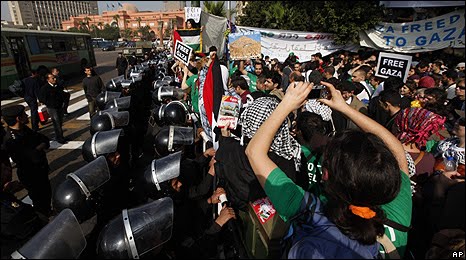
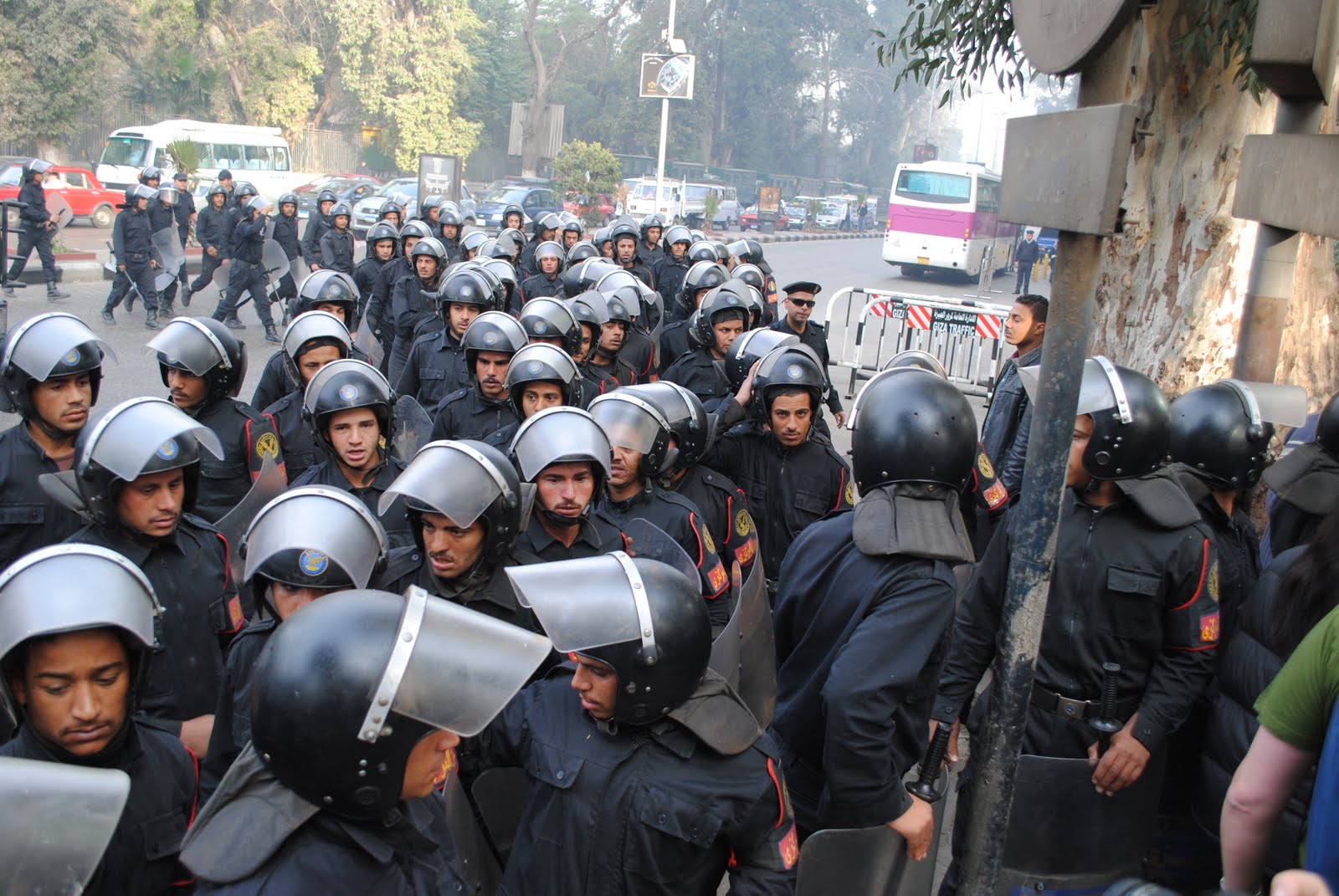
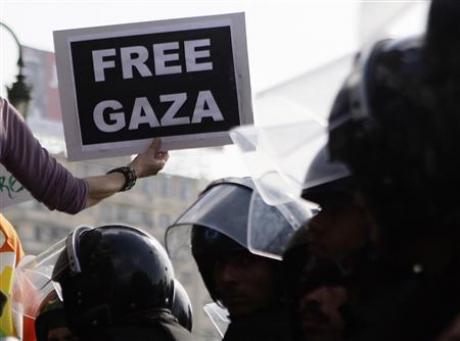
Cairo riot police confront Gaza Freedom March. Top photo from AP. Bottom photo by Brandon Delyzer from rabble.ca.

Gaza Freedom March:
Lively demonstration at the Egyptian Museum

By Bill Ayers and Bernardine Dohrn / The Rag Blog / January 1, 2010

Also see ‘Egyptian security forces attack Gaza protesters,’ by Max Ajl, Below.

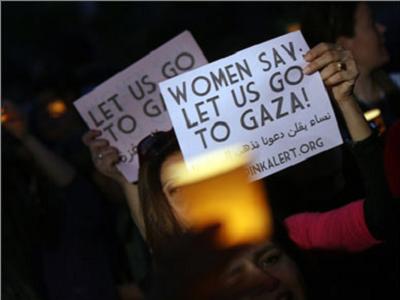
CAIRO — In Cairo yesterday, a spirited, highly visible and noisy demonstration held sway at a central traffic point — the Nile Corniche — across from the Egyptian Museum for seven hours, affixing huge banners in Arabic and English to trees and fences. In Gaza, a peace march took place including the 80 GFM participants who were able to enter the blockaded and occupied part of Palestine.

More than 500 people converged in small groups at the museum at 10 a.m. to press for freedom for Gaza and Palestine. Police blockaded the small hotels where marchers were staying, preventing dozens of people from leaving for several hours, and harshly attempted to contain the demonstration.

As the groups came together in the street, numerous marchers were clubbed to the ground, kicked and thrown into the center of Tahrir Square where police barricades and circles of Egyptian security quickly closed in. Those covering the action, observers, and members of the legal team, were seized by security police and pushed into the square.

Medical team personnel treated gashes, lacerations, broken noses, and bruised ribs. As has been true all week, Egyptian citizens who joined in or manifested support were treated most severely or were taken away.

The day before, the French GFM delegation had gone to the pyramids; someone faked an illness and while security forces moved in to respond, they unfurled a giant Palestinian flag across the pyramid. From that photo, they made an enormous color streamer, stamped with GAZA, now rippling in the square. The endless stream of Cairo traffic (23 million people living in this city), buses, taxis, cars and crowds, heard and saw the protest.

At 11:30 pm, under a full moon, we participated in a candlelight vigil in Tahrir Square where we danced and sang in the New Year.

Five days of rallies, actions, frustration and setback: the GFM wanted to enter Gaza 1,400 strong to express solidarity with civil society, witness their struggle for survival and self-determination, and join in a massive peace march. Instead, we found ourselves in Cairo for the week, a determined group from 42 countries trying mightily to realize our original goal in different circumstances.

In the end, we found unity among differences, common ground, and new alliances. There was a gallant effort to make a way out of no way, to keep focused on Gaza and the needs and desires of the Palestinian people, and to press forward to a more robust international peace and justice movement. If there was a silver lining here, perhaps this was it.

Egyptian security forces
Attack Gaza protesters and blockade hotels

By Max Ajl / December 31, 2010

CAIRO — Egyptian security forces were attacking protesters in Tahrir Square, at the core of downtown Cairo, after they sat down in the middle of a busy Cairo street, protesting the imprisonment of the people of Gaza. Others were literally barricaded inside their hotel, the entrance surrounded by steel riot barriers. Egyptian security forces refuse to allow them to leave. Green personnel carriers line the streets. It is pandemonium.

The protesters are part of the Gaza Freedom March, a group of 1,400 delegates from 42 countries, including France, the United States, the Philippines, Italy, Germany, Sweden, Brazil, Australia and Japan. They converged on Cairo intending to march with Gazan civil society in a massive show of nonviolent resistance against the blockade, which 16 international NGO’s and charities condemned in a report released December 22 as “preventing reconstruction and recovery” in the Gaza Strip and which the United Nations Development Program has criticized as contributing to Gaza’s “de-development.”

But Egypt refused them entry into Gaza, just days before most of the marchers were to arrive in Cairo. Since then, the marchers have convoked a series of vigils, demonstrations and marches, accompanied by song, chants and bright banners. The Egyptian state has responded with repression, putting groups of riot police around marchers, harassing hunger strikers, canceling permits, detaining marchers and threatening them with water cannons, arrest and deportation.

Two days ago, Egypt attempted to placate the marchers by offering the organizers permission for a token 100 marchers to enter Gaza. Initially, a segment of the steering committee accepted the offer.

But after many of the core delegations refused to submit to tokenism, including the French EuroPalestine group, which has spent nearly a week sleeping in tents in front of their embassy, and the South African contingent, with leadership strengthened in the crucible of the anti-apartheid struggle, a fuller, more representative segment of the steering committee rejected the offer in deliberations that lasted until dawn, and attempted to prevent the buses from leaving.

Two young Palestinian-American sisters, Dana and Lara Elbrno, their father from Gaza, were among those who refused to go. They said they could not accept the offer and were unwilling to accept the terms the Egyptian government had imposed: the buses allowed into Gaza under the auspices of CodePink and not the Gaza Freedom March, their purpose framed explicitly as a humanitarian convoy and not a political symbol — ultimately, they said, the conversion of a political statement against the siege into charity.

Others, selected among the 100, refused the offer too. Palestinian author Ali Abunimah and Filipino politician and writer Walden Bello of the Akbayan Party disembarked when they heard that the Gaza Freedom March’s core partners in Palestinian civil society, including Haidar Eid, a literature professor at Al-Aqsa University and Omar Barghouthi, the founder of the Boycott, Divestment, and Sanctions campaign, also spurned the offer, claiming it was divisive, and so, “we deeply feel, terrible for the solidarity movement.”

The GFM steering committee in Gaza reportedly abstained from receiving those who boarded the buses in Cairo. The real Gaza Freedom March remains “stalled in Cairo,” says march communications coordinator Ziyaad Lunat.

Or surrounded. A huge group of internationals attempted to march in the direction of Gaza from Tahrir Square. The marchers, hundreds of them, came to the streets from cafes, hookah bars, the KFCs and Hardees that sit on the sidewalks surrounding the square, swarming in from points all around, stopping traffic on the circular ring road around the center of the square. Then they collided with Egyptian riot police.

They sat down, blocking several lanes of traffic for 45 minutes. Retaliation was violent. The plainclothes police picked the protesters up, one by one, pulling them by the hair, roughly throwing them around, until they had them cloistered on a corner, and then closed the museum and the metro. They broke cameras and video cards, and left one delegate with several fractured ribs.

Several were hit, some left bloodied and bruised. One, Suleika Jaouad, a student at Princeton University, was punched in the face. As she says, “I was witness to bloody, indiscriminate violence.” She was on the periphery of the protest and says she was “assaulted just for being there and attempting to film the police brutality – evidence that they clearly did not want to be documented.”

Things got much quieter when the protesters were no longer blocking traffic. They quickly set up an encampment. Conscripted riot police, in visored black helmets, stood around them, blocking sight of anything except for the multi-colored banner hanging from the tree around which they were clustered. Gael Murphy, one of the organizers of the march, says that the protesters “renamed Tahrir Square Free Gaza Square” and sang songs, played the accordion and waved banners reading “those who stand up for human rights will never be wrong.”

There were many chants of “Free Gaza.” Marchers were jumping up and down, practically screaming. One attendee, Max Geller of Brookline, Massachusetts, said, “It’s at a fever pitch, it looks like a rock concert.” The excitement level was alpine. Bill Ayers added, “We shine a light on a dark spot in Gaza,” in the process offering “solidarity with the people of Gaza, letting them know that they’re not alone.”

While the protesters were alternately sitting down and being slammed around in Tahrir Square, others were trapped inside their hotels. Egyptian security forces had preemptively barricaded many of them, in a desperate bid to prevent them from joining today’s protests.

One march participant, Desiree Fairoz, after speaking to the police from outside, attempting to convince them to remove the barriers, “was lifted by the Egyptian police forces and literally tossed over the fence.”

Nonetheless, over 300 internationals made it to the protest, in a show of solidarity with Gaza’s inhabitants and Palestinian society that has riveted the world’s attention on Gaza, and made front-page news in the Egyptian press. Despite not getting to Gaza, it was unprecedented. As one South African marcher commented, “The Gaza Freedom March got 1,400 people to Cairo to march in solidarity with the Palestinian people. That’s amazing.”

Source / truthout

The Rag Blog

Posted in Rag Bloggers | Tagged , , , , , , , , , | 5 Comments

New York : Marching for the Children of Gaza

Thousands marched in New York on Dec. 27, 2009, in support of the people of Gaza. Photo by Bud Korotzer / NLN.

Marching for the children of Gaza:
Thousands demonstrate in New York City

By Fran Korotzer / The Rag Blog / January 1, 2010

NEW YORK — On December 27, the first anniversary of Israel’s brutal attack on Gaza that left 1,400 dead (mostly civilians), thousands wounded, and hundreds of thousands homeless, 2,000 people met in New York’s Times Square.

The throng marched through streets filled with New Yorkers and tourists in holiday mode, passed crowded Rockefeller Center, and ended at the Israeli Consulate at 42nd Street and 2nd Avenue. Participants represented all ages and all racial and ethnic groups. The march was timed to coincide with marches in solidarity with the people of Gaza that are taking place all over the world.

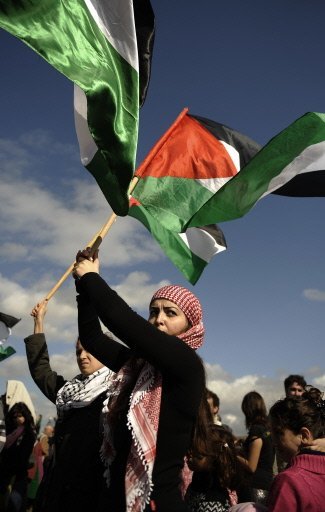
As the marchers moved through the streets they carried signs and Palestinian flags and chanted, “Israel, Israel, you can’t hide. We charge you with genocide.” Or, “Gaza, Gaza, don’t you cry. Palestine will never die.” Many wore buttons supporting the Palestinian liberation struggle. One woman had “Resistance is not Terrorism” printed on the back of her jacket.

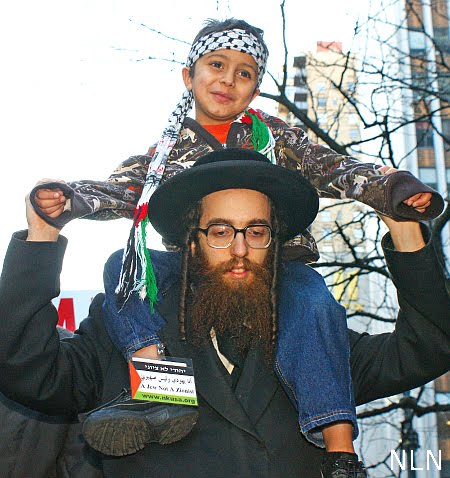
A large group of orthodox Jews who oppose the Israeli state marched too. Seeing them, some Jewish people in the streets cursed them and spit at them. They appeared to take it in stride.

At one point a call came in from Kevin Ovington, one of the leaders of the Viva Palestina convoy which was in Jordan with 500 people from 17 countries, and 250 trucks loaded with humanitarian aid for the people of Gaza. Egypt was not allowing them to pass through to Gaza so a hunger strike had begun. He said that they were “determined to enter Gaza and break the siege.” He said, “One day we will all be together in a free Palestine.” The marchers were asked to call the Egyptian Embassy and urge them to allow the Freedom Marchers and humanitarian aid to pass into Gaza.

Outside the Israeli Consulate in New York, the marchers demanded an end to the blockade which protesters argue is a violation of international law.

[Fran Korotzer is an independent journalist and a contributor to Next Left Notes, where this article also appears.]

The Rag Blog

Posted in Rag Bloggers | Tagged , , , , , , | 1 Comment

Rush Limbaugh : Get Well, Class Clown

Rush Limbaugh. From “Republican Clowns” / Daniel Kurtzman / Ask.com.

Sick, sick, sick…
Rush Limbaugh, Class Clown

By Carl R. Hultberg / The Rag Blog / December 31, 2009

There’s one in every classroom. Competing with the teacher for attention, cracking jokes, disrupting the course of study. It doesn’t matter if few other students laugh along with him, a couple will do.

Later they meet in the recreation yard to idolize their rebel leader. This is the guy who will save them from having to read books and consider other people’s points of view, save them from being educated, indoctrinated into the modern adult order. Later, this is the kid who will hopefully give them a job, even though they never got a diploma, when he inherits his father’s auto dealership.

Who do you want to be like, the cool fat kid who mouths off in class or the poor hysterical obviously underpaid teacher? Disrespect can definitely work to make you respectable in the USA. Anti-intellectualism is still very often the smart way to go. We got this far being wrong, who’s going to stop us now?

That’s why so many people worship the ground Rush Limbaugh tramples on.

Rush to judgment (off the radio).

Rush to the hospital. In Hawaii, one of only two states in the Union to have fully socialized medicine. But that’s alright folks, Rushie’s rich and he has made sure to tell everyone that he is self-insured and paying his own way. Being rich will also protect him from having his insurance cancelled for having a problem with a “pre-existing condition.”

Just a few days ago he was castigating Obama for being in Hawaii, possibly not even really part of the USA. (That’s a fallback position in case it turns out BO was actually born there.) But that’s also okay, because Class Clown thrives on being able to drive inconsistencies home by force of his personality. Being wrong and still always sounding right is the best act he’s (we’ve) got. In America, relentless self confidence in the face of adversity/reality is the mechanism that has so far never failed to unlock the gold rush.

After the Gold Rush?

Word has it that Limbaugh’s words were halting and slurred when he called in to his guest-hosted radio show yesterday. Perhaps the man has had a stroke. Obesity, hard drug use and a generally apoplectic personality will eventually add up, even with the best of them.

Although he would never do the same himself for any of us, we would like to join the other members of the liberal blogosphere to wish Rush Limbaugh a speedy recovery.

Free speech is what we should all respect the most. In the world of words, being wrong is far better than being silent or being suppressed. If we are busy hiding lies we may just as soon be hiding the truth.

Class Clown should always have a place in our education system. Let the teachers stop the class to reason it out with the young person. Create a debate. Perhaps the heckler is right. (I sure thought I was. Still do.)

If we learn to take our time in the field of education we might not have so many “children left behind.” People with obvious intelligence but also an eternal ax to grind.

Why Rush?

The Rag Blog

Posted in Rag Bloggers | Tagged , , , , , , , , | 1 Comment

Bernardine Dohrn : Gaza Freedom March: Reimagining Change

UPDATE: See ‘Gaza Freedom march converges on Midan Tahrir,’ Below.
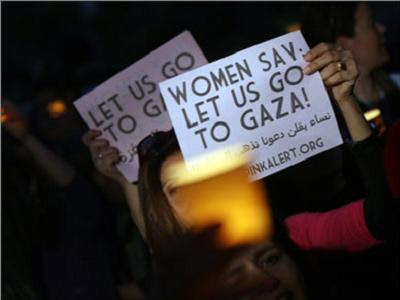
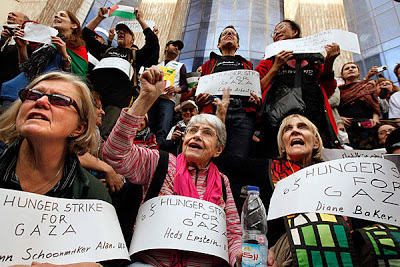
Above, photo from Palestine Chronicle / Aljazeera. Below, holocaust survivor Hedy Epstein, center, and Gaza Freedom March activists in Cairo Tuesday. Photo by Amr Nabil / AP / Christian Science Monitor.

A Movement reimagining change:
Freedom marchers head for Gaza

By Bernardine Dohrn / The Rag Blog / December 31, 2009

More on the Gaza Freedom March, Below.

CAIRO — It has been a tumultuous 15 hours. Two buses, carrying 100 people from the GFM and loads of humanitarian supplies, just departed from Cairo for Gaza. This was a victory and a concession. The decisions and the manner in which this opportunity was framed and promoted by various actors fractured the GFM participants in familiar and unlikely, real and sectarian ways — all documented by media cameras and hundreds of Egyptian security forces.

Ali Abunimah, Veterans for Peace organizers, Israeli journalist Amira Hess, and this writer were among the 100 people on the list to go, who arrived at 6:30 this morning, on the corner of Ramsis by the 6th October Bridge at the Al Gona Bridge, to depart for Gaza.

Tuesday morning, delegates from several countries went to their embassies in Cairo to plead for help getting to Gaza. Most were met with predictable bureaucratic intransigence. The French, however, staged an extraordinary encampment in front of their embassy and their ambassador and his wife came out and spent time speaking with them individually and in small groups.

That action continues today. Bill [Ayers] and I went to the American Embassy at 10 a.m. and asked to see the Ambassador. We were ushered into a holding pen a block away from the embassy building where we joined 35 people already there, surrounded by Egyptian soldiers. Over the next four hours, another dozen Americans arrived, and those of us who asked to leave were denied.

Meanwhile, Medea Benjamin, Kit Kiteredge, and Ali Abunimah were meeting with an embassy official and stressing that we intended to go to Gaza on a nonviolent, humanitarian mission, and requesting their assistance. Further, they asked that the embassy officials release the U.S. citizens who were now clearly being detained outside.

Ali emerged first to tell us that their discussion achieved nothing, and they were now requesting that we be free to go. This process took another hour. Ali refused to enter the holding cage, and spoke to us from outside. At one point, out of nowhere, military personnel grabbed Ali, and Medea — who was standing a few feet away — sprang to action, shouting “No! No!” and grabbing Ali’s arm and pulling him down to the ground with her. As soon as they were prone, the security backed off. It was an impressive display of nonviolent direct action and solidarity in-the-moment, performed with speed, force and clarity.

In late afternoon, a huge demonstration took place outside the Syndicate of Journalists, a traditional site of political mobilizations in downtown Cairo. The GFM was a force, and joined by large numbers of Egyptian citizens chanting in solidarity with Palestine and in opposition to the visit that day by Netanyahu. This action got widespread coverage throughout the Arab world.

Late last night, it was announced at the nightly team leaders’ meeting that our three days of actions across Cairo, the international pressure around the world, and consistent efforts by CodePink leadership to meet with high level Egyptian officials — including a meeting yesterday at the offices of Suzanne Mubarak — resulted in an agreement with the Egyptian government that two buses could leave for the Rafah crossing into Gaza early Wednesday.

The names of the 100, however, had to be submitted to Egyptian officials by Tuesday evening. This resulted in a (necessarily) rushed process, without the opportunity for full debate, discussion, and input about criteria for selection, or about the strategic goals of sending a smaller, incomplete team of people to enter Gaza and participate in the New Year’s freedom march with the people there. By mid-evening, whole delegations (South Africa, New York) announced that they would not participate. In part, they critiqued the process of decision-making; in part, they took the position, “all of us or none.”

As we stood in the morning chill of the stunningly polluted Cairo sky, those boarding the buses felt that it was a partial victory to have two busloads depart for Gaza, that we would take supplies, and witness the realities of life under the occupation/blockade. We thought that our primary objective was to break the isolation of Gaza, and to join with the civil society forces there who wanted us to come join them. The GFM forces opposed to the compromise that left 1,300 of the GFM still in Cairo, gathered at the departure point and began painting banners and chanting against the departure of the buses. Egyptian security grew.

We boarded the buses, loaded supplies, handed over our passports and sat on the buses, excited and exhausted, watching the opposition to our departure gather steam. Signs were hoisted, some began shouting and crying, and chants to Don’t Go, Get off the Bus, and All of Us or None grew in force. Many, unhappy to have worked so hard to get here and who built critical support for Palestinian solidarity and human rights, felt that it was unfair to be left behind, and not to have been consulted. People wavered.

Resentment and criticism of leadership (legitimate and small-minded) and the obvious manipulation of the situation by the Egyptian (and Israeli and U.S.) governments escalated. Al Jazeera ran a story quoting the Egyptian Prime Minister who proclaimed that only the reliable and respectable people had been selected to travel to Gaza (!), leaving behind the rabble rousers and unruly GFM marchers, and claiming credit for delivering the humanitarian supplies to the people of Gaza.

It was clear to us in the hours of debate and delay that some would leave for Gaza, and that others would stay in Cairo to press the demand that the border be opened, the blockade ended, and that all of the GFM participants be allowed to enter Gaza. One of the great difficulties throughout these several days has been to keep ourselves and all participants focused on Gaza.

We find ourselves unwillingly in Cairo, drawn into clashes with authorities and one another on side issues, when what we most want it to keep our eyes on the Palestinian people and our spirits with those confined in Gaza. This is the challenge of the next three days. A large group of us is planning to try to walk to Gaza starting tomorrow, December 31. Buses and taxis containing smaller groups have been turned back all week, and the situation remains fluid, dynamic, and fraught.
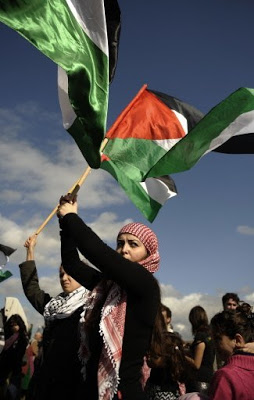
The activists who entered Gaza were joined by a few hundred Palestinians as they marched to the Erez crossing. Photo from AFP.

Protesting the siege:
International contingent marching to Gaza

CAIRO — Following Egypt’s refusal to allow the Gaza Freedom Marchers to enter Gaza, the more than 1,300 peace-and-justice activists are setting out on foot. Despite police blockades set up throughout downtown Cairo in an attempt to pen the protesters in and prevent them from demonstrating in solidarity with Palestinians, the internationals are unfurling their banners and calling on supporters of peace around the world to join them to demand the end of the siege of Gaza.

Egypt’s offer to allow 100 of the 1,400 marchers to enter Gaza was denounced as insufficient and deliberately divisive by the organizers. Meanwhile, the Egyptian Minister of Foreign Affairs has sought to spin this last-minute offer as an act of goodwill for Palestinians and isolation of “troublemakers.” The Gaza Freedom March categorically rejects these assertions. Activists are in Cairo because they are being prevented by the Egyptian government from reaching Gaza. “We do not wish to be here, Gaza has always been our final destination”, said Max Ajl one of the marchers.

Some individuals managed to overcome the police barricades and began the march at the meeting point in Tahreer Square in downtown Cairo. They were joined by Egyptians who also wished to denounce the role of their government in sustaining the Gaza siege. The authorities have sought to separate international from the locals. The police is brutally attacking the nonviolent marchers.

Many plainclothes police officers have infiltrated the crowds and are violently assaulting them. “I was lifted by the Egyptian police forces and literally tossed over the fence,” said Desiree Fairooz, one of the protesters. Marchers are chanting and resisting the attempt to disperse them, vowing to remain in the square until they are allowed to go to Gaza. The GFM banner is hanging up high in a tree in the square. Some marchers are bleeding and riot police destroyed their cameras.

The Gaza Freedom March represents people from 43 countries with a diversity of backgrounds. They include peoples of all faiths, community leaders, peace activists, doctors, artists, students, politicians, authors and many others. They share a commitment to nonviolence and a determination to break the siege of Gaza.

“Egypt has tried every way possible to isolate us and to crush our spirit,” the march organizers say. “However, we remain as committed as ever to standing up against tyranny and repression. We will march as far as we can towards Gaza, and if we are stopped by force, we will hold our ground in protest. We call on those committed to justice and peace everywhere to support our stand for freedom for Palestinians.”

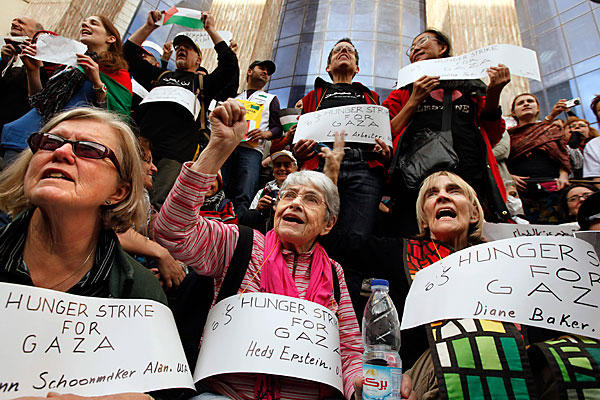
Among the participants are Pulitzer Prize winning author Alice Walker, Filipino Parliament member Walden Bello and former European Parliamentarian Luisa Morgantini from Italy. More than 20 of the marchers, including 85-year-old Holocaust survivor Hedy Epstein, have launched a hunger strike against the Egyptian crack-down and are now entering their fourth day.

Source / Gaza Freedom March!
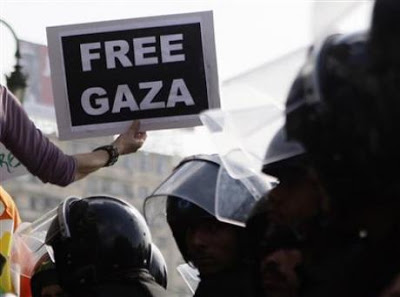
Photo from Reuters.

Endorse the Gaza Freedom March!

Israel’s blockade of Gaza is a flagrant violation of international law that has led to mass suffering. The U.S., the European Union, and the rest of the international community are complicit.

The law is clear. The conscience of humankind is shocked. Yet, the siege of Gaza continues. It is time for us to take action! On Dec. 31, we will end the year by marching alongside the Palestinian people of Gaza in a non-violent demonstration that breaches the illegal blockade.

Our purpose in this March is lifting the siege on Gaza. We demand that Israel end the blockade. We also call upon Egypt to open Gaza’s Rafah border. Palestinians must have freedom to travel for study, work, and much-needed medical treatment and to receive visitors from abroad.

As an international coalition we are not in a position to advocate a specific political solution to this conflict. Yet our faith in our common humanity leads us to call on all parties to respect and uphold international law and fundamental human rights to bring an end to the Israeli military occupation of Palestinian territories since 1967 and pursue a just and lasting peace.

The march can only succeed if it arouses the conscience of humanity.

Statement of Context

Amnesty International has called the Gaza blockade a “form of collective punishment of the entire population of Gaza, a flagrant violation of Israel’s obligations under the Fourth Geneva Convention.” Human Rights Watch has called the blockade a “serious violation of international law.” The United Nations Special Rapporteur for Human Rights in the occupied Palestinian territory, Richard Falk, condemned Israel’s siege of Gaza as amounting to a “crime against humanity.”

Former U.S. president Jimmy Carter has said the Palestinian people trapped in Gaza are being treated “like animals,” and has called for “ending of the siege of Gaza” that is depriving “one and a half million people of the necessities of life.”

One of the world’s leading authorities on Gaza, Sara Roy of Harvard University, has said that the consequence of the siege “is undeniably one of mass suffering, created largely by Israel, but with the active complicity of the international community, especially the U.S. and European Union.”

The law is clear. The conscience of humankind is shocked.

[….]

Sources of Inspiration

The Gaza Freedom March is inspired by decades of nonviolent Palestinian resistance from the mass popular uprising of the first Intifada to the West Bank villagers currently resisting the land grab of Israel’s annexationist wall.

It draws inspiration from the Gazans themselves, who formed a human chain from Rafah to Erez, tore down the border barrier separating Gaza from Egypt, and marched to the six checkpoints separating the occupied Gaza Strip from Israel.

The Freedom March also draws inspiration from the international volunteers who have stood by Palestinian farmers harvesting their crops, from the crews on the vessels who have challenged the Gaza blockade by sea, and from the drivers of the convoys who have delivered humanitarian aid to Gaza.

And it is inspired by Nelson Mandela who said: “I have walked that long road to freedom. I have tried not to falter; I have made missteps along the way. But I have discovered the secret that after climbing a great hill, one only finds that there are many more hills to climb. … I dare not linger, for my long walk is not ended.”

It heeds the words of Mahatma Gandhi, who called his movement Satyagraha-Hold on to the truth, and holds to the truth that Israel’s siege of Gaza is illegal and inhuman.

Gandhi said that the purpose of nonviolent action is to “quicken” the conscience of humankind. Through the Freedom March, humankind will not just deplore Israeli brutality but take action to stop it.

Palestinian civil society has followed in the footsteps of Mandela and Gandhi. Just as those two leaders called on international civil society to boycott the goods and institutions of their oppressors, Palestinian associations, trade unions, and mass movements have since 2005 been calling on all people of conscience to support a non-violent campaign of boycott, divestment and sanctions until Israel fully complies with its obligations under international law.

The Freedom March also draws inspiration from the civil rights movement in the United States.

If Israel devalues Palestinian life then internationals must both interpose their bodies to shield Palestinians from Israeli brutality and bear personal witness to the inhumanity that Palestinians daily confront.

If Israel defies international law then people of conscience must send non-violent marshals from around the world to enforce the law of the international community in Gaza. The International Coalition to End the Illegal Siege of Gaza will dispatch contingents from around the world to Gaza to mark the anniversary of Israel’s bloody 22-day assault on Gaza in December 2008 – January 2009.

The Freedom March takes no sides in internal Palestinian politics. It sides only with international law and the primacy of human rights.

The March is yet another link in the chain of non-violent resistance to Israel’s flagrant disregard of international law.

Citizens of the world are called upon to join ranks with Palestinians in the January 1st March to lift the inhumane siege of Gaza.

Please join us.

Go here to learn more and to sign the pledge.

UPDATE:
Gaza Freedom march converges on Midan Tahrir

By Joshua Brollier / December 31, 2009

CAIRO — Today at 10 a.m., the Gaza Freedom march converged on Midan Tahrir, or Liberation Square in English. This was no easy task for the marchers. We left in small groups to avoid being followed by police who were monitoring our hotels. Several of the larger hotels were monitored more closely, and the Lotus Hotel was completely barricaded, making it impossible for most of the Marchers to leave.

Many marchers, maybe three to four hundred, did make it to the square and a delegation of women gave the signal to converge by waving large flags. We moved into the streets with the intention to occupy a major thoroughfare and march towards Gaza.

Egyptian police and riot cops fanned out of alleyways and side streets as quickly as we came together. The police then attempted to push us out of the street and into the square. As planned, we continued to try to march, but things quickly came to a head. Most of the marchers decided to sit down and lock arms.

The Egyptian cops swiftly became violent and began grabbing, beating, and pulling marchers who did not leave the street. I was kicked in the side and back, punched in the head and slapped in the face. My glasses were broken and one plainclothes officer pulled violently on my hair for what seemed like nearly a minute.

I managed to hold on to one of my comrades,and we held the space in the street for a while longer. Many of the police in uniform were trying to avoid violence, but a handful of plain clothes officers were taking pot shots at the crowd of peaceful and non-violent protesters. Eventually the police succeeded in moving the marchers to the sidewalk where we were barricaded and surrounded by several rows of cops.

I emerged alright from the incident, but several others were not so fortunate. One young man had his shoulder dislocated and others were close to passing out from the trauma of the encounter.

Though we were removed from the square, beaten and prohibited from marching, our spirits were quickly rekindled through the solidarity born out of the struggle and by remembering the much worse hardships that Palestinians often face when they attempt to hold peaceful demonstrations; it is not uncommon for Israeli troops to fire on crowds of Palestinians with rubber and real bullets merely for assembling.

It is difficult to imagine the horror of being trapped in Gaza and having to endure an onslaught like the one that occurred last January. We held a moment of complete silence as we honored those who had died. Not even a cop made a noise.

So we chanted, we marched, we danced, drummed and sang, as we were together in Midan Tahrir. We may not have liberated the Gazan border, but my spirit certainly felt liberated for standing and sitting in solidarity with the Palestinians. We held the space for approximately six hours.

We were a truly international group, and it was inspiring to hear about the different facets of the movement across the world. Many people’s commitments to resisting injustice were renewed; some talked of a Cairo Declaration to unite the worldwide struggle for Palestinian freedom.

After holding a consensus meeting among the different delegations, we decided to disperse and regroup for another action later tonight. What a way to hold a New Year’s celebration; taking action with some of the finest people I’ve ever encountered! It may be held at the French Embassy since many from the French delegation that were encamped at their embassy were prevented by the police from entering the square.

I heard that the group of 85 delegates that headed to Rafah with humanitarian aid did make it into Gaza and have marched there with 6,000 Palestinians to the Israeli border. When reaching the border, the internationals,when within 500 meters of the border,sat down while holding a press conference. I hope to find more details on the scene in Gaza soon.

I’m wishing a happy New Year to all, worldwide! I hope this year to be a year of liberation. May we have liberation in our own hearts, in our relationships, in all of our various countries and especially, liberation to the Palestinians in Gaza and the West Bank.

[Joshua Brollier is a Chicago peace activist who co-coordinates Voices for Creative Nonviolence.]

Source / Voices for Creative Nonviolence

The Rag Blog

Posted in Rag Bloggers | Tagged , , , , , , | 1 Comment

Fear in 2009: Year of the Bullet

“Playing with Guns.” Photo from Mikesjournal.

The fear stimulus:
Year of the Bullet 2009

For every claim that the Obama landslide transformed American culture in 2009 we have ‘bullet points’ that document a grassroots prairie fire of gut fear…

By Greg Moses / The Rag Blog / December 31, 2009

As one hand of history played high keys of hope and change during the inaugural days of 2009, the other hand was reaching for more ominous sound. Across the keyboard of our national concerto, some chimed celebration, others hoarded bullets.

Reporter Harry Pierson Curtis of the Orlando Sentinel wrote about the 2009 stampede for small arms and ammo in early February: “Most in demand is handgun ammunition, including 9 mm and .45-caliber for semiautomatic pistols and .38-caliber for revolvers.” Customers, retailers, manufacturers, and interest groups all had something to say. The usual American demand for 7 billion rounds of ammo per year (23 bullets per capita?) was fixin’ to head North.

“The Ammo Boom is No Dud,” declared ESPNOutdoors.com in late March. Special contributor Colin Moore attributed the “irrational” hoarding frenzy to a “fear factor” caused by the Democratic Party landslide. Handgun owners, especially, were worried that their ammo would soon be taxed into extinction. One Winchester bullet factory was said to be working 24/7 to meet the hyped-up demand.

By Labor Day, the Los Angeles Gun Club had imposed a four-box limit on ammo sales per customer per visit, reported L.A. Times writer W. J. Hennigan. Bullet manufacturers were running “full bore.” Even the military was outsourcing contracts to fill its need for 1.6 billion rounds per year.

Quarterly excise-tax figures posted November 2 by Ted Novin for the National Shooting Sports Foundation (NSSF) confirmed that the gun and ammo sector of the national economy was pumped up. Tax reports for the second-quarter of 2009, compared to the second quarter of 2008, were “up 44.4 percent for handguns, 51.3 percent for long guns, and 57.5 percent for ammunition.” Since the tax rate had not been raised, the increasing tax amounts could be roughly equated to rising sales. Gross Domestic Product meanwhile had fallen over the same two quarters, year over year. For bullet makers, fear of Obama Democrats turned out to be a stealth stimulus.

On the export front, USA ammo manufacturers also logged record sales to global customers. According to a Census Bureau database, exports of small arms ammunition through the first ten months of 2009 have exceeded $2 billion compared to $2.17 billion for all twelve months of 2008.

Through October 2009 we can sort the top eight client nations for American-made small-arms ammo into three clubs: the $Hundred-Million, $Two-Hundred-Million, and $Three-Hundred-Million Clubs. Five members of the $Hundred Million Club received small arms ammo exports ranging from $105 million to $150 million: Poland, Canada, Korea, the United Arab Emirates, and Australia. In the $Two-Hundred-Million Club are two states: the United Kingdom, whose common-law traditions formed the foundation of the U.S. Constitution’s Second Amendment; and Japan, the home of the Peace Constitution. One country stands alone in the $Three-Hundred-Million Club. Can you guess? Israel.

In 2008, the $Two-Hundred-Million Club was curiously occupied by The Netherlands, which has only booked about $17 million in ammunition receivables through October 2009. Israel in all of 2008 had purchased $184 million in American-made ammo supplies. So far in 2009, small arms ammo sales to Israel are up 69 percent.

As an item in the 2009 national account, small arms ammo has been good for GDP and for the balance of trade. Although imports of small-arms ammo are up slightly, edging toward $800 million for the year, American bullet makers are likely to end the year by maintaining something close to a three-to-one trade advantage over their foreign competitors. When it comes to guns and ammo, America knows her stuff.

Shopping for guns in Las Vegas. Photo by Ethan Miller / Getty Images / Life.

According to Google Trends, the “ammunition” search term has leveled out to normal since its Second Quarter spike, although its value to the news industry seems to be steadily growing these past few years. Salt Lake City ranks first for taking interest in the term, followed by Phoenix, Denver, St. Louis, Houston, Dallas, Portland, Tampa, Austin, and Orlando (three cities in Texas, two in Florida, nothing on the East Coast North of Florida or the West Coast South of Portland). If you don’t shop for bullets, you might be interested to read what “ammunition” looks like under Google shopping. Kubrick fans should check out the Winchester Full Metal Jacket Value Pack.

Political theorist Hanes Walton, Jr. developed the concept of the “political context variable” to analyze what happened to history between 1965 and 1995. In the Year of the Bullet 2009 we find hard-core evidence of a singular economic countertrend that defies deindustrialization and depression. If political contexts have a material basis, then we have something material to consider about the political context of the first Obama year.

For every claim that the Obama landslide transformed American culture in 2009 we have “bullet points” that document a grassroots prairie fire of gut fear. If progressive activists have felt tiredness in their bones, it may have something to do with a visceral recognition that fear is what we are fighting but never get the chance to confront.

“Contextual transformation in the political arena is a multi-phased process,” argues Walton, Jr. “First, a desire to transform the political context must be evident, along with a strategy. Second, that desire and strategy must become institutionalized.” What progressives generally want is a different kind of fearlessness than the kind you buy with bullets. Yet the strategy of confronting bullets is not quite the strategy of confronting the fear that organizes the production and distribution of bullets. There will not be an end to the boom in bullets until the fear itself is busted.

In parts of Obama’s agenda there seems to be a spark of fearlessness. Health care security would supplement social security as a means of reducing the daily experience of fear. But Obama is also from the Jane Addams school of social progress, which means he’s not going to make a step forward today that people didn’t first demand yesterday. In 2009, people’s fear of health care insecurity got mowed over by louder fears. How do we strategize and institutionalize a truly disarming fearlessness? In the progressive activism of our post-9/11 world, every time we turn around another fear come smashing up.

Organizers of the upcoming SHOT Show in Las Vegas (Jan. 19-22) report that interest is up for “the world’s premier exposition of combined firearms, ammunition, archery, cutlery, outdoor apparel, optics, camping and related products and services.” If you go to Vegas for the SHOT Show, make sure you are a member of the industry (or media) and don’t forget that “personal firearms or ammunition are not allowed.” You don’t see industry attorneys challenging the Second Amendment infringements of that rule. In the end, even the purveyors of guns and ammo would rather push that fear out their door.

[Greg Moses is editor of the Texas Civil Rights Review and author of Revolution of Conscience: Martin Luther King, Jr. and the Philosophy of Nonviolence. He can be reached at gmosesx@gmail.com.]

The Rag Blog

Posted in Rag Bloggers | Tagged , , , , , , | 1 Comment

VERSE / Larry Piltz : From God’s Lips to Yours

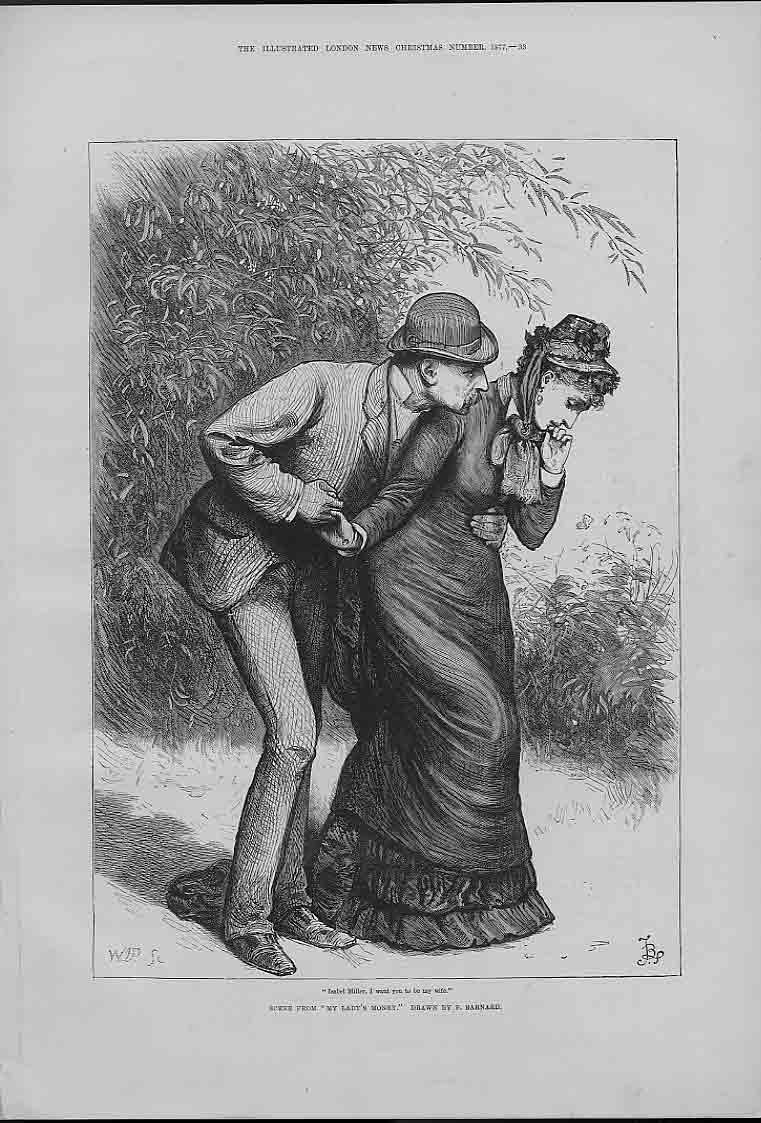
“A Marriage Proposal.” Wood engraving by Barnard from an 1877 issue of The Illustrated London News / Old-Print.com.

From God’s Lips to Yours Happy New Year!

At the calendar’s turn past choice becomes clear
as our marriage strolls into its fourteenth year
that decision writ large wove a soft comfy throw
built a nimbly steered barge with its speed set at slow
with potential adversity more than offset
by inspired hilarities no doubt we’ll have met
two idiosyncrasies set into stone
two radio frequencies sharing a bone
with two sets of families times two sets of friends
the occasional frenzy the holiday binge
the surfacing urges the personal dirges
skirting disasters and nursing the singe

It’s someone to listen with two half-cocked ears
tears of anguish that glisten while craving some beers
the freedom of knowing our bread’s always buttered
the solace each night of our bed partner’s mutter
It’s old faithful the geyser of love and respect
with a pool of concern if one just might defect
It’s years of the same-old flow of life
that waters the hearts of each husband each wife
all deserve the chance of sharing this bliss
and to know it’s street-legal to publicly kiss
in a world whose bright days are meant for all
Now good luck with whom you entangle enthrall

Either way it’s expressive impulsive to care
a bit obsessive-compulsive this permanent share
a boon heart condition this terminal rendition
with pretenses that drop when you’re out of ammunition
My disarming life is a moveable truce
a surrender to hope a set table a deuce
All who want it should be so blessedly mixed
to grow to enjoy that they’re neutered and fixed
Though I joke and laugh I know that I’m blessed
as we learn and evolve and transform this fine mess
I wouldn’t trade even a moment since my wedding
not even the sorrows nor for the hair I’ve been shedding
and certainly not the devotion of wedlock
especially through times of marital gridlock
For what is one egg compared to a basket’s
Yes thank you I’m wedded till forced to my casket

Marriage is kindness stretched to infinity
with the marks to prove it just an amenity
no matter for whom you have an affinity
Your love is your personal God-given identity

Larry Piltz / The Rag Blog

Indian Cove
Austin, Texas
December 28, 2009

Dad and Jean in Omaha at the 2009 College World Series.

The Rag Blog

Posted in Rag Bloggers | Tagged , , , | 2 Comments

UT-Austin’s Kuperman : Bomb Iran’s Nukes

Image from Crusader Rabbit.

UT non-proliferation ‘expert’ calls for
Military strikes against Iran nuclear facilities

[Alan J. Kuperman is] ‘director of the Nuclear Proliferation Prevention Program at the University of Texas at Austin,’ but his Christmas eve call to war relies on disinformation and contradiction, not on objective scholarly analysis.

By Paul Craig Roberts / December 30, 2009

On Christmas eve when Christians were celebrating the Prince of Peace, the New York Times delivered forth a call for war. “There’s only one way to stop Iran,” declared Alan J. Kuperman, and that is “military air strikes against Iran’s nuclear facilities.”

Kuperman is described as the “director of the Nuclear Proliferation Prevention Program at the University of Texas at Austin,” but his Christmas eve call to war relies on disinformation and contradiction, not on objective scholarly analysis.

For example, Kuperman contradicts the unanimous report of America’s 16 intelligence agencies, the reports of the International Atomic Energy Agency, and Russian intelligence with his claim that Iran has a nuclear weapon program. Astonishingly, it does not occur to Kuperman that readers might wonder how an academic bureaucrat in Austin, Texas, has better information than these authorities.

Kuperman is so determined to damn President Obama’s plan to have other countries enrich Iran’s uranium for Iran’s nuclear energy program and medical isotopes that Kuperman commits astounding blunders. After claiming that Iran has a “bomb program,” Kuperman claims that “Iran’s uranium contains impurities” and that Ahmadinejad’s threat “to enrich uranium domestically to the 20 percent level . . . is a bluff, because even if Iran could further enrich its impure uranium, it lacks the capacity to fabricate the uranium into fuel elements.”

What was the New York Times op ed editor thinking when he approved Kuperman’s article? Iran, Kuperman writes, needs “90 percent enriched uranium” to have weapons-grade material, but cannot reach 20 percent or even make fuel elements for its nuclear energy. So, how is Iran going to produce a bomb? Yet, Kuperman writes that “we have reached the point where air strikes are the only plausible option with any prospect of preventing Iran’s acquisition of nuclear weapons. The sooner the United States takes action, the better.”

It could not be made any clearer that, as with the U.S. invasion of Iraq, a military attack on Iran has nothing to do with weapons of mass destruction. An “Iranian nuke” is just another canard behind which hides an undeclared agenda.

One wonders about Kuperman’s non-proliferation credentials. How does a wanton military attack on a country encourage non-proliferation? Aren’t America’s bullying, threats and acts of war more likely to encourage countries to seek nuclear weapons?

At the end of the first decade of the 21st century, the United States has wars ongoing in Iraq where the ancient Chaldean Christian community was destroyed — not by Saddam Hussein but by the neoconservatives’ illegal invasion of Iraq — in Afghanistan, Pakistan, Yemen, and Sudan. The U.S. initiated a war, which it lost, between its puppet ruler in the former Soviet province of Georgia and Russia.

The U.S., the world’s greatest supporter of terrorism, is the main financier of terrorist groups that stage attacks within Iran, and U.S. money succeeded in financing protests against President Ahmadinejad’s reelection and in dividing the ruling Islamic clerics. It was American money, weapons, and diplomatic cover that enabled the Israeli war crimes against the Lebanese people during 2006 and against Palestinian civilians in Gaza during 2008-2009, crimes documented in the Goldstone Report.

Iran has never interfered in U.S. internal affairs, but the U.S. has a long record of interfering in Iranian affairs. In 1953 the U.S. overthrew Iran’s popular prime minister, Mohammed Mosaddeq, and installed a puppet who tortured Iranians who desired political independence. Despite this and other American offenses against Iran, Ahmadinejad has repeatedly expressed Iran’s interest to be on friendly terms with the United States, only to be repeatedly rebuffed. The U.S. wants war with Iran in order to expand U.S. world hegemony.

One might expect a non-proliferation expert to take history into account, but Kuperman fails to do so. Kuperman also has nothing to say about Israel’s, India’s, and Pakistan’s nuclear weapons. Unlike Iran, none of these countries are signatories to the Nuclear Non-Proliferation Treaty. Israel, India, and Pakistan all developed their nuclear weapons in secret, and many experts believe Israel had American help, an act of treason. All three countries have been rewarded by Washington despite their perfidy.

Why is Kuperman concerned about Iran, which submits to the IAEA inspections, but is unconcerned with Israel, a country that has never permitted a single inspection? The answer is that the Israel Lobby, the U.S. military-security complex, and the “Christian” Zionists have succeeded in demonizing Iran.

Every real expert knows that an Iranian nuclear weapon would have no function other than deterring an attack on Iran. Ever since the U.S. lost its monopoly on nuclear weapons, after using them offensively and pointlessly against a defeated Japan, nuclear weapons have served no purpose other than deterrence.

The U.S. has no conflicting economic interests with Iran. Iran is simply a supplier of oil, an important one. A U.S. attack on Iran, such as the one advocated by Kuperman, would most likely shut down oil flows to the West through the Strait of Hormuz. This might benefit refiners, who sell gasoline to the West and could charge enormous prices, but no one else would benefit.

Adding to the war cry are congregations of fake Christians. A great number of them, organized by someone’s money under the banner, “Christian Leaders for a Nuclear-free Iran,” have written to Congress demanding sanctions against Iran that amount to an act of war. The roll call includes the “Christian” Zionist John Hagee, who, according to reports, denigrates Jesus Christ and preaches to his illiterate congregation that it is God’s will for Americans to fight and die for Israel, the oppressor of the Palestinian people.

Among the signatories of the “Christians” demanding an act of war against Iran, are Dr. Pat Robertson, president of Christian Broadcasting Network; Nixon-era criminal Chuck Colson; and Richard Land, president of Ethics and Religious Liberty Commission, Southern Baptist Convention. Obviously, for Southern Baptists, ethics means murdering Islamists, and religious liberty excludes everyone but “Christian” Zionists.

It is a simple matter for an educated person to make fools of these morons who profess to be Christians. However, these morons have vast constituencies numbering in the tens of millions of Americans. There are, in fact, more of them than there are intelligent, informed, moral, and real Christian Americans. The votes of the morons will prevail.

In the second decade of the 21st century, America’s Zionist wars against Islam will expand. America’s wars on behalf of Israel’s territorial expansion will complete the bankruptcy of America. The Treasury’s bonds to finance the U.S. government’s enormous deficits will lack for buyers. Therefore, the bonds will be monetized by the Federal Reserve.

The result will be rising rates of inflation. The inflation will destroy the dollar as world reserve currency, and the U.S. will no longer be able to pay for its imports. Shortages will appear, including food and gasoline, and “Superpower America” will find itself pressed to the wall as a Third World country unable to pay its debts.

America has been brought low, both morally and economically, by its obeisance to the Israel Lobby. Even Jimmy Carter, a former President of the United States and Governor of Georgia, recently had to apologize to the Israel Lobby for his honest criticisms of Israel’s inhumane treatment of the occupied Palestinians in order for his grandson to be able to run for a seat in the Georgia state senate. This should tell the macho super-power American tough guys who really runs “their” country.

[Paul Craig Roberts, a former Assistant Secretary of the U.S. Treasury and former associate editor of the Wall Street Journal, has held numerous academic appointments. He has been reporting shocking cases of prosecutorial abuse for two decades. A new edition of his book, The Tyranny of Good Intentions, co-authored with Lawrence Stratton, a documented account of how Americans lost the protection of law, was published by Random House in March, 2008.]

Source / OpEdNews

The Rag Blog

Posted in RagBlog | Tagged , , , , , , , | 2 Comments

FARC in Colombia : A History of Armed Resistance

“Por la nueva Colombia, la patria grande y socialismo.”(“For the new Colombia, the greater fatherland, and socialism.”) — FARC motto. Photo from HubPages.

Armed struggle for land reform and justice:
Fuerzas Armadas Revolucionarias de Colombia

By Marion Delgado / The Rag Blog / December 30, 2009

CARTAGENA DE INDIES, Colombia — In May 2003 a leak from the Bush Treasury Department indicated that the Office of Foreign Assets Control (OFAC) was about to add to its extensive narcotics traffickers list. This time it would add someone in Colombia.

OFAC would be using one of the enlightened Republican Congress’s new drug war laws, the Foreign Narcotics Kingpin Designation Act. I was pretty sure who the new addition would be. The word “kingpin” was a dead giveaway.

It had to be the guy who had attained high office; whose brother had organized 20 or more death squads and maintained a couple of them out at the family hacienda; whose cousin in the Colombian Congress was the mouthpiece for those death squads as well as a close friend and promoter of various well known narcotrafficantes, including the legendary Pablo Escobar; someone whose own father was wanted by the Colombian police and the U.S. DEA for cocaine trafficking when he was killed in an abortive kidnap plot; and who himself was removed from his position as mayor of Medellín for having well-known ties to drug runners.

Who else could it be, but master criminal and El Presidente himself, Alvaro Uribe?

Imagine my surprise when it was announced the next day, that it was not Uribe after all, but the Revolutionary Armed Forces of Colombia — Peoples Army (FARC or FARC-EP) and 15 of their known or suspected leaders, even though I already knew they had to be a bad bunch of hombres. Five years before, in 1997, they were named a Foreign Terrorist Organization by the U.S. Department of State.

It couldn’t have been easy to make it to the top of two government lists at the same time (the terrorist list and the narcotrafficantes list) and be the defining designees of a whole new hyphenated word, “Narco-terrorist”! That should keep them from gaining credibility with anyone with media access in the U.S.! I started wondering who these FARC guys were. Somebody needed to check them out, find out where they came from, and why.

The roots of FARC-EP

The current civil war in Colombia has been characterized by gross human rights violations, increasing dramatically over the past two decades. International human rights organizations have repeatedly singled out right-wing paramilitary groups (paracos) as being the principal perpetrators of human rights abuses.

The paracos are intertwined with the Colombian Armed Forces as they wage war against, not only the guerrillas, but anyone suspected of being a guerrilla sympathizer: union members, peasant organizers, human rights workers, and religious activists. Some paracos leaders have extended the parameters of the war against the guerrillas and their suspected fellow travelers to include drug addicts, alcoholics, prostitutes, petty criminals, and the homeless, in an attempt to “cleanse” Colombian society. Social cleansing is different from ethnic cleansing only in the presumed reasoning, it has the same results.

Over the years, several Colombian presidents have attempted to address the social, political, and economic injustices that are the principal causes of the conflict. However, these efforts have been repeatedly thwarted by the U.S. and its war on drugs, and by the Colombian political, economic, military elite, who are desperately trying to preserve a “democracy” that has disenfranchised much of the population.

News accounts often label the conflict a “35-year-old civil war,” counting its origin from the official formation of several guerrilla groups in mid-1960. However, the roots of Colombia’s largest guerrilla group, the FARC, date back to peasant armed self-defense movements formed between 1948 and 1958.

The National Front

During the 19th and early 20th centuries, Colombia’s Liberal and Conservative parties, whose influence reached from Bogotá to virtually every village in settled regions of the country, dominated politics. Ideological differences between these elites reverberated throughout society, often resulting in outbreaks of violence that repeatedly pitted loyal Liberal and Conservative factions, both peasant and elite, against each other.

In the late 1940s, dissident Liberal Jorge Eliécer Gaitán emerged from the Liberal and communist-led agrarian and labor reform movements as the leading presidential candidate. On April 9, 1948, Gaitán was assassinated on a Bogotá street. The killing triggered a popular uprising by the Liberal lower classes that resulted in massive destruction and looting in the capital. This uprising, known as the Bogotazo, was the opening act of a 10 year period in Colombian history recalled as La Violencia.

Liberal peasant uprisings occurred throughout the country, pitting rural Liberals and Conservatives against each other. Fearing a peasant-led social rebellion, the elite Liberal leadership supported repression used by the Conservative government to quell the uprisings and preserve the elite oligarchy. But after two high-ranking Liberals were assassinated in 1949, the Liberals boycotted the 1950 presidential election, won uncontested by Conservative Laureano Gomez.

Although rebellion had been effectively quelled in Bogotá, sporadic armed peasant uprisings continued in several rural departments. Gomez, who considered Liberal peasants kin to Communists, responded to these with violent repression. Many Liberal members of the national police force were dismissed and replaced with peasants from the Conservative Boyacá district of Chulavista. The chulavistas became infamous for their brutal tactics in repressing rebellious Liberals and communists.

In the early 1950s, the Gomez regime, supported by the Catholic Church, which had been left out of the various negotiations during the uprisings, and by the U.S., which viewed Communist support for peasants in a Cold War prospective, elevated expression to new heights. Chaotic violence pitted rural Liberals and Conservatives against each other, and resulted in battles between the oligarchy and land-starved peasants. Many large landowners abandoned their properties, fleeing to the relative safety of the cities.

In 1953, Gomez was overthrown by a military coup that brought General Gustavo Rojas Pinilla to power. Rojas Pinilla immediately dispatched the military to reclaim the property of the large landowners still in the cities. In response, armed peasant groups called for agrarian reform.

In June, 1953, in an attempt to end the violence, Rojas Pinilla issued an amnesty to all the armed peasants and responded to their call for agrarian reform by creating the Office of Rehabilitation and Relief. In reality, this office did little to address the agrarian problem, yet the Liberal and Conservative elite felt that Rojas Pinilla was using it to build popular support for himself. To quell their suspicions, in June 1954 Rojas Pinilla extended the amnesty to right wing thugs imprisoned for acts of terror on behalf of the ruling Conservative elite and the Gomez regime.

Many of the Gomezistas released from jail immediately began killing peasants, forcing those that had accepted amnesty to again take up arms. Rojas Pinilla responded in 1955 by launching a major military offensive against the rearmed peasants that became known as La Guerra Villarica. It was in the department of Tolima during this offensive that the armed self-defense movements that would later evolve into the FARC came into existence. The Conservative and Liberal elite blamed the renewal of La Violencia on Rojas Pinilla, and in 1957 organized a general strike and street protests in the capital that forced him to resign.


Following the ouster of Rojas Pinilla, the Conservative and Liberal elite agreed on a power-sharing agreement, the National Front. Beginning in 1958, the parties alternated four-year terms in the presidency (no need to rig elections), and distributed all public positions evenly between the two parties. The formation of the National Front brought an end to the 19th century aspect of La Violencia: conflict between factions of the ruling class. However, the new government still had to contend with armed peasants, whose demand for land reform was being denied.

A FARC is born

According to a 2000 book by Alfredo Molano, Violence and Land Colonization, Violence in Colombia: The Contemporary Crisis in Historical Perspective, many peasants, mostly Liberals and Communists, survived the military offensives of the 1950s by undertaking long marches, under the protection of armed self-defense groups, to the mostly uninhabited eastern departments of Meta and Caquetá.

They cleared and worked new lands in areas they declared “independent republics,” in an attempt to regain subsistence land and free themselves from a national government they distrusted due to “personal experience with social and economic partisanship and… the double value system upheld by the ruling classes.”

However, the colonists soon discovered they had not found the autonomy they so desperately sought. Large landowners, intent on increasing their own holdings, soon began laying claim to the newly cleared lands. Furthermore, the government had no intention of leaving the colonists alone.

“In defining these republics as gangs of communist bandits, the government had an excuse to launch military attacks against them, condemn them politically, and blockade them economically… The only possible outcome was war. One by one the republics fell to the army, and once they were under government control the land became concentrated in the hands of the large landowners,” Molano wrote.

The peasants, forced deeper into the jungle, realized their only chance of achieving social justice lay in their ability to wage war against the government on a national level. As a result, the armed self-defense movements dispersed units to various regions of the country to fight the army on several fronts simultaneously under a central command structure. On July 20, 1964, the various fronts of the armed self-defense movements issued their agrarian reform program. Two years later, they officially became known as the FARC.

Guerrilla groups begat guerrilla groups

In 1960, an independent political party, National Popular Alliance (ANAPO), formed by supporters of Rojas Pinilla was contending in congressional elections. ANAPO’s popularity increased steadily throughout the 1960’s as it appealed to many who had been left out of the National Front alliance. Rojas Pinilla ran as ANAPO’s candidate in the 1970 presidential election and, after holding an early lead, was narrowly defeated by National Front candidate Misael Pastrana Borrero. Many ANAPO supporters accused the government of manipulating the vote count, and in response to perceived electoral fraud; socialist members of ANAPO formed the M-19 guerrilla movement in 1972.


M-19 gained notoriety through a series of daring urban raids that included the occupation of the Dominican Embassy in Bogotá in 1980 and an ill-fated takeover of the Palace of Justice in 1985. The latter resulted in the deaths of more than 100 people, including 11 Supreme Court judges, in a two-day battle in which the army leveled the massive courthouse. In 1989, M-19 guerrillas decided to lay down their weapons in return for a full government pardon. The ex-guerrillas formed a political party, the Democratic Alliance M-19, to participate in the upcoming elections; however, right-wing death squads soon assassinated many of the party’s leaders, including presidential candidate and former M-19 commander Carlos Pizarro.

M-19 had been formed as a response to the National Front, which successfully reserved positions of power for members of the Conservative and Liberal elite. This “limited democracy” spawned other guerrilla movements in the 1960’s. Other factors also came into play.

The Cuban Revolution influenced many radicals in Latin America, as it did in the U.S., convincing them that Ernesto “Che” Guevara’s foco theory of armed insurrection was the revolutionary road to follow. The Colombian Communist Party’s support of resolutions passed by the 20th Congress of the Soviet Communist Party, calling for a peaceful road to revolution, led many young Colombians to split from the Party in order to follow the Cuban model.

The Ejército Popular de Liberacion (Popular Army of Liberation, EPL) was thus formed in the department of Antioquia in the mid-1960’s. Following the Soviet-Chinese split, the EPL espoused the Maoist theory of a “prolonged popular war.” But after 1980 it began to distance itself from the goal of prolonged war and in August 1990 many members laid down their arms in order to participate in the political process, while a small dissident faction continued to fight in northern Colombia.


In 1964, university students who had recently returned from Cuba formed Colombia’s second-largest guerrilla group, the Army for National Liberation (Ejército de Liberación Nacional, ELN), in the department of Santander. The ELN adhered strictly to Che’s principles of rural guerrilla warfare and, in contrast to the M-19 and EPL, has so far refused to lay down its arms and participate in the political process. Sociologist Eduardo Pizarro says that, “In recent years the ELN has focused its activities almost exclusively on efforts to disrupt and destroy the oil industry, attacking with great success the pipelines of the north.”

In fact, between 1986 and 1997 the ELN was responsible for 636 pipeline bombings that resulted in $1.5 billion in lost revenue for the state-owned oil company, the oddly named Ecopetrol. For many years, the FARC and EPL denounced the ELN for pursuing a strategy of economic sabotage that has failed to increase its popular support. However, by the end of the 1990s, the FARC was also targeting pipelines used by multinational corporations to transport oil from remote drilling fields to coastal ports.

The FARC is the only Colombian guerrilla group with peasant roots that pre-date both the National Front and the Cuban Revolution. In contrast, the ELN, EPL and M-19 were all movements led by urban intellectuals, typical of many Latin American guerrilla groups that evolved in the 1960s, Cuban-inspired armed reactions to domestic political, social and economic situation.

FARCing cocaine…

The 1974 presidential election brought an end to the National Front alliance as Liberal and Conservative candidates again ran against each other. Sixteen years of National Front rule had reduced the number of killings — in contrast with the 200,000 Colombians who died during La Violencia — but had failed to address the agrarian issue and a dramatic increase in poverty.

During the National Front years, the percentage of the nation’s work force living in absolute poverty more than doubled, from 25% to 50.7%. Figures were even worse for the rural labor force, where the rate of absolute poverty soared from 25.4% to 67.5%. It is no surprise that when the coca boom began in the late 1970s, the lure of drug profits brought a massive migration of urban jobless and landless peasants to the predominantly FARC-controlled colonized regions.

Initially, the FARC was concerned that the new mass migration would undermine the political and social status quo in areas it controlled. At the same time, its income, from war taxes imposed on the local population in return for maintaining social order, increased dramatically.

New revenue enabled the rebel group to vastly improve its military capabilities, modernizing its weapons and improving the guerrilla fighter’s standard of living. In addition, the FARC was able to offer social and economic services “in the areas of credit, education, health, justice, registry, public works, and ecological and cultural programs.”

During the early years of the coca boom, the guerrillas and the drug lords worked together. Guerrillas controlled many of the coca growing regions while the cartels managed much of the cocaine production and trafficking.

However, this informal alliance collapsed when the leaders of drug cartels in Medellín and Cali began investing their new found wealth in property, primarily large cattle ranches, placing themselves firmly in the ranks of the guerrillas’ traditional enemy. The new narco-landowners soon began organizing their own paramilitary armies in order to fight the guerrillas and those they saw as guerrilla sympathizers.

Until today…

For 50 years the FARC and its predecessors have claimed to be fighting for agrarian reform and social justice for Colombia’s peasant population. The FARC has evolved into a powerful military force of 15,000 to 20,000 fighters who now control approximately 40% of the country. A U.S. Defense Intelligence Agency (DIA) report issued in November 1997 found that “the Colombian Armed Forces could be defeated within five years unless the country’s government regains political legitimacy and its armed forces are drastically restructured.”

U.S. President Bill Clinton’s bizarre Drug Czar, Gen. Barry McCaffrey, echoed these findings when he claimed that Colombian democracy is seriously threatened by the growing military strength of the guerrillas.

Such statements lead one to believe that McCaffrey’s concept of “democracy” involves social order being “maintained” under a military state of siege, impunity for paramilitary forces who regularly massacre the civilian population, political candidates in opposition to the Conservative and Liberal elite being routinely assassinated, a judicial system paralyzed by fear, rigged and stolen elections, and thousands of peasants whose only economic means of survival is illicit coca production.

Indeed, if the ruling political, economic and military elite, aided by the paracos, continue to stifle truly democratic reform, the demise of Colombian “democracy” may well be inevitable.

For its part, the U.S. appears intent on “Salvadorizing” the conflict. Colombia, as was the case with El Salvador in the 1980’s, is today the hemisphere’s leading recipient of U.S. military aid. And it appears that Washington, in its attempt to prevent a guerrilla victory, is once again intent on supporting a repressive military closely allied to right-wing death squads. Such a policy will inevitably result in the continued suffering of the Colombian people, who are routinely subject to massacres, torture, disappearance, kidnapping, and forced displacement.

Any possibility of achieving a peaceful resolution to the conflict depends on the government’s ability to dismantle the paramilitary organizations and create a climate conducive to negotiations between the government and the guerrillas. Then, and only then, will it be possible to address the political, social, and economic causes of the conflict. So far the government has made little headway in eliminating the paracos.

The FARC is absolutely necessary to the survival of the large agrarian class of Colombia. Only land reform, justice, and true democracy will make it unnecessary; this is the only route to the elimination of FARC. Pointless and brutal alternatives, which will not result in the elimination of FARC-EP, is the way chosen by Hillary Clinton, Gates and Obama, sending more arms and U.S. troops, paid for with your money, to maintain civil war within Colombia and perhaps spread it to neighboring countries.

Note: Much research for this article came from various reports produced by the North American Congress on Latin America (NACLA); my thanks to them for keeping track of all this stuff over these many years. — md

  • For Marion Delgado’s previous reports from Colombia on The Rag Blog, go here.

.The Rag Blog

Posted in Rag Bloggers | Tagged , , , , , , | 2 Comments

James Retherford : Sweeping Away the Snow

Art by Mark Fiore. See link to animation below.

Citizens of the earth:
Best wishes in bad times

By James Retherford / The Rag Blog / December 29, 2009

Pardon me if I use this greeting to sweep away the usual seasonal accumulation of snow… and more. This is the time of year when we typically offer each other best wishes and hopes for peace and prosperity in the new year, and I wish each and every one of you all of these things and more.

But this year I also must consider how hollow these thoughts ring when so many of our fellow Americans are jobless and sinking into poverty — and, in too many cases, homelessness. As I think about this, I must, as a citizen of the Earth, also consider how the collapse of the American middle class is but a ripple compared to the economic tsunami unleashed by the worldwide Ponzi scheme hatched by the grifters on Wall Street.

Finally I think of young men and women, forced to choose between careers in legalized war (the military) and illegal wars (drug gangs) because of the wholesale export of American manufacturing jobs to cheap labor markets.

American soldiers are returning from endless deployments to the endless war physically broken and psychologically devastated — haunted by the growing awareness that they have participated not in a noble cause to keep America safe from terrorists or a grand religious crusade against the anti-Christ but rather that they themselves were unwitting pawns in a grand larceny and are nothing more than mercenary terrorists hired by American corporatists to steal the national wealth of Islamic peoples halfway around the world.

This is the season to stop and take stock of where we have been and what we must do. For me — and I strongly hope for you too — this is time to seriously consider what we ALL must do together in 2010 to FIGHT BACK! … to take our nation back from the criminals, the oily oligarchs, the fancy financiers, the war-mongers, the inside-traders, the political hacks, the brown shirts, and — did I mention? — the criminals.

‘Tis the season for giving, so let’s hand out some long prison sentences at hard labor to ALL of those who have been robbing us blind while pimping the Constitution.

Maybe after we give Guantanamo back to its rightful owners, the Cuban government would loan it back to us as a place to incarcerate the corporate crooks and their cronies.

Meanwhile please enjoy Mark Fiore’s seasonal reminder and “Ho! Ho! Whoa!” (Christmas may have passed, but the season of consumption is still with us.)

Oh, and have a happy new year. Please.

CLICK HERE FOR MARK FIORE ANIMATION.

The Rag Blog

Posted in Rag Bloggers | Tagged , , , , , , , | Leave a comment