Comcast-NBC Merger : Controlling Content and Delivery

Image from ZeroPaid.

The Comcast-NBC marriage:
The importance of Net Neutrality

With a monopoly on delivery, what’s to stop a new breed of ISPs/cable providers from dictating content to customers?

By Jared Moya / December 10, 2009

See ‘Internet war: The fight for free access,’ Below.

A scary thing happened last week when the Comcast Corporation, the largest cable provider in the U.S. and ISP to some 15 million customers, decided to to purchase NBC Universal in order to delve further upstream from the pipe that simply delivers content to the world where’s it created.

“We believe this venture represents a natural evolution in the world of communications and entertainment, a marketplace that becomes more open, more competitive, and more global every day,” it says. “The opportunity to combine these assets makes possible some innovative programming opportunities that will permit the new company to better serve the interests of many key segments of the viewing audience, including local viewers in the markets served by NBCU’s owned-and-operated stations, and the particular interests of Hispanics, African Americans, children and families, and other key audience segments. This combination also permits us to hasten the arrival of the multiplatform, ‘anytime, anywhere’ future that Americans want.”

In other words, it has seen the writing on the wall in terms of streaming video-on-demand services. Consumers increasingly want to watch content when and where they want.

However, the move means Comcast will control every step of the system from content creation to delivery, and could easily begin preventing customers from accessing competing content or charging them more to do so than they would normally as a sort of a penalty.

“While we believe that this transaction is, and will be determined to be, pro-competitive, pro-consumer, and strongly in the public interest, we recognize that competitive concerns will be raised about the combination of such significant multiplatform assets in a single company,” it adds. “Therefore, we also intend to make a number of affirmative voluntary commitments in our applications for approval that we believe will effectively address any such concerns.”

It leaves out the fact that none of its “commitments” say anything about guaranteeing online access to its competitors or allowing competing streaming services to exist on its network. Since streaming is the future of content delivery it’s important that equal access be guaranteed to all, especially since ISPs enjoy regional monopolies around the country (try finding more than one broadband provider in your area).

“I am not exaggerating when I say that Comcast’s proposed acquisition of NBC Universal poses a genuine threat to free expression and diversity of speech in our democratic society,” says Andrew Jay Schwartzman, president of the Media Access Project, a non-profit law firm and free speech advocacy organization that promotes freedom of expression, independent media, and low-cost, universal access to communications services.

“I believe that the sale should not be permitted. The deal is the first attempt at vertical integration of content and delivery in the broadband era. It presents antitrust and communications regulators with the challenge of addressing whether any one company should be allowed to hold dominant positions in both video and Internet delivery,” he says.

Exactly.

The easiest manifestation of the harm it could do to competitors is the simple withholding of NBC content from both standard cable and online competitors. It also has an inherent interest in making sure that competing video streaming services don’t succeed.

Comcast CEO Brian Roberts says that “today NBC makes certain content available online and I can’t imagine we will change that process,” but we all know that could change with time. The primary concern of a business will always be profits, and it’s only a matter of time before Comcast begins attempting to maximize the potential of of NBC content by dictating the price and availability.

Gigi Sohn, executive director of Public Knowledge, a public interest advocacy organization dedicated to promoting the public interest in access to information, warns that the deal will ultimately harm consumer choice and result in higher fees for services.

“With all that programming under its control, Comcast will have every incentive to take its shows off of the Internet and force consumers to buy a cable subscription to get online access to that programming,” she said. “Want to watch reruns of 30 Rock? Buy a Comcast subscription.”

The whole affair makes Network Neutrality even more important. Federal Communications Commission (FCC) Chairman Julius Genachowski has already emphasized that we need to “safeguard the free and open Internet” by ensuring, among other things, that consumers must be able to access the lawful Internet content, applications, and services of their choice.

Without it, Comcast will have a free hand to do as it pleases.

Stay tuned.

Source / ZeroPaid

Graphic from techrepublican.

Internet war:
The fight for free access

There is a silent battle occurring in Washington, D.C., over our ability to freely access and exchange information through our last unbiased medium, the Internet. The telecom industry is feverishly buying up policy-makers in an attempt to block new, unanimously approved FCC regulations on Internet service providers.

The new plan would ensure Internet users’ equal rights to its content, while prohibiting broadband providers such as AT&T, Comcast and Verizon from selectively blocking or slowing content and discriminating against competitors.

In retribution, the big telecom interests are sending a message using their highest paid member of Congress, Sen. John McCain, to submit the Internet Freedom Act, which is anything but. The act states the FCC “shall not propose, promulgate or issue any regulations regarding the Internet or IP-enabled services.”

So the FCC would not be allowed to be the FCC, giving service-providers freedom to control, without checks, any and all bandwidth, connection speed, content and applications.

Misleading policy makers and scare tactics should be ignored. FCC regulations would only affect the big Telecom interests and not the Internet itself. Opponents mistakenly claim regulations might slow innovation. Does this include censoring, blocking or stifling applications such as VoIP, Google Voice and legal peer-to-peer networking applications by companies such as AT&T and Comcast?

Regulation preventing such acts, according to a number of studies, will not only lower prices and guarantee higher performance overall, but open the web to more users — allowing people to share ideas and programs and accelerating innovation and investment. AT&T’s own two year experiment in 2006 with neutrality rules brought about greater increases in investment than any other ISP in America.

What deregulation means to these companies is not freedom from some fictitious dictatorial power but immunity from having to answer for their own irresponsible and inevitably oppressive actions. What has deregulation really given us, besides robbing us of laws designed to protect the environment, worker safety and consumer rights?

Michael A. Burger / CJOnline

  • For previous Rag Blog articles about Net Neutrality, go here.

Thanks to Media Reform Daily / The Rag Blog

Posted in RagBlog | Tagged , , , , , , , , , , , | 1 Comment

Health Care : Senate Clowns Come Up With a Deal

Same old song. Harry Reid’s committee comes up with a health care deal. Image from Liberal Street Fighter.

Health care and the Senate:
The circus comes to town

By Dr. Stephen R. Keister / The Rag Blog / December 10, 2009

Mark Twain in 1891 described Congress like this: “The smallest minds and the selfishest souls and the cowardliest hearts that God makes.” And little has changed as we watch in action the dysfunctional legislative body that is the United States Senate as it fumbles the ball on health care reform.

Finally the physicians of the United States have overcome their fear and their lethargy and the vast majority are willing to speak up for a government health care program for all Americans. They have been joined in this by most of the nurse’s associations, the bulk of the Union movement, and, in fact, the majority of the American people. Sixty-five percent of Americans approve of a public plan.

And so what happens? Our elected representatives, especially in the Senate, have given away the store to their paymasters in the health insurance and pharmaceutical industries, with the exception of a courageous and honorable few. Now, all that stands between a decent health care system for all and total capitulation to the corporatocracy, is the House Progressive Caucus. One hopes that they are able to exhibit the courage of the Greeks at Thermopile or the Cold Stream Guards holding the perimeter at Dunkirk.

Where is the President in all of this? Mr. Obama would appear never to have had any commitment to universal/single payer health care, and in spite of his campaigning for reasonably priced health care he has bent knee to the health insurance cartel and PhARMA, to which the White House has been an open house since his inauguration. The bow to the Emperor of Japan was minor compared to the deference paid to these two cartels.

I believe that the best description of Mr, Obama’s style of leadership comes from Brendan Cooney, writing in Couterpunch about the president’s handling of the Honduran situation:

But perhaps most haunting of all in this mess is the man in the White House. He showed that while he has better instincts for democracy than his predecessor, the results are the same because he does not act on them. What good is a quarterback who can find the open receiver if he can’t pass the ball?

My fear is that his timidity on these issues — just like his Justice Department’s recent interference in the indictment of John Yu, and the administration’s handling of other matters involving Bush war crimes — will leave him with the same legacy with the American progressives as Pierre Laval left with the majority of the French people in 1940.

We have much to hang our heads in shame about. The Progress Report on November 24 reveals that a record 49 million Americans had trouble finding enough to eat in 2008. The USDA reported in the annual food security report that the number of people who “lacked consistent access to adequate food” soared to the highest level since the study began 14 years ago. Even more disturbing, nearly one in four children — almost 17 million — lived in households in which food at times was scarce. Not only do we let people die in this country for lack of a physician, but we also let them go hungry.

The public option appears to be lost in the Senate. Instead Democrats would allow older Americans starting at 55 to buy into Medicare. There is a definite spin to this. The “buy-in” would not kick in until 2011 and a “subsidized buy-in” would not be available until 2014. And only Americans without current health insurance would be eligible. There is no provision for those paying outlandish premiums for private insurance to switch to the Medicare substitute. And what happens to all those Americans under the age of 55 who are being gouged and deceived by the health insurance cartel?

Sen. Jay Rockerfeller would also require insurers to spend at least 90% of premium money on medical care, rather than on administrative costs or profits. Of course we do not know the details of the proposed deal, nor whether it has any possibility of being sustained by the full Senate. To their credit Senators Feingold and Sanders are reserving judgment.

Former insurance industry flak turned reform crusader Wendel Potter wrote in The Huffington Post:

There was a time, in the early 1990s, when health insurance companies devoted more than 95 cents out of every dollar to paying doctors and hospitals for taking care of their members. No more. Since President Bill Clinton’s health plan died 15 years ago, the health insurance industry has come to be dominated by a handful of insurance companies that answer to Wall Street investors, and they have changed that basic math. Today, insurers only pay about 81 cents of each premium dollar on actual medical care. The rest is consumed by rising profits, grotesque executive salaries, huge administrative expenses, and the cost of weeding out people with pre-existing conditions and claims designed to wear out patients with denials and disapproval’s of the care they need most.

Mr. Potter continues:

Wall Street investors expect insurers to pay as little as possible for medical claims. As a result, the nation’s health insurance industry has evolved into a cartel of huge for-profit companies that together reap billions of dollars a year at the expense of their policyholders. The seven largest firms — United Group, WellPoint, Aetna, Humana, Cigna, Health Net, and Coventry Health Care — enroll nearly one of three Americans in their health insurance plans. This year the industry will take about 25 BILLION in profits for getting between American patients and their doctors. Further in Firedoglake of December 4, Jason Rosenbaum revealed that Aetna had cut 600,000 people from its insurance rolls to raise its profits for next year. This was in accord with Wellpoint CEO Angela Braly when she said, ‘We will not sacrifice profitability for membership.

Bill Scher in Campaign For America’s Future discusses another part of the Senate deal.

The new compromise proposal would mean an insurance exchange would offer private plans. This alternative would create a national coverage plan operated by private insurers but run by the Office of Personnel Management, which administers health coverage for federal workers, Senators participating in the talks said the OPM idea had been well received across the ideological spectrum, although details were sketchy.

Public option architect Jacob Hacker rips the idea. He writes,

An even stranger idea is to offer the non-profit plans available in the Federal Employees Health Benefit Plan within the exchange. Since the FEHBP is itself a form of exchange, this amounts to offering a new set of private plans within a new set of private plans. How is this going to provide real pressure on private insurers in a consolidated insurance market in which non-profit plans already have a large presence (and often act little differently from the for-profit plans)?

This sounds to me like another variant of the old shell game.

When buying health insurance, the average American is completely cowed by the legalese in the terms of the policy. The information provided by Isaiah Poole, writing in OurFuture, should be very helpful in this regard. Before buying a private health insurance policy it is always best to discuss the specifics of that policy with your attorney or personal physician.

An excellent summary of the overall health care situation is provided by John Garry Maxwell, M.D. — who has practiced surgery in university and community hospitals for 40 years — in his superbly written op-ed in The Wilmington, Star News.

In Great Britain several years ago, a perceptive woman afflicted with a bowel disease requiring a great deal of medical attention, offered me her view: ‘Americans have no sense of community welfare, no willingness to be discomforted in the least for the greater good of the entire population.’

As I have previously noted, we in the United States have a blindspot in this country when it comes to the public good. Our national problem is much larger that how we provide health care to our citizens. At the core, we have become a “what is good for me,” “lets make a lot of money” society. This may well explain why we in the United states are still fighting for the right for all Americans to have decent health care, a right that has existed in Western European nations, in Canada, Japan and Australia, for decades.

[Dr. Stephen R. Keister lives in Erie, Pennsylvania. He is a retired physician who is active in health care reform. His writing appears regularly on The Rag Blog.]

The Rag Blog

Posted in Rag Bloggers | Tagged , , , , | 8 Comments

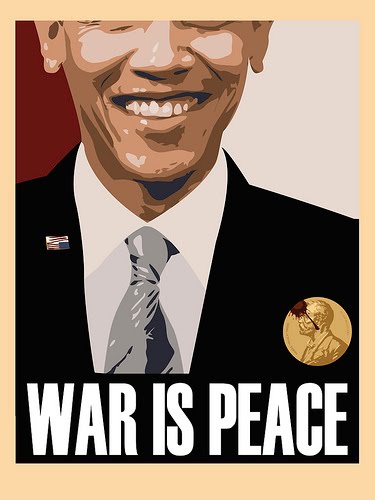
Obama Administration : Growing Influence of the Neo-Cons

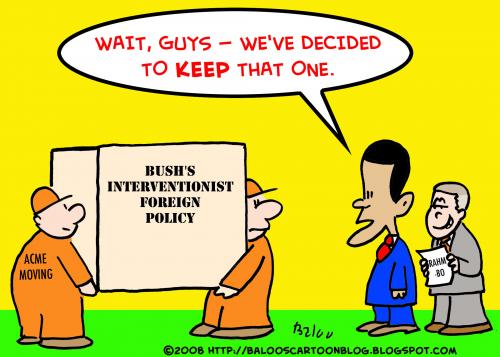
Cartoon By Baloo from Baloo Cartoons.

White House foreign policy:
Globalist/pragmatist hybrid

While the political philosophy articulated or implied by President Obama is far from that of the neo-conservatives, [many of the] concrete policies that he has embraced do in fact resemble Reagan/Bush era policies.

By Harry Targ / The Rag Blog / December 10, 2009

Last January Jonathan Clarke, co-author of America Alone: The Neo-Conservatives and the World Order, posed a question to readers of BBC News: “With the Bush Administration about to recede into history, a widely asked question is whether the neo-conservative philosophy that underpinned its major foreign policy decisions will likewise vanish from the scene.”

While Clarke tended to believe the answer to the question was “yes,” he did warn that pundits had predicted the end of neo-con influence when President Reagan left office as well.

Clarke then listed several key characteristics of neo-conservative foreign policy:

  • viewing the world in terms of the forces of good and evil
  • rejection of diplomacy as a tool of international relations
  • readiness to use military force as a first tool to achieve global goals
  • unilateralism
  • disdain and rejection of international organizations
  • concentration on the Middle East and the Persian Gulf

Years earlier I had labeled the neo-conservative foreign policy advocates the “globalists.” They were committed to an unbridled use of force to transform the world in the political, military, and economic interests of the United States. The doctrine of preemption epitomized this approach to the world. In his National Security Strategy document of 2002, and elsewhere, President Bush asserted the right to engage in military action against nations and/or groups that the United States perceived as a threat. The days of deterrence were over. The United States was prepared to act first.

While globalists dominated United States foreign policy off and on for the last 30 years, they have been challenged by foreign policy influentials I have called the “pragmatists.” Even though both the globalists and pragmatists are driven by the needs of capitalist expansion, the pragmatists see the world as much more complex and demanding of a variety of approaches to other countries and peoples.

Globalists are committed to acting unilaterally while pragmatists are multilateralists; that is they prefer to act in coalition with other nations. Pragmatists regard diplomacy as an important tool for relating to other nations, even when others are enemies.

Whereas globalists are militarists, pragmatists regard the use of the military as a last resort. And when pragmatists endorse the use of violence to achieve particular goals they choose subversion and small wars over big ones. Pragmatists regard international organizations as a site for diplomacy, coalition-building, and engaging in behaviors designed to communicate respect rather than disdain for others. And finally, pragmatists usually embrace deterrence, rather than preemption, as their military doctrine.

Reflecting on Barack Obama’s first year in office we can see evidence of these two kinds of influences on his policymaking. Obama evidenced pragmatism in his performance at the first G20 meeting in London last spring. He engaged in public and private diplomacy and seemed to hear demands from the Global South about increasing its representation in the International Monetary Fund and World Bank. At the G20 meeting and elsewhere in his travels he admitted that the United States is responsible for some of the world’s problems.

Shortly after G20, Obama met with leaders of Western Hemisphere countries and was caught on camera shaking hands with Hugo Chavez of Venezuela. In addition, he lifted some Bush era restrictions on the rights of Cuban Americans to travel to the island to visit relatives and increased the amount of money relatives could send to Cuba.

Regarding the Middle East and Persian Gulf, Obama demanded that the Israeli government halt construction of settlements in the occupied territories and began modest troop reductions from Iraq as part of a phased withdrawal. The President initiated some dialogue with the regime in Iran over the latter’s nuclear program.

In addition pragmatist Obama condemned the military coup in Honduras. And he canceled construction of a US missile shield in Eastern Europe.

However, the President has embraced a variety of policies that resemble those of his predecessors. He committed the United States to establishing seven U.S. military bases in various parts of Colombia. This projected military presence has been coupled with strong words critical of the regime in Venezuela. Despite growing expectations, the Obama administration has not publicly demanded an end to the embargo of Cuba nor has his government acted to reverse the sentences of the Cuban 5. No significant action has been taken to insure that those who carried out the coup against President Zelaya step down. In fact, the administration has declared that it will respect the recently completed Honduran election.

The Obama administration seemed to reduce the pressure it originally applied to Israel about the occupied territories and ongoing violence against the Palestinian people. There still is a large U.S. troop presence in Iraq. Defense Department budget requests continue to rise (despite a few publicized cases of contract cancellations for individual weapons systems).

Finally, President Obama last week announced a substantial increase of some 30,000 U.S. troops to Afghanistan. He claimed that it was necessary to eliminate Al Queda from Afghanistan (even though there are less than 100 in the country) and keep the Taliban from power, even though the current Afghan regime is riddled with corruption and the eight-year war resembles the quagmire that was the Vietnam War.

While the political philosophy articulated or implied by President Obama is far from that of the neo-conservatives, these concrete policies that he has embraced do in fact resemble Reagan/Bush era policies. The language the current president uses to defend these policies does not have the apocalyptic and zealous quality that his predecessors utilized, but the consequences for targets of war and U.S. military personnel are the same.

Perhaps the Obama foreign policy can best be described as a “hybrid globalist/pragmatist” approach. The first task of those committed to peace is to demand of the new president that he reverse, not shift toward, the policies of his predecessor.

[Harry Tarq is a professor in American Studies who lives in West Lafayette, Indiana. He blogs at Diary of a Heartland Radical, where this article also appears.]

The Rag Blog

Posted in Rag Bloggers | Tagged , , , , | 4 Comments

Amy Goodman : Take Me to Your Climate Leader

Photo from NASA.

In a freshly released report on Tuesday, the World Meteorological Organization (WMO) stated that 2000-2009 was the warmest decade ever on record. While the WMO has warned the world about this dire situation before, this new analysis further confirms the urgency and need for us to take action. The agency’s findings arrived in time to counteract the scrutiny of global warming deniers who have been increasingly more vocal as the COP15 conference to fight the effects of climate change commenced in Copenhagen. — inhabitat

Take me to your climate leader:
Activism in Copenhagen

By Amy Goodman / December 9, 2009

COPENHAGEN — “Politicians talk, leaders act” read the sign outside the Bella Center in Copenhagen on the opening day of the United Nations climate summit. Inside the convention center, the official delegations from 192 countries, hundreds of NGOs (nongovernmental organizations)—an estimated 15,000 people in all — are engaging in two weeks of meetings aiming for a global agreement to stave off catastrophic global climate change. Five thousand journalists are covering the event.

Outside, Copenhagen has been transformed into a vibrant, global hub of climate-change activism, forums and protest planning. In one square, an ice sculpture of a polar bear melts day by day, and an open-air exhibit of towering photos displays “100 places to remember that will disappear.”

While the U.S. Environmental Protection Agency this week designated carbon dioxide as a threat to health, President Barack Obama has said that there will not be a binding agreement from this summit. Many see the U.S. as a key obstacle to it and are seizing the opportunity to assert a leadership role in what environmental writer and activist Bill McKibben has described as “the most important diplomatic gathering in the world’s history.” At stake are not only the rules that will govern entire economies, driven for well more than a century by fossil fuels, but the very existence of some nations and cultures, from the tropics to the arctic.

The Republic of Maldives, an island nation in the Indian Ocean, sent 15-year-old Mohamed Axam Maumoon as a climate ambassador. After attending the Children’s Climate Forum, he told me, “We are living at the very edge… because our country is so fragile, only protected by the natural barriers, such as the coral reefs and the white sandy beaches.”

Most of the 200 inhabited islands of the Maldives are at most 3 feet above sea level, and projected sea-level rises would inundate his country. Even at his age, Axam comprehends the enormousness of the threat he and his country face, and starkly frames the question he poses to people in the industrialized world: “Would you commit murder, even while we are begging for mercy and begging for you to stop what you’re doing, change your ways and let our children see the future that we want to build for them?”

Farther north, in Arctic Village, Alaska, indigenous people are fighting to survive. Sarah James is an elder and a chair member of the Gwich’in Steering Committee. I met her this week at Copenhagen’s Klimaforum09, dubbed “The People’s Summit,” where she told me: “Climate change, global warming is real in the Arctic. There’s a lot of erosion, because permafrost is melting… And last summer, there was a fire all summer long, no visibility. Last spring, 20 villages got flooded along the Yukon. Sixty villages within the Yukon area never got their fish.”

Emerging economies like China and India are growing rapidly and are becoming top-tier carbon emitters, yet none approaches the per capita emission levels of the United States. With just 4 percent of the world’s population, the U.S. produces about a quarter of the world’s greenhouse gases. The model for the past century has been clear: If you want to escape poverty, grow your economy by industrializing with fossil fuels as your main source of energy. Yet the wealthy nations have not been willing to pay for the environmental damage they have caused, or significantly change the way they operate.

Author Ross Gelbspan says poverty is at the root of the problem: Take care of poverty, and humanity can solve the climate crisis. He says retooling the planet for a green economy can be the largest jobs program in history, can create more equality among nations, and is necessary, immediately, to avoid catastrophe.

Tuesday, between sessions at the Bella Center, in the cafe area packed with thousands, a group of activists dressed as space aliens, in white spacesuits and with green skin and goggles, walked in. “Take us to your climate leaders!” they demanded. “Show us your binding treaty!” In the rarified diplomatic atmosphere of the summit, such antics stand out. But the calls from the developing world, both inside and outside the summit, to cut emissions and to compensate countries, from Africa to Asia and Latin America, for the devastating effects of global warming they did not cause are no laughing matter.

Protesters are planning confrontations as more than 100 world leaders descend on Copenhagen next week. The battle cry at the Klimaforum09 is “Mobilize, Resist, Transform.” The people are leading, while the politicians talk.

© 2009 Amy Goodman

[Amy Goodman is the host of Democracy Now!, a daily international TV/radio news hour airing on more than 800 stations in North America. She is the author of Breaking the Sound Barrier, recently released in paperback and now a New York Times best-seller. Denis Moynihan contributed research to this column.]

Source / TruthDig / Common Dreams

The Rag Blog

Posted in RagBlog | Tagged , , , , , , , | 6 Comments

Infinite Universes : Death Does Not Exist

Conscioussness and our perception of space and time. Art by Bruce Rolff / FeaturePics.com / Cosmic Log.

Does death exist?
New theory says ‘No’

One of the surest axioms of science is that energy never dies; it can neither be created nor destroyed. But does this energy transcend from one world to the other?

By Dr. Robert Lanza / December 9, 2009

Many of us fear death. We believe in death because we have been told we will die. We associate ourselves with the body, and we know that bodies die. But a new scientific theory suggests that death is not the terminal event we think.

One well-known aspect of quantum physics is that certain observations cannot be predicted absolutely. Instead, there is a range of possible observations each with a different probability. One mainstream explanation, the “many-worlds” interpretation, states that each of these possible observations corresponds to a different universe (the ‘multiverse’). A new scientific theory — called biocentrism — refines these ideas.

There are an infinite number of universes, and everything that could possibly happen occurs in some universe. Death does not exist in any real sense in these scenarios. All possible universes exist simultaneously, regardless of what happens in any of them. Although individual bodies are destined to self-destruct, the alive feeling — the “Who am I?” — is just a 20-watt fountain of energy operating in the brain. But this energy doesn’t go away at death. One of the surest axioms of science is that energy never dies; it can neither be created nor destroyed. But does this energy transcend from one world to the other?

Consider an experiment that was recently published in the journal Science showing that scientists could retroactively change something that had happened in the past. Particles had to decide how to behave when they hit a beam splitter. Later on, the experimenter could turn a second switch on or off. It turns out that what the observer decided at that point, determined what the particle did in the past.

Regardless of the choice you, the observer, make, it is you who will experience the outcomes that will result. The linkages between these various histories and universes transcend our ordinary classical ideas of space and time. Think of the 20-watts of energy as simply holo-projecting either this or that result onto a screen. Whether you turn the second beam splitter on or off, it’s still the same battery or agent responsible for the projection.

According to Biocentrism, space and time are not the hard objects we think. Wave your hand through the air — if you take everything away, what’s left? Nothing. The same thing applies for time. You can’t see anything through the bone that surrounds your brain. Everything you see and experience right now is a whirl of information occurring in your mind. Space and time are simply the tools for putting everything together.

Death does not exist in a timeless, spaceless world. In the end, even Einstein admitted, “Now Besso” (an old friend) “has departed from this strange world a little ahead of me. That means nothing. People like us… know that the distinction between past, present, and future is only a stubbornly persistent illusion.” Immortality doesn’t mean a perpetual existence in time without end, but rather resides outside of time altogether.

This was clear with the death of my sister Christine. After viewing her body at the hospital, I went out to speak with family members. Christine’s husband — Ed — started to sob uncontrollably. For a few moments I felt like I was transcending the provincialism of time. I thought about the 20-watts of energy, and about experiments that show a single particle can pass through two holes at the same time. I could not dismiss the conclusion: Christine was both alive and dead, outside of time.

Christine had had a hard life. She had finally found a man that she loved very much. My younger sister couldn’t make it to her wedding because she had a card game that had been scheduled for several weeks. My mother also couldn’t make the wedding due to an important engagement she had at the Elks Club. The wedding was one of the most important days in Christine’s life. Since no one else from our side of the family showed, Christine asked me to walk her down the aisle to give her away.

Soon after the wedding, Christine and Ed were driving to the dream house they had just bought when their car hit a patch of black ice. She was thrown from the car and landed in a banking of snow.

“Ed,” she said “I can’t feel my leg.”

She never knew that her liver had been ripped in half and blood was rushing into her peritoneum.

After the death of his son, Emerson wrote “Our life is not so much threatened as our perception. I grieve that grief can teach me nothing, nor carry me one step into real nature.”

Whether it’s flipping the switch for the Science experiment, or turning the driving wheel ever so slightly this way or that way on black-ice, it’s the 20-watts of energy that will experience the result. In some cases the car will swerve off the road, but in other cases the car will continue on its way to my sister’s dream house.

Christine had recently lost 100 pounds, and Ed had bought her a surprise pair of diamond earrings. It’s going to be hard to wait, but I know Christine is going to look fabulous in them the next time I see her.

[Robert Lanza, MD, is considered one of the leading scientists in the world, especially for his pioneering work in stem cell research. He is Adjunct Professor at the Institute for Regenerative Medicine, Wake Forest University School of Medicine. He is the author of Biocentrism: How Life and Consciousness Are the Keys to Understanding the True Nature of the Universe , a book that lays out his theory of everything.]

Source / The Huffington Post

Thanks to Harry Edwards / The Rag Blog

Posted in RagBlog | Tagged , , , | 13 Comments

Chrysler for World Peace? : Ad Agency Sour Grapes

To view video, go here.

Rebranding Chrysler?
U.S. ad agency misses message

By Larry Ray / The Rag Blog / December 9, 2009

A truly uplifting 45 second public service television spot features a new Chrysler 300 breaking through the Berlin wall with the flying stones turning into white doves. No overt sales pitch for Chrysler is made at all, but the fact that an appeal for international peace and freedom is being made by Chrysler may be one of their strongest company messages in a while.

However, their long time U.S. ad agency, BBDO, is crying foul because Chrysler Group’s Olivier Francois, the new president-CEO of the Chrysler vehicle brand, hired an Italian ad agency to produce the spot, which is very similar to a Lancia commercial from a year ago. Lancia is part of the Fiat group.

Francois commented in a press release, “For Chrysler, this is a chance to use our brand image to join with others in the fight for peace and to knock down the walls that divide us. We at Chrysler believe in doing the right thing and making a difference.”

The Italian cinematography celebrates Chrysler visually while delivering a strong message for achieving world peace. The spot ends with a call for the release of Aung San Suu Kyi, Burma’s immobilized pro-democracy leader. She is a Nobel Peace Prize Laureate, who has been in and out of house arrest since 1989.

The Chrysler message supports the 10th World Summit of Nobel Peace Laureates being held in Berlin December 10-11, 200, coinciding with the 20th anniversary of the fall of the Berlin wall, as well as an international internet campaign to free Nobel Laureate Aung San Suu Kyi.

BBDO’s contract with Chrysler runs out at the end of next month, and trade publication Advertising Age, had a banner headline today proclaiming, “After Taking U.S. Bailout, Chrysler Hires Italian Agency.” A former Chrysler Group marketing chief, Julie Roehm, blasted the international peace message noting that “social causes have a place in advertising,” but not this one.

“The message is a disconnect to what matters to people here,” she said. Americans are focused now on getting back to work and the economy back on track, she said. “I don’t think the vast majority of Americans know who this woman is or frankly care.”

To Ms. Roehm there apparently is no greater cause for concern than envisioning out of work BBDO staffers at the end of January being forced to pound the pavement in New York City. An international internet awareness effort, Your Face For Freedom, is raising support, money and global awareness for “this woman” for whom Ms. Roehm, in her narrow nearsightedness exhibits such crass indifference.

If she and her chums at BBDO had been doing a more far-sighted job for Chrysler, BBDO might not be losing their contract and Chrysler might not have had to be saved from collapse which involved getting rid of ineffective executives and replacing them with new leadership.

The U.S. financing was loaned to Chrysler to allow it to reorganize and emerge from bankruptcy, which it accomplished in record time. New robust changes are but the beginning of what could eventually see Italy’s Fiat with a 51% ownership of the new Chrysler Group LLC, “if it meets financial and developmental goals for the company.” And those goals center upon revitalizing its manufacturing facilities, parts suppliers and work force in the USA as well as abroad.

Starting to make Chrysler a name known and respected in European and other international markets is what this powerful TV imagery is beginning to do. A friend of mine in Italy who saw the spot emailed me saying, “I think it’s great and almost enough to get me to buy a Chrysler! ALMOST — can I trade in my 2003 Fiat Punto???”

Take a look at the Chrysler spot and see what your gut reaction is.

[Retired journalist Larry Ray is a Texas native and former Austin television news anchor. He also posts at The iHandbill.]

The Rag Blog

Posted in Rag Bloggers | Tagged , , , , | 1 Comment

Colombia : Cocaine, Corruption and the U.S. Army

Image from The Latin Americanist.

The U.S. and the Colombian invasion:
A history of corruption, cocaine, and paramilitary violence

By Marion Delgado / The Rag Blog / December 7, 2009

CARTAGENA DE INDIES, Colombia — Well, kids, answering our own question from last week, it turns out that there is corruption within the Colombian military!

It’s not just the shake-downs, rip-offs, and small time bribery that are so much a part of daily life throughout the third world; in Colombia there is big time corruption, much of it encouraged and supported by U.S. government departments and agencies using your tax dollars. In some cases one part of the U.S. government pays to support one “side” and another agency pays their opponents. All’s fair in corruption as long as the goal is to get your money into the pockets of one or another “official.”

I want to focus on two types of military corruption this week. One involves cocaine production and transportation. You had to kind of know about this already, just by walking down to the corner or calling your favorite delivery service to get your share of the high quality “Cartagena marching powder” that has been in uninterrupted, steady supply since the early 80’s.

The other type is more esoteric and you might only be aware of it if you are very familiar with the civil war that’s been going on here for at least four decades, with roots that can be traced back to 1948 — or even earlier — if one studies Colombian political history.

First: cocaine, corruption and cartels
(They are not who you think they are.)

“Cocaine smugglers have infiltrated senior levels of the Colombian army, impeding efforts at fighting drugs,” Defense Minister Juan Manuel Santos has said. The country’s cocaine cartels have bribed officials “at a high level” into sharing information that has helped bosses of these illegal groups avoid capture, Santos told reporters. Colombia remains the world’s biggest exporter of cocaine, despite billions of dollars in mostly military aid from Washington aimed at stamping out the trade. “Unfortunately, the infiltration has impeded us from capturing some of the big fish we had been investigating,” Santos added. D’oh!

Implicated in the latest scandal is Diego Montoya Sanchez, aka “Don Diego,” head of the Norte del Valle cartel, accused of exporting hundreds of tons of cocaine to the United States. U.S. nose candy consumption is estimated at between 500 and 1500 tons a year, depending on which government figures are used. (For a better estimate, add up your own yearly use and multiply by 60 million.)

Investigators say Montoya recruited army officers to provide him with protection and help plan the breakout of his brother, Eugenio Montoya, who has been in a high-security prison since early in 2009.

Last year, 10 anti-narcotics police, specially trained with your money, were gunned down by Colombian soldiers supported by your money and also in the pay of drug traffickers, near the western town of Jamundi, prosecutors charge.

On August 26, 2007, Colombian media reported that members of the Norte del Valle cartel had been bribing military and police units to deactivate radar units to allow the gang to ship marijuana and cocaine from Colombia. The newspaper El Tiempo reported that the Colombian Navy had been the most infiltrated through bribes ordered by Diego Montoya and his henchmen.

The newspapers also revealed the possible involvement of the top Admiral of the Colombian Navy, Gabriel Arango Bacci, who used his influence to support drug cartels. Documents found by Colombian authorities in the possession of a smuggler known only as “Lord of the Horseshoe,” and bearing his “mark,” or logo, also had the personal classification stamp of the Admiral. The Admiral’s fingerprint was found on a receipt bearing the same logo and attesting to the transfer of $115,000 dollars from the “Lord” to the Admiral. Two other Admirals and several other high-ranking naval officers have recently been arrested in the scandal. The classified documents were flight routes to be used by the Norte del Valle Cartel on both the Pacific Ocean and Caribbean Sea coasts, through Ecuador, Panama, Colombia, and Venezuela.

This past Thursday, December 3, the Colombian Supreme Court found retired Admiral Arango innocent on appeal of ties to the paramilitary and drug traffickers, due to a lack of evidence. The Court ordered the Prosecutor General to investigate the alleged false testimony supplied by witnesses in the case. Former Defense Minister Juan Manuel Santos and current Navy Commander Guillermo Barrera are among witnesses that will be investigated.

In 2008, military tribunals found Bacci guilty of receiving U.S. $115,000 for selling the coordinates of Navy patrols to drug traffickers, so the traffickers could avoid authorities and get their drugs out of Colombia safely. Bacci requested a civil hearing before the Supreme Court.

The Supreme Court reprimanded the U.S. Ambassador to Colombia William Brownfield in November for what they termed “undue interference” in the case, after Brownfield announced that there was clear evidence linking the retired Admiral to drug traffickers. The Supreme Court said Brownfield had no jurisdiction to comment on matters of civil justice.

Arango Bacci maintains his innocence and says he is the victim of a plot to discredit him.

Montoya Sanchez (Don Diego) was captured on September 10, 2007, by Colombian authorities in a rural area of the municipality of Zarzal in Valle del Cauca state. He was accompanied by his mother and some 17 other close relatives.

On May 19, 2008, Carlos Holguin, a former Colombian Interior Minister and Justice Minister, announced that “Don Diego,” together with some prominent paramilitary leaders, would be extradited to the United States. The extradition would take place in “the coming few days”, said the Minister.

Seven months later, on December 12, 2008, Montoya was finally taken to Miami on a D.E.A. helicopter. He appeared in court on December 15, facing 12 charges including drug trafficking, obstruction of justice, money-laundering, and murder.

The North Valley cartel is believed by some to be the most powerful and violent drug trafficking organization in Colombia. The cartel reportedly relies heavily for protection on illegal armed groups, from right-wing paramilitaries to leftist rebels.

On October 21, 2009, a federal judge sentenced Montoya to 45 years in prison. Approving the sentence, Judge Cecilia Altonaga also ordered Montoya to pay $500,000 in restitution to the family of Jhon Jairo Garcia, a long-time associate of Montoya who was kidnapped, tortured and murdered by the cartel in 2003. The prosecution had said Montoya ordered the killing of Garcia after accusing him of becoming an informer for U.S. enforcement agencies. Mr. Garcia’s dismembered body was found in a river near the Colombian city of Cali.

Rather than regale you with a litany of examples of the cocaine corruption in the Colombian military. I’ve concentrated on the Montoya case because it shows the breadth of it all — and that the corruption goes to the top echelons of the military.

Not only were the brass corrupted, but bribes were paid to the right-wing Autodefensas Unidas de Colombia or AUC (United Self-Defense Groups of Colombia) and the left-wing Fuerzas Armadas Revolucionarias de Colombia — Ejército del Pueblo, (FARC or FARC-EP; Revolutionary Armed Forces of Colombia — Peoples Army.)

Erythroxylum coca, Koehler’s Medicinal-Plants 1887. From Koehler Images / Wikipedia.

Too much trouble over this plant — just legalize it already.

Corruption related to the white powder known as “girl” on the streets of Detroit isn’t limited to the Colombian military. The “hidden hand” of greed has also grabbed U.S. servicemen and officers by the balls.

When a fishing boat used to smuggle cocaine was intercepted in January 2006 by the Colombian coast guard, in a region Admiral Arango oversaw, investigators found navigational charts on board that showed not only the positions of U.S. vessels, but also those of warships from Britain, the Netherlands, and Colombia.

Colombia doesn’t track U.S., British, or Dutch vessels, leaving open the possibility that there may also be a leak from U.S. anti-drug intelligence sources. The U.S. Embassy in Bogotá wouldn’t discuss the case or say whether it was investigating.

At U.S. Southern Command in Florida, American headquarters for U.S. military operations in Latin America, a spokesman said the military was unaware of any investigation into the allegations. The spokesman, Jose Ruiz, said security measures were tight at an interagency anti-drug task force in Key West, FL, that coordinates anti-drug monitoring in the Caribbean for the United States and its allies, including Colombia. The Joint Interagency Task Force-South (JIATF-S), run by the Defense Department, “has very stringent and effective security measures,” Ruiz said, “and as of today, we have no reason to believe that [they] have been compromised.”

Four U.S. soldiers serving on anti-narcotics missions in Colombia are being held on charges of drug trafficking after the discovery of 35 pounds (15 kg) of cocaine on a military aircraft. The four, who haven’t yet been publicly identified, were arrested at the end of March when their plane landed in Texas after taking off from southern Colombia. A fifth man was released. (Snitch?) Colombian authorities are investigating to see if other members of the U.S. or Colombian military were involved.

William Wood, the former U.S. ambassador in Bogotá, said the four would not be extradited even if it was proved they had committed crimes on Colombian soil. He said a three-decade old agreement gave immunity to U.S. soldiers serving in Colombia, but stressed, “We do not tolerate corruption.” lol

The four busted soldiers are among about 1,000 U.S. military and private contractors in Colombia, providing training, supplying intelligence, and helping run aerial spraying, or “fumigation” missions, (actually airborne herbicide dispersal of glyphosate, known as Roundup® in the U.S.).

Colombian cop walks on packages of cocaine in Buenaventura in March, 2009. Colombian police had seized 3.5 tons of cocaine in a container of vegetable grease bound for Mexico. Photo by Fernando Vergara / AP.

And in the U.S. Officer Corps…

The case of Colonel James Hiett, former commander of U.S. Army anti-drug advisors in Colombia, found guilty of covering up his wife’s drug smuggling, is an international embarrassment to the United States. Its outlines have been widely reported. In the mid-1990s, while Hiett was stationed in the U.S., his wife, Laurie Ann Hiett, was treated in an Army hospital for drug addiction.

Later, Hiett was named to head a 200-strong battalion of U.S. military advisors in Bogotá. (WTF?) The couple went — though Laurie had lapsed back into “addiction,” even snorting coke in front of her husband. Soon she was buying cocaine through her Army-employed Colombian driver. By 1998 she was under investigation by the Army, not only for using drugs, but for shipping $700,000 worth of powder, wrapped in brown paper, to the States in diplomatic mail.

She handed some of the cash proceeds, collected on trips to New York, to her husband — who proceeded to carefully spend the wad on household bills, to “dissipate,” in his own words, ”the money trail.” Laurie Hiett pleaded guilty to smuggling and was sentenced to five years in federal prison. The Colonel was dropped from Army personnel rolls and will lose his pension. A federal judge sentenced him to five months in prison, five months home arrest and one year of probation.

Hiett’s corruption itself isn’t necessarily unusual. Former U.S. Ambassador to El Salvador and Paraguay Robert White told Salon‘s Jeff Stein, “There’s always been a fear of this by sensible people in the Pentagon. The legend is that the United States military is incorruptible, but that has proven not to be the case. There are quite a few instances.”

With the addition of thousands more U.S. troops, officers, and civilian mercenaries to the cesspool of cocaine corruption, there are sure to be more instances. Remembering the Iran/Contra coke-for-guns trades of the past, we can only hope for cheaper “Contra coke” in the future, to help the U.S. through the tough economic times of today!

Corruption of another kind, more deadly to our troops

Rebels from the FARC obtained reports about Army operations against guerrilla commanders in the far south, officials say. So far, two lieutenant colonels in the army have been arrested, as have four majors and a noncommissioned officer — for supplying the info.

The episodes, some of which have been outlined in the Colombian press in the past month, represent the most serious cases of infiltration in recent years and are a blow to a military that depends on U.S. funds and training. The U.S. has provided $5.4 billion in mostly military aid to Colombia this decade, making the country the biggest recipient of American support outside of the Middle East.

In interviews, Defense Minister Juan Manuel Santos and the commanders of the armed forces said that the breaches were discovered by military counterintelligence operatives and the evidence was turned over to the attorney general’s office, which has opened several investigations. While other cases of infiltration have been discovered in the past, officials suggested that those cases were often not investigated properly.

“From the beginning, I’ve said we have to see how penetrated we are,” said Santos, a civilian who headed the Defense Ministry for 3 years. “The situation is a penetration of some sectors of the military forces, and it’s a small percentage of the forces. We cannot say it’s generalized.”

Selling military information to FARC or ELN is nothing new, it has been going on forever, with each new revelation always described as the “most serious” and the disclaimer that only a small minority is involved, much like stories of police corruption in the U.S. that always add, “most of the force is honest.”

Santos added that he has sacked about 150 officers during his tenure, many of whom were suspected of corruption or ties to illegal armed groups. He said investigators are continuing to search for moles in the ministry.

More disconcerting is the military web of corruption that leads directly to AUC.

A short history of AUC

Colombia has a long history of privately financed self-defense groups, usually suffused with their wealthy patrons’ right-wing beliefs. These groups’ numbers began to grow rapidly in the 1980s. The growth coincided with the advent of Colombia’s drug trade. Newly wealthy drug traffickers laundered their profits by buying up as much as 2.5 million acres in northern Colombia. These new landholders put together private armies to deal with the guerrillas who kidnapped and extorted wealthy ranchers in the area. One of the first, and most feared, was a group calling itself “Death to Kidnappers” (Muerte a Secuestradores, or MAS), active in the Magdalena Medio region of north-central Colombia.

With funding from drug traffickers and other large landholders, and close and open collaboration with Colombia’s armed forces, such paramilitaries gained strength throughout the 1980s. Their tactics — selective assassinations and forced disappearances, massacres, forced displacement of entire populations — quickly made them one of the country’s main human rights abusers. They also played a strong role in the decimation of the Patriotic Union political party.

The abuses of groups like MAS caused paramilitaries to be declared illegal in 1989. Little was done to disband them, though. Human rights groups have documented widespread post-1989 collaboration between Colombia’s armed forces and paramilitary groups.

In the early 1990s the United Self-Defense Forces of Córdoba and Urabá (ACCU), a group headed by brothers Carlos and Fidel Castaño, emerged in northwestern Colombia. Using extreme brutality toward civilian populations, the group grew to be a powerful player in the northern regions of Colombia. Fidel Castaño was probably killed by guerrillas in 1995.

By 1997, Carlos Castaño had organized the ACCU and several other paramilitary groups throughout the country into a national structure, the AUC. The group grew rapidly, from perhaps 4,000 members in 1998 to a reported 13,000 in 2002. By the time its last declared members demobilized in 2006, however, their number had reached about 32,000.

The AUC was more of a loose, fluid confederation than a unified structure. It even dissolved momentarily in 2002, when Carlos Castaño briefly resigned from the leadership because “everyone does as he wishes.” Divisions within the group over links to the drug trade worsened during the early 2000s, exacerbated by the U.S. Justice Department’s requests to extradite AUC leaders for narcotrafficking and the State Department’s inclusion of the AUC on its list of international terrorist groups.

At the same time, a new wave of individuals with long histories as narcotraffickers began entering AUC’s top leadership. Leaders like Diego Fernando Murillo (“Don Berna“), Victor Manuel Mejia (“El Mellizo“), and Francisco Javier Zuluaga (“Gordolindo“) moved from Colombia’s drug underworld to commanding key paramilitary blocs.

After several years of divisions, including increasing incidents of combat between groups (particularly in Magdalena and Casanare), the interests that had funded AUC became more adequately represented by blocs than by one singular banner. Several prominent paramilitary leaders died at the hands of fellow paramilitaries in 2004: Carlos Castaño in April, “Rodrigo 00” of the now-defunct Metro Bloc in June, and Miguel Arroyave of the Centauros Bloc in September.

After Carlos Castaño, the most publicly recognized leader of the AUC was Salvatore Mancuso. A former Córdoba rancher, Mancuso became the “Maximum Comandante” of the AUC and chief negotiator in Santa Fe de Ralito. Mancuso was the first top AUC leader to testify under the Justice and Peace Law.

Corruption, AUC, and the U.S. Army

In May 2005 Colombian authorities arrested Lieutenant Colonel Alan Norman Tanquary and Sergeant Jose Hernandez, of the United States Army, for illegally trafficking weapons and ammunition. The arms — according to press reports, were more than 30,000 “projectiles” that were found in the house where the two were arrested — were almost certainly meant for sale to paramilitary groups, the right-wing death squads that terrorize Colombia’s people.

(Tanquary was reported to be a Lieutenant Colonel by Colombia’s RCN radio shortly after the arrest. U.S. media have since identified him as an Army Warrant Officer. We don’t know if he was a Lt. Colonel or a Warrant Officer because he was never tried, in Colombia or in the U.S.)

The U.S. Embassy and its bosses back home have kicked into damage control mode, and are trying to sweep this one under the rug. And so far, the U.S. media isn’t doing much to stop them. U.S. soldiers in Colombia supposedly have two goals — to combat production of cocaine, and help end the 40-year-old civil war. In 2005, five U.S. soldiers were caught smuggling coke back to the United States, and now more soldiers, one of them a Lieutenant Colonel, no less, have been found helping and profiting from the most brutal force in the hemisphere.

The U.S. often justifies its aid (nearly $800 million this year) to a military known to collaborate and work closely with paramilitary groups by saying it is helping the Uribe government clean up the army; like the U.S. presence there is a magical cure for corruption and human rights abuses. Such fantasies may not survive many more incidents like this one.

Some questions

How did the American troops manage to strike these deals? It’s not as though U.S. soldiers in Colombia are being pursued by members of the paramilitaries pestering them to run drugs and arms for them. This money-making opportunity will only knock if someone else first makes the introduction. Who, then, is helping corrupt Americans link up with their paramilitary customers? What bridges the two degrees of separation?

Could it be that Colombian military personnel, members of U.S.-aided units that have supposedly severed their ties with the paramilitaries, help facilitate contacts with “friends” among the local paramilitaries?

Had the paramilitaries involved bought bullets from U.S. soldiers in the past? At what level of the AUC, which spreads terror throughout the country, were these deals struck?

For eight years, George Bush prattled on with his Big Lie, unsupported by any evidence, that Venezuela’s arms purchases could “end up in the hands of the FARC,” while his own soldiers were caught red-handed arming Colombia’s worst perpetrators of political violence.

What about Obama, and Hillary, and Secretary of War Gates: are they ashamed to be part of Colombia’s terrible record on human rights? Apparently not. Republicans are now urging Obama to sign a new “free trade” agreement with Colombia to go along with the already-signed Military Pact. Will he do it? You bet your sweet ass he will. I’m disgusted; anyone want to join me?

Next week: We tie it all together. The cocaine, corruption, the violations of human rights, the chain-saw massacres, the disappeared citizens, the death squads, and your tax dollars in their Swiss bank accounts, and lay it at the doorstep of the highest level of the Colombian government. Mr. Big will be revealed.

Rare frog from Pangan Nature Reserve in the Chocó Biogeographic Region, a giant rain forest that is home to the Malaga Naval Base.

Know your new military bases

This week, get to know your new military base in Magdalena on the beautiful Colombian Pacific coast.

The region where Bahia Malaga lies is known to conservation experts as the Chocó Biogeographic Region. It is a tropical rainforest larger than Costa Rica (second only to the Amazon in size at 71,000 sq. km), extending from the state of Darien in Panama to Esmeraldas in Ecuador along the entire Pacific coast of Colombia, flanked between the western slopes of the Andes and the Pacific Ocean. The area is virtually sealed off from the rest of the country. This isolation, combined with the institutional weakness of the Colombian government, has discouraged development along the coast.

From 20-50% of all plants and animals in the Chocó are not found anywhere else in the world. Thus there is a fantastic variety of unique flora and fauna. Numerous species have limited distribution within the area, creating great “beta” diversity, or variations from one locality to another. Most plants and animals of Chocó are yet to be discovered! Approximately 3,500 species of plants are known to exist here, and scientists predict as many as 6500 await identification, 25% of them unique to the area.

Chocó contains one of the last pristine stretches of coastline in tropical America, a rest stop for migratory humpback whales and a feeding, wintering, and stopover site for millions of migratory shorebirds. Mangrove forests protect the coast from erosion and provide a nursery for young fish in its nutrient-rich waters. The region’s marine area is home to an abundance of fish species and marine mammals.

Bahia Malaga Naval Base, 50 km north of Buenaventura was the first project begun by the state in the area. An access road to the base now brings traffic, pollution, and new settlers to the area and has increased the likelihood that a second major port will be established in this once-pristine bay, In addition of course to the new U.S. naval base being built adjacent to the Bahia Malaga Naval Base.

Military units you pay for at Malaga Naval Base include:

  • Naval Forces Pacific (FNP)-Buenaventura
  • Pacific Naval Regional Intelligence Center (RINPA)
  • Pacific Surface Fleet (CFSUP)
  • Pacific Naval Air Group (CGANPA)
  • Pacific Coast Guard (CGAPO)
  • Pacific Training Center (CENPA)
  • For previous articles by Marion Delgado about the U.S. military presence in Columbia, go here.

The Rag Blog

Posted in Rag Bloggers | Tagged , , , , , , | 3 Comments

John Ross : Days of Dementia in Obamalandia

The Zhu Zhu virtual hamster: Dementia in Obamalandia. Photo by Rex Larsen / The Grand Rapids Press.

On the loose in Obamalandia:
Days of Dementia (‘Is the war over yet?’)

Yes, Baracko, the economy is booming again for Chinese-made mechanical hamsters but homelessness is the real growth industry.

By John Ross / The Rag Blog / December 7, 2009

TRINIDAD, CA. — Each Friday afternoon since Bush’s illegal invasion and occupation of Iraq in March 2003, my old friend Janine V. has been standing with Women In Black here near the 101 off-ramp as a silent reminder of the on-going Bush-Obama genocide in the Middle East.

In the early days of this heroic now-nearly eight year-old vigil, patriotic motorists, often on their way to the local Tsuri Indian Casino to swill at the Firewater Lounge, would hurl invectives and sometimes loaded beer cans at the women. But as the war settled into a daily grind and the U.S. body count climbed incrementally towards 5000, the insults and the beer cans diminished and a few locals now even honk their horns in support.

In the seven years that Trinidad Women In Black have held their ground by the off-ramp, the participants, never spring chickens to begin with, have grown older and one now suffers from dementia. Now when the women stand, she turns to Janine and often asks if the war is over yet?

Barack Obama’s nationally televised December 1 declaration of renewed jihad against Al Qaeda’s estimated 100 Afghan warriors that will elevate U.S. troop deployment to nearly a quarter of a million in Afghanistan and Iraq (plus another quarter million mercenary contractors) will keep Trinidad Women In Black in business for at least another decade.

The President’s goal of “disrupting, dismantling, and destroying” the Taliban-Qaeda Axis of Evil is calculated to tickle America’s terrorist nerve. As his grip on the wheel of state grows slack, Obama’s presidency increasingly depends on harpooning “America’s white whale” as Robert Wright recently dubbed Bin Laden in a New York Times op-ed piece. Al Qaeda’s spiritual leader, a Frankenstein fabricated by Reagan’s CIA, probably died years ago dragging his dialysis machine over the Khyber Pass.

Robert Fisk notes that Obama-man’s West Point kowtow to the generals parallels a similar Soviet troop build-up way back in 1980 that was designed to train Afghan security forces to confront the CIA-financed Muhajadeen. We all know how successfully that plan backfired.

With Blackwater loading up the drones in Pakistan, it’s only a matter of months before General McCrystal marches into Pakistan to wipe out the Taliban’s safe havens and the Commander-in-Chief puts another 50,000 boots on the ground to secure that nuclear-empowered nation against “international terrorism.”

Factoring in another 120,000 “crusaders” bogged down in Iraq, Gates & Company is talking about a bigger army — actually U.S. economic calamity has translated into box office business for Army and Marine recruiters who are filling out their quotas for the first time since the 9/11 rush to vengeance thanks to the American “downturn.”

Predictably, the chickens keep coming home to roost. Major Nidal Hasan’s November 5 homicidal rampage at Fort Hood, the most dastardly act of “Islamic terrorism” on U.S. turf since 9/11 as the Glenn Becks vomit, is indeed an ominous sign. Driven by years of hearing out the horror stories of returning soldiers, the Major, a military psychiatrist and a devout Muslim who recoiled at the thought of deploying to Afghanistan to kill other Muslims, created his own horror story. Fort Hood is home to such time bombs. In the month since Major Hasan opened fire with a weapon bought a few yards off base, at least two other Fort Hood soldiers have been killed in soldier-to-soldier violence.

In the first nine months of 2009, 10 soldiers have commited suicide on base — 76 in all at Fort Hood since Bush and his cronies declared war on Iraq. Soldier suicides in 2009 will again set a record (over 140) as they have every year for the past four. Another 1000 members of the U.S. Army are thought to have attempted suicide — numbers are not available for other branches of the armed forces.

Meanwhile, domestic violence is pandemic on military bases. During a visit to Fort Bragg North Carolina, the home of the Center for Special Forces and the much-redeployed 81st Airborne a couple of years ago, I was told of soldiers who returned home at noon and by nightfall had massacred their entire family — local newspapers no longer ran the stories. Fort Bragg, Fort Hood, and Fort Campbell Kentucky have the highest redeployment rates in the military.

The havoc that the Bush-Obama wars continue to wreck upon military families is of course a mere drop in the bucket of blood that these criminal aggressions have poured upon the peoples of Iraq and Afghanistan, a million of whose citizens have been slaughtered and maimed and exiled since 9/11. Despite the deadly outfall and the palpable suffering now so evident on the streets of America, Congress continues to allocate hundreds of billions of increasingly worthless greenback dollar bills to sustain this ghastly genocide.

I have been on my annual Day of the Dead pilgrimage to the land where my father croaked. I huddle in the kitchen hard by the carcass of this year’s dead bird and try to divine the future from its picked-over bones. The task is not a thankful one. A full year after Obama’s geyser of hope drenched North America from sea to stinking sea, the forecast is as bleak as a Cormac McCarthy novel. It’s not just the venomous particulate drizzling from those few pulp mills and coal-burning plants that are still operating that batters the physical contours of our befouled lives.

Official unemployment is running 12.5% in California and 15% in Michigan but the real numbers are probably twice that if those who have given up looking for work or whose checks have run out or who are working part-time for less pay are counted into the mix. Despite Obama’s scripted optimism that the “economy is growing again,” there are currently six applicants for every job available and those in the know anticipate double-digit unemployment through 2012 — the end of the world on the Mayan calendar.

A million more workers will soon have no income whatsoever when Congress, in an interlude of maximum callousness, fails to get around to extending their unemployment benefits while it debates the pros and cons of spending billions more that could nourish social lifelines to kill civilians on the ground in Afghanistan, Pakistan, and Iraq. No dear, the wars are not over yet.

Thanksgiving 2009 was a particularly cruel season for the homeland. Fifteen percent of your fellow citizens — one in every seven families — are struggling to put food on the table if the mal gobierno‘s indicators are to be believed. According to the numbers, 17.5 million Americanos suffer “food insecurity,” that is they have been forced to reduce their daily caloric intake at some point in the past year.

Such belt tightening has not much slimmed down the poor. The physique of poverty is now corpulence — 34% of those living under the poverty line are considered obese and Precious is the new Miss America. And as with every set of stats cranked out by Obama’s bean counters, those of darker hue suffer the brunt of deprivation — 70% of those families who go to bed hungry every night are brown or black. Meanwhile, Wall Street, a gated community where white skin privilege is rewarded, is making a killing again.

The turkey bones yield apocalyptic visions of melting icebergs and Palin/Dobbs in the White House. The portents for this dynamic duo are particularly favorable. As the self-styled “rogue of the right” zooms to the top of the airport best-seller list, Lou Dobbs gloats that times are so tough for “illegal aliens” (read Mexicans) that they will soon be driven from the country — impoverished families back in hardscrabble Michoacan and Oaxaca are now sending relatives stranded at the bottom of the Yanqui Depression money from home. Remittances from Mexican workers in El Norte, the lifeblood of the Mexican rural economy (10,000,000 Mexicans are dependent on them), dipped 35% this October.

To spice up this end-of-the-world scenario (2012 is boffo at the Multiplex), plague stalks the republic. The Center for Disease Control reports 6,000,000 case of H1N1 in 48 out of 50 states. The swine flu is spread exponentially by infected workers obligated to punch in and send their kids to school every day because they have no paid sick leave — 40% of all U.S. workers suffer this affliction. Even those ostensibly covered do not stay home for fear that they will lose their jobs. The New York Times reports on one Wal-Mart worker sent home after he turned pale on the job and who fell gravely ill with the swine flu but failed to visit a doctor because he couldn’t afford the co-pays on the mega-corps’ health care plan.

Nonetheless, this worker’s forced furlough may well have saved his life this past Black Friday when hordes of berserk consumers are wont to break down Wal-Mart doors and trample the help underfoot in their eagerness to spend money they do not possess. This year’s toy to die for is a Chinese-made mechanical hamster at $17 a crack (one to a customer), a no-nuisance substitute for the real thing.

Yes, Baracko, the economy is booming again for Chinese-made mechanical hamsters but homelessness is the real growth industry. 2010 is expected to be a peak year for foreclosures — business is percolating for the Flint, Michigan, sign maker in Michael Moore’s Capitalism: A Love Story who has landed a contract from local banks to churn out “Foreclosure” signs.

As evictions soar, the homeless overrun the shelters. Perhaps the cruelest twist of the holiday season was the 90-day jail sentence meted to an elderly rancher in San Luis, Obispo, California, for housing a score of homeless clean-and-sober vagrants on his property.

The mood of the country as the Yuletide season heaves into view is decked with dark resentment. One AP story reports that food stamp eligibility workers in Detroit fear for their safety. Irritated applicants herded into long lines that snake into the street throw chunks of concrete through the windows. The cops are called to control unruly clients.

The rule of thumb posits that hard times drive the underclass together. Class distinctions become viscerally clear and solidarity flows. But given American exceptionalism, this is not a likely trend in Obamalandia.

This is a nation where the Great Unwashed have been coerced by vulture consumerism that puts them at each other’s throats over mechanical hamsters. American workers have become independent contractors battling with their neighbors over scraps. Most of us do not even know who lives on the other side of the sheetrock. Racism has raised the walls even more precipitously in this post-racialist year. Hate crimes are on a roll — how about the thug who butchered a Florida Greek Orthodox priest because he thought he was a Muslim? President Obama is said to have spiked at nearly 400 death threats a day.

Recent revelations by those who purportedly speak for the Left have not been helpful. Moore’s Capitalism seriously soft soaps criminal capitalism. The 1950s and ’60s were hardly the working class paradise the filmmaker portrays — strikers were beaten, workers were red-baited and blacklisted, black people dangled from poplar trees, fieldworkers were poisoned by the Agribiz kings. The bosses may have seemed like so many benevolent Scrooge McDucks to Moore when he was a lad growing up in a Catholic Caucasian industrial elite household but he is indeed spreading a white lie.

Michael Moore’s egregious absolution of Barack Obama for his complicity in beefing up the fat cats while the rest of us grovel for carfare is Capitalism‘s most painful flaw. MM affirms that the Obamanator’s candidacy so discombobulated the rulers that they threw gobs of money at him out of fear of what he represented and abracadabra he became the first Afro-American president of these United States.

We see Obama surrounded by jubilant throngs. We do not see the money. We see nothing about how the first Afro-American president feathered the nests of the Wall Street vultures. Nothing about the sleazy White House backroom deals with pharmaceutical industry creep Billy Tauzin to greenlight the steepest rise in prescription drug prices in 20 years as a prelude to Obamacare. Nothing about dishing up the whole enchilada to the insurance vampires so they can more commodiously gouge the aged and infirm.

Since I was diagnosed with liver cancer eight months ago (now in remission), I have accumulated a foot-high stack of bills and am dunned daily to pay off California-Pacific Medical Center to the tune of $34,000, nearly five times my yearly social security checks — from which Medicare deducts a hundred bucks a month to allegedly cover my health needs.

Obama’s health care pogram has never been about reforming a deformed system to treat the medically indigent. Obamacare was conceived to insure reelection and the health of the Democratic Party and the insurance tycoons. Let’s face it. We’re all on the Jack Kevorkian health plan.

Another apostle of the Left I bumped into during my recent foray in Obamalandia was Amiri Baraka who as Leroi Jones I sometimes ran with back in the Village during the bebop ’50s. Performing before a packed house in an auditorium named for a notorious San Francisco sweatshop at the main branch of the SF Public Library, Baraka read a love letter to Obama written soon after the election of the first Afro-American President and reviled those on the Left who continue to take to the streets to protest his tainted policies, as “infantile anarchists” and closet racists.

The former Marxist-Leninist-Maoist-Stalinist poet laureate of New Jersey (a dubious distinction of which Amiri was stripped after claiming that 1400 “Hymies” employed at the World Trade Center stayed home on 9/11 day) raised eyebrows by hailing Obama’s appointment of Rahm Emanuel, a member of the Israeli Defense Forces, as his chief of staff, a clever trick on the Zionists Baraka called it.

He urged his audiences to continue to vote vote vote for fork-tongued Democratic candidates. We have to grow the unlikely coalition that elected these charlatans! Other evasions and foolishness followed. Baraka was not much alarmed by his president’s firing of Van Jones, the first Afro-American green jobs czar.

I was one of the first to take the mic for q’s and a’s. For 22 days prior to Obama’s stirring inauguration on the Capitol mall, I pointed out, the Israelis had rained death down on Gaza, slaughtering 1400 civilians — 360 more have died since — and then the Zionists judiciously paused for Barack’s historic oath-taking. Throughout this grotesque bloodletting, Obama (and Emanuel) remained stonily silent. All they had to say were three little words: Stop the Killing! Why had they not responded?

Barraka was irritated by my question and waved me away from the mic. Then poet Michael McClure pointed out that Amiri had not once mentioned the other elephant in the room, Afghanistan. “He’s trying to get us out of there,” the poet blathered. Sure, by sending in another 30,000 dead soldiers, we yodeled back.

“Is the war over yet?”

With Barack Obama calling the shots, and lefties like Michael Moore and Amiri Baraka defending him, the Trinidad Women In Black will all be slipping into dementia before the war is over.

[“On The Loose In Obamalandia” is the first dispatch from the North American underbelly as John Ross embarks on a monster 2010 book tour presenting his latest cult classic El Monstruo: Dread and Redemption In Mexico City from sea to stinking sea. The author continues to seek midwest, southern, and east coast venues for late March and April. Any bright ideas? Write johnross@igc.org.]

The Rag Blog

Posted in Rag Bloggers | Tagged , , , , , , , , , , | 4 Comments

Economy and Unemployment : Real Recovery a Long Shot

Photo from OOlaah.com

Real unemployment nears depression levels;
Sustained recovery appears unlikely

By Roger Baker / The Rag Blog / December 6, 2009

It should come as no big surprise that our economy is in worse shape than the U.S. government would like to admit. Lets start out by looking at the current U.S. economic situation.

John William’s Shadow Government Statistics argues that the REAL unemployment rate is about 22%, with an obvious upwards momentum that can be seen on the unemployment chart. This figure is calculated in such a way as to roughly correspond to earlier times. We had about 25% national unemployment during the great depression in 1932, when FDR was elected.

This video graphically shows the current dynamics of unemployment spreading geographically:

There are now numerous areas of high unemployment in the USA, with a severity no doubt comparable to the great depression. The portion of the population dependent on food stamps is soaring. A quarter of the children in Travis County, Texas, now receive food stamp support as this interactive map from The New York Times indicates.

From the same Times article:

With food stamp use at record highs and climbing every month, a program once scorned as a failed welfare scheme now helps feed one in eight Americans and one in four children.

Another way to view our depressed economy is in the recent contraction of the banking credit market — a type of funding source close to small business and the average consumers who mostly drive the US economy. Look at the credit chart in this article form the Asia Times:

A 20% decline year on year does not look like a recovery. In fact, it looks like nothing we have seen since the Great Depression. C&I loan growth lags the end of recessions, to be sure, but this extreme level of credit reduction suggests profound trouble.

35% or so of Americans work for enterprises with fewer than 100 employees, and 20% work (or used to work) for firms with fewer than 20 employees. The percentages of employment in smaller firms (less than 100 employees) are much higher in real estate (46%) and construction (77%) as of the 2004 Economic Census.

It isn’t just the 17.5% broad-measure unemployment number that we should worry about, but the massacre of smaller businesses, who are concentrated in the most vulnerable sectors: real estate, construction, and retail. Retail sales may get a temporary shot in the arm from cash for clunkers, and a combination of tax credits and (de facto) subsidized mortgage rates may hold up the bottom of the housing market for a short time. But today’s data show how fragile these matters are.

In other words, the banks are not lending to support business as usual, because they realize the average American is deep in debt and thus a bad loan risk. This fact drags down other sectors. They say commercial loans will be the next sector to need a bailout. In the case of the “zombie banks,” we have the remains of a vastly over-extended sector of the U.S. economy — the byproduct of unregulated investment bankers competing to issue mountains of leveraged debt based on the capitalist credo of exponential growth forever until 2007. Yet a lot of these junk loans are still on the books.

With all these bad loans, the world of big investment banks looks objectively like a shaky house of cards, a monkey on the back of U.S. taxpayers. What to do? The answer, so far, has been to apply economic band-aids while allowing the banks to generate phony profits.

Does it ever occur to folks that the supposedly recovering banks sure are making a lot of profit on something mighty mysterious for a country that has many of its factories shut down or outsourced, and about 20% real unemployment?

Here is how the phony profit scam works. The Fed’s covert tactic of using monetary policy to recapitalize the banking system is also proving effective, perhaps too effective. By keeping short-term interest rates at or close to zero per cent, it is enabling banks to borrow at minimal cost and to invest the proceeds in higher yielding securities. The “spread” on this trade amounts to a gift from the government, and, because the Fed has promised to keep rates low for the indefinite future, it is almost risk free. Bank of America is making so much money it can afford to give the government 26.2 billion dollars in cash — or so it says. (The other 18 billion dollars will come from a new issue of convertible stock.)

The downside is that eventually those blessed with the cash are going to take these newly abundant bank profits and try to buy something that is not equally abundant, like maybe oil. Lots of hoarded dollars, not much goods. Under these conditions, and as soon as people start spending freely again, you have a self-reinforcing tendency for commodity prices to soar.

The USA seems at this point to be willfully devaluing the dollar. To the world’s many treasury bond holders, like China, this comes as bad news because they are pegged to the dollar, which means this trend degrades the value of their currency at the same time. So the Chinese are now on a global natural resource buying spree using their trillion or so of accumulated U.S. dollars, spending them on mineral deposits like oil, copper, and iron — things calculated to give a long-term trade advantage before their dollars go bad on them.

Devaluing the dollar has several U.S. government advantages. It makes it easier to compete in trade in those areas where we are still competitive (while making key imports like oil cost more). Second, it is an easy choice for a government to, in effect, just print a bunch of money to pay off the bills. Debt for economic stimulus, bills for wars, for handling the soaring social security costs of an aging population, for paying the bills of a medical system that is impervious to cost reform, for keeping GM afloat, for bankrolling Freddie and Fannie, for backing up bad credit default swaps, for paying off the previous debt, for widespread food stamp support, bank bailouts, keeping the prime rate near zero, and the list goes on. And on.

You don’t have to be a genius to see that this economic process, taken as a whole, is unlikely to get the U.S. economy back on track. What it is most likely to lead to is repaying the lenders with effectively shrunken dollars when the treasury debt comes due. As the U.S. government, you have little alternative when already debt-ridden taxpayers who provide the revenue are too far in debt to help by paying many taxes.

Dollar devaluation is a process of the marketplace expressing the supply and demand for our fiat currency. This loss of faith is already being reflected in the soaring price of gold, as central banks stock up on something that has held its value throughout history. When global lenders shun the dollar and buy gold, it really means that the buyers think the dollar is going to shrink in exchange value. Ultimately, on close examination, economics is seen to be a branch of politics. And politics, as we know, is based on psychology.

When gold soars in price like now, it means that the big players who still have dollars to lend to the U.S. government are signaling that they expect dollar devaluation, which means price inflation for internationally traded goods . Before long, lenders are likely to demand more treasury bond interest in compensation for the shrinking dollars paid back on their loans. Although the Federal Reserve is promising to keep interest rates low, there is only so long that they can defy what amounts to an economic law of gravity. Rising interest rates would of course further depress an already depressed U.S. economy.

When you are a government that can make the rules, you can get away with running heavy deficits and generating lots of Keynesian stimulation spending for years. Prominent Keynesian economists like Paul Krugman are urging heavy spending right now. However, both Krugman and most other Keynesians, like University of Texas economist Dr. James Galbraith, insist that this spending must be accompanied by banking reform. In other words, strict rules need to be imposed to stop the U.S. Treasury from becoming even more of a politicized cookie jar than it has already become.

However, the political will to reform the U.S. banking and finance system is still missing. Needless to say, this is an ominous sign. Levy Institute Scholar Galbraith recently reported on an international meeting of mostly-liberal economists, assembled a few months ago to discuss the state of the global economy. Suffice to say that the prevailing mood was not one of optimism. You can read more details of the conference notes here:

A group of experts associated with the Economists for Peace and Security and the Initiative for Rethinking the Economy met recently in Paris to discuss financial and monetary issues; their viewpoints, summarized here by Senior Scholar James K. Galbraith, are largely at odds with the global political and economic establishment.

Despite noting some success in averting a catastrophic collapse of liquidity and a decline in output, the Paris group was pessimistic that there would be sustained economic recovery and a return of high employment. There was general consensus that the pre-crisis financial system should not be restored, that reviving the financial sector first was not the way to revive the economy, and that governments should not pursue exit strategies that permit a return to the status quo. Rather, the crisis exposes the need for profound reform to meet a range of physical and social objectives.

[Roger Baker is a long time transportation-oriented environmental activist, an amateur energy-oriented economist, an amateur scientist and science writer, and a founding member of and an advisor to the Association for the Study of Peak Oil-USA. He is active in the Green Party and the ACLU, and is a director of the Save Our Springs Association and the Save Barton Creek Association. Mostly he enjoys being an irreverent policy wonk and writing irreverent wonkish articles for The Rag Blog.]

Also see:

The Rag Blog

Posted in Rag Bloggers | Tagged , , , , , | 7 Comments

Women : The Secret Weapon of the Marijuana Reform Movement

Art from Anne of Carversville.

The secret to legal marijuana?
It may just be women

Public acceptance of pot is at an all-time high, and the fact that women have drastically changed their attitudes may be what is most fascinating about the sea change in public opinion…

By Daniela Perdomo / December 6, 2009

In September, ladymag Marieclaire ruffled some feathers when it published a piece about women who smoke weed. But its most interesting effect was not the “marijuana moms” chatter it unleashed, and instead the fact that it brought to the mainstream media a more open discussion of the fact that women can be avid tokers, too.

Public acceptance of pot is at an all-time high, and the fact that women have drastically changed their attitudes may be what is most fascinating about the sea change in public opinion — and policy — regarding marijuana. In 2005, only 32 percent of polled women told Gallup they approved legalizing pot, but this year 44 percent of them were for it, compared to 45 percent of men. In effect, women have narrowed what had been a 12-point gender gap.

Women are also smoking more weed. The most recent National Survey on Drug Use and Health shows that current marijuana use increased from 3.8 to 4.5 percent among women, while there was no significant statistical change for men.

Indeed, it appears the growing acceptance of marijuana is fueled by women having joined the movement for reform.

Women “can reach people’s hearts and minds,” says Mikki Norris, co-author of Shattered Lives: Portraits from America’s Drug War, managing editor of the West Coast Leaf, and director of the Cannabis Consumers Campaign. “I think we can really take it from the third- to the first-person, and make it personal.”

Norris, who’s participated in numerous successful marijuana campaigns, may be onto something. If pro-weed women are a new momentum behind the normalization of marijuana, they may also become the driving force behind game-changing drug reform.

If that’s the case, then it’s worth examining why some women have signed onto the marijuana reform movement — because it may soon be why many others will as well.

‘A bigger amygdala’

The avenue through which women have been foremost leaders in the movement is medical marijuana advocacy.

There are currently 13 states that have legalized medical marijuana use and at least 14 other states with pending legislation or ballot measures. In California, where cannabis has been legalized for medical use since 1996, a Field poll found 56 percent support for adult legalization — and the matter may very well make its way onto the 2010 ballot.

Every woman I spoke to referenced cannabis’ medicinal properties as a major reason they are so personally impassioned by the marijuana reform debate.

One of these is Valerie Corral, dubbed “the Mother Teresa of the medical marijuana movement,” by Ethan Nadelmann, executive director of the Drug Policy Alliance.

Corral was introduced to the medical benefits of marijuana in 1973, when she was the victim of a car crash that left her an epileptic. At one point, while on pharmaceuticals, she was having up to five seizures each day.

In 1974, her husband read an article in a medical journal that described how positively rats had reacted to cannabis when treated for certain ailments. Soon thereafter, Corral started applying a strict regimen of marijuana, and kept a catalog of its effects.

“Within a few weeks, I noticed change,” Corral said. And over time, she was able to control seizure activity in a way that allowed her to wean herself off the prescription drugs. To this day she does not take anything other than marijuana for her epilepsy.

Not only did medical marijuana change Corral’s quality of life, it changed its course. She went on to found Wo/Men’s Alliance for Medical Marijuana (WAMM), a patient collective based in Santa Cruz, Calif. that offers organic medical marijuana and assistance to those who have received a terminal or chronic illness diagnosis.

WAMM currently serves about 170 patients. When I spoke to Corral, she was late to hit the road for her Thanksgiving holiday. She had spent the morning with a patient who was anxious about his radiation therapy. She then spent the afternoon delivering marijuana before counseling — “and learning from” — terminal patients.

While Corral knows first-hand the physical benefits of marijuana, she believes its most important effect is “the way it affects how we look at things that are difficult.”

“No matter what else happens to us,” Corral said, “the quality with which we live our lives is so important.”

Cheryl Shuman, a 49-year-old optician in Los Angeles, would agree. Up until she started using cannabis therapy to treat her cancer, she was on a daily regimen of 27 prescription drugs, attached to a mobile intravenous morphine pump, and undergoing constant CAT and MRI scans. In 2006, her doctors told her she’d be dead by the end of that year.

“I had to make a decision [regarding] which way I was going to go and quite frankly, I thought if I am going to die, I want to control how my life is going to be,” Shuman said, her voice breaking. “And the only side-effects were that I was happy and laughing.”

It turns out those may not have been the only effects of her cannabis therapy. Her cancer has been in remission for 18 months now — and that coincides precisely with the start of the marijuana treatment.

Shuman had previously used pot medicinally in 1994, when going through a harrowing divorce. Up to 80 milligrams of Prozac a day, coupled with multiple therapy sessions a week, did not help her get over the sense that she could barely make it through each day.

During one session, she says, “my therapist said, ‘I could lose my license, but I think what would help you more than anything is just smoking a joint.’ I didn’t know how to respond! I said I couldn’t do that — I don’t drink, I’ve never even smoked a cigarette!”

But after researching medical marijuana and realizing that cannabis had been available in pharmacies until the early 20th century, Shuman acquiesced and tried a joint. At 36 — after learning to inhale — Shuman says she found she “finally had some peace.”

This year, Shuman became the founding director of Beverly Hills’ National Organization for the Reform of Marijuana Laws (NORML) chapter — and she hopes to attract women to the cause.

Corral, for her part, acknowledges that the role she fills within the marijuana movement is one that fits the traditional female archetype. “Maybe it’s because we have a bigger amygdala,” she laughs, referring to the part of the brain that processes emotions. “It probably is!”

Valerie Corral, “the Mother Teresa of the medical marijuana movement.” Image from 420 Magazine.

Debby Goldsberry, director of the Berkeley Patients Group, a medical marijuana dispensary, feels similarly: “It’s our job in our families and in our circles of friends to be caregivers. It makes sense that women would gravitate to cannabis.”

In a recent study of a sample of patient reviews at a chain of medical marijuana assessment clinics in California, Craig Reinarman, a sociology professor at UC-Santa Cruz, found that only 27.1 percent of the patients were female. Another study, conducted on a sample of patients at Goldsberry’s Berkeley dispensary, found that 30.7 percent of those patients were women.

Those numbers are close to the general expert estimate that women constitute about a third of marijuana consumers.

Mainstream myth-busting

Since more women are smoking weed, it’s no surprise there has finally been an onslaught of girl stoner coverage in the corporate media.

It probably started with Weeds — a Showtime series about a bodacious soccer mom who deals and smokes pot — which is now readying for its sixth season premiere. But the big dam opener this year was the aforementioned publication of the Marieclaire article, “Stiletto Stoners,” which paints the portrait of a whole class of “card-carrying, type A workaholics who just happen to prefer kicking back with a blunt instead of a bottle.”

Julie Holland, a clinical assistant professor of psychiatry at the NYU School of Medicine, has been called onto NBC’s Today Show twice now to explain why women are gravitating towards weed.

During one of her appearances, Holland seemingly shocks the hosts by telling them that 100 million Americans have tried weed — 25 million of them over the past year. The most recent National Survey on Drug Use and Health shows that 10.6 million women used marijuana in 2008.

Also surprising to the TV hosts was Holland’s assertion that marijuana is the least addictive substance among many. According to a 1999 Institute of Medicine report, the rate at which people who try a substance and go on to become addicted is 32 percent for nicotine, 23 percent for heroin, 17 percent for cocaine, 15 percent for alcohol, and 9 percent for cannabis.

“Look at what the choices are. Cannabis isn’t toxic to your brain, to your liver, it doesn’t cause cancer, you can’t overdose, and there’s no evidence that it’s a gateway drug,” Holland said. “I believe that the majority of adults can healthfully integrate altered states into their lives, and it makes sense to do it with the least toxic substance you can. “

The public seems to agree.

Societal mores around marijuana are at their most progressive in at least 40 years, when Gallup first started asking Americans whether they believed marijuana ought be legalized. This year, 44 percent of those polled — up from 36 percent in 2005 — said they are in favor of legalization. A May Zogby poll found marijuana legalization was even more popular with its respondents, at 52 percent.

Harry Levine, professor of sociology at Queens College and co-author of Crack in America: Demon Drugs and Social Justice, attributes a lot of the mainstreaming of progressive views on pot to the medical marijuana movement.

“What it has done is change the image of marijuana from this tie-dye 1960s hippie-dippy kind of thing to a real drug, a real substance that has medical uses,” he said. “You can separate it from the scary image of drugs.”

Showtime’s Weeds stars Mary Louise Parker.

Why do girls smoke?

As weed is no longer considered by the public to be a “hard drug,” three presidents — 41, 42, and 43 — have admitted to smoking marijuana. “The whole association of failure and dropouts [with marijuana] has been smashed in an important kind of way,” Levine says.

In other words, you can smoke pot and be successful. Look at Natalie Angier, for example. In her book Woman: Intimate Geography, this Pulitzer Prize-winning science writer interjects a personal note of — and case for — female empowerment through weed:

All the women in my immediate family learned how to climax by smoking grass — my mother when she was over thirty and already the mother of four. Yet I have never seen anorgasmia on the list of indications for the medical use of marijuana. Instead we are told that some women don’t need to have orgasms to have a satisfying sex life, an argument as convincing as the insistence that homeless people like living outdoors.

As Angier writes, alcohol is a “global depressant of the nervous system” so marijuana can be a woman’s best friend. In that vein, Holland has clinically observed that many of her female patients choose marijuana over alcohol — for all kinds of social situations — because it makes them “more present instead of absent.”

“You can relax but not be incapacitated. You can keep your wits about you and protect yourself,” Holland told me, adding that women don’t always tolerate alcohol the way men do.

Diana, 37, a published writer in Madison is one such woman. She uses marijuana as a social lubricant: “If I drink, I know I’ll be throwing up by night’s end, even if it’s only a couple of beers. But with weed, I know I can make it to closing time — and keep up with all the steely-stomached drinkers.”

Paloma, 25, a Bay Area union organizer, told me she smokes weed two to three times a week to “relax, sleep, work on arts and crafts or clean the house and cook” without being distracted by what she calls her “explosive” attention deficit disorder.

A few women smokers said they did not initially like the effects marijuana had on them. Tessa, 29, a doctoral student in Portland, said, she didn’t enjoy weed in college “because I would not be able to do anything besides be high and stupid. Now I know to smoke less — maybe a hit or two — and then relax on that.”

What a lot of women like Tessa don’t know is that there are several kinds of weed that have different effects on the mind and body. Women who live in places where marijuana can be purchased at dispensaries are often more attuned to the fact that cannabis sativa gives a euphoric head high while cannabis indica results in a lazy body high. And then there are hybrids — the equivalent to blends in wine culture.

Ally, 34, an architect and mother in San Francisco, sees weed as similar to vino: “Smoking a joint and taking a bath is what drinking a glass of wine and taking a bath was to my mom,” she says, balancing a baby on her knee. “It’s ‘me’ time!”

Think of the children!

The acceptance of pot has led to discussion of how marijuana reform might positively impact families and children. This may change the debate because family values have long been employed by drug warriors as reasoning for why weed ought remain criminalized.

Enter Jessica Corry, a pro-life Republican from Denver. A mother of girls aged two and four, this 30-year-old newly-minted lawyer is widely hailed as a rising star in Colorado politics. She is currently working on her first book, which she described to me as an “analysis of how race consciousness and political correctness are silencing America’s students and our entrepreneurial spirit.”

Conservative Republican Jessica Corry speaks out for reform of marijuana laws on Fox News.

A real conservative. Yet she is also one of the most outspoken proponents of marijuana legalization.

In 2006, she started a group called Guarding Our Children Against Marijuana Prohibition, which supported a statewide initiative to legalize marijuana.

“I had high-ranking Republicans politely encouraging me to write my political eulogy,” Corry said. “Fortunately, they were wrong. While the initiative failed, it garnered more general election support than that year’s Republican candidate for governor.”

Corry doesn’t smoke pot — though she is open about past use. “As a mother,” she says, “I’m far more concerned about my kids having access to a medicine cabinet than having access to a joint or a liquor cabinet. Marijuana, when consumed independently, has never been linked to a single death.”

Mothers like Corry are drawn to marijuana regulation as part of a larger appeal that encourages the use of harm reduction to more pragmatically deal with substance abuse. Examples of harm reduction include providing designated drivers for drinkers and clean needles for heroin addicts.

Concerned moms may be moved to action by studies such as the Teen Survey, conducted by the National Center on Addiction and Substance Abuse at Columbia. This year, there was a 37 percent increase in teens who said pot is easier to buy than cigarettes, beer or prescription drugs. Nearly one-quarter said they can get weed within the hour.

Those stats matter to women. In light of this, children and family will be included in the mission statement of the Women’s Alliance, a group NORML will launch next year. The coordinator, Sabrina Fendrick, plans to include mention of how current marijuana policy undermines the American family and sends mixed messages to young people.

An economic savior?

The harm reduction approach extends itself from families and children to our ailing economy. With the largest economic recession since the Great Depression firmly in place, more people see the benefits of taxing and regulating marijuana for adults.

Economist Jeffrey Miron has calculated that, assuming a national market of about $13 billion annually, legalization would reap state and federal governments about $7 billion each year in extra tax revenues and save about $13.5 billion in law enforcement costs.

This kind of math attracts libertarian support, ranging from Gov. Arnold Schwarzenegger of California who recently called for an open discussion on legalization, to Rep. Ron Paul, a physician and Republican congressman from Texas, who has long advocated it.

The problem with a fiscal approach, however, might be that it could have more traction as a top-down rather than a bottom-up movement. Deborah Small, a drug reform veteran and founder of Break the Chains, a group that engages communities of color around drug reform policy, believes the reason the medical marijuana movement has been so successful is that its female leaders have made it a “real grassroots movement.”

“Male-dominated libertarian philosophy and money has dominated” the general marijuana reform movement, Small says, and “there’s a struggle in this next stage to see whether the movement will be driven by people with a lot of money or people on the ground — or if they can agree to work together.”

Perhaps male drug reform leaders can learn from the ladies. Jessica Corry, the GOP mom from Denver, turns the economic discussion back to the home: “It’s generational child abuse to waste billions of dollars every year on marijuana prohibition.”

Mikki Norris, the California marijuana activist, observed gender-specific focus groups in Oakland on Measure Z, a 2004 ballot initiative that ultimately succeeded in making marijuana the lowest law enforcement priority. She heard the women’s group speaking on behalf of their children — “they wanted money for their kids’ education and they didn’t want kids arrested for pot.” Men, on the other hand, were more worried about children getting involved with drugs, she told me.

Norris said, “I just think women have a better grasp of home economics,” or what’s really important in a family.

Today’s economic climate lends itself to easy parallels with the fight to repeal Prohibition in the 1920s, which was also framed as a family issue. Harry Levine, the sociologist, reminded me of Pauline Sabin, a high-society Chicago feminist who organized women in the fight to repeal the 18th Amendment.

“Sabin said that because of the violence, the corruption, the bootleggers, and all the resulting lost tax revenue, that alcohol undermined the home and therefore women should speak out for themselves and children,” Levine said.

Many point to the moment when women joined the fight against Prohibition as the tipping point for the ultimate success of the movement.

Women as a new force

The women in the marijuana reform movement have different reasons for trumpeting policy change. Some see cannabis as a medicinal wonder drug, others see tangible — and sensible — socio-economic benefits to taxing and regulating it.

Trends indicate that as more states legalize the use of cannabis for medical purposes, more people will discover first-hand that legalization of marijuana does not equate with anarchy and instead with more effective control of a substance so readily available to Americans — and American kids — across the country.

And as Californians may next year, Americans will soon be exposed to the choice between regulating marijuana for adult use or continuing a failed drug war that incarcerates 850,000 people a year — tearing apart families, ruining futures, and siphoning from public funds that might otherwise benefit the next generation. All this for a relatively mild psychotropic that at least a third of us has tried.

As the recession continues to unravel communities across the country, the economic incentive to end this drug war will affect the opinions of many who might never otherwise have considered legalization. The time may very well be now.

Similar to the prohibition of alcohol in the early twentieth century, what we have today is a federal policy that is at odds with public opinion. It is a policy without a plurality of citizen supporters.

And many women are at the vanguard of the movement that recognizes this and is fighting for change.

[Daniela Perdomo is a contributing writer & editor at AlterNet. You can follow her on Twitter @danielaperdomo.]

© 2009 Independent Media Institute. All rights reserved.

Source / AlterNet

Thanks to Mariann Wizard / The Rag Blog

Posted in RagBlog | Tagged , , , , , , , , | 9 Comments

Prepare to Howl : Dana Lyons’ ‘Three Legged Coyote’


A happy holiday howl:
Dana Lyons’ Three Legged Coyote is an irreverent hoot

By Harvey Wasserman / The Rag Blog / December 6, 2009

If you’re bummed by Obama, nagged by nukes and turned totally off by your TV, here’s a happy holiday homeopathic: Three Legged Coyote, the soulful, irreverent and occasionally hilarious new CD by Dana Lyons (Lyons Brothers Music).

My brilliant singer-songwriter-activist long-time buddy has done it again.

Lyons is the singing satirist whose “Cows With Guns” has become the anthem of the vegan/vegetarian movement. [See “Cows With Guns” flash animation.] The very idea of uzi-packin’ bovines has become stock-in-trade for even those pacifists who would end at last the horrors of factory farming.

Dana has also rendered immortal a wide range of dam-busting, nuke-fighting, war-opposing activists. Their often lonely quest for peace, justice and the long-forgotten American way somehow finds a home in Lyons’ range, which roams from the soulful to the sinful with shocking ease.

As usual, Dana’s new Three Legged Coyote CD is a joy to behold. It’s full of haunting incantations to the west, hilarious dissections of the tortures of the male-female relationship, and searing political balladeering to the injustices endured in Latin America, New Orleans and among us all.

Dana Lyons’ cow with gun.

It opens with “Crazy Cowboy,” a mellow ode to life on the prairie which carries through “Big Rolling Country” and “Three Legged Coyote.”

But Dana can never stay too serious too long. The absolutely hilarious “How I Miss Your Dog” is the ultimate down-home put-down of a relationship gone wrong. No doubt countless thousands of future break-ups will be cemented with a rendition of this howl of a f—you farewell.

“Grandma’s Up in Heaven, Giving Hell to God” will also surface at innumerable funerals dedicated to those old ladies in tennis shoes who really run the world.

But when we get to “Patagonia Dam Song” we get to another level altogether. Dana puts himself in the soul of a Patagonian rebel whose life has spanned a horrific coup now being topped off by the “sale” of the nation’s water supply. We see these fights over water now more and more, between impoverished nations and mega-corporations that would claim the very air we breathe and water we drink. Time is on the people’s side, and this brilliant, searing song comes right from their heart.

In “Blameless,” Dana stops to take another crack at the ceaseless turmoil/torment of the dance of relationships. This one’s a love/hate admonition to try to make peace. Dana lets you know he’s serious… in a way… about the “can’t we all get along” thing. But he’s also savvy enough to know that, hey, if you can’t laugh about the perils of sex and love, nobody’s going to get much peace — or much of anything else.

This CD does save the most powerful for last. The concluding “Sweet New Orleans” is a devastating, heart-breaking ode to the horrible suffering imposed on our most musical city by a government too callous to care. Drowned pianos, abandoned saxophones and the voice of a culture abandoned by the rich and powerful makes for a combined dance and dirge almost too painful to bear. Dana wears the shroud lightly, though, mixing the suffering with bitter irony and the tunes of hope. It’s an unforgettable piece to remind us of the beauty lost and the power of redemption embodied in the world down there after Katrina.

In all, this CD, like so much Lyons has done, walks a hard line between serious politics, outrageous humor, compelling melody, and very good singing. Dana likes to tour and sing to citizen groups wherever possible. Hear this album and sign him up. You and your community will never be the same.

[Harvey is co-author (with Dana Lyons) of “Shoshanna’s Solartopian Tree Stomp,” which appears at www.solartopia.org. He is Senior Editor of www.freepress.org, where this review also appears.]

The Rag Blog

Posted in RagBlog | Tagged , , , , , , , | 1 Comment

Health Care ‘Reform’ : Tough Pill to Swallow


Best health care in the world?
A sad state of affairs

It is not only unfortunate that the health insurance industry plays on the fears of the elderly, but also that the Republican Party has become complicit in the deceit.

By Dr. Stephen R. Keister / The Rag Blog / December 5, 2009

If anyone is still under the illusion that the United States has “the best health care in the world” they should check out a recent incident in the Aria Health Hospital in Philadelphia.Under investigation is the death of one Joaquin Rivera, a musician and high school counselor, who lay on the floor of the hospital’s waiting area for 50 minutes after losing consciousness and appearing to quit breathing.

The investigating officer reported that surveillance tapes showed Rivera going to the check-in window twice in 11 minutes complaining of chest pain before losing consciousness. While he was unconscious someone stole his watch! The thief was the only person shown on security video approaching the man after he clutched his chest and lost consciousness.

Aria Health Care is a for-profit hospital which is part of a conglomerate including Aria Home Health Care based in Dallas, Aria Colonic Hydrotherapy Clinics, Aria Breast Health Programs, Aria Physical and Occupational Therapy Clinics, and a provider of medical and nutritional supplies. The Philadelphia hospital is widely advertised as a resource for joint replacements, which is of special interest because of the investigation into and prosecution of joint replacement manufacturers for collusion with orthopedic surgeons throughout the nation, in some cases for using substandard appliances.

Meanwhile, have you seen the recent television advertising by the Humana HMOs? The ads are directed at the elderly, encouraging them to sign up for the Medicare Prescription Plan, but appear to be aimed at getting them to enroll in Humana’s Medicare Advantage program. Humana is a corporation that manages private hospitals and is a major player in the Medicare Advantage business. The sad reality is that the majority of the elderly who enroll in Medicare Advantage do not realize that they are forfeiting the protection of the government Medicare program and consigning themselves to the tender care of the private health insurance industry. The con game has always been a feature of American society!

For another example of the “best health care in the world,” read Michael J. Klag’s article in the magazine of the Johns Hopkins Bloomberg School of Public Health. Klag writes: “I have to find a new doctor. Last month, my primary care physician wrote me a letter. He said he was leaving private practice. He’s an outstanding physician — a doctor’s doctor who I’ve known since he was a medical student. His reason for closing up shop? The sheer frustration of getting paid by private insurance companies.”

I retired from the medical profession in 1990, at the age of 70. It was then that the takeover of the American medical profession by the Health Insurance Cartel was complete. It was then that medicine ceased to be a healing profession and became a business where health care is rationed by the insurance companies and their oddly named HMO’s. It was then that the judgment of a physician could be overruled by an insurance clerk, whose purpose was to maintain the profits of the carrier at the expense of what is best for the patient. It was then that the cost of health care began to accelerate toward today’s outlandish levels.

I can understand the decision by Michael Klag’s physician, who would appear to be a conscientious and honorable gentleman and an excellent doctor.

There is a very interesting exposition on health care in the December 12 New Yorker Magazine, by Jill Lepore, entitled “Pre-Existing Condition.” The author begins: “‘At present the United States has the unenviable distinction of being the only great industrial nation without compulsory health insurance,’ the Yale economist Irving Fisher said in a speech in December. December of 1916, that is. More than nine decades ago, Fisher thought that universal health care coverage was just around the corner. ‘Within another six months it will be a burning question’ he predicted.”

Nearly a century after Irving Fisher’s discussion, our wise men/women in the Senate and House are continuing their health care kabuki dance. As we have noted in prior articles, since President Obama would not even consider universal/single payer health care — Medicare for all — the central issue revolves around including a true, unfettered, unencumbered public option in any legislation.

And this appears more and more unlikely as our more forward-looking representatives compromise time and time again with the Republicans and the Blue Dogs. By the time revisions and compromises are finally totaled up, the entire enterprise may once again be consigned to the dust heap of history. Robert Reich has addressed this in his usual lucid style in his blog: “Harry Reid, and What Happened to the Public Option?”

If Congress passes a bill without a “robust” public option while at the same time requires compulsory health insurance for all, the upshot will be the subsidization of the health insurance industry by the taxpayer. We will be passing the burden of health care costs to the illiterate and the poor. H. L. Mencken said: “Congress consists of one-third, more or less, scoundrels, two-thirds, more or less, idiots; and three-thirds, more or less, poltroons.” He also said: “Democracy is the art of running the circus from the monkey cage.”

Yet, this is very serious, as the public still has only a vague idea of what is transpiring in the debate. The mainstream media gives extensive accounts of Senator McCain’s rants about the legislation cutting Medicare benefits — when in fact it is not designed to cut payments to the elderly, but to eliminate waste such as the Medicare Advantage Plans and the terribly conceived Medicare Drug Plan — and to do away with the outright theft of Medicare funds by criminal elements establishing medical supply and orthopedic supply outlets. (This issue was discussed on CBS’ 60 Minutes several weeks ago.) It is not only unfortunate that the health insurance industry plays on the fears of the elderly, but also that the Republican Party has become complicit in the deceit.

As the Senate debate continues we watch the drug makers raise drug prices in anticipation of reform. The November 16 New York Times reported that the industry has raised the wholesale price of brand name prescription drugs by about 9%. This will add more than $10 billion to the nation’s drug bill, which is already on track to exceed $300 billion this year. According to at least one analysis, it is the highest annual rate of inflation for drug prices since 1992. This flies in the face of the Consumer Price Index, which has fallen 1.3% in the last year.

The President was promised by the pharmaceutical industry, through his discussions with Billy Tauzin, that they would shave only $8 billion a year off the nation’s drug costs after the legislation takes effect! The United States has the highest drug prices in the industrialized world, and is one of two nations that permit the advertising of prescription drugs on TV. I rarely watch television but last week I watched an hour-long program and 50% of the commercials were for pharmaceutical companies. Imagine the cost — which in turn is passed on to the person getting a prescription filled.

An example, noted in The Times, is the cost of Singulair, an asthma medication produced by Merck, which now sells the 10 mg pills at a wholesale price of $1330 a year, $147 more than last year. Other brand name prescription drugs have seen a price increase from $2000 a year to $2200 per year. Unhappily brand name drugs account for 78% of the market. Why? Do the patients demand the drugs they see on TV and are then accommodated by physicians too busy to explain that generics, when available, are just as effective? Or are the physicians themselves influenced by the pharmaceutical industry? Or, for that matter, do physicians ignore information like that published in the New England Journal of Medicine reporting that Pfizer fudged it reports on studies of their epilepsy drug Neurontin and its use for off-label marketing practices.

We are faced what could be an even more difficult future as the Congress dallies regarding health care. The President commits the nation to an ongoing “war” in Afghanistan with poorly documented reasons for doing so and further burdening the citizens with an unconscionable national debt, originally run up by President Bush with his fruadulent war in Iraq, with money borrowed from China.

The most frightening aspect of all is the lack of knowledge and the lack of concern on the part of the American public, fed by the lackeys of the corporate interests that dominate our society.

[Dr. Stephen R. Keister lives in Erie, Pennsylvania. He is a retired physician who is active in health care reform. His writing appears regularly on The Rag Blog.]

The Rag Blog

Posted in Rag Bloggers | Tagged , , , , , | 5 Comments