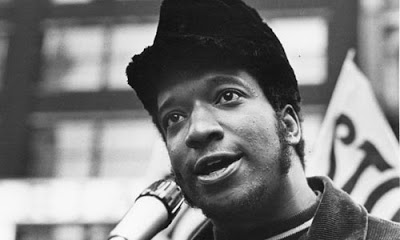
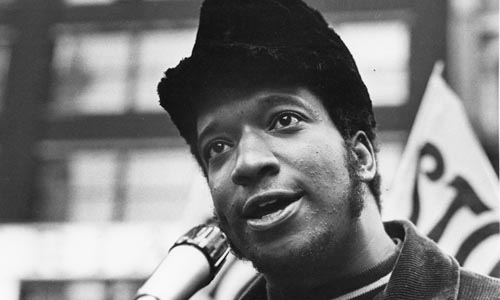
Black Panther leader Fred Hampton in 1969. Photo by Paul Sequeira.I will never forget…
The assassination of Fred Hampton
I protested in New York with hundreds of other people, all of us outraged… I was arrested and beaten on 51st Street opposite St. Patrick’s Cathedral by plainclothes police officers, and, along with dozens of other demonstrators, locked up in jail.
By Jonah Raskin / The Rag Blog / November 29, 2009
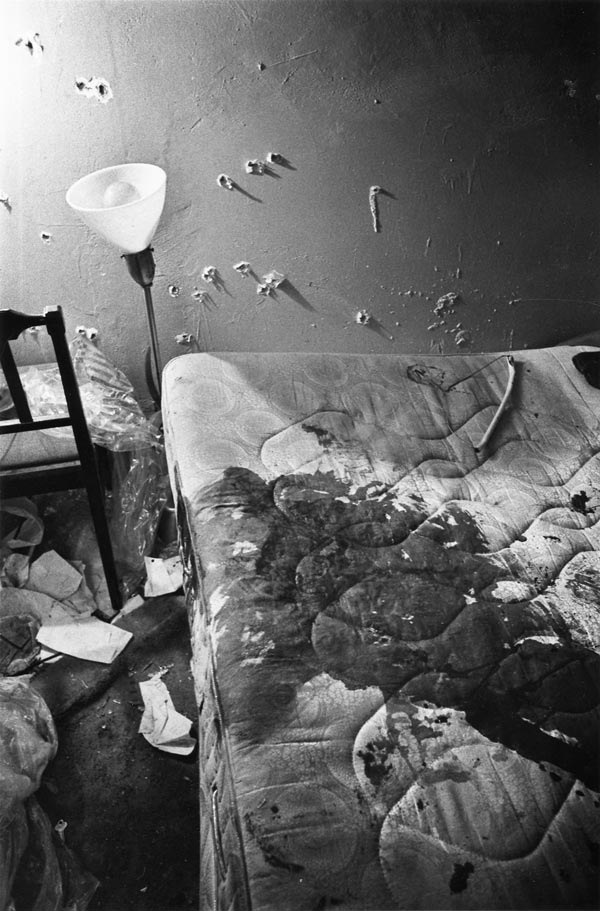
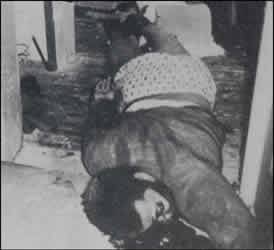
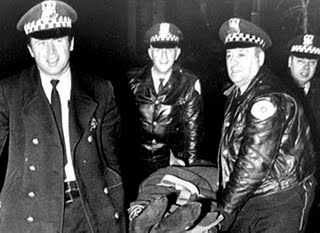
See photos from the murder scene, Below.
I have a special relationship to Fred Hampton, the charismatic leader of the Black Panther Party who electrified crowds in Chicago in the late 1960s with fiery comments such as “You can jail the revolutionary but you can’t jail the revolution.”
I first heard about Hampton — “Chairman Fred” as he was affectionately called — in the summer of 1969 when I was working in the national office of Students for a Democratic Society (SDS) in Chicago, where Hampton was born in 1948, and where he joined the Black Panther Party at the age of 20 in 1968.
That summer I wrote a pamphlet about him and about the attacks on the Panthers that were mounted by state and federal law enforcement. Six months later — on December 4, 1969 — Hampton and fellow Black Panther Mark Clark were murdered by the Chicago police in an apartment at 2337 West Monroe. Five days after those murders, on December 9, I protested in New York with hundreds of other people, all of us outraged.
At about 7 p.m., I was arrested and beaten on 51st Street opposite St. Patrick’s Cathedral by plainclothes police officers, and, along with dozens of other demonstrators, locked up in jail. All that night and into the wee hours of the next morning I was beaten by at least a dozen police officers in several precincts in Manhattan. My hands were handcuffed behind my back. I was punched, pushed, kicked, clobbered, and struck with a variety of blunt and sharp instruments, including truncheons. At the time it felt like torture.
My lawyer, Paul Chevigny of the American Civil Liberties Union, who specialized in cases of police brutality, said then that the beating that I received was the worst beating he had ever seen at the hands of the New York police. To document the case that he hoped to bring against the police on charges of brutality he took dozens of color photos of me that showed every cut, laceration and bruise — I was black and blue and swollen from head to toe — but someone broke into his law office and stole the photos.
When I appeared before a judge that December I was charged with attempted murder of a police officer, though I thought the police had been trying to murder me, or at least to make me feel that my life was in danger. “If you want war, we’ll give you war,” one of the New York City police officers who beat me said. He was a veteran of the War in Vietnam who believed in the war, and he carried out his own personal war against anyone and everyone who was opposed to that war.
In fact, it was a time of war and not only in Vietnam. America itself seemed to be on the brink of civil war in those violent days at the very end of the 1960s and on the cusp of the 1970s, and as President Nixon, FBI Director J. Edgar Hoover, and U.S. Attorney General John Mitchell launched a program to combat the tide of rebellion in every possible way.
The murders of Fred Hampton and Mark Clark, and the attacks on the Black Panther Party all around the country, added up to a war with real guns and real bullets. It was accompanied by a public relations campaign that the forces of law and order in the Nixon administration aimed at black militants and at their white supporters: a rag-tail army of rebels, resisters, rioters, anarchists and saboteurs who did everything in their power to disrupt the orderly, day in and day out operations of the American Empire.
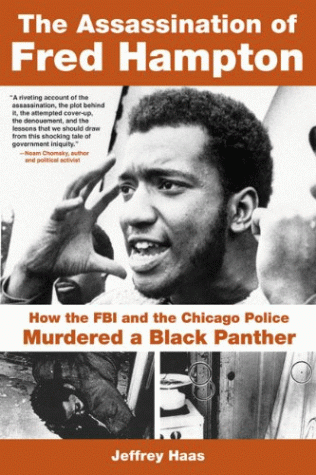
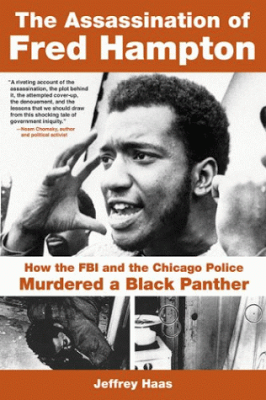 The Assassination of Fred Hampton: How the FBI and the Chicago Police Murdered a Black Panther, by Jeffrey Haas. Lawrence Hill Books; $26.95.
Recently, I had the opportunity to revisit those turbulent times, and to rethink the murder of Hampton. Forty years is a long time, but my memories of that era are crystal clear. I was also aided and abetted by The Assassination of Fred Hampton, a new and engaging book by long-time radical lawyer Jeff Haas who spent more than a decade aiming to uncover the government conspiracy against the Panthers and to see justice done.
Haas brought a civil suit against the real criminals in the case such as Edward Hanrahan, the Illinois State Attorney and a Harvard Law School graduate, who dispatched 14 heavily armed Chicago police officers to 2337 West Monroe on December 4, 1969, at 4 a.m.. “Heavily armed” is no exaggeration. In addition to shotguns and handguns, the officers had a Thompson machine gun, wielded by officer Joe Gorman.
One can only imagine what Gorman and his fellow police officers thought they were doing, but it seems possible that they saw themselves as actors in a movie about a Chicago gangland massacre in which they played the part of gangsters with police badges.
The seven Panthers who survived the raid on West Monroe were indicted by an Illinois grand jury on charges of attempted murder and aggravated battery, but the indictments were dismissed. And that was only the beginning of a series of legal battles that went on and on and on, into the 1980s.
In The Assassination of Fred Hampton Haas shows that an undercover police agent infiltrated the Illinois Panthers, that he became Hampton’s bodyguard, and furnished to law enforcement officials vital information about Hampton, Clark and their comrades. The Chicago police had a floor plan of Hampton’s apartment, and knew exactly where he would be sleeping. Someone, perhaps the undercover agent, drugged Hampton so that he would be asleep and unable to fire a shot.
Haas also shows that the police had a green light from FBI Director Hoover who created the FBI Counterintelligence Program (COINTELPRO), and who sent a directive to Marlin Johnson, the head of the Chicago FBI office, in which he ordered operatives to “disrupt, expose, misdirect, discredit, or otherwise neutralize” the Panthers, and “prevent the rise of a messiah who could unify and electrify the militant black nationalist movement.”
It didn’t matter that Hampton wasn’t a black nationalist. He was messiah-like and he was young. He was a Panther, and the Panthers, who carried guns, used the rhetoric of urban guerrillas, urged members to “Off the Pig” in the parlance of that era. In fact, on November 13, 1969, two Chicago police officers were ambushed and murdered. The FBI pointed an accusing finger at the Panthers, and the local police carried out their directive. One Panther would testify that on December 4, while inside the apartment at 2337 West Monroe, he heard a police officer say, “If Black Panthers kill police, police will kill Black Panthers.”
The Assassination of Fred Hampton has plenty of drama both in and out of the courtroom, and at times it reads like a suspenseful Perry Mason case, though it was, of course, far more political than any case Perry Mason ever handled and with more far-reaching implications. Hanrahan was never able to run successfully for public office in Chicago after Hampton’s murder, and Panthers as well as the African American community at large found solace in his failure. But there was no real justice, and no happy ending of the sort Mason always enjoyed at the end of a case.
The surviving occupants of the Panther apartment filed for damages against 28 state and federal law enforcement officials. Haas was their lawyer. The complaints alleged violations of constitutional rights. The jury trial lasted 18 months, generating a 37,000-page transcript. At the close of the case, a District Court granted verdicts in favor of the federal and most of the state defendants. Neither the judge nor the jury wanted to believe that the government had actually conspired to murder two men.
After I was beaten by New York City police officers some of my friends assumed that I was to blame, and that I deserved the harsh treatment I received. After all, they said, I had rioted in the streets. I had damaged property and I was violent. That the police who beat me were no less violent many friends could not and did not see or understand. The police had cracked my skull — I required dozens of stitches — and had beaten me to a bloody pulp, but in the eyes of many citizens the police were simply doing their job and enforcing law and order.
Forty years later, I am not sorry that I rioted in the streets of New York. I am, of course, happy to be able to say that the charges of attempted murder against me were dropped when I agreed to drop the case against the police for brutality.
When police officers murder men in their sleep one can’t simply go on living as though nothing has happened. Indeed, something very terrible happened in America when Fred Hampton and Mark Clark were assassinated. I have not forgotten them, and I have not forgotten what happened to me on December 9, 1969. The stain is still there on the national conscience. That is how I feel now, 40 years later.
Perhaps if you read Haas’s relentlessly honest book, and also see reproduced here the photos of the Panther apartment with bullet holes in the walls, and the bloody mattress of the bed in which Hampton lay asleep, you will not forget either.
[Jonah Raskin is the author of The Mythology of Imperialism: Revolutionary Critique of British Literature and Society in the Modern Age (Monthly Review Press), and American Scream: Allen Ginsberg’s “Howl” and the Making of the Beat Generation (University of California Press.]
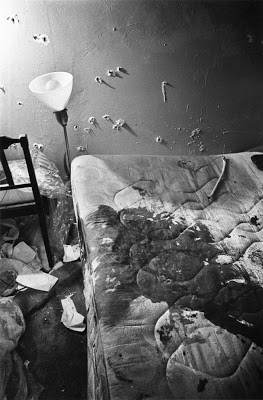
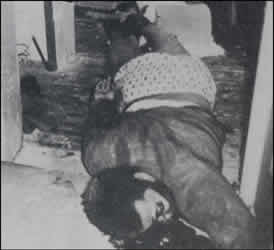
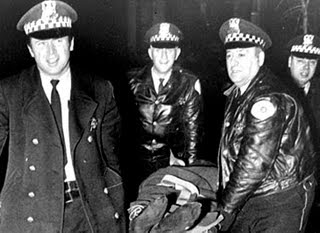
Fred Hampton murder scene. Photos, from top, by Paul Segueira, from the Chicago Police Department, and from AP / World Wide Photos.
The Rag Blog
















Career Tips : Pollyanna’s Postmodern Pointers
Employment trends for a post-widget world
By Pollyanna O’Possum / The Rag Blog / December 1, 2009
AUSTIN, Texas — Let’s face it, friends: the U.S. of A. is not going back to making widgets anytime soon.
Not even the deepening economic crisis has had any effect in moving us towards an economy that produces material goods for trade; if anything, it has demonstrated that in general, Americans would prefer to become subsistence farmers, or even roving hunter-gatherers, rather than go back to factory work.
So be it. In the Future, unique communitarian ecotribes will rule. Yum, yum, acorn meal!
But there seems likely to be a lengthy and bumpy transition period, and I worry about the welfare of those now between the ages of two and 20, who are most likely to experience the full transitional mood swings to come.
I like to help young folks, and I’ve come up with a short list of potentially rewarding near-term future careers. Kids, while you’re learning to pickle beets and/or raise milk goats, consider summer jobs or internships in the following growth areas:
1. Celebrity stalker. Pick of the crop, really; “it’s in the stars!” As the number of celebrities grows exponentially, so does the need for stalkers. Tasks include writing crazy love or hate messages, lurking around celebrities’ homes or hangouts, and making up bizarre alternate histories in which you and the celeb were married last year on Triton, or exchanged identities while in kindergarten. This position requires enthusiasm, spontaneity, a poor command of logic, and most of all, people skills.
Remuneration varies, and until a new national union of celebrity stalkers gets its legs under it, is likely to be spotty. Best bet so far: getting a lump sum settlement after having the crap beaten out of you by celebrity bodyguards.
2. Like outdoor work? Street riot tactician is bound to be an up-and-coming occupation as economic woes spread! Mobile combat paramedics and, for you more authoritarian kids, FBI informer, should also see continued growth. Tip: for best success in this fast-moving area, learn a second language well enough to appear to be an immigrant if that seems advisable. A theatrical flair is a big plus: you have to be able to project your voice to be a really good street commando!
3. Another outdoor job we’re seeing a lot of these days is sale sign holder. It doesn’t have to involve a costume anymore!!! No-credit-check cell phone companies, quick oil-and-lube shops, and retailers in trouble are resorting to person-with-a-sign-standing-on-the-curb advertising with surprising frequency. It may look good on your resume, but I’m not optimistic about the long-term outlook for this position — after all, it depends on those small businesses being in business! Bottom line: summer job or moonlighter. And if you can handle the costume, tax season officially kicks off on the first of the year, aspiring “Uncle Sams” and “Statues of Liberty” should be out there now putting in applications. Note that this job actually pays, maybe in free tax return preparation; maybe in tacos, but it pays.
4. Speaking of tacos, the proliferation of fast-food trucks around town is leaving us wondering when we’ll begin to see the first big-time, hip-fashionable reviewers of mobile fare — you know, people whose tweets matter! This should be good for at least a few meals — and say, can you tell me about the food truck sushi on Manor Road? Is it really fresh?
5. Finally, I’m going to suggest dusting off an oldie-but-goldie for the End Times Ahead: perpetual student. The return of Pell grants and continuing economic pressure for extended adolescence may portend a return to the carefree days of the mythic Sixties — minus the free love, of course; again, sorry about that, kids! — when one could change one’s major six or seven times, getting ever-so-close to graduation each time, before being actually forced to choose a lifepath. Instead of overgrown state universities, look for community colleges and alternative institutions — such as the new cannabis colleges sprouting in California, Michigan, and no doubt soon in a state near you — to be venues for a new rash of prolonged educational detours. Study anything they’ll pay you to study; little of it will prove useful once you leave school, but if you learn it well enough, you can teach.
Sharp-eyed readers will notice that I’m not recommending some of today’s hottest employment choices, notably reality show contestant and porno actor/actress. The first field has gotten terribly overcrowded and is really the basis for the recommendation above to consider subsidiary fields, such as celebrity stalker. It’s a choice that still leaves you well-positioned if the right show comes along! And porno movies, despite our aging population, are still really only good gigs for the young. Let’s face it, you don’t have to pay good money to see old people getting screwed!
For longer term opportunities, think about preparing for work as a draft counselor (it’s coming, dearies!), a Seventies re-enactment stunt person (disco will be played!), or applying for membership on your local death panel. The main thing to remember is that every generation has its own challenges, and for every disappearing job category — such as, “employed” — there’s something new right around the corner. Re-use, re-train, re-volt!
The Rag Blog