Marilyn Buck from the Greybar: Thoughts on the Recent Election

Marilyn J. Buck was an activist in Austin, Texas in the late sixties. She was a staffer on The Rag, the underground newspaper that was The Rag Blog’s inspiration. She is also a former editor of the original SDS’ New Left Notes, former member of San Francisco’s movement film project Newsreel, an accomplished poet, and a literacy and AIDS prevention educator. She is also the longest-held woman political prisoner in the US today. To learn more about Marilyn’s history, her incarceration and her creative work, go to her Web page and to her entry on the Rag Authors’ Page.

Behind the walls and fences of Dublin Federal Correctional Institution in California, where she may now begin cautiously to anticipate her release in 2010, Marilyn has a unique perspective on the prospects and reality of social and political change. What follows is her most recent monthly letter to supporters she cannot always write to individually, handwritten and mailed by her, typed and e-mailed by friends in the Bay Area. We think it’s worth passing on here.

Mariann Wizard / The Rag Blog / December 20, 2008

Kinder and Gentler Empire Maintenance
By Marilyn Buck / The Rag Blog / December 20, 2008

Another year is nearly done, and thank the intelligence of the mass of voters, many who could never stomach the Bush regime, and others whose stomachs are shrinking because of the war and the rapacious neoliberal boondogglers. I wept, along with nearly all the Black women here, as well as some other women here inside prison walls, to see that in this lifetime, from the civil rights and black power movements that were revitalized by black GIs returning from the 2nd world war to now, that a person of African heritage would be elected.

Changes have occurred here in the U.S. Of course there were radical changes when the Black Reconstruction period opened. White supremacy and privilege are still alive and well. As we well know, capitalism accommodates any and all who support its agenda, especially a more centrist agenda. Hopefully in this next period, a more visionary, and materialist, strategy along with movements will emerge or continue to develop with a new resolve. The rest of the world is watching and holding its breath, wondering if the U.S. will reform its bellicosity and greed, or if this might just be a new face, in order to look more like the rest of the world. Kinder and gentler empire maintenance.

I’m sure you have read and heard more, and know more the sentiment in society as a whole. It is always a little strange to know the world through what I read, and hear on KPFA. I sometimes forget that I am plagued with a myopic view and imagine that I know “stuff.” I wonder what I might have missed, because as yet I haven’t heard or read about any vision of what might be done. Thus, I have one imperative question as I look at how the capitalists were so able and ready to replace any socialist economic vestige, at whatever price (despite the view that the fall of the wall and the USSR underwent a peaceful transition to capitalism).

That is: what is a strategy for the peaceful, at least non-declared war, to replace capitalist mode of finance and production? What could be done in such a capitalist crisis as we are now experiencing? What is our plan, those of us who imagine socialism as a possibility? What if there is no “revolution”? I’ve heard and read some tactical suggestions. But tactics don’t automatically marshal into a vision or a strategy! I am woefully underdeveloped in the realm of “alternative” economic systems, so don’t have much of a clue. I would have liked to hear something more than tactical alternatives when the 700 billion “stimulus” package was introduced and with a little tiny bit of foot-dragging was smilingly passed.

Many of the women here in Federal prison are holding their breaths expectantly. The possibility that there will be a forthcoming change in the draconian sentencing laws of 1987 has more than a few glued to the TV and radio news; rumors abound. Those who are foreign national are also holding their breaths, hopeful that they too will be included in any relief, but fearful and resentful that some proposals would not affect their purgatory at all. After more than 20 years of the 1987 “new law”, there may be a change in the number of good days at least, though there hasn’t been mention of shortening sentencing guidelines.

Those who would have voted for McCain were curiously silent, didn’t even watch the election results (some people can’t get past their whiteness, no matter what! Many of these same people here also avidly watch all the prison lock-up and Wanted-type programs. I don’t quite get it, except most are anti-women in more than a few ways. It really is our fault, Eve!!)

This is the expected after the beleaguering storms of the torturer’s war against the world, and the wobbling legs of capitalism! But now the to-be-expected advisors are arriving in order to continue the empire as kinder and gentler, and to look more like the world that feeds its best minds, natural and human resources to the empire. I mean, Rahm Emmanuel!! A Mossadian lout.

And so we march forward into unending war, still believing that war keeps capitalism strong. And besides, isn’t it our natural state of being? Perhaps, one day, cooler heads will prevail. A new conception of leadership. I suspect such leadership will be full of women with a new attitude!

HAPPY NEW YEAR!

The Rag Blog

Posted in Rag Bloggers | Tagged , , , | Leave a comment

Lame Duck Dubya’s Belated Bailout

President Bush pauses during a statement on the auto industry at the White House on Friday, December 19, 2008 in Washington. Photo by Evan Vucci / AP.

‘It looks like the feds are going to end up owning and supporting a failed industry that lacks the cheap oil to give it a credible future.’
By Roger Baker
/ The Rag Blog / December 20, 2008

See ‘Bush: auto plan only way to stave off collapse’ by Tabassum Zakaria, Below.

The real problem is that keeping a failed and mismanaged industry on life support for a few more months doesn’t do much good. Not unless somebody in charge can think of a smart way forward after that down payment runs out.

“…the carmakers would provide a restructuring plan by March 31 that would show they would survive, or they would be required to repay the loans…”

Is this requirement really serious? How could these companies possibly repay the bridge loans if they need the money so badly right now? Or is it considered acceptable to lie to the public this openly about how our future tax obligations are being handled.

It looks like the feds are going to end up owning and supporting a failed industry that lacks the cheap oil to give it a credible future.

(Gasoline is cheap for the moment, but future fuel affordability is an illusion.)

If Detroit can make cars, they SHOULD be able to make the trains and wind turbines we will really need in the future. But how could the Detroit car companies, given their track record, possibly decide to do something that bold on their own?

It is obviously going to take the feds to tell them they must make such basic changes. We are groping toward socialist management and public control of the unprofitable sectors of US basic industry, all the while being afraid to admit that this is happening.

Bush: auto plan only way to stave off collapse
By Tabassum Zakaria / December 20, 2008

WASHINGTON — President George W. Bush on Saturday said offering government loans to U.S. automakers was the only option left to prevent the industry from collapsing after alternatives were ruled out or failed.

Bush on Friday announced the government would provide $17.4 billion in emergency loans to financially strapped General Motors (GM.N: Quote, Profile, Research) and Chrysler LLC CBS.UL to prevent them from failing. Ford decided it did not immediately need similar loans.

In return, the carmakers would provide a restructuring plan by March 31 that would show they would survive, or they would be required to repay the loans.

Lawmakers from Bush’s own Republican Party criticized the plan, which can be changed by the incoming administration of Democratic President-elect Barack Obama after he takes office Jan. 20.

“We have ended up with an agreement open to interpretation, that eliminates the sense of crisis, where taxpayer dollars are expended and we are left to hope that the next administration has the will to enforce the tough concessions necessary to make these companies viable for the long term,” Sen. Bob Corker, a Tennessee Republican said.

Bush in a weekly radio address said his economic advisers warned that if the automakers filed for bankruptcy it would lead to a “disorderly collapse” of the industry and send the economy into a “deeper and longer recession.”

After Congress was unable to pass legislation to bail out the auto industry, the only way to stave off a collapse was for his administration to step in, Bush said.

The automakers are capable of demonstrating by the end of March that they can restructure into viable companies, he said. If not, the loans would provide time for the carmakers to prepare for an “orderly” Chapter 11 bankruptcy process that offered a better prospect of long-term success, Bush said.

“This restructuring will require meaningful concessions from all involved in the auto industry — management, labor unions, creditors, bondholders, dealers, and suppliers,” he said.

“The actions I’m taking represent a step that we all wish were not necessary,” Bush said. “But given the situation, it is the most effective and responsible way to address this challenge facing our nation.”

Source / Reuters, UK

The Rag Blog

Posted in Rag Bloggers | Tagged , , , , , | Leave a comment

BOOKS / Thoreau’s Worst Nightmare : Self-Denial as Self-Promotion

Illustration by Maurice Vellekoop / Mother Jones.

The most notorious neo-Thoreauvian might be Colin Beavan, a 45-year-old New Yorker better known as No Impact Man, and even better known as The Man Who Doesn’t Let His Wife Use Toilet Paper.

By Michael Agger

[This article appears in the November/December issue of Mother Jones.]

When Henry David Thoreau retreated to the woods, he famously told his readers that he wanted “to front only the essential facts of life.” What he didn’t say is that he also wanted to front the essential facts of his ambition. It was at Walden Pond where Thoreau, an original slacker, finally became a writer. He finished his account of a canoe ride with his brother, A Week on the Concord and Merrimack Rivers, and wrote the first draft of Walden, the book that made his name.

After 150 years, Walden endures as a monument to frugality, solitude, and sophomore-year backpacking trips. Yet it’s Thoreau’s ulterior motive that has the most influence today. He was one of the first to use lifestyle experimentation as a means to becoming a published author. Going to live by the pond was a philosophical decision, but it was also something of a gimmick. And if you want to land a book deal, you gotta have a gimmick. Recently, with “green living” having grown into a thriving and profitable trend, the sons and daughters of Thoreau are thick on the ground. Not many retreat to the woods anymore, but there are infinite ways to circumscribe your life: eat only at McDonald’s, live biblically, live virtually, spend nothing. Is it still possible to “live deliberately”? What wisdom do we take away from our postmodern cabins?

The most notorious neo-Thoreauvian might be Colin Beavan, a 45-year-old New Yorker better known as No Impact Man, and even better known as The Man Who Doesn’t Let His Wife Use Toilet Paper. That last detail was the highlight of a 2007 New York Times profile of Beavan, which portrayed how he, his wife, and their two-year-old daughter were attempting to live in downtown Manhattan with zero “net impact” on the environment. This goal involves eating only organic food grown within a 250-mile radius, composting inside their small apartment, forgoing paper, carbon-based transportation, dishwashers, TV, and adhering to whatever new austerities Beavan dreams up.

Naturally, Beavan is hoping his no impact experiment has maximum impact. Like Thoreau, who, after all, was living on Emerson’s land, Beavan is well connected. He has a book contract. His wife’s friend has made him the subject of her documentary film, and he has a website, where people praise his boldness and question his motives. One commenter, Naysayer, speaks for the cynical: “Well, you’ve found your ticket to fame and fortune. Just undergo a period of time where you are inconvenienced (but plenty of exceptions) then cash in with book and movie deals, then speaking engagements around the globe.” And then there are those whom Beavan has simply annoyed: “For the next year, I will be your polor [sic] opposite,” writes Full Impact Woman. Unlike his deadly earnest spiritual mentor, though, Beavan views his project with an ironic distance, telling the Times, “Like all writers, I’m a megalomaniac. I’m just trying to put that energy to good use.”

Beavan can be overbearing, but every ascetic choice implies a critique of those who aren’t following the same path: I am giving up my car, therefore you are a selfish, earth-destroying auto addict. Also, extreme conservation—not flushing the toilet, not showering, and the like—can turn people off to conserving at all. Thoreau took it on the chin from Robert Louis Stevenson, who wrote of him, “So many negative superiorities begin to smack a little of the prig.” The critique of Beavan is the same. These men have walled themselves off in a little hothouse of their own ego. They are not living courageously and independently in the real world, nor could they if they tried. Fair points, but what’s the alternative? Every decision to try to live differently starts with a little showmanship.

So the self-deprivation author must tread lightly: Bear witness to my extreme example, but realize that I’m just like you. Judith Levine, who charts her Year Without Shopping in Not Buying It, manages this balance gracefully. She goes on a spree before the pledge begins, and keeps in touch with her imperfection throughout. Yes, there is the thrifty virtue in resisting the latest, expensive fashions, but not buying also means becoming a cultural recluse. “An informed person like me needs to see new art, new films,” Levine writes, longing for all the movies passing her by. She and her partner Paul discover that to subsist on free entertainment is to read dusty library books and endure bad performance art. Levine does experience the joyful liberation from stuff, and she temporarily gets off the hedonic treadmill. Yet she also admits that to not consume anything is to become a burden to friends, to feel old, and to develop an unholy craving for Q-tips.

Inspiration for these books can arrive in ridiculous ways. Mary Carlomagno, the author of Give It Up!: My Year of Learning to Live Better With Less, launched her self-denying quest this way: “While reaching for my black sling backs, an avalanche of designer shoeboxes hit me squarely on the head.” Gotcha. She spends a month each giving up different things: alcohol, elevators, newspapers, multitasking, cursing, cell phones, and coffee. (Coffee is a common enemy in these books, including Walden.) Carlomagno is a less rigorous self-denier than most—the height of her deprivation is to give up dining out for a month. Yet she arrives at the same destination as do her peers: reading more poetry, taking longer walks.

While most of these authors accessorize their quests with some larger purpose, Sara Bongiorni, the author of A Year Without “Made in China”: One Family’s True Life Adventure in the Global Economy, decides to boycott China simply to “see if it can be done.” (See our own experiment in buying American.) Her book is marred by a faint jingoistic tone and a deadening obviousness. Guess what? A lot of the stuff in your house comes from China! (But not Hungry Hungry Hippos, apparently.) Toward the end of her year, Bongiorni debates whether to extend her pledge, but concludes, “A Christmas without Chinese gifts under the tree looms like a date with the executioner.” Never has an attempt at conscientious consumption so missed the point.

In all of these self-deprivation experiments, there comes a moment when self-denial becomes self-defeating. An Internet entrepreneur from San Diego named Dave Bruno has received a lot of back pats for his “100 Thing Challenge,” a goal to limit his possessions to that magic number. It’s a useful thought experiment, but do shoes count as one thing, or should each shoe count as a separate item? The point—how much crap do you really need?—can quickly get lost in the details. Ascetics often become distracted by the rules or take things too far. Consider the fervent subculture of people who try to live plastic-free lives. Another perfectly worthy goal, but then you stumble upon advice like this on the blog PlasticLess.com: “Get a Vasectomy: Children are the target market for pointless plastic stuff. Most temporary forms of birth control involve some plastic packaging.” (Uh, okay.)

I don’t mean to throw cold water on earnest self-improvement. But maybe we should set about such tasks in a way that doesn’t reek of personal branding. Thoreau, after all, left the cabin behind, which earned the respect of Robert Louis Stevenson: “When he had enough of that kind of life, he showed the same simplicity in giving it up as in beginning it. There are some who could have done one, but, vanity forbidding, not the other; and that is perhaps the story of hermits; but Thoreau made no fetish of his own example.” While that doesn’t mean not writing a book, it may mean not letting the rigor of your experiment get in the way of the lessons.

All of these writers have good advice for our economically perilous and environmentally precarious moment. Not many, however, were permanently changed by their yearlong experiments. The authors of Plenty: One Man, One Woman, and a Raucous Year of Eating Locally welcome lemons and beer back into their house. Judith Levine is thrilled to buy new socks and starts to consume again, albeit in a more deliberate way. The ultimate lesson of the new Thoreauvians seems to be that change is rarely drastic. We must strive for continuous, daily, incremental improvement toward whatever social, environmental, and economic goals we deem important. That path won’t land you on Morning Edition, but it might just get you to floss, recycle, grow your own food, sit in the dark, air-dry yourself, take daily walks, and read more poetry. Which puts us back where we started: Walden Pond, 1845.

[Michael Agger has yet to write a book on self-sacrifice.]

Source / Mother Jones

The Rag Blog

Posted in RagBlog | Tagged , , , | Leave a comment

Support for the Shministim : Concientious Objectors in the Israeli Army


‘These are young adults, just out of high school, who have managed to break through all the myths that they have been immersed in and figured out for themselves what the Army actually does.’
By Rebecca Vilkomerson / December 19, 2008

It is hard to convey, and impossible to overstate, just how completely saturated Israeli culture is by the heroic image of the Israeli Army. In school, advertisements, marketing campaigns,store discounts, discussions with neighbors, every way you can imagine, the Army is portrayed as the ultimate form of service to the country. When I took my daughter, who is five, to the doctor recently, the doctor began her explanation of how vaccines worked in this way: “you know how Israel has an Army that protects us? Well the vaccines are your body’s army…”

It is simply everywhere.

That is what makes the shministim all the more remarkable. These are young adults, just out of high school, who have managed to break through all the myths that they have been immersed in and figured out for themselves what the Army actually does. Having reached the conclusion that being in the Army would force them to commit immoral actions, they have taken the next obvious—but in no way easy—step of taking action by refusing to serve. All in the face of family pressure, peer pressure and societal pressure that is absolutely intense. They are willing to pay the price, which can and does include jail time, for standing up for what they know is right.

As far as I am concerned, as a mother who is raising two Israeli daughters, they could not be better role models.

So I invited my daughter to join me at the December 18th Day of Action in Solidarity with the Shministim, and I was thrilled that she even agreed to leave her sister’s Chanukah party early to accompany me.

The Day of Action had already attracted welcome attention: a front page article this morning in Haaretz, a moving statement of solidarity from U.S. Army war resisters, and a strongly worded statement of support from Amnesty International.

When we arrived, the first thing we saw was box after box after box after box lined up on the street. These were the letters and postcards that had been generated by the international campaign, over 20,000 in total.

We were arrayed across the street from the imposing kiriya, the Army headquarters. This was as close as the police would allow us to get. We were a small group, about two hundred people, and this reminded me just how brave and still isolated the refusenik movement in Israel is, and therefore how much the international support really means.

The spirited crowd chanted and yelled support as some of the shministim–Omer Goldman, Sahar Vardi, Raz Bar-David Varon–and the relatives of Yuval Ophir-Auron and Sahar Vardi, took turns bringing the boxes of letters to the locked gates of the kiriya, where eventually two men in suits agreed to take them all inside. They make a nice group, indicative of how a refusenik can come from any part of Israeli society, as Omer’s father made his career high up in the Mossad and Sahar’s family are relentlessly dedicated left-wing activists.

There is a traditional belief in Yiddish culture, which comes from the Jewish mystical tradition, about the lamedvavniks, the thirty six righteous and humble people for whom God saves the world. The shministim are our lamedvavniks-our voice of conscience, our tiny flickering hope of building a society that does not willingly participate in controlling, terrorizing, and killing the Palestinian people-enforcing the checkpoints, demolishing homes, destroying ancient olive groves, building the Wall, confiscating land, enforcing siege and all the other immoral and illegal actions of the occupation.

In the last minutes of the demonstration, I talked briefly with one of the organizers. She said, “you know, there’s a lot more we can do with these letters. We can hand them out on the streets of Tel Aviv. There are all sorts of things we can do.” She was clearly buoyed and excited about building on the movement the Day of Action had generated. And as we got back on our bike to ride home in the still-warm December air, my daughter said to me, “Mama, I never want to be in the Army.”

This is how it can begin. Because what if instead of six, or ten or sixty, six hundred refused? What if 6000 refused? The occupation would be over.

Israeli Conscientious Objectors — Shministim — say why they refuse to serve in the Israeli army that occupies the Palestinians.

For more information, go to Jewish Voice for Peace.

To sign a letter of support, go here.

Thanks to Fran Hanlon / The Rag Blog

Posted in RagBlog | Tagged , , , , , , | Leave a comment

Austin Iraq Vets : ‘Ain’t Gonna Study War No More’

Casey Porter. Photos by Sandy Carson / Austin Chronicle.

Stop the Loss:
Austin veterans turn away from Iraq and war

By Richard Whittaker / December 19, 2008

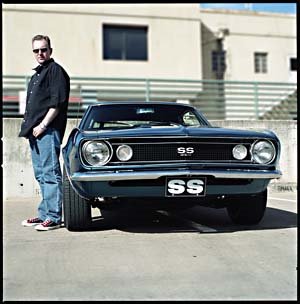
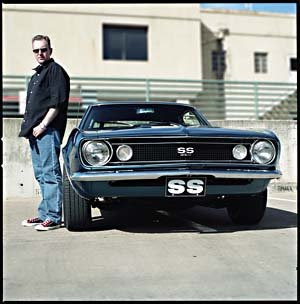
Eight years ago, Casey Porter and his father started rebuilding a ’68 Chevrolet Camaro. It was a junker with no paint and no engine, and getting it roadworthy was a family project. But for the last four years, progress has been slow. That’s how long Porter’s been in the Army. For 21 months, he’s been “stop-lossed,” the U.S. Army’s way of keeping soldiers enlisted beyond their original contract. Now Porter is eight months into his second Iraq deployment, engaged in a war that he, like many other soldiers and veterans, no longer believes in.

So now he has a new project: making films about the reality of life in Iraq for U.S. military personnel.

These aren’t rough clips of gory attacks that spark online controversy, and they’re definitely not gung-ho recruitment ads. Nor are they the 30-second casualty reports or the congressional committee coverage that too often pass for “war reporting.” It’s one soldier talking to other soldiers about his or her experiences, then using the Internet to let everyone else know what’s going on. Using a $150 off-the-shelf camcorder, a laptop, some editing software, and a YouTube account, Porter has created short documentaries to show to his viewers the raw, unvarnished truth. “There might be music, and I might have some flair in my videos, but they’re not getting a government-sanctioned version,” he said.

That doesn’t mean Porter’s footage, of life in a war zone, is not brutal. He shows acts of kindness as well, such as sharing rations with children. But there are the roadside bombs and the body parts, the badly maintained military facilities and the wrecked streets, the sandstorms and the fireballs. It’s nothing that hasn’t been talked about – but to see it, five years into the occupation, makes quite a remarkable impact.

Some of Porter’s tales are heartrending. In “The Story of Two Dogs,” the fate of a pair of puppies his unit adopted is a savage indictment of the linear military mindset. In the simpler “Miller’s Story,” a comrade explains what it’s like to survive a mortar attack. Porter’s latest, “Deployment Game: Living FOBulous,” was shot inside the post exchange – imagine a Best Buy crossed with a Wal-Mart and a car dealership, then add incoming mortar rounds – at Camp Taji, north of Baghdad. (“FOB” is Army lingo for “forward operating base,” a secure camp away from the main base.) For Porter, it’s all part of the way troops are being misused. As one soldier tells him in “Deconstructed”: “It’s going to take a lot of stuff to fix this bruise we’ve put on the whole earth.”

Challenge and Disenchantment

Arranging a meeting with Porter, like everything else in his military career, took longer than it should have. First there were phone conversations from Iraq, plagued with a four-second signal delay (“It takes a little time for the CIA to listen in,” he joked in his first call). Then his leave, originally scheduled for Octo­ber, was pushed back to late November. His flight stateside had long layovers in Ireland and Dallas. When he finally made it to Katz’s Deli and ordered a burger (“I eat rare meat. Now you know the worst thing about me,” he grinned as he slathered on some cream cheese), he was greeted by the staff like a regular who had just stepped out for a moment.

Porter doesn’t look like a returning warrior, and he didn’t plan to be one. From age 11, when he first saw Terminator 2, he wanted to make films, but as an adult he tired of surviving on nickel-and-dime jobs. The Army was a change and a challenge. “I think, for a man in Ameri­can society, we question, ‘What can we handle?'” he said. “I had some misgivings about the war, but I didn’t question whether I believed in the fight. I put it on the back burner, like most Americans. But almost immediately I realized, in basic training, I had made a mistake.”

When he was deployed to Iraq for his first tour in December 2005, his disenchantment worsened. “There’s no reconstruction going on at the level they show you,” he explained. “The soldier’s mission is to survive. Not to win the fight, not to fight the enemy that is the main threat to the United States, but to simply survive. You’re sent on these missions that don’t make any sense, you’re patrolling these roads that you don’t care about, and the people on that road really don’t want you there.”

He was away from the Camaro, but as an Army mechanic, he was still fixing vehicles. First it was tanks, then the new mine-resistant ambush-protected vehicles, designed to survive improvised explosive devices – Iraq’s infamous IEDs. Being the unit film geek also paid off, as his first sergeant made him the company photographer. “What I basically ended up photographing was funeral services,” he says, “and stuff from outside the wire.”

During his first tour, from December 2005 to November 2006, he took footage with no real goal in mind, but when he returned to Texas in November 2006, the filming quickly became part of his anti-war protest. He joined Iraq Veterans Against the War and found he could use the footage he had gathered. “I came back and realized that filmmaking was still in my blood, something I never should have walked away from,” he explained. Through IVAW, he started showing his documentaries at colleges. “I would talk, show a film, talk, show a film, and then there would be these Q&As. What I realized was that these films – while they were [posted] online – in person, they had a strong emotional impact.”

Part of what frustrated him was the media coverage, which he knew was misleading or just wrong. Too often, Porter explained: “There’s a guy reporting live from the streets of Baghdad, and it’s total bullshit. He’s completely inside the [heavily protected] Green Zone.” Not that anyone who doesn’t know Baghdad intimately would know that. “There’s a big disconnect between the military service and civilian populations, and that works to the advantage of the military and the government, because they can pack so much bullshit in that big gap.”

Showing protest movies in Austin and filming them in Iraq are two quite different things. Porter knew he was at risk of being stop-lossed: After his first tour, he’d been transferred out of his unit to one more likely to be deployed. His contract, expiring January 2007, got extended, and under the lesser-known “stop-movement” program, he couldn’t transfer out to another unit less likely to be deployed. Then last December he got confirmation: His second Iraq tour would start in March 2008. This time, Porter was ready, and his decision was simple. “No wife, no kids, no debt. So you know what? I’ll make films about what I see.”

Making his movies, like being a member of IVAW, is completely legal under Army regulations: He has a civilian lawyer to review the films and posts them with all the necessary disclaimers. The problem for Porter is that some military personnel and most Iraqi civilians are nervous about talking on camera. It’s too risky, for their lives or their careers or both. “I need to expose people to what they’re not seeing,” he said, “but my only concerns are soldiers’ safety and the Iraqis’ safety.” The most important thing, he finds, is letting people know what he’s doing, so they have the chance to back out. “You may get someone on camera who just thinks you’re doing it for yourself, and that Iraqi is having to explain to somebody why he’s on YouTube with the Americans,” he said.

Yet while some people are cautious about being on camera, the finished films are popular with the troops. Well, mostly. “Lifers, they’re upset about it,” he explained. “Their whole career in the Army is spent in preparation [for] the mission, a mission, any mission. They say, ‘How dare you question it?’ and I say, ‘Well, why shouldn’t I?'” But among those on short contracts, he said, “I have guys who’ll throw me a peace sign on the sly.” He also doesn’t buy the line that it’s bad for troop morale – because it’s the troops that help him make the films. “When they see the footage they’ve given me, they see it edited and color-treated, they feel a part of something.”

Honoring the Contract
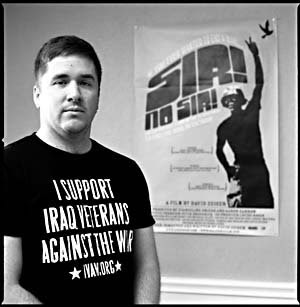
Ronn Cantu.

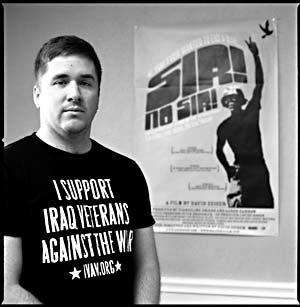
Porter is not the only Central Texas veteran speaking out. Los Angeles native turned Austin resident Ronn Cantu volunteered for the Army on March 9, 1998, for four years. His contract expired just after the 9/11 attacks. Since there was no stop-loss then, he was out. But he started to reconsider his future on Feb. 5, 2003: The day Secretary of State Colin Powell made his now-infamous presentation on Iraqi weapons of mass destruction to the United Nations Security Council. “I remember watching … and buying into it hook, line, and sinker,” said Cantu. His good memories of the Army helped: “In 1998, in the quote-unquote peacetime, I couldn’t take 10 steps without someone pulling over and offering me a ride to where I needed to go. There was a lot of camaraderie, a lot of esprit de corps and high morale.” So he re-enlisted as a sergeant.

Almost immediately, he knew something was wrong. The camaraderie was gone, the quality of recruits was dropping, and then in 2004, he was deployed to Iraq. “Some of us joked we were only there to test our armor, but none of us could understand why our brothers and sisters were dying,” he said. “I really felt betrayed, because we were not doing what I and the rest of the country were told we were supposed to be doing, and that’s helping the people.”

After his first tour, he returned to Fort Hood. With his unit broken up, he had no one to talk to who had shared his experiences, until finally he found Iraq Veterans Against the War. Then he heard he was going back to Iraq. Like Porter, he tried to make it as palatable as possible, switching from infantry to interrogation. After his second deployment, while publicly criticizing the war, Cantu faced possibly the strangest moment of his military career. “They made me a staff sergeant. No board [interview], no questions asked, just, ‘Here’s your extra rank, here’s your extra money, but by the way … you don’t get anyone below you.'” Automatic promotions above one-stripe privates, he said, are “a sign of how much the military is breaking down and losing leadership.”

While Porter and many others have made clear their opposition to the war, they still have a job to do. Porter explained: “I’m honoring the contract. I work hard; I don’t do shortcuts. One person in the anti-war community suggested I do sabotage. Absolutely not. I’m doing this, obviously for the Iraqis but for the other soldiers, because they’re the ones in the wringer.”

That attitude doesn’t surprise Cantu. “I haven’t seen Casey run from anything,” he said; but he understands why other soldiers are afraid to speak out and instead just keep their heads down. “If you get anything less than an honorable discharge or get jail time, that can really ruin your future,” he said. “The military attracts recruits by selling hope. They tell them: ‘We can make your life better. You need a steady job, and we can give you a steady job, with security.’ Nobody enlists to make their life worse. Nobody holds their hand up to take that oath thinking they’re going to go to jail for something they don’t believe in.” That’s something that radical anti-war activists don’t understand, he said. “The people that tell you to go AWOL aren’t offering you a job at the same time.”

The Chaplain’s Passion
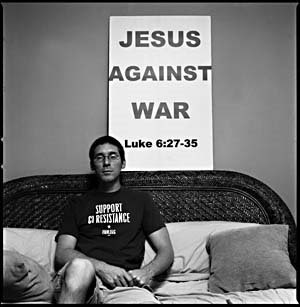
Benjamin Hart Viges.

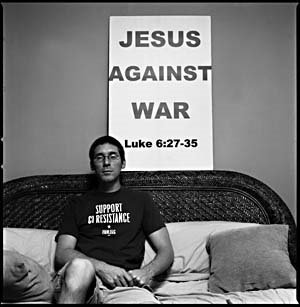
For others, leaving the military immediately is the only option. Like Cantu, Benjamin Hart Viges isn’t a native Texan, having traveled before joining the Army. That’s what brought him to Austin, where he is now the unofficial chaplain for the local IVAW branch. “I’m building my roots here,” he said. “I’ve given up moving.”

His story almost reads like a recruitment poster. “I joined the Army because of September 11 and went to Iraq in the initial year of the invasion in the 82nd Airborne Division.” For Viges, his Christianity is his bedrock; he was baptized in Baghdad. (“I was pissed when I didn’t get to go to Ur, the birthplace of Abraham,” he half-joked.) After returning, his resistance to the war became an act of religious devotion, but it took time. He said: “I thought that we’d done a good thing. I held on to that string that we’d got rid of Saddam.” It was then that he met his future fiancée, Alejandra, who placed in him what he calls “the burning question of why. In the same period, I saw the film The Passion of the Christ, and it gave me my language to resist.”

Viges applied for conscientious objector status, entering a battle with the Army bureaucracy. First there’s a lengthy form, he said, “Then you go through three interviews: One with a psychiatrist to show you’re not insane, one with a chaplain to verify how sincere you are and when you crystallized your belief, and one with an officer to rip you a new one.” After that, the paperwork went to the Department of the Army where “it has a 50-50 chance of being accepted,” he said. Not only was his accepted, but he went on to get his taxes exempted from being put toward military spending. “I realized that my real tax dollars buy real bullets that kill real people,” he said, “and that violated my conscientious objector status that I legally obtained through the Army.”

Now, in between working in a cafe, writing his memoirs, and planning to return to college to study theology, Viges has become a passionate and well-traveled voice against the war. He has spoken before the French, German, and European Union parliaments. Closer to home, he has spoken all around Texas, as well as taking calls on the GI Rights Hotline. “Sometimes,” he said, “I make a big ‘Jesus Against War’ sign and walk around Downtown Austin.” If kids want to serve, he points them toward organizations such as AmeriCorps, to change the dynamic of the military as the solution to all personal, professional, and international ills. “Doctors and teachers are peacetime reconstruction. When you carry a gun, the intimidation level is there.”

Sucking It Up

For Viges and Cantu, the war is over. In April, Cantu also applied for conscientious objector status. “I had taken a human life, and this is not how human beings are supposed to be treating each other,” he said. In August, he told his battalion executive officer that he would rather go to jail than do a third tour in Iraq. On Nov. 6, with 13 months left on his contract, he was honorably discharged. “I think they didn’t want to look bad, punishing a staff sergeant with 10 years experience who’s been there twice before with no bad marks on his record,” he said. What makes him suspicious is that three other active members of IVAW’s Fort Hood branch also got their walking papers early in the last month – effectively breaking up the branch.

Like Cantu, Porter’s been promoted out of harm’s way. “I’m a sergeant now,” he explained. But again, Porter feels the promotion works to the Army’s advantage, as it moved him away from his friends and comrades. Now he spends his days watching the radio. “They used this to boot me out of the unit,” he said, “and they won’t give me any soldiers to lead. But that’s OK, because they come up to talk to me.”

Porter’s leave was up on Dec. 10. He’s got another seven months left in the Army. “I’m not really worried about getting stop-lossed again,” he said. “I’m worried about being on the active ready reserve list, of being out for a year and getting called back.” As much as he looks forward to being back home, he knows how hard it can be, maybe even harder than just staying in. “There’s a term, ‘suck it up, and drive on,'” he said. “When I’m home, I try to readjust to civilian life. Like today, I’m in a really good mood, because it’s my first day back. But when I was back last time, it was, well, wait a minute, you’ve got to get back to real life again, and there’s that adjustment.”

But there’s one thing waiting for him when he leaves the Army. While he was on this current deployment, his father finished the Camaro. When he last saw it, the hood and the grill were off, and the chrome wasn’t finished. Now it sits off Sixth Street, its metallic paint iridescent in the sun. As he hits the ignition switch, it rumbles to life, and Casey grins.

Source / Austin Chronicle

Casey Porter’s videos can be viewed here.

Also see Austin : Iraq Veterans Speak Out Against the War by Susan Van Haitsma / The Rag Blog / Nov. 13, 2008

And BOOKS: Iraq Occupation Through Eyes of U.S. Soldiers by Dahr Jamail / The Rag Blog / Sept. 17, 2008

And GI’s Voice Dissent : War-Torn Vets Speak Out by Claudia Feldman / The Rag Blog / April 19, 2008

The Rag Blog

Posted in RagBlog | Tagged , , , , , , , , , | 2 Comments

Jim Hightower : Diminishing the Stench in Congress


Senate Majority Leader Harry Reid: ‘In the summer, because of the heat and high humidity, you could literally smell the tourists coming into the Capitol.’
By Jim Hightower / December 19, 2008

Perhaps you are as excited as I am that, at long last, our Congress critters have delivered for us!

Health care for all, you ask? No, not that. A real economic recovery program? Uh… no. An end to the Iraq war? No, again. Instead, what the lawmakers have produced for us is (hold on to your hat, now) a new Capitol Visitor Center!

Yes, if you and your family go to Washington to absorb a bit of the majesty of our country’s democratic institutions, a brand spanking new, 580,000-square-foot facility is now open for you and me – America’s hoi polloi. So, instead of standing in line outside the Capitol building to take a tour, we can stand in line inside the center. At least it’s air-conditioned.

And having AC turns out to have been a big selling point to get congressional leaders to spend $621 million for this tourist holding pen. It’s not that they’re concerned about the creature comfort of the 3 million hometown folks who trek through the Capitol each year – it’s that they don’t want to have to smell us.

Smell us? Yes, Senate Majority Leader Harry Reid announced that the center solves one of our country’s most pressing problems: stinky constituents. At the opening ceremony for the facility, Reid offered this homage to the common citizen: “My staff tells me not to say this, but I’m going to say it anyway. In the summer, because of the heat and high humidity, you could literally smell the tourists coming into the Capitol. Well, that is no longer going to be necessary.”

It’s good to know that the sweaty masses will no longer be quite so offensive to our finicky salons – but wouldn’t it have been cheaper just to have the guards hose us down as we enter the marble halls? Besides, with all the stench that constantly comes out of Congress, who knew that a senator’s nostrils can even detect BO?

Source /Jim Hightower

Jim’s sources:

Reid: We won’t smell the tourists anymore By Jeff Dufour and Patrick Gavin / DC Examiner / Dec. 2, 2008.

And Congress Won’t Have to ‘Smell the Tourists’ Anymore by Scott Ross / NBC Washington / Dec. 3, 2008

And Reid: Capitol Visitor Center Will Minimize ‘Smell’ of Tourists / Fox News / Dec. 2, 2008

The Rag Blog

Posted in RagBlog | Tagged , , , | 1 Comment

Dick Cheney: Forever Through the Looking Glass

Needless to say, the guy on the right isn’t the gang leader. Photo source.

Dick Cheney’s fantasy world: Despite the facts, the vice-president still insists that Saddam Hussein could have produced weapons of mass destruction
By Scott Ritter / December 16, 2008

In yet another attempt at revisionist history by the outgoing Bush administration, vice-president Dick Cheney, in an exclusive interview with ABC News, took exception to former presidential adviser Karl Rove’s contention that the US would not have gone to war if available intelligence before the invasion had shown Iraq not to possess weapons of mass destruction. Cheney noted that the only thing the US got wrong on Iraq was that there were no stockpiles of WMD at the time of the 2003 invasion. “What they found was that Saddam Hussein still had the capability to produce weapons of mass destruction. He had the technology, he had the people, he had the basic feed stock.”

The vice-president should re-check both his history and his facts. Just prior to President Bush’s decision to invade Iraq, the UN had teams of weapons inspectors operating inside Iraq, blanketing the totality of Iraq’s industrial infrastructure. They found no evidence of either retained WMD, or efforts undertaken by Iraq to reconstitute a WMD manufacturing capability. Whatever dual-use industrial capability that did exist (so-called because the industrial processes involved to produce legitimate civilian or military items could, if modified, be used to produce materials associated with WMD) had been so degraded as a result of economic sanctions and war that any meaningful WMD production was almost moot. To say that Saddam had the capability or the technology to produce WMD at the time of the US invasion is a gross misrepresentation of the facts.

While one can make the argument that Saddam had the people, insofar as the scientists who had participated in the WMD programmes of the 1980s were still in Iraq and, in many cases, still employed by the government, these human resources were irrelevant without either the industrial infrastructure, the economic base or the political direction needed to produce WMD. None of these existed. The argument Cheney makes on feed stock is even more ludicrous. Precursor chemicals used in the lawful manufacture of chemical pesticides were present in Iraq at the time of the invasion, but these were unable to be used in manufacturing the sarin, tabun or VX chemical nerve agents the Bush administration claimed existed inside Iraq in stockpile quantities prior to the invasion.

The same can be said about Iraqi biological capability. The discovery after the invasion of a few vials of botulinum toxin suitable for botox treatments, but unusable for any weapons purposes, does not constitute a feed stock. And as for the smoking gun that the Bush administration did not want to come in the form of a mushroom cloud, there was no nuclear weapons programme in Iraq in any way shape or form, nor had there been since it was dismantled in 1991. Cheney’s dissimilation of the facts surrounding Iraqi WMD serves as a distraction from the reality of the situation. Not only did the entire Bush administration know that the intelligence data about Iraqi WMD was fundamentally flawed prior to the invasion, but they also knew that it did not matter in the end. Bush was going to invade Iraq no matter what the facts proved.

Cheney defended the invasion and subsequent removal of Saddam from power by noting that “this was a bad actor and the country’s better off, the world’s better off with Saddam gone”. This is the argument of the intellectually feeble. It would be very difficult for anyone to articulate that life today is better in Baghdad, Mosul, Basra or any non-Kurdish city than it was under Saddam. Ask the average Iraqi adult female if she is better off today than she was under Saddam, and outside of a few select areas in Kurdistan, the answer will be a resounding “no”.

The occupation of Iraq by the United States is far more brutal, bloody and destructive than anything Saddam ever did during his reign. When one examines the record of the US military in Iraq in terms of private homes brutally invaded, families torn apart and civilians falsely imprisoned (the prison population in Iraq during the US occupation dwarfs that of Saddam’s regime), what is clear is that the only difference between the reign of terror inflicted on the Iraqi people today and under Saddam is that the US has been far less selective in applying terror than Saddam ever was.

At a time when the US and the world struggle with a resurgent Iran, the Iranian-dominated Dawa party of Prime Minister Nuri al-Maliki governs Iraq today in name only. The stability enjoyed by Iraq today has been bought with the presence of 150,000 US troops who have overseen the ethnic cleansing of entire neighbourhoods in cities around Iraq, and who have struck temporary alliances with Shia and Sunni alike which cannot be sustained once these forces leave (as they are scheduled to do by 2011).

Invading Iraq and removing Saddam, the glue that held that nation together as a secular entity, was the worst action the US could have undertaken for the people of Iraq, the Middle East as a whole and indeed the entire world. For Cheney to articulate otherwise, regardless of his fundamentally flawed argument on WMD, only demonstrates the level to which fantasy has intruded into the mind of the vice-president.

Source / The Guardian

The Rag Blog

Posted in RagBlog | Tagged , | Leave a comment

Does the Pentagon Intend to Betray the Iraq SOFA?

U.S. Army soldiers search an abandoned house for weapons and illegal materials during a patrol in Haidraq, Iraq, April 6, 2008. Photo courtesy of U.S. Army, by Spc. C.W. Gill.

U.S. Military Defiant on Key Terms of Iraqi Pact
By Gareth Porter / December 18, 2008

WASHINGTON – U.S. military leaders and Pentagon officials have made it clear through public statements and deliberately leaked stories in recent weeks that they plan to violate a central provision of the U.S.-Iraq withdrawal agreement requiring the complete withdrawal of all U.S. combat troops from Iraqi cities by mid-2009 by reclassifying combat troops as support troops.

The scheme to engage in chicanery in labeling U.S. troops represents both open defiance of an agreement which the U.S. military has never accepted and a way of blocking President-elect Barack Obama’s proposed plan for withdrawal of all U.S. combat troops from Iraq within 16 months of his taking office.

By redesignating tens of thousands of combat troops as support troops, those officials apparently hope to make it difficult, if not impossible, for Obama to insist on getting all combat troops of the country by mid-2010.

Gen. David Petraeus, now commander of CENTCOM, and Gen. Ray Odierno, the top U.S. commander in Iraq, who opposed Obama’s 16-month withdrawal plan during the election campaign, have drawn up their own alternative withdrawal plan rejecting that timeline, as the New York Times reported Thursday. That plan was communicated to Obama in general terms by Secretary of Defence Robert M. Gates and Chairman of the Joint Chiefs of Staff Admiral Mike Mullen when he met with his national security team in Chicago on Dec. 15, according to the Times.

The determination of the military leadership to ignore the U.S.-Iraq agreement and to pressure Obama on his withdrawal policy was clear from remarks made by Mullen in a news conference on Nov. 17 — after U.S. Ambassador Ryan Crocker had signed the agreement in Baghdad.

Mullen declared that he considered it “important” that withdrawal of U.S. forces from Iraq “be conditions-based”. That position directly contradicted the terms of the agreement, and Mullen was asked whether the agreement required all U.S. troops to leave Iraq by the end of 2011, regardless of the security conditions. He answered “Yes,” but then added, “Three years is a long time. Conditions could change in that period of time…”

Mullen said U.S. officials would “continue to have discussions with them over time, as conditions continue to evolve”, and said that reversing the outcome of the negotiations was “theoretically possible”.

Obama’s decision to keep Gates, who was known to be opposed to Obama’s withdrawal timetable, as defence secretary confirmed the belief of the Pentagon leadership that Obama would not resist the military effort to push back against his Iraq withdrawal plan. A source close to the Obama transition team has told IPS that Obama had made the decision for a frankly political reason. Obama and his advisers believed the administration would be politically vulnerable on national security and viewed the Gates nomination as a way of blunting political criticism of its policies.

The Gates decision was followed immediately by the leak of a major element in the military plan to push back against a 16-month withdrawal plan — a scheme to keep U.S. combat troops in Iraqi cities after mid-2009, in defiance of the terms of the withdrawal agreement.

The New York Times first revealed that “Pentagon planners” were proposing the “relabeling” of U.S. combat units as “training and support” units in a Dec. 4 story. The Times story also revealed that Pentagon planners were projecting that as many as 70,000 U.S. troops would be maintained in Iraq “for a substantial time even beyond 2011”, despite the agreement’s explicit requirement that all U.S. troops would have to be withdrawn by then.

Odierno provided a further hint Dec. 13 that the U.S. military intends to ignore the provision of the agreement requiring withdrawal of all U.S. combat troops from cities and towns by the end of May 2009. Odierno told reporters flatly that U.S. troops would not move from numerous security posts in cities beyond next summer’s deadline for their removal, saying “We believe that’s part of our transition teams.”

His spokesman, Lt. Col. James Hutton, explained that these “transition teams” would consist of “enablers” rather than “combat forces”, and that this would be consistent with the withdrawal agreement.

But both Odierno’s and Hutton’s remarks were clearly based on the Pentagon plan for the “relabeling” of U.S. combat forces as support forces in order to evade a key constraint in the pact that the Times had reported earlier. In an article in The New Republic dated Dec. 24, Eli Lake writes that three military sources told him that the U.S. “Military Transition Teams”, which who have been fighting alongside Iraqi units, as well as force-protection units and “quick-reaction forces”, are all being redesignated as “support units”, despite their obvious combat functions, “in order to skirt the language of the SOFA [status of forces agreement]”.

U.S. commanders have not bothered to claim that this is anything but a semantic trick, since the redesignated units would continue to participate in combat patrols, as confirmed by New York Times reporters Elisabeth Bumiller and Thom Shanker Thursday.

The question of whether Iraqis would permit such “relabeled” combat forces to remain after next June was discussed with Obama on Monday, according to the Times report. One participant reportedly said Gates and Mullen “did not rule out the idea that Iraqis might permit such troops…”

Despite Odierno’s assertion of the U.S. military’s prerogative to unilaterally determine what U.S. troops may remain Iraqi cities, the Iraqi government has already made it clear that the U.S. military has no such right. Defence Ministry spokesman Maj. Gen. Mohammed al Askari, responded to Odierno’s and Hutton’s statements by saying that U.S. commanders would have to get permission from the Iraqi government to station any non-combat troops in cities beyond the deadline.

The signals from Odierno of U.S. military defiance of the withdrawal agreement suggest that the Pentagon and military leadership still do not take seriously the views of the Iraqi public as having any role in determining the matter of foreign troops in their country. Nevertheless, the withdrawal agreement is still subject to a popular referendum next July, and Iraqi politicians have already warned that evidence of U.S. refusal to abide by its terms will affect the outcome of that vote.

Washington Post reporters quoted Sunni legislator Shata al-Obusi as saying that Iraqis “will see this procrastination and they will vote no against the agreement, and after that the government should cancel it according to its provision”.

Beyond the aim of getting Obama to abandon his 16-month plan, the military and Pentagon group still hopes to pressure Obama to agree to a long-term U.S. military presence in Iraq.

Further evidence emerged last week that Gates is a central figure in that effort. In a Washington Post column Dec. 11, George Will quoted Gates as saying that there is bipartisan congressional support for “a long-term residual presence” of as many as 40,000 U.S. troops in Iraq, and such a presence for “decades” has been the standard practice following “major U.S. military operations” since the beginning of the Cold War.

Those statements evidently represent part of the case Gates, Mullen and the military commanders are already making behind the scenes to get Obama to acquiesce in the subversion of the intent of the U.S.-Iraq agreement.

[Gareth Porter is an investigative historian and journalist specialising in U.S. national security policy. The paperback edition of his latest book, “Perils of Dominance: Imbalance of Power and the Road to War in Vietnam”, was published in 2006.]

Source / IPS News

H/t Juan Cole / The Rag Blog

* SOFA = Status of Forces Agreement

Posted in RagBlog | Tagged , , , | Leave a comment

Jeff Jones : The Bay Area Reacts to the Rick Warren Saga

San Francisco mayor Gavin Newsom has always been a vocal supporter of diversity and the GLBT community.

‘As an enthusiastic gay Obama supporter, I can see that his choice of a homophobe preacher is a gratuitous political gaffe that he didn’t have to make.’
By Jeff Jones / The Rag Blog / December 19, 2008

See ‘Gay leaders angered by Obama’s prayer pick,’ Below.

SAN FRANCISCO — Although conventional wisdom holds there are two sides to every story, there are some issues that really do not have two sides. What is the other side of racial equality? What is the other side of anti-Semitism? Surely, Obama would not have anyone be part of his inauguration who was an overt racist or an anti-semite. But apparently, whether the nation’s LGBT residents deserve to be treated equally is still up for debate.

As an enthusiastic gay Obama supporter, I can see that his choice of a homophobe preacher is a gratuitous political gaffe that he didn’t have to make. Clinton made a big mistake by getting involved in the “Don’t Ask/Don’t Tell” controversy at the very outset of his administration; I am very surprised that Obama has now made the same mistake.

Unfortunately, I don’t think Obama knows how bitter Queer Californians feel about the religious right’s passage of Proposition 8: it means discrimination against the LGBT community is now legal in California. Obama has put himself in the unenviable position of having to defend homophobia, since Warren was a militant advocate of Prop. 8. Although this situation will probably get nastier — there will inevitably be Queer protestors on Jan 20– after he’s sworn in Obama might feel compelled to repeal Don’t Ask/Don’t Tell, pass federal legislation to end LGBT discrimination, and maybe end the discriminatory exclusion of LGBT artists from federal arts funding. In the interim, here’s a sample of how San Francisco’s elected officials are reacting to this situation:

Gay leaders angered by Obama’s prayer pick

[….]Newsom disappointed

The mayor said the decision is painful for the gay and lesbian community, especially in California, where people are still reeling from the passage of Prop. 8.

“The gay community has every right to be upset,” Newsom said. “I hope people appreciate that Rick Warren was not just indirectly involved but very involved in taking people’s rights away. I’m disappointed, but I understand the decision.

“Rick Warren is not someone who has been a champion of gay rights, and the president-elect could not be naive to that, yet he felt that the other attributes outweighed that,” Newsom said.

Warren’s other attributes are not enough for state Sen. Mark Leno, D-San Francisco.

“His work on HIV/AIDS is laudable, but that doesn’t change the fact that he thinks I am a second-class citizen and should be denied fundamental rights guaranteed to me in a constitutional democracy,” Leno said.

“My concern is the selection of Rick Warren goes far beyond Proposition 8. He has spent a lifetime disparaging and disregarding the LGBT community,” Leno said.

Obama’s choice appears to fulfill his campaign promise of bringing opposing groups together to heal, said Sue Kuipers, the youth pastor at Christ’s Community Church in Hayward, whose Christian parishioners spent 40 days studying Warren’s book, “The Purpose Driven Life.”

“It’s sad that it’s become political,” Kuipers said. “We can agree to disagree, but that shouldn’t interfere with our ability to pray for each other as a nation.”

San Francisco Supervisor Bevan Dufty first heard of Warren’s selection in a text message from a friend in South Africa.

Dufty said he is perplexed but is giving Obama the benefit of the doubt.

“It’s difficult to understand, but I would like to look back on this in a year or two and see it was a longer-term effort to heal division in this country,” he said. “Maybe strategically we’ll see something positive in this in the future, but right now, it doesn’t make much sense.”

Signal of anti-gay policies?

Andrea Shorter, campaign director for And Marriage 4 All, a Northern California gay marriage advocacy organization, is worried that Obama’s choice could signal four more years of anti-gay presidential policy.

“Rick Warren is clearly divisive and anti-gay. He is a kinder, gentler dose of Jerry Falwell and Oral Roberts. He presents himself as a warm and fuzzy new-age version of the same old stuff,” she said.

“I think Obama did this because he has been under such scrutiny throughout the campaign about his legitimacy as a person of Christian faith. Maybe he sees this also as a way to give a nod of thanks and gratitude to voters who come from the evangelical right.”

The Rev. Amos Brown, head of the San Francisco NAACP, campaigned heavily against Prop. 8.

“I’m very upset. I can understand that Obama wants to be inclusive but not at this moment in his life and the life of this nation. We should be pulling people together. It is most unfortunate. Rick Warren belongs to a conservative evangelical group that is divisive and in some regards mean-spirited.”

Source / SF Gate

[Rag Blog contributor Jeff Jones, a San Francisco-based advocate for social justice and GLBT rights, is a former Austin activist who worked with the sixties underground paper The Rag and was president of the student body at the University of Texas-Austin.]

The Rag Blog

Posted in Rag Bloggers | Tagged , , , , , , | Leave a comment

The Rick Warren Debacle : Views From the Left and the Right

Barack Obama’s choice of pastor Rick Warren to give the invocation at his inauguration has stirred up a storm.

Dancing with Rick Warren is more than making nice with a sector of our society that Obama probably views as an important component in his perceived grand consensus. This is a move that carries with it great symbolism, and it seems quite clear that it reflects a serious tactical miscalculation on the part of the Obama transition.

By Thorne Dreyer / The Rag Blog / December 19, 2008

See ‘Censuring and Moving On’ by Todd Gitlin, and ‘Why Obama Chose Rick Warren’ by Jon Henke, Below.

Below are two interesting takes on President-elect Barack Obama’s astonishing choice of Rick Warren to deliver the invocation at his inauguration – and the ensuing storm that decision has created.

The first is from sociologist and former SDS leader Todd Gitlin; the second is from a right wing blogger. Carl Davidson of Progressives for Obama sent them our way with these words:

“The right has its own troubles here, and senses it is being divided, as in ‘unite the progressive forces, win over the middle and divide the right.’ Todd Gitlin’s piece is a call to unite the progressives once again, post-venting. Somehow, though, I suspect there’s too many wild cards here to render a final verdict yet.”

Bottom line, most of us remain appalled and at the moment have trouble seeing explanations as anything more than rationalizations. And I am one inclined to give Obama the benefit of the doubt, at least until the man takes office!

I believe Obama to be his own man to a unique degree, am not all that concerned about his appointments, and still think that, in the end , he will be one of our most progressive presidents – if only because the times and the economy will demand such a president. And because I believe the left will work hard to hold him accountable.

But dancing with Rick Warren is more than making nice with a sector of our society that Obama probably views as an important component in his perceived grand consensus. This is a move that carries with it great symbolism, and it seems quite clear that it reflects a serious tactical miscalculation on the part of the Obama transition. Personally, I strongly believe that it reveals nothing about the man’s character, but it may give even reluctant supporters pause about his eccentric strategic approach as has been revealed so far.

Rick Warren, though he stands out in the religious right for his positions on AIDS and the environment, has not simply opposed abortion and Proposition 8. This man has compared efforts to make abortion more accessible to the Holocaust and has informed us that homosexuality is akin to incest and pedophilia.

Censuring and Moving On
By Todd Gitlin / December 19, 2008

My initial reaction to Obama’s Rick Warren announcement was horror.

After what seems like weeks of intense back-and-forth, but in fact is only a day’s worth, I’m still appalled. It’s one thing to invite the adversary into the tent the better to defeat him with a smile–neutralize him, in colder terms–but it’s quite another to give him a throne, even if a purely symbolic throne. Warren’s political interventions are mostly terrible (AIDS and environment are the exceptions). The argument that this was crass political calculation–triangulation, as another president once said–comparable to FDR making nice to segregationists and Stalin, falls afoul of the fact that this overture to Warren was unnecessary. To get the New Deal, FDR really did have to make deals with the racist devil. To defeat Hitler, FDR really had to ally with Stalin. It’s history: get used to it. But I’ve yet to see a single argument to the effect that Obama’s invitation to Warren accomplishes a single practical thing, let along that it was necessary. So I take it as an ugly brush-back: a gratuitous slap at feminists and LGBT’s. I hope it’s ill-considered, impromptu, but suspect it’s actually one of a series–bridge-building to the right on principle.

But meanwhile, some proportion here, people. Other appointments are arguable but some are clearly superb. Harold Meyerson, than whom no one knows L. A. and labor better, says bluntly: “Hilda Solis is great.” (So does every union person I’ve seen quoted.) E. J. Dionne, Jr., makes a firm case for Arne Duncan at Education. John Judis calls Obama’s incoming science adviser John Holdren “the Mick Jagger of climate change,” meaning that “by the end of Holdren’s speech, I was ready to join the world environmentalist crusade.” When I was teaching at Berkeley, I heard Holdren, who taught physics there, give a fabulous talk about nuclear dangers.

Meantime, Obama still hasn’t taken up residence in the White House.

Wes Boyd and Joan Blades had the right idea, back in the fading days of the 20th century, when they started what became the excellent Move On with a simple petition.

Vis-a-vis Clinton-Lewinsky, recall that their petition read: “Congress must Immediately Censure President Clinton and Move On to pressing issues facing the country.”

Censure Obama over Warren–directly, sincerely, viscerally–and move on.

Source / Talking Points Memo

And, an extremely interesting view from the right:

Why Obama Chose Rick Warren
by Jon Henke / December 17, 2008

Barack Obama’s selection of Rick Warren to give the invocation at his inaugural ceremony may seem like a nice overture – a reassuring gesture – to the middle and the Right, but it is stirring up a great deal of grief on the Left.

This is exactly what Obama intends.

Let’s back up for a moment: President Clinton went into office in 1993 and quickly alienated the public, resulting in an opposition Congress for the next 6 years.

Clinton’s later triangulation conceptually legitimated the policies of Republicans, but it put public approval (and some political capitabl) back behind Clinton.

But Barack Obama faces a much different situation. He will walk into office with a very solid majority Democratic Senate and House, and with overwhelming public favor. Obama does not have to seek the best deal he can get out of a Republican agenda; he does not have to moderate his policy agenda for a Republican Congress.

Obama can set his own agenda….as long as he has the public on his side.

Clinton faced an opposition Congress, so he had to moderate on policy. Obama faces a friendly Congress, so he has to moderate on rhetoric.

I’m not sure why this rhetorical moderation is still a surprise to anybody. Obama has been doing this for awhile: he praised Reagan, recognized legitimate grievances of opponents of affirmative action, affirmed the excesses of New Deal/Great Society liberalism. But while each of those set aflutter the hearts of independents, moderates and the Right, none of them involved actual policy changes.

Most people have only a very superficial intersection with politics, so trivial gestures – like inviting an evangelical preacher to deliver the invocation for a Democratic President – are powerful. They send the signal to a low-information public that Obama is one of them, sympathetic to them, respectful of them…without actually requiring substantive political concessions of the Obama administration.

And if the noisy Left cries foul at Obama’s un-progressive rhetoric…well, so much the better for the substantive progressive agenda.

Rhetorically moderate, politically Left. Expect to see that over and over again from President Obama.

Source / The NextRight

The Rag Blog

Posted in Rag Bloggers | Tagged , , , , | 3 Comments

Galveston Lawsuit : Police Beat 12-Year Old ‘Prostitute’ Outside Home

A Galveston vice officer talks to Hurricane Ike evacuees in September 2008. It would appear that they’re not always so helpful.

‘As Dymond headed toward the breaker, a blue van drove up and three men jumped out rushing toward her. One of them grabbed her saying, “You’re a prostitute. You’re coming with me.”‘
By Chris Vogel / December 18, 2008

It was a little before eight at night when the breaker went out at Emily Milburn’s home in Galveston. She was busy preparing her children for school the next day, so she asked her 12-year-old daughter, Dymond, to pop outside and turn the switch back on.

As Dymond headed toward the breaker, a blue van drove up and three men jumped out rushing toward her. One of them grabbed her saying, “You’re a prostitute. You’re coming with me.”

Dymond grabbed onto a tree and started screaming, “Daddy, Daddy, Daddy.” One of the men covered her mouth. Two of the men beat her about the face and throat.

As it turned out, the three men were plain-clothed Galveston police officers who had been called to the area regarding three white prostitutes soliciting a white man and a black drug dealer.

All this is according to a lawsuit filed in Galveston federal court by Milburn against the officers. The lawsuit alleges that the officers thought Dymond, an African-American, was a hooker due to the “tight shorts” she was wearing, despite not fitting the racial description of any of the female suspects. The police went to the wrong house, two blocks away from the area of the reported illegal activity, Milburn’s attorney, Anthony Griffin, tells the Houston Press’ Hair Balls.

After the incident, Dymond was hospitalized and suffered black eyes as well as throat and ear drum injuries.

Three weeks later, according to the lawsuit, police went to Dymond’s school, where she was an honor student, and arrested her for assaulting a public servant. Griffin says the allegations stem from when Dymond fought back against the three men who were trying to take her from her home. The case went to trial, but the judge declared it a mistrial on the first day, says Griffin. The new trial is set for February.

“I think we’ll be okay,” says Griffin. “I don’t think a jury will find a 12-year-old girl guilty who’s just sitting outside her house. Any 12-year-old attacked by three men and told that she’s a prostitute is going to scream and yell for Daddy and hit back and do whatever she can. She’s scared to death.”

Since the incident more than two years ago, Dymond regularly suffers nightmares in which police officers are raping and beating her and cutting off her fingers, according to the lawsuit.

Griffin says he expects to enter mediation with the officers in early 2009 to resolve the lawsuit.

The following comes from William Helfand, lawyer for the officers:

Both the daughter and the father were arrested for assaulting a peace officer. “The father basically attacked police officers as they were trying to take the daughter into custody after she ran off.”

Also, “The city has investigated the matter and found that the conduct of the police officers was appropriate under the circumstances,” Helfand says. “It’s unfortunate that sometimes police officers have to use force against people who are using force against them. And the evidence will show that both these folks violated the law and forcefully resisted arrest.”

Source / Hair Balls / Houston Press

The Rag Blog

Posted in RagBlog | Tagged , , , | 1 Comment

Post-Katrina Vigilante Rampage : The Untold Story

Edna Glover holds a portrait of her son, whose remains were found behind a police station in New Orleans after Katrina. Photo by Chandra McCormick and Keith Calhoun / The Nation.

‘After the storm, White vigilantes roamed Algiers Point shooting and, according to their own accounts, killing Black men at will– with no threat of a police response.’

By James Rucker / December 19, 2008

See revealing video Below.

A new report in The Nation documents what many have claimed for years — for some Black New Orleanians the threat of being killed by White vigilantes in Katrina’s aftermath became a bigger threat than the storm itself.

After the storm, White vigilantes roamed Algiers Point shooting and, according to their own accounts, killing Black men at will– with no threat of a police response. For the last three years, the shootings and the police force’s role in them have been an open secret to many New Orleanians. To date, no one has been charged with a crime and law enforcement officials have refused to investigate.

The facts are finally seeing the light of day. Now we must demand action. Given Louisiana’s horrible record when it comes to criminal justice and Black folks, it’s the only path to justice.

In the two weeks after Hurricane Katrina made landfall, the media created a climate of fear with trumped-up stories of Black lawlessness. Meanwhile, an armed group of White vigilantes took over the Algiers Point neighborhood in New Orleans and mercilessly hunted down Black people. “It was great!” said one vigilante. “It was like pheasant season in South Dakota. If it moved, you shot it.”

The Nation’s article tells the story of Donnell Herrington, Marcel Alexander, and Chris Collins — a group of friends who were attacked by shotgun-wielding White men as they entered Algiers Point on September 1, 2005. As they tried to escape, Herrington recalls, their attackers shouted, “Get him! Get that nigger!” He managed to get away. Alexander and Collins were told that they would be allowed to live on the condition that they told other Black folks not to come to Algiers Point. Herrington, shot in the neck, barely survived.

And there’s the story of Henry Glover, who didn’t survive after being shot by an unknown assailant. 2 Glover’s brother flagged down a stranger for help, and the two men brought Glover to a police station. But instead of receiving aid, they were beaten by officers while Henry Glover bled to death in the back seat of the stranger’s car. A police officer drove off in the car soon afterward. Both Glover’s body and the car were found burnt to cinders a week later. It took DNA analysis to identify the body.

Then there’s the story of White militiamen who tried to drive their Black neighbors from their homes. Reggie Bell, who lived just two blocks down the street from the vigilantes’ ringleader, was told at gunpoint, “We don’t want you around here. You loot, we shoot.” Later, another group of armed White men confronted him at his home, asking, “Whatcha still doing around here? We don’t want you around here. You gotta go.”

These are only a few of the stories of Black folks who were accosted in Algiers Point, and you can read more in The Nation. But unless you speak out, we may never learn the full extent of the violence. Journalists have encountered a wall of silence on the part of the authorities. The coroner had to be sued to turn over autopsy records. When he finally complied, the records were incomplete, with files on several suspicious deaths suddenly empty. The New Orleans police and the District Attorney repeatedly refused to talk to journalists about Algiers Point. And according to journalist A.C. Thompson, “the city has in nearly every case refused to investigate or prosecute people for assaults and murders committed in the wake of the storm.”

The Nation’s article is important, but it’s just a start. For more than three years now, these racist criminals have by their own admission gotten away with murder, while officials in New Orleans have systematically evaded any kind of accountability. We have to demand it.

Color of Change asks you to join them in calling on Louisiana Governor Bobby Jindal, Louisiana’s Attorney General Buddy Caldwell, and the U.S. Department of Justice to conduct a full investigation of these crimes and any police cover-up.

[James Rucker served as Director of Grassroots Mobilization for MoveOn.org Political Action and Moveon.org Civic Action from the fall of 2003 through the summer of 2005, and was instrumental in developing and executing on fundraising, technology, and campaign strategies. ColorOfChange.org exists to strengthen Black America’s political voice. Our goal is to empower our members—Black Americans and our allies—to make government more responsive to the concerns of Black Americans and to bring about positive political and social change for everyone.]

In this Nation Institute exclusive video, reporter A.C. Thompson talks with innocent victims and ruthless vigilantes about his expose on shootings of black New Orleans residents fleeing the city in the wake of Hurricane Katrina, and police misconduct after the storm. Video by Hidden Driver, supported by the Nation Institute.

Pleae see Katrina’s Hidden Race War by A.C. Thompson / The Nation / Dec. 18, 2008

And Body of Evidence by A.C. Thompson / The Nation / Dec. 18, 2008

Thanks to Mariann Wizard / The Rag Blog

Posted in RagBlog | Tagged , , , , , | Leave a comment