Hunger: The Real Killer in Afghanistan

Up to 18 million people in Afghanistan live on less than US$2 a day and are considered food-insecure, FAO says. Photo source.

Hunger could kill more people in Afghanistan than the Taliban
By AsiaNews / October 31, 2008

At least 8.4 million Afghans are facing food shortages as a result of poor harvest, drought and inadequate irrigation. World Food Programme calls for at least 95,000 tonnes in food aid by February.

A team of experts from the Royal United Services Institute (RUSI), a leading British defence think-tank, said that famine is a greater threat to Afghanistan than the Taliban.

According to its data an estimated 8.4 million Afghans are now suffering from malnutrition and food insecurity.

British charity Oxfam warned earlier this year that around five million Afghans faced food shortages.

A combination of factors—from rising global food prices to a summer drought—have created the conditions for famine in Afghanistan. The approaching winter is making things even worse.

The local population are more interested in food aid from the international mission that protection against terrorism.

“Afghanistan may be on the brink of a calamity which has the potential to undermine much of the progress which has been achieved there, especially in areas ostensibly free of insurgent activity,” the RUSI said.

“”If the international community is found wanting, we can expect increasing frustration and anger from a population which once saw the international intervention in Afghanistan as a source of hope.”

The United Nations World Food Programme has estimated that the country will need 95,000 tonnes in food aid.

“This year alone, DFID has contributed £20.5 million to alleviate the food shortages in Afghanistan,” a spokeswoman for the UK Department for International Development said.

But greater measures are needed. The “best way to deal with the humanitarian situation in Afghanistan is through the recovery voucher scheme which supports farmers in drought-affected provinces in the north and north-west of the country.”

“This is designed to increase the purchasing power of poor farmers to ensure that they are able to purchase agricultural inputs including seeds, fertilisers and tools.”

UN’s special representative in Afghanistan has appealed to insurgent leaders to allow aid workers to distribute food ahead of winter.

Source / Asia News

The Rag Blog

Posted in RagBlog | Tagged , , | Leave a comment

Profound Elements of Instability Characterize Iraq

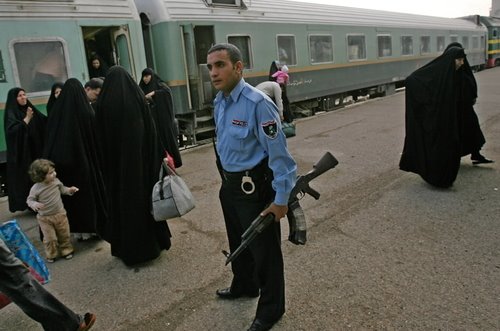
An Iraqi police officer guards passengers recently at a central Baghdad railway station. Photo: Hadi Mizban/AP.

Iraq smolders even as it cools as voter issue
By Liz Sly / November 2, 2008

War’s pull at U.S. polls is lessened, even as Iraqis adapt to savage kind of calm…

BAGHDAD — The relative calm that has descended on Baghdad over the past year has helped keep Iraq mostly off center stage as an issue in the U.S. presidential race. But the violence is still at a level that would be intolerable in any other society.

Take the sniper of Mansour, who has killed at least six Iraqi soldiers in recent weeks in this upscale neighborhood, shooting from a distance across crowded shopping streets and a busy traffic circle.

The U.S. military says the sniper is operating as part of a sophisticated, highly trained team affiliated with Al Qaeda in Iraq, the down-but-not-yet-out terrorist group that stubbornly persists in its efforts to stage a comeback.

In bustling Mansour, a mostly Sunni neighborhood in western Baghdad that has sprung partially back to life in recent months, residents seem unconcerned, however.

“It is safe here, very safe,” said Hussein Aamer, 25, who owns a fashion store near the scene of one recent shooting. “Or at least, it’s 90 percent safe. It’s true there is a sniper, and we had some small bombs,” he says, pointing in the directions from which recent attacks had come.

“But still it’s completely different now, like the difference between the sky and the earth, compared to 2007 and before.”

Such is the tenor of life these days in post-surge Baghdad, where the presence of a sniper in a community’s midst can be shrugged off as a minor annoyance compared to the onslaught of car bombings, killings and kidnappings that raged throughout 2006 and much of 2007.

The 80 percent reduction in violence from the peaks of those years has enabled Iraqis to breathe a little easier, open their shops and businesses until well after dark, visit friends in far-flung neighborhoods and even go out at night.

It has also helped minimize the debate about Iraq on the campaign trail.

Yet a recent AP-Yahoo poll found that 74 percent of Americans rated the Iraq War as a “very important” or an “extremely important” factor in their voting decision.

And the lingering level of violence that remains means Iraq is still a chronically unstable, dangerous country, one that is certainly going to thrust itself onto the next president’s agenda regardless of who wins the election.

“Iraq isn’t settled at all,” said Andrew Terrill, a strategic studies professor at the U.S. Army War College in Carlisle, Pa. “Iraq has no shortage of problems that the next president is going to have to deal with. We are not on an easy glide path to a problem-free Iraq.”

Though Baghdad is calmer, it can hardly be called safe. At least one small-scale bombing kills someone, somewhere in the city every day, and on most days more.

The 15-foot concrete barriers dividing Sunni and Shiite neighborhoods remain in place, and few of the more than 2 million Iraqis displaced by the violence have returned home, leaving virtually intact the front lines of the sectarian war that raged until last year.

Further afield, tensions are brewing across northern Iraq between Kurds and Arabs, over land, oil and political power, the issues that lie at the root of all of Iraq’s unresolved problems.

In the south, fierce political rivalries between Shiite factions with close ties to Iran threaten the stability of one part of the country that has remained relatively peaceful.

In Sunni areas, question marks remain about the fate of the 100,000 Sons of Iraq, the members of the Sunni Awakening movement who were paid by U.S. forces to fight Al Qaeda. They are seeking jobs in the security forces, but Iraq’s Shiite-led government has proved reluctant so far to employ Sunnis who may once have fought with the insurgency.

Any or all of these issues could erupt violently at any moment, plunging Iraq back into chaos, said Terrill.

Yet at the same time it is also possible to chart a course toward a more stable future. Under that scenario, Prime Minister Nouri al-Maliki succeeds in steering a path between the ethnic, sectarian and factional rivalries, and the Iraqi army continues to gain in strength, enabling the central government to assert its control as U.S. forces draw down.

Provincial elections due to be held by the end of January, just as the next U.S. president takes office, will be crucial in determining whether Iraq continues to stabilize or slips back into conflict. U.S. officials are hoping that factions currently shut out of power, such as the Awakening and the Sadrists loyal to Shiite cleric Moqtada Sadr, gain enough political representation in local government to deter them from resorting to arms — and that those who lose out accept their loss.

One certainty is that whoever becomes president is going to have to manage Iraq’s problems with fewer and fewer troops on the ground. The Iraqi government is pressing hard for a strict withdrawal timetable, and though the chances are dwindling that a security deal will be signed this year with the Bush administration, the Iraqis will likely sustain that pressure on a new U.S. president.

Sen. Barack Obama says he would bring the troops home by mid-2010, 18 months earlier than the Bush administration. But even if the next president is Sen. John McCain, who has opposed a troop withdrawal timetable, it is unlikely the Iraqi government will accept any deadline later than the end-of-2011 date already offered, said Mahmoud Othman, an independent Kurdish legislator.

On the streets of Mansour, uncertainty about the future mingles with relief that the present is better than the past. As much as Iraqis want U.S. troops to go home, they also fear a sudden departure that would leave a security vacuum to be filled by the extremists on both sides still lurking among them.

Source / Chicago Tribune

The Rag Blog

Posted in RagBlog | Tagged , | Leave a comment

Singin’ on Sunday – Terry Thompson

Terry is an old Friend, as we posted something from him several months ago. This is his latest adventure into musical political commentary, an excellent effort indeed. We love this song. It says everything about the foreign policy approach if McCain/Palin are elected. We trust we will be spared …

Richard Jehn / The Rag Blog

Sarah Palin taking a bite of Terry's guitar
Sittin’ Down with Spain
By Terrill Thompson / October 19, 2008

OK, so I couldn’t resist the urge to record a political tune. My main motivation was a Spanish-influenced chord progression that had been looping in my head for a while. Then, a couple of weeks ago John McCain, exemplifying his Bushian strategy of refusing to talk with foreign leaders who don’t agree with him, refused to meet with Prime Minister Zapatero of Spain. This issue came up in both the presidential and vice presidential debates, and it, shall we say, struck a chord.

How do we work out our disagreements unless we talk? This is something my eight and ten year old kids are starting to understand. In doing so they’ve learned that talking through problems requires listening and trying to develop an understanding of the other person’s perspective. Why is it so far-fetched for world leaders to apply this basic playground principle to their own interactions?

I could go on and on about this issue, but instead I think I’ll leave politics for another day, and just share my music. I call my new tune “Sittin’ Down With Spain”. Check it out at myspace.com/flowtheory.

And those of you who are U.S. citizens, please vote!

Source / TerrillThompson.com

With sincere thanks to Betsy Gaines / The Rag Blog

Posted in RagBlog | Tagged , | 1 Comment

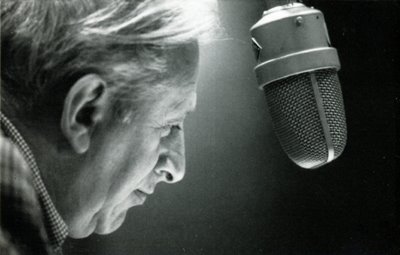
Studs Terkel : A People’s Journalist Passes


‘For Studs, listening was a craft, deeply studied and deliberately honed.’
By Bruce Shapiro / November 1, 2008

When I was a student in Chicago in the late 1970s, Studs Terkel’s daily radio interview programs on WFMT were my morning seminars. Even on some mornings when I was supposed to head out the door to real, tuition-billing courses, he’d come on interviewing a renowned soprano or playing his old tapes made on the train to the March on Washington, and I was done for.

People describe Studs’s genius as a listener as if it were an innate gift. But for Studs, listening was a craft, deeply studied and deliberately honed. You could learn so much from those interviews: Studs gently focusing his guests on storytelling, giving an hour’s conversation dramatic shape and musical punctuation with the rising and falling timbre of his voice and even the occasional, audible lighting of a cigar, all setting a pitch of intimate trust and respect.

It wasn’t hard for a college kid in Chicago to meet Studs. He was a soft touch for emceeing a protest: with Studs as ringmaster, a rally over Pinochet’s Chile or a commemoration of the long-vanished Wobblies always took on a welcome quality of celebration.

For a young journalist, having some opportunities over time to watch Studs work, and see just how deep his craft ran, was a revelation. Studs developed self-deprecatory clowning to a high art–getting into pitched battles with recording equipment, for instance–as a tactic for putting anxious interview subjects at ease. Authors on his show were almost invariably impressed by how he would enter the studio with their books scored with his scrawled notations as if he were preparing a term paper. Sure, he was a careful reader, but it was also theater, conveying immediate respect to writers accustomed to clueless celebrity interviews.

One consequence: this great interviewer was himself one tough interview. Ask Studs a question and he’d respond with a yarn, a memory, a song lyric–all great stuff, but all headed where he wanted to go rather than where you intended. His direction was usually smarter and more interesting anyway. In 1995 I interviewed Studs for a special issue of The Nation on World War II. I don’t remember now what I had hoped would come out of it. But Studs just wanted to talk about another radio man, CBS legend Norman Corwin, and the great broadcast Corwin mounted for VE Day. So we did, over a long lunch at a Lebanese joint off Michigan Avenue, charting 1945 through jazz and dancing and the airwaves, with a detour into back-porch folk music and immigrant neighborhood culture swamped in the all-American postwar years. And he remembered, with some shame, his own celebration at the dropping of the atom bomb.

Studs always stood for the radical idea of the long memory. After his wife, Ida, died, his loss was acute. But the bluff radio gangster was still there–and the vigilant optimist about civil rights and social progress. How could it be otherwise, for a man who was born the year Jack Johnson was denied passage on the Titanic and who lived to see an African-American from Chicago on the verge of the presidency? The last time I saw Studs I asked how he was recovering from open-heart surgery–he was the oldest bypass patient on record. “Fightin’ trim!” he assured me.

[Bruce Shapiro, a contributing editor to The Nation, is an investigative reporter, political essayist and journalism reformer. He is executive director of the Dart Center for Journalism and Trauma, a global resource center and think tank for journalists covering violence, conflict and tragedy. more…]

Source / The Nation

The Rag Blog

Posted in RagBlog | Tagged , , , , , , , | Leave a comment

McCain’s Big Backfire : Most Americans Favor ‘Spreading the Wealth’


It must come as a surprise to the Republicans that the public favors Obama’s style of wealth spreading by a whopping margin.
By Alexander Zaitchik / November 1, 2008

John McCain and Joe the Plumber are campaigning for Barack Obama, and they don’t even know it. The more McCain has ramped up his attacks on Obama as a “spreader of wealth,” the more the country has lined up behind the Democrat’s plan to spread the wealth. If McCain’s economic agenda was a gun and his attacks on Obama’s agenda the bullets, the old soldier would have shot both his feet clean off a long time ago.

Watching the GOP’s coordinated if increasingly delirious attacks on Obama’s economic plan, it’s clear that the party is even further out of touch with the America of 2008 than previously imagined. After eight years of establishing and then extending America’s lead as the most unequal of all industrialized countries, Republicans thought they could deflect a national groundswell of righteous anger by dusting off and hurling every insult in the conservative arsenal, including old favorites “extremist,” “radical,” “Marxist” and “socialist.” One suspects they are saving “anarchist” and “Hessian” for McCain’s last-gasp speech on Monday.

But a funny thing happened on the way to the Republican hammer-and-sickle-themed haunted house: Nobody showed. The McCain campaign’s attempts to smear Obama as a Trojan donkey for socialistic un-Americanism have belly-flopped, if not backfired. Obama has not only maintained a stable lead under the Republican barrage, he has increased his positives in the traditionally Republican territory of taxes. The final national polls before Tuesday all show a national hunger for national wealth redistribution downward. An Ipsos/McClatchy poll finds that likely voters prefer Obama’s tax plan to McCain’s by 8 points. Pew says Obama added to his edge on taxes and the economy between mid-September and mid-October by 6 points, jumping from 44 to 39 earlier to 50 to 35. On Oct. 30, Gallup released results showing Americans favor Obama’s style of wealth spreading by a whopping 58-to-37 margin.

It appears the nation’s sanity and sense of fairness has reasserted itself to wipe the floor with condescending GOP red-baiting.

It hasn’t hurt that the GOP attacks have been absurd on their face. A 3-point increase in the top marginal income tax rate to 39 percent is not easily morphed into the face of Pol Pot. For much of the 20th century, the top income tax rate in the United States slid between 50 percent and 90 percent, peaking at 94 percent during the final two years of World War II. Most Americans would agree that the mid-century rates were excessive, but support for some kind of progressive tax curve remains widespread. Both Bill Clinton and Al Gore ran winning campaigns promising to raise taxes on the rich.

“The public has always supported moderately progressive taxation, so I don’t think McCain’s pitch had much resonance unless he could convince people that Obama would raise their taxes,” says Dean Baker, co-director of the Center for Economic and Policy Research. “Obama inoculated himself against this attack by saying that he would cut taxes for 95 percent of the public. Basically, McCain was trying to make things up, and most people didn’t believe him.”

Charges of socialism are especially discordant coming from the McCain campaign. The top marginal income tax rate held steady at 50 percent for five years under McCain’s hero, Ronald Reagan. His other hero, Teddy Roosevelt, was a fierce and early booster for federal income and estate taxes. And Sarah Palin? It wouldn’t be all that surprising to see her turn up at a commemoration of this year’s 70th anniversary of the Fourth International. As Hendrik Hertzberg noted in one of many recent pieces debunking the newest GOP attack line, the redistributive principle is practiced with particular gusto in Palin’s Alaska, where the governor spreads the oil wealth like creamy butter around the state’s absorbent white bread. “One of the reasons Palin has been a popular governor,” notes Hertzberg, “is that she added an extra $1,200 to this year’s (government) check, bringing the per-person total to $3,269.” Earlier this summer, Palin boasted to journalist Philip Gourevitch, “Alaskans collectively own the resources. We share in the wealth.”

Like Alaskans, we’re all socialist now, to an extent, and have been for a long time. It’s just a question of daring to speak the adjective’s name, which happens to describe hugely popular programs like Social Security and Medicare. Watching McCain’s socialist attack line flop, it’s tempting to think that the country is edging closer to the day when the word, stripped of its Cold War baggage, no longer has the power to frighten Ohio. Another element is the further eclipse of the culture war by economics. As the country’s shifting demographics grow over the divides opened up during the 1960s and ’70s, attempts to bundle pinko economics with fears of godless agents of chaos become increasingly meaningless.

The Right is aware of and worried about this growing de-contextualization of the word “socialism.” The counterrevolution against the New Deal was aided by the presence of the Soviet Union as a running counterpoint. But it’s now almost 20 years after 1989. A generation has matured that never soaked up any of the old propaganda. This generation has studied abroad and knows you can Super-size it in Sweden. It has no memory of “Better Dead Than Red” and can’t imagine an elderly British logician making international headlines for saying he’d rather crawl to Moscow on his hands and knees than die in a nuclear war. Conservatives worry about this group much as arms controllers worry that kids today don’t understand the dangers posed by nuclear weapons. The right’s fright over the post-Cold War generation’s immunity to cries of “socialism!” was expressed clearly in an Oct. 27 editorial in the Investor’s Business Daily titled “Defining Problems With Socialism for the Post-Cold War Generation.”

“John McCain has finally called Barack Obama’s agenda by its proper name,” it begins. “But if he assumes voters understand what he means when he uses the word ‘socialism,’ he assumes too much. Sadly, most people under 60 in this country went to schools and universities where socialism isn’t considered a bad thing.”

Actually, those are two distinct groups — those who don’t understand the word or its gradations, and those who do and wouldn’t mind living under most of them. What they have in common is that together they constitute a future United States where the word “socialist” carries an ever-weakening stigma.

Whether we choose to reclaim or dispense with the word, its days as a conversation stopper appear to be over. Over the last eight years, 90 percent of the new income generated has accrued to the top 10 percent, while average family incomes have dropped $2,000. These numbers have engendered bitterness on top of anxiety that has shifted the economic debate. If Democrats get a chance to seek forceful redress in the coming years, Republicans are sure to call Obama a socialist and much else besides. But that’s OK. Tuesday’s election is going to show that when people are hurting, they don’t mind a little “socialism” — just as long as it’s pointed their way.

Source / AlterNet

The Rag Blog

Posted in RagBlog | Tagged , , , , | Leave a comment

Feliz Dia de los Muertos


Thanks to Harry Edwards / The Rag Blog

Posted in RagBlog | Tagged , , | Leave a comment

Austin Treasure : Vintage Video from Historic Protest Actions


Found Footage Reveals Bygone Era in Austin
By Amy Smith / October 31, 2008

See vintage Video of Austin protest activities in three parts, Below.

Austin native Patrick McGarrigle has put together a treasure trove of Sixties-era video footage culled from reels of film found in an alley off of Red River Street. “What They Sayin’: A Tribute to Austin Protesters” is a lovely, grainy remembrance of another era – civil rights demonstrations, the Cuban Missile Crisis, the Vietnam War. Some familiar faces appear onscreen, including Margret Hoffmann in a 1963 “Easter March,” in which a small group of peace activists walked from the Capitol to the gates of the former Bergstrom Air Force Base, and a camera-toting Alan Pogue, who had recently returned from the war. The video can be viewed on YouTube (search by title) or rented at Vulcan Video.

What They Sayin : A Tribute to Austin Protesters by Patrick McGarrigle

Part I


Part II

Part III

Source / Austin Chronicle

The Rag Blog

Posted in RagBlog | Tagged , , , , , , | 2 Comments

William Blum on McCain and Much More

Jay McShann playing piano in a whore house.

The Anti-Empire Report: Read this or George W. Bush will be president the rest of your life
By William Blum / The Rag Blog / October 30, 2008

Don’t tell my mother I work at the White House. She thinks I play the piano in a whore house.

The Republican presidential campaign has tried to make a big issue of Barack Obama at one time associating with Bill Ayers, a member of the 1960s Weathermen who engaged in political bombings. Governor Palin has accused Obama of “palling around with terrorists”, although Ayers’ association with the Weathermen during their period of carrying out anti-Vietnam War bombings in the United States took place when Obama was around 8-years-old. Contrast this with whom President Ronald Reagan, so beloved by the Republican candidates, associated. Gulbuddin Hekmatyar was an Afghan warlord whose followers first gained attention by throwing acid in the faces of women who refused to wear the veil. This is how they spent their time when they were not screaming “Death to America”. CIA and State Department officials called Hekmatyar “scary,” “vicious,” “a fascist,” “definite dictatorship material”.1 None of this prevented the Reagan administration from inviting the man to the White House to meet with Reagan, and showering him with large amounts of aid to fight against the Soviet-supported government of Afghanistan.

Reagan’s successor, George H.W. Bush, palled around with characters almost as unsavory during his first campaign for the presidency in 1988. His campaign staff included a number of genuine pro-Nazi, anti-Semitic types from Eastern and Central Europe. Several of these worthies were leaders of the Republican campaign’s ethnic outreach arm, the Coalition of American Nationalities, despite the fact that their checkered past was not a big secret. One of them, Laszlo Pasztor (or Pastor) had served in the pro-Nazi Hungarian government’s embassy in Berlin during the Second World War. This had been revealed in a 1971 page-one story in the Washington Post.2 When this past was again brought up in September 1988, the Republicans were obliged to dump Pasztor and four others of his ilk from Bush’s campaign.3

And who has John McCain been palling around with? Who has been co-chair of McCain’s New York campaign and a foreign policy adviser to McCain himself? None other than the illustrious unindicted war criminal and mass murderer Henry Kissinger, who must be very careful when he travels to Europe for there are committed and serious people in several countries there who will again try to have him arrested for the crimes against humanity he’s responsible for … Chile … Angola … East Timor … Vietnam … Laos … Cambodia …

By contrast, there is no evidence that Bill Ayers was involved in any Weathermen bombing that killed anyone; nor have I seen any evidence that on the very rare occasion that an anti-Vietnam War bombing in the United States resulted in a casualty that it could be ascribed to the Weathermen.

John McCain’s bombings certainly killed – some two dozen aerial attacks upon the people of Vietnam, people who had neither done nor threatened any harm to him or his country. What label do we give to such acts, to such a man? His level of violence is matched by his degree of hypocrisy. Speaking of Ayers, McCain asked: “How can you countenance someone who was engaged in bombings that could have or did kill innocent people?”4

In his 2001 memoir, “Fugitive Days,” Ayers writes: “I don’t regret setting bombs. I feel we didn’t do enough.” This is something very few Americans can accept, and I wouldn’t even make the attempt to persuade them. But I personally didn’t blame the Weathermen then, and I don’t blame them now. The Vietnam War was in its eighth year of barbarity. I and the rest of the army of the powerless needed a few points up there on the scoreboard against the lords of the national-security corporate state. A bombing, with a suitably war-criminal target – like the State Department or the Pentagon – and taking care to prevent any casualties, told the bastards that we were still out there, that their impunity was not total, that this is how it feels to be bombed. Armed propaganda. It told the public that there was something more serious going on than a town-hall difference of opinion that could be reasonably resolved by reasonable people discussing things in a reasonable manner. And like an unhappy child having a temper tantrum, we needed some instant gratification. We were struggling against the most powerful force in the world.

The Weathermen were on the right side of that war. John McCain on the wrong side.

And who has Sarah Palin herself been palling around with? John McCain, and the Alaska Independence Party, a secessionist party her husband belonged to for seven years. “My government is my worst enemy. I’m going to fight them with any means at hand,” Joe Vogler, who founded the party, once declared. Earlier this year Governor Palin shouted out to party members: ”Keep up the good work. And God bless you.”5

I do believe that secession of a state from the union is somewhat frowned upon by the powers that be, and if memory serves me, the last time it was seriously tried the government actually went to war. Who do these Alaskans think they are, the Kosovo gangsters whose secession from Serbia was immediately recognized by Washington?

This just in: John McCain (yes, the same one), as a congressman, met in 1985 in Chile with General Augusto Pinochet, one of the world’s most notorious violators of human rights, credited with killing more than 3,000 civilians, jailing tens of thousands of others, and torturing a great many of them. McCain met with Pinochet apparently without any preconditions, which is what McCain has repeatedly criticized Obama for saying he would do with certain present-day foreign leaders whom McCain doesn’t like. At the time of the meeting, the US Justice Department was seeking the extradition of two close Pinochet associates for an act of terrorism in Washington, DC – the 1976 car-bomb assassination of former Chilean ambassador to the US, Orlando Letelier, a prominent critic of Pinochet, and his American assistant. McCain made no public or private statements critical of the dictatorship, nor did he meet with members of the democratic opposition in Chile. Senator Edward Kennedy arrived only 12 days after McCain in a highly public show of support for democracy, meeting with Catholic church and human rights leaders and large groups of opposition activists.6

The John McCains of America, in and out of Congress, would much sooner pal around with Augusto Pinochet than Hugo Chavez or Fidel Castro or Bill Ayers.

The bourgeois triumphalism that attended the funeral of the USSR

Greed is a hot topic now. Stock brokers and others involved in the current financial crisis are angrily accused of being greedy. Time magazine declared that the nation’s current troubles were “the price of greed”. “Blame greed,” echoed the Chicago Tribune. But these establishment publications can’t be taken too seriously. Like other believers in the system, they’re convinced that greed is a built-in, valuable, and necessary feature of capitalism and capitalist man, that it’s indispensable for motivating entrepreneurs, and that it results in all manner of innovation and invention. During the years of the Cold War, this was a key element of the interminable discussions cum arguments between defenders of free enterprise and defenders of socialism; the arguments still continue, although most people now think that history has answered the question – capitalism has won. “The end of history”, leading conservative Francis Fukuyama called it in his well-received book in 1992. He asserted that we couldn’t expect to find a better way to organize society than the marriage of liberal democracy and market capitalism. Subsequent world movements such as anti-globalization and political Islam caused Fukuyama to have some second thoughts about whether history had actually come to an end. (He also came to renounce the war in Iraq which he had initially embraced on the premise that it would bring the joys of liberal democracy and market capitalism to the benighted Iraqi people.)

Since the dissolution of the Soviet Union in 1991, the boys of Capital have chortled in their martinis about the death of socialism. Until recently, the word had been banned from polite conversation (now achieving new notoriety as a term of political insult). And no one seems to notice that every socialist experiment of any significance in the twentieth century was either bombed, invaded, or overthrown; corrupted, perverted, or destabilized; or otherwise had life made impossible for it, by the United States. Not one socialist government or movement – from the Russian revolution to the Vietnamese communists to the Sandinistas in Nicaragua, from Communist China to Salvador Allende in Chile to the FMLN in Salvador – not one was permitted to rise or fall solely on its own merits; not one was left secure enough to drop its guard against the all-powerful enemy abroad and freely and fully relax control at home. It continues today with Washington’s attempts to subvert the governments of Venezuela and Bolivia, and, of course, still, forever, Cuba.

Imagine that the Wright brothers’ first experiments with flying machines had all failed because the automobile interests had sabotaged each test flight. And then, thanks to the auto companies’ propaganda, the good and god-fearing folk of the world looked upon this, took notice of the consequences, nodded their collective heads wisely, and intoned solemnly: Man shall never fly.

It’s widely assumed that the Soviet Union demise resulted from gross shortcomings intrinsic to its socialist system, that the economy somehow imploded from its inherent contradictions. But all the shortcomings and contradictions that could have been found in the Soviet system in 1990 could have as well been found in 1980, or 1970, or 1960. Unlike capitalism, whose volatility is legendary, as each day’s headlines remind us anew, the Soviet system with its government ownership of the means of production and its command economy, whatever its other defects, remained relatively stable and uniform. The question is thus: What happened in the late 1980s in the Soviet system to cause it to unravel? I believe that the best answer to the question lies in the person of Soviet President Mikhail Gorbachev, who came to power in 1985.

Gorbachev’s long-time and ardent ambition was to model the Soviet Union after a West European social democracy and have the country accepted as such by the Europeans. That’s the principal reason he put an end to the Soviet military involvement in Afghanistan; and why he instituted his historic economic and political changes at home (with their unintended consequences), and relinquished control over Eastern Europe without resorting to military force. The war in Afghanistan certainly had its effects, financially and psychologically, upon the people of the Soviet Union, and is commonly cited as a major cause for the nation’s breakup. But the same can be said even more so of the effect of the wars in Afghanistan and Iraq upon the American people, millions of whom have marched against the wars, yet none of this has led to an American withdrawal from either place; not even close. Superpowers should not be confused with democracies.

Ayn Rand’s social philosophy: Let the strong prevail, let the weak pay for their weakness

“I made a mistake in presuming that the self-interests of organizations, specifically banks and others, were such that they were best capable of protecting their own shareholders and their equity in the firms. … So the problem here is [that] something which looked to be a very solid edifice and, indeed, a critical pillar to market competition and free markets, did break down. And I think that, as I said, shocked me.”

A remarkable admission from Alan Greenspan, former chairman of the Federal Reserve, long-time opponent of government regulation of the corporate world, and friend and devoted follower of Ayn Rand, the selfishness guru who turned the emulation of two-year olds into a philosophy of life. “I have found a flaw,” said Greenspan, referring to his economic philosophy. “I don’t know how significant or permanent it is. But I have been very distressed by that fact.”7

Greenspan was induced into these admissions by tough questioning from congressmen at a hearing called in October to deal with the financial crisis. There was a time when Greenspan was looked upon as a guru by a largely unquestioning and unchallenging congress and media, no matter how dubious or obscure his pronouncements. He could have passed at times for Chauncey Gardener, the main character of the book and film “Being There”. Gardener, brought to life by Peter Sellers, was a simple man with very simple thoughts and behavior, who might have been considered to be borderline “retarded”, but fortuitous circumstances and the deference toward him by those of insufficient intellect and/or courage resulted in him being thought of as brilliant by people in high positions.

There was one noteworthy exception to this delicate treatment of Greenspan. In July 2003, Rep. Bernie Sanders of Vermont faced the Fed chairman across the table at a congressional hearing and said:

“Mr. Greenspan, I have long been concerned that you are way out of touch with the needs of the middle class and working families of our country, that you see your major function in your position as the need to represent the wealthy and large corporations … I think you just don’t know what’s going on in the real world. … You talk about an improving economy, while we have lost 3 million private sector jobs in the last two years. Long-term unemployment has more than tripled. … We have a $4 trillion national debt. 1.4 million Americans have lost their health insurance. Millions of seniors can’t afford prescription drugs. Middle class families can’t send their kids to college because they don’t have the money to do that.”

“Congressman,” Greenspan replied, “we have the highest standard of living in the world.”

“No, we do not,” insisted Sanders. “You go to Scandinavia, and you will find that people have a much higher standard of living, in terms of education, health care and decent paying jobs. Wrong, Mister.”

Not accustomed to having to defend his profundities, Greenspan could do no better than to counter with: “We have the highest standard of living for a country of our size.”8

This was quite a comedown from “in the world”, and inasmuch as the only countries of equal or larger population are China and India, with Indonesia being the fourth largest, Greenspan’s point is rather difficult to evaluate.

The idea that the United States has the highest standard of living in the world is one that is actually believed by numerous grownups in America, and most of them believe that this highest standard applies across the board. They’re only minimally conscious of the fact that whereas they’ve made extremely painful sacrifices to send a child to university, and they often simply can’t come up with enough money, and even if they can the child will be very heavily in debt for years afterward, in much of Western Europe university education is either free or eminently affordable; as it is in Cuba and was in Iraq under Saddam Hussein.

The same lack of awareness about superior conditions in other countries extends to health care, working hours, vacation time, maternity leave, child care, unemployment insurance, and a host of other social and economic benefits.

In short, amongst the developed nations, the United States is the worst place to be a worker, to be sick, to seek a university education, to be a parent; or, in the land of two million incarcerated, to exercise certain rights or be a defendant in court.

To which the Chauncey Gardeners of America, including the one who used to sit in the Federal Reserve and the one presently sitting in the Oval Office, would say: “Duh! Whaddaya mean?”

The Rosenbergs as heroes

John Gerassi, professor of political science at Queens College in New York City, recently wrote a letter to the New York Times:

To the Editor: NYT

In his “A Spy Confesses” (Week in Review 9/21), Sam Roberts claims that folks “fiercely loyal to the far left, believed that the Rosenbergs were not guilty …” I am and have always been, since my stint as a correspondent and editor in Latin America for Time and Newsweek, a “far leftist,” and I have never claimed the Rosenbergs were not guilty. Nor have any of my “far leftist” friends. What we always said, and what I repeat to my students every semester, is that “if they were guilty, they are this planet’s great heroes.” My explanation is quite simple: The US had a first-strike policy, the USSR did not (until Gorbachev). In 1952, the US military, and various intelligence services, calculated that a first strike on all Soviet silos would wipe out all but 6% of Russian atomic missiles (and, we now know, create enough radiation to kill us all). But those six percent would automatically be fired at US cities. The military then calculated what would happen if one made a direct hit on Denver (why they chose Denver and not New York or Washington was never explained). Their finding: 200,000 would die immediately, two million within a month. They concluded that it was not worth it. In other words, I tell my students, you were born and I am alive because the USSR had a deterrent against our “preventive” attack, not the other way around. And if it is true that the Rosenbergs helped the Soviets get that deterrent, they end up among the planet’s saviors.

– John Gerassi (tgerassi@hotmail.com)

[It will not come as a great surprise to learn that the Times did not allow such thoughts to appear in their exalted pages.]

Notes

1. Tim Weiner, “Blank Check: The Pentagon’s Black Budget” (1990), p.149-50.
2. Washington Post, November 21, 1971
3. Los Angeles Times, September 13, 1988, p.19. For further discussion of this issue, see Russ Bellant, “Old Nazis and the New Right: The Republican Party and Fascists”, Covert Action Information Bulletin (Washington, DC), #33, Winter 1990, p.27-31
4. New York Times, October 3, 2008
5. David Talbot, Salon.com, October 7, 2008
6. John Dinges, The Huffington Post, October 24, 2008, based on a declassified US Embassy cable
7. Washington Post, October 23, 2008
8. House Financial Services Committee, July 15, 2003; http://commdocs.house.gov/committees/bank/hba91775.000/hba91775_0f.htm

[William Blum is the author of:

* Killing Hope: US Military and CIA Interventions Since World War 2
* Rogue State: A Guide to the World’s Only Superpower
* West-Bloc Dissident: A Cold War Memoir
* Freeing the World to Death: Essays on the American Empire]

This article was also posted at Killing Hope.

The Rag Blog

Posted in RagBlog | Tagged , , , , , , | Leave a comment

Bush’s Exit Strategy : A Deregulation Frenzy

Dubya: The legacy.

The Legacy Grows: ‘Every rule in every agency is under attack.’
By Thomas Cleaver / The Rag Blog / October 31, 2008

See ‘A Last Push To Deregulate: White House to Ease Many Rules’ by R. Jeffrey Smith, Below.

In the past three months, the Bush Administration has begun announcing significant rule changes, and they will all be in place before they leave office.

The administrative rules they are revising are an obscure body of law known as the Federal Administrative Regulations. These are the rules drawn up by every federal agency to detail the administration of the laws they are responsible for enforcing. The original reason was to insure justice, that there would be similar decisions in similar circumstances, so the law was clear to all. What they are doing now is the reverse of that.

These rules have the force of law with federal agencies, and it is very time-consuming the revise them. The Bushies have been working on these for at least the past two years. Even if the Democrats win a 60-seat Senate and a veto-proof House, with Obama in the White House, and they set to work on January 21, 2009, to change all these back, it would take a minimum of two years to accomplish.

Allow me to give an example of how bad this is: in August, the Interior Department announced they were revising the FARs for the Endangered Species Act. Specifically, they were revising the Independent Review Rule to allow the relevant agency to have the power to make the review independently themselves. What this rule is (it has been responsible for saving the majority of endangered species for the past 34 years) is that when a federal agency is making any decision that could impact an endangered species, they have to get an independent review from the Fish and Wildlife Service. It if is reasonably foreseeable that they will harm a species, they have to stop and revise the decision, revise the plan, so it does no harm.

Their change would allow the agency making the decision to review itself, to determine if it is reasonably certain they would harm a species, and determine what level of harm was acceptable, and make its own determination of what should be done. With no right of appeal or judicial review of that decision. As Secretary of the Interior Dirk Kempthorne said when he announced it, “this will keep the environmentalists from stopping our projects.” The proposed rule change was given a 30-day public comment period (these have heretofore traditionally been 120-day reviews, with revisions as a result of comments), which was up on Sept. 15. They will be announcing the rule implementation probably any Monday after the election.

How would this rule wreck things? Here’s an example: last March, the Interior Department announced they were de-listing the Yellowstone Wolves from the Endangered Species List on the grounds there were now 1500 wolves, and would turn over administration of the wolves to the states of Wyoming, Montana and Idaho — which had already announced their decision that there only needed to be 300 wolves in the area. When Interior was sued to have the independent review process, they went ahead and de-listed the wolves. During the 60 days the wolves were de-listed, 60 were killed. When the NWF and Environmental Defense Fund got into court, they got an immediate injunction that stopped the killing, and then proved in court that Interior had disregarded its own rules, with the court putting the wolves back under protection in September. Were the new rule in effect then, we’d be burying 1200 wolves.

What has to be done is to go into court, get an injunction against implementation of the rule, and then to prove in court that the agency violated the law in revising the rule. This can be done. The EPA was successfully sued over an attempt to do this to the Clean Water Act, with the Second Court of Appeal telling them in August that they couldn’t implement their revision. IT TOOK FOUR YEARS TO DO THIS.

Regardless of who gets into office next week, these fights will have to be made. They are revising the mining rules to get rid of the requirement that a coal company clean up the mess after blowing the top off a mountain for strip-mining, to get rid of the rules requiring maintenance of water and access for salmon runs, etc., etc. EVERY RULE IN EVERY AGENCY IS UNDER ATTACK.

We are all going to need to support those organizations, like Sierra Club, National Wildlife Federation, NRDC, EDF, etc., that will be making these fights. Whatever interest you have, it is under attack.

All that money you were giving every month to Obama? Figure out what organization making these fights you support and make a monthly sustainer to them, so they can make the fight.

This is the Bush Administration’s real legacy.

So, while we’ve all been distracted by the campaign…

A Last Push To Deregulate:
White House to Ease Many Rules

By R. Jeffrey Smith / October 31, 2008

The White House is working to enact a wide array of federal regulations, many of which would weaken government rules aimed at protecting consumers and the environment, before President Bush leaves office in January.

The new rules would be among the most controversial deregulatory steps of the Bush era and could be difficult for his successor to undo.

Some would ease or lift constraints on private industry, including power plants, mines and farms.

Those and other regulations would help clear obstacles to some commercial ocean-fishing activities, ease controls on emissions of pollutants that contribute to global warming, relax drinking-water standards and lift a key restriction on mountaintop coal mining.

Once such rules take effect, they typically can be undone only through a laborious new regulatory proceeding, including lengthy periods of public comment, drafting and mandated reanalysis.

“They want these rules to continue to have an impact long after they leave office,” said Matthew Madia, a regulatory expert at OMB Watch, a nonprofit group critical of what it calls the Bush administration’s penchant for deregulating in areas where industry wants more freedom. He called the coming deluge “a last-minute assault on the public . . . happening on multiple fronts.”

White House spokesman Tony Fratto said: “This administration has taken extraordinary measures to avoid rushing regulations at the end of the term. And yes, we’d prefer our regulations stand for a very long time — they’re well reasoned and are being considered with the best interests of the nation in mind.”

As many as 90 new regulations are in the works, and at least nine of them are considered “economically significant” because they impose costs or promote societal benefits that exceed $100 million annually. They include new rules governing employees who take family- and medical-related leaves, new standards for preventing or containing oil spills, and a simplified process for settling real estate transactions.

While it remains unclear how much the administration will be able to accomplish in the coming weeks, the last-minute rush appears to involve fewer regulations than Bush’s predecessor, Bill Clinton, approved at the end of his tenure.

In some cases, Bush’s regulations reflect new interpretations of language in federal laws. In other cases, such as several new counterterrorism initiatives, they reflect new executive branch decisions in areas where Congress — now out of session and focused on the elections — left the president considerable discretion.

The burst of activity has made this a busy period for lobbyists who fear that industry views will hold less sway after the elections. The doors at the New Executive Office Building have been whirling with corporate officials and advisers pleading for relief or, in many cases, for hastened decision making.

According to the Office of Management and Budget’s regulatory calendar, the commercial scallop-fishing industry came in two weeks ago to urge that proposed catch limits be eased, nearly bumping into National Mining Association officials making the case for easing rules meant to keep coal slurry waste out of Appalachian streams. A few days earlier, lawyers for kidney dialysis and biotechnology companies registered their complaints at the OMB about new Medicare reimbursement rules. Lobbyists for customs brokers complained about proposed counterterrorism rules that require the advance reporting of shipping data.

Bush’s aides are acutely aware of the political risks of completing their regulatory work too late. On the afternoon of Bush’s inauguration, Jan. 20, 2001, his chief of staff issued a government-wide memo that blocked the completion or implementation of regulations drafted in the waning days of the Clinton administration that had not yet taken legal effect.

“Through the end of the Clinton administration, we were working like crazy to get as many regulations out as possible,” said Donald R. Arbuckle, who retired in 2006 after 25 years as an OMB official. “Then on Sunday, the day after the inauguration, OMB Director Mitch Daniels called me in and said, ‘Let’s pull back as many of these as we can.’ “

Clinton’s appointees wound up paying a heavy price for procrastination. Bush’s team was able to withdraw 254 regulations that covered such matters as drug and airline safety, immigration and indoor air pollutants. After further review, many of the proposals were modified to reflect Republican policy ideals or scrapped altogether.

Seeking to avoid falling victim to such partisan tactics, White House Chief of Staff Joshua B. Bolten in May imposed a Nov. 1 government-wide deadline to finish major new regulations, “except in extraordinary circumstances.”

That gives officials just a few more weeks to meet an effective Nov. 20 deadline for the publication of economically significant rules, which take legal effect only after a 60-day congressional comment period. Less important rules take effect after a 30-day period, creating a second deadline of Dec. 20.

OMB spokeswoman Jane Lee said that Bolten’s memo was meant to emphasize the importance of “due diligence” in ensuring that late-term regulations are sound. “We will continue to embrace the thorough and high standards of the regulatory review process,” she said.

As the deadlines near, the administration has begun to issue regulations of great interest to industry, including, in recent days, a rule that allows natural gas pipelines to operate at higher pressures and new Homeland Security rules that shift passenger security screening responsibilities from airlines to the federal government.

The OMB also approved a new limit on airborne emissions of lead this month, acting under a court-imposed deadline.

Many of the rules that could be issued over the next few weeks would ease environmental regulations, according to sources familiar with administration deliberations.

A rule put forward by the National Marine Fisheries Service and now under final review by the OMB would lift a requirement that environmental impact statements be prepared for certain fisheries-management decisions and would give review authority to regional councils dominated by commercial and recreational fishing interests.
An Alaska commercial fishing source, granted anonymity so he could speak candidly about private conversations, said that senior administration officials promised to “get the rule done by the end of this month” and that the outcome would be a big improvement.

Lee Crockett of the Pew Charitable Trusts’ Environment Group said the administration has received 194,000 public comments on the rule and protests from 80 members of Congress as well as 160 conservation groups. “This thing is fatally flawed” as well as “wildly unpopular,” Crockett said.

Two other rules nearing completion would ease limits on pollution from power plants, a major energy industry goal for the past eight years that is strenuously opposed by Democratic lawmakers and environmental groups.

One rule, being pursued over some opposition within the Environmental Protection Agency, would allow current emissions at a power plant to match the highest levels produced by that plant, overturning a rule that more strictly limits such emission increases. According to the EPA’s estimate, it would allow millions of tons of additional carbon dioxide into the atmosphere annually, worsening global warming.

A related regulation would ease limits on emissions from coal-fired power plants near national parks.

A third rule would allow increased emissions from oil refineries, chemical factories and other industrial plants with complex manufacturing operations.

These rules “will force Americans to choke on dirtier air for years to come, unless Congress or the new administration reverses these eleventh-hour abuses,” said lawyer John Walke of the Natural Resources Defense Council.

But Scott H. Segal, a Washington lawyer and chief spokesman for the Electric Reliability Coordinating Council, said that “bringing common sense to the Clean Air Act is the best way to enhance energy efficiency and pollution control.” He said he is optimistic that the new rule will help keep citizens’ lawsuits from obstructing new technologies.

Jonathan Shradar, an EPA spokesman, said that he could not discuss specifics but added that “we strive to protect human health and the environment.” Any rule the agency completes, he said, “is more stringent than the previous one.”

Source / Wahington Post (Subscription)

The Rag Blog

Posted in Rag Bloggers | Tagged , , , , | 1 Comment

Guantanamo Torture : CIA Officers Could Face Trial in Britian


‘British resident held in Guantanamo Bay was brutally tortured after being arrested and questioned by American forces.’
By Robert Verkaik / October 31, 2008

Senior CIA officers could be put on trial in Britain after it emerged last night that the Attorney General is to investigate allegations that a British resident held in Guantanamo Bay was brutally tortured, after being arrested and questioned by American forces following the terrorist attacks on New York and Washington in 2001.

The Home Secretary Jacqui Smith has asked Baroness Scotland to consider bringing criminal proceedings against Americans allegedly responsible for the rendition and abuse of Binyam Mohamed, when he was held in prisons in Morocco and Afghanistan.

The development follows criticism of US prosecutors by British judges who have seen secret evidence of torture committed against Mr Mohamed, including allegations his torturers used a razor blade to repeatedly cut his penis. The Attorney’s investigation is expected to include allegations that MI5 colluded in Mr Mohamed’s rendition. Mr Mohamed, 30, an Ethiopian national and British resident, was arrested in Pakistan in 2002, when he was questioned by an MI5 officer.

On Tuesday, Government lawyers wrote to the judges hearing Mr Mohamed’s case against the UK government in the High Court. In the letter they said “the question of possible criminal wrongdoing to which these proceedings has given rise has been referred by the Home Secretary to the Attorney general for consideration as an independent minister of justice”. Baroness Scotland has been sent secret witness statements given to the court and public interest immunity certificates for the proceedings.

Mr Mohamed, 30, accuses MI5 agents of lying about what they knew of CIA plans to transfer him to a prison in north Africa, where he claims he was subjected to horrendous torture. Mr Mohamed, who won asylum in the UK in 1994, has been charged with terrorism-related offences. He awaits a decision on whether he is to face trial at the US naval base. He is officially the last Briton at Guantanamo. Last night his lawyer, Clive Stafford Smith, said: “This is a welcome recognition that the CIA cannot just go rendering British residents to secret torture chambers without consequences, and British agents cannot take part in US crimes without facing the music. Reprieve will be making submissions to the Attorney General to ensure those involved, from the US, Pakistan, Morocco, Britain, are held responsible.”

Richard Stein, of Leigh Day, representing Mr Mohamed in the High Court proceedings, said: “Ultimately the British Government had little choice once they conceded that a case had been made that Binyam Mohamed was tortured. The Convention Against Torture imposes an obligation on signatory states to investigate torture.”

In August two judges ruled allegations of torture were at least arguable and that MI5 had information relating to Mr Mohamed that was “not only necessary but essential for his defence”.

The judges have read statements and interviews with Mr Mohamed between 28 and 31 July, 2004 when he says he was forced to confess to terrorism. The judges said: “This was after a period of over two-and-a-half years of incommunicado detention during which Binyam Mohamed alleges he was tortured.”

He was first held in Pakistan in 2002, where a British agent interrogated him; he was then sent to Morocco by the CIA and allegedly tortured for 18 months. He was rendered to the secret “Dark Prison” in Afghanistan, where his torture is alleged to have continued. Since September 2004, he has been in Guantanamo Bay.

Source / The Independent, U.K.

Thanks to truthout / The Rag Blog

Posted in RagBlog | Tagged , , , , , , , , | Leave a comment

The Last Days of Dubya : Plunder and Run


The Bush gang’s parting gift: a final, frantic looting of public wealth.
By Naomi Klein / October 31, 2008

The US bail-out amounts to a strings-free, public-funded windfall for big business. Welcome to no-risk capitalism.

In the final days of the election many Republicans seem to have given up the fight for power. But don’t be fooled: that doesn’t mean they are relaxing. If you want to see real Republican elbow grease, check out the energy going into chucking great chunks of the $700bn bail-out out the door. At a recent Senate banking committee hearing, the Republican Bob Corker was fixated on this task, and with a clear deadline in mind: inauguration. “How much of it do you think may be actually spent by January 20 or so?” Corker asked Neel Kashkari, the 35-year-old former banker in charge of the bail-out.

When European colonialists realised that they had no choice but to hand over power to the indigenous citizens, they would often turn their attention to stripping the local treasury of its gold and grabbing valuable livestock. If they were really nasty, like the Portuguese in Mozambique in the mid-1970s, they poured concrete down the elevator shafts.

Nothing so barbaric for the Bush gang. Rather than open plunder, it prefers bureaucratic instruments, such as “distressed asset” auctions and the “equity purchase program”. But make no mistake: the goal is the same as it was for the defeated Portuguese – a final, frantic looting of the public wealth before they hand over the keys to the safe.

How else to make sense of the bizarre decisions that have governed the allocation of the bail-out money? When the Bush administration announced it would be injecting $250bn into US banks in exchange for equity, the plan was widely referred to as “partial nationalisation” – a radical measure required to get banks lending again. Henry Paulson, the treasury secretary, had seen the light, we were told, and was following the lead of Gordon Brown.

In fact, there has been no nationalisation, partial or otherwise. American taxpayers have gained no meaningful control over the banks, which is why the banks are free to spend the new money as they wish. At Morgan Stanley, it looks as if much of the windfall will cover this year’s bonuses. Citigroup has been hinting it will use its $25bn buying other banks, while John Thain, the chief executive of Merrill Lynch, told analysts: “At least for the next quarter, it’s just going to be a cushion.” The US government, meanwhile, is reduced to pleading with the banks that they at least spend a portion of the taxpayer windfall for loans – officially, the reason for the entire programme.

What, then, is the real purpose of the bail-out? My fear is this rush of dealmaking is something much more ambitious than a one-off gift to big business: that the Bush version of “partial nationalisation” is rigged to turn the US treasury into a bottomless cash machine for the banks for years to come. Remember, the main concern among the big market players, particularly banks, is not the lack of credit but their battered share prices. Investors have lost confidence in the honesty of the big financial players, and with good reason.

This is where the treasury’s equity pays off big time. By purchasing stakes in these financial institutions, the treasury is sending a signal to the market that they are a safe bet. Why safe? Not because their level of risk has been accurately assessed at last. Not because they have renounced the kind of exotic instruments and outrageous leverage rates that created the crisis. But because the market will now be banking on the fact that the US government won’t let these particular companies fail. If they get themselves into trouble, investors will now assume that the government will keep finding more cash to bail them out, since allowing them to go down would mean losing the initial equity investments, many of them in the billions. (Just look at the insurance giant AIG, which has already gone back to taxpayers for a top-up, and seems likely to ask for a third.)

This tethering of the public interest to private companies is the real purpose of the bail-out plan: Paulson is handing all the companies admitted to the programme – a number potentially in the thousands – an implicit treasury department guarantee. To skittish investors looking for safe places to park their money, these equity deals will be even more comforting than a triple-A from Moody’s rating agency.

Insurance like that is priceless. But for the banks, the best part is that the government is paying them to accept its seal of approval. For taxpayers, on the other hand, this entire plan is extremely risky, and may well cost significantly more than Paulson’s original idea of buying up $700bn in toxic debts. Now taxpayers aren’t just on the hook for the debts but, arguably, for the fate of every corporation that sells them equity.

Interestingly, mortgage fund giants Fannie Mae and Freddie Mac both enjoyed this kind of unspoken guarantee before they were nationalised at the start of this crisis. For decades the market understood that, since these private players were enmeshed with the government, Uncle Sam could be counted on to always save the day. It was, as many have pointed out, the worst of all worlds. Not only were profits privatised while risks were socialised, but the implicit government backing created powerful incentives for reckless business practices.

With the new equity purchase programme Paulson has taken the discredited Fannie and Freddie model and applied it to a huge swath of the private banking industry. Again, there is no reason to shy away from risky bets, especially since the treasury has made no such demands of the banks (apparently it doesn’t want to “micromanage”.)

To further boost market confidence, the federal government has also unveiled unlimited public guarantees for many bank deposit accounts. Oh, and as if this were not enough, the treasury has been encouraging the banks to merge, ensuring that the only institutions left will be “too big to fail”, thereby guaranteed a bail-out. In three ways, the market is being told loud and clear that Washington will not allow the financial institutions to bear the consequences of their behaviour. This may be Bush’s most creative innovation: no-risk capitalism.

There is a glimmer of hope. In answer to Senator Corker’s question, the treasury is indeed having trouble dispersing the bail-out funds. So far it has requested about $350bn of the $700bn, but most of this hasn’t yet made it out the door. Meanwhile, every day it becomes clearer that the bail-out was sold to the public on false pretences. Clearly, it was never really about getting loans flowing. It was always about doing what it is doing: turning the state into a giant insurance agency for Wall Street, a safety net for the people who need it least, subsidised by the people who will most need state protections in the economic storms ahead.

This duplicity is a political opportunity. Whoever wins on November 4 will have enormous moral authority. It should be used to call for a freeze on the dispersal of bail-out funds, not after the inauguration but right away. All deals should be renegotiated, this time with the public getting the guarantees.

It is risky, of course, to interrupt the bail-out process. Nothing could be riskier, however, than allowing the Bush gang their parting gift to big business – the gift that will keep on taking.

Source / Guardian, U.K.

The Rag Blog

Posted in RagBlog | Tagged , , , , | Leave a comment

ART / George W. Urinal : Pee for Peace

Pee art by Clark Sorensen, famed floral urinal designer.

Go with the flow: Art from the men’s room
By Sean Fallon / October 30, 2008

No matter who you are pulling for in this election, the popularity polls indicate that the vast majority of Americans are ready to see Bush pack up his things and get the hell out of the White House. While there is tons of anti-Bush paraphernalia out there, few things capture our disdain as well as “George W. Flush” — a design by famed urinal sculptor Clark Sorensen.

Unfortunately, this urinal is one of a kind, but it will be on display at his one-man show entitled “Down The Drain – The Legacy of George W. Bush.” at Ruby’s Clay Studio and Gallery in San Francisco. The show runs from January 17 to February 16, 2009. Hopefully, visitors will be allowed to relieve themselves in it. Let’s be honest—it would be satisfying on multiple levels.

Source / Gizmodo

Thanks to S. R. Keister / The Rag Blog

Posted in RagBlog | Tagged , , , | Leave a comment