As far as the eye can see:
Rally for Barack Obama on Saturday, Oct. 18, 2008, in St. Louis, draws a crowd estimated by police at more than 100,000.
Source / Wall Street Journal.
As far as the eye can see:
Rally for Barack Obama on Saturday, Oct. 18, 2008, in St. Louis, draws a crowd estimated by police at more than 100,000.
Source / Wall Street Journal.
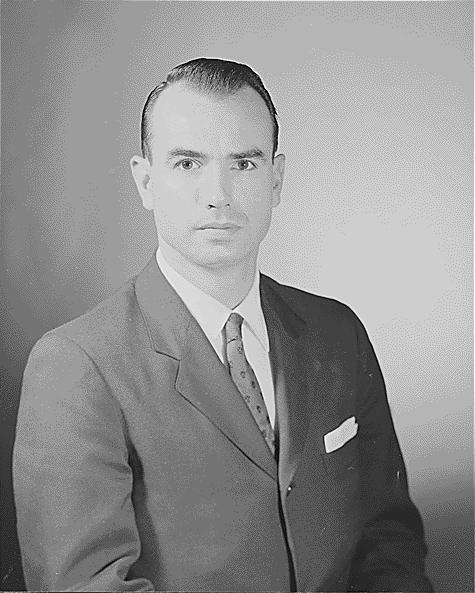
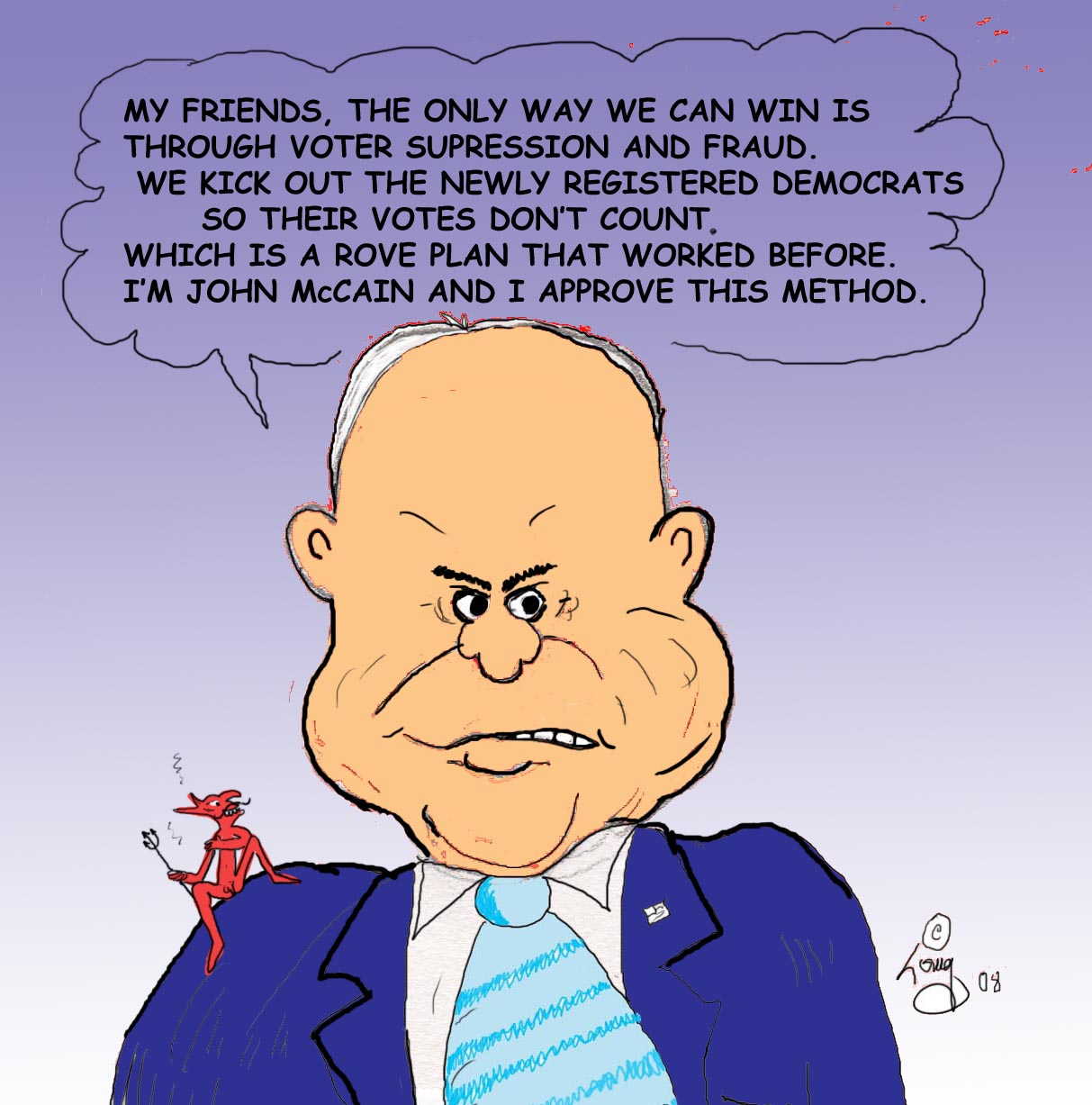
It’s not Joe the Plumber that matters, it’s G. Gordon Liddy the “Plumber” of Watergate fame. David Letterman’s interview with McCain last night should prove to be absolutely devastating to the McCain campaign, if we don’t let the mainstream media ignore McCain’s relationship to Liddy while they obsess about Bill Ayers.
John McCain has defended Liddy, an ex-felon who was part of Watergate, one of the worst abuses of executive power in American history.
John McCain has knowingly attended a fundraiser at the home of Liddy, an unrepentent terrorist who plotted the assassination of a journalist and encouraged the murder of federal law enforcement agents. Yet John McCain just a year ago declared that he was “proud” of this man.
Here’s a summary of all the crimes of G. Gordon Liddy, the responses of John McCain, and the questions that need to be asked:
Last night on Letterman, here’s what McCain said.
DL: But did you not have a relationship with Gordon Liddy?
JM: I met him, you know, I mean…
DL: Didn’t you attend a fundraiser at his house? JM: Gordon Liddy’s?
“I met him”? “I met him”? And when you’re asked about attending a fundraiser at his house, you don’t answer? You don’t admit that Liddy hosted a fundraiser for you in 1998? You just say, “Gordon Liddy’s?” as if you don’t know what Letterman’s talking about?
After the commercial break, McCain quickly tried to explain himself:
JM: I know Gordon Liddy. He paid his debt. He went to prison, he paid his debt, as people do. I’m not in any way embarrassed to know Gordon Liddy. And his son, who is also a good friend and supporter of mine.
DL: But you understand that the same case could be made of your relationship with him as is being made with William Ayers.
JM: Everything about any relationship that I’ve had I will make completely open and give a complete accounting of. Senator Obama said that he was a guy who lived in the neighborhood. OK, it was more than that.
Note this: McCain said that Liddy’s son is “also a good friend and supporter of mine.” That means McCain is saying that Liddy himself is friend of his. Contrast that with Obama, who has never called Ayers his friend (David Axelrod described them as “friendly,” which is much different).
Liddy did go to prison for Watergate. Does McCain mean to say that it’s okay to pal around with criminals so long as they’ve served time in prison? (Ayers, by the way, did turn himself him; he was never convicted of a crime due to technicalities. Would McCain claim that it would be okay to hang out with Ayers if he had spent time in prison?)
But Liddy’s never served any time in prison for urging the murder of federal law enforcement officials, or for plotting the assassination of a newspaper columnist, or for encouraging the murder of possible burglars, or for illegally using firearms despite being an ex-felon. So by McCain’s logic, Liddy has never paid his debt for those actions.
McCain claims, “Senator Obama said that he was a guy who lived in the neighborhood. OK, it was more than that.” It was.
As Obama actually said: “This is a guy who lives in my neighborhood, who’s a professor of English in Chicago, who I know and who I have not received some official endorsement from. He’s not somebody who I exchange ideas with on a regular basis.” There’s nothing false about that.
According to a McCain TV ad, “Obama’s blind ambition. When convenient, he worked with terrorist Bill Ayers. When discovered, he lied. Obama. Blind ambition. Bad judgment.” The Washington Post fact checker concluded, “The McCain campaign is distorting the Obama-Ayers relationship, and exaggerating their closeness. There is no evidence that Obama has ‘lied’ about his dealings with Ayers.”
But you could make the same exact argument that when McCain said about Liddy, “I met him,” it was definitely “more than that.” If somebody hosts a fundraiser for you, do you honestly describe your relationship as “I met him”? McCain, unlike Obama, was lying about his relationship. McCain, unlike Obama, was actually defending an unrepentant terrorist.
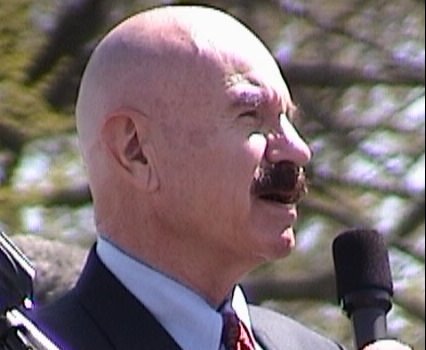
I’m proud of you, I’m proud of your family….It’s always a pleasure for me to come on your program, Gordon, and congratulations on your continued success and adherence to the principles and philosophies that keep our nation great.
By contrast, Obama has never said that he’s “proud” of Bill Ayers
What are Liddy’s crimes? Let’s go through the details. G. Gordon Liddy is a lunatic who grew up admiring Hitler. But what really matters are his crimes. Watergate alone should be a good enough reason for any presidential candidate to avoid any association with the man whose criminal activities helped to bring down Richard Nixon.
However, Liddy’s plotting of crimes went far beyond the Watergate break-in.
At the Committee to Re-Elect the President,
Liddy concocted several plots, some far-fetched, intended to embarrass the Democratic opposition. These included firebombing the Brookings Institution in Washington, D.C. (where classified documents leaked by Daniel Ellsberg were being stored), kidnapping anti-war protest organizers and transporting them to Mexico during the Republican National Convention (which at the time was planned for San Diego), and luring mid-level Democratic campaign officials to a house boat in Baltimore where they would be secretly photographed in compromising positions with call girls. Most of Liddy’s ideas were rejected, but a few were given the go ahead by Nixon Administration officials, including the break-in at Daniel Ellsberg’s psychiatrist’s office.
Liddy has Source revealed that he was prepared to murder someone “if necessary” during the Ellsberg break-in. He also said that he “plotted with a ‘gangland figure’ to murder Howard Hunt to prevent him from cooperating with investigators.”
Does John McCain support murdering people? How about kidnapping protesters? Firebombing liberal think tanks? Why is McCain defending this man?
Liddy also plotted the assassination of a journalist:
“In 1980, Liddy published an autobiography, titled Will, which sold more than a million copies and was made into a television movie. In it he states that he once made plans with Hunt to kill journalist Jack Anderson, based on a literal interpretation of a Nixon White House statement we need to get rid of this Anderson guy.”
Liddy has never expressed regret for this. In fact, in 2004, Liddy explicitly embraced the idea of murdering columnists: “If they were traitors as Jack Anderson was, directly helping the enemy, then yes.”
So, does John McCain support the murder of journalists?
Liddy also openly violates gun laws. As an ex-felon, he’s banned from owning guns. In 1990, I heard him speak at the University of Illinois and brag about how his wife owned a large collection of guns which she conveniently keeps under his side of the bed. Later in the 1990s, “he mentioned labeling targets ‘Bill’ and ‘Hillary’ when he practiced shooting.” Does McCain think that ex-felons like Liddy should have guns? Does he approve of Liddy naming his shooting targets after the President and First Lady?
And then there’s this well-known terrorism advocated by G. Gordon Liddy on his radio show, August 26, 1994:
“Now if the Bureau of Alcohol, Tobacco and Firearms comes to disarm you and they are bearing arms, resist them with arms. Go for a head shot; they’re going to be wearing bulletproof vests….They’ve got a big target on there, ATF. Don’t shoot at that, because they’ve got a vest on underneath that. Head shots, head shots…. Kill the sons of bitches.”
And September 15, 1994:
“If the Bureau of Alcohol, Tobacco and Firearms insists upon a firefight, give them a firefight. Just remember, they’re wearing flak jackets and you’re better off shooting for the head.”
Here’s how Liddy later explained himself:
“The law is that if somebody is shooting at you, using deadly force, the mere fact that they are a law enforcement officer, if they are in the wrong, does not mean you are obliged to allow yourself to be killed so your kinfolk can have a wrongful death action. You are legally entitled to defend yourself and I was speaking of exactly those kind of situations. If you’re going to do that, you should know that they’re wearing body armor so you should use a head shot. Now all I’m doing is stating the law, but all the nuances in there got left out when the story got repeated.”
Of course, that’s not true (you’re not legally entitled to kill law enforcement officers, even if they are in the wrong). But it’s also not what Liddy said. Remember: “if the Bureau of Alcohol, Tobacco and Firearms comes to disarm you and they are bearing arms, resist them with arms.” Liddy was talking about ATF agents “bearing arms,” not shooting at people. He was talking about ATF agents trying to “disarm” people, not kill them.
In 1998, Liddy hosted a fundraiser for McCain, and has given his campaigns $5,000, including $1,000 to McCain’s current presidential campaign.
By contrast, Ayers never hosted a fundraiser for Obama (it was a meet-and-greet in 1995), and at the time Obama didn’t know about Ayers’ past. Ayers gave Obama a small donation in 2000, but nothing recently.
John McCain not only knew about Liddy’s criminal past, he knew about Liddy’s 1994 comments urging listeners to shoot law enforcement agents in the head when he attended that 1998 fundraiser at Liddy’s home.
How do we know that McCain knew about Liddy’s comments? Because it was mentioned in a Washington Post story on May 18, 1995, which noted that Liddy had been “disinvited from a recent GOP fund-raiser because of his embarrassing exhortations to shoot pesky federal law enforcement officers.” That same article discussed McCain joking around at an event with Liddy about his psychotic propensity to burn himself.
Is it really possible that McCain was unaware of the controversy about Liddy? Is it really possible that McCain didn’t hear anything about the national outrage over Liddy’s remarks? Is it really possible that McCain never heard about his own party banning Liddy from a fundraiser? Is it really possible that McCain didn’t read the Washington Post story mentioning his own name that directly addresses Liddy’s remarks? No, it’s not possible. And if McCain conveniently forgot that his buddy urged the murder of federal agents, what does that say about his judgment?
Let’s be clear-cut about this:
If you urge people to shoot federal agents in the head, you are encouraging terrorism.
If you plot the firebombing of a liberal organization, you are plotting terrorism.
If you plan the assassination of a journalist and thirty years later still embrace the idea, you are an unrepentant terrorist.
Do you disagree, John McCain?
You say, “Everything about any relationship that I’ve had I will make completely open and give a complete accounting of.” So let’s hear it: do you think this is terrorism? And why are you “proud” of this unrepentant terrorist?
McCain claims, “I think not only a repudiation but an apology for ever having anything to do with an unrepentant terrorist is due the American people.” We’re waiting for our apology, Senator McCain.
Source / The Huffington Post

As they say, the more things change, the more they stay the same.
Take, for example, the use of mandatory-minimum prison sentences to punish, and supposedly deter, drug crimes. The U.S. first tried this approach in dealing with the “drug problem” in 1951 with the passage of the Boggs Act, named for Louisiana Dem Rep. Hale Boggs, which imposed prison terms of two to five years for a first offense, including for simple possession. And, as a new report released late last month by Families Against Mandatory Minimums points out, the Boggs Act “made no distinction between drug users and drug traffickers for the purposes of sentencing.” Fifty-seven years ago, lawmakers passed the Boggs Act in part because they believed that “drug addiction was a contagious and perhaps incurable disease and that addicts should be quarantined and forced to undergo treatment,” FAMM’s report explains.
But the Boggs Act (and its successor, the Narcotics Control Act of 1956, which increased Boggs Act penalties) did little, if anything, to control drug use. Instead, during the 1960s, drug use increased; by the end of the decade, criminal justice officials were increasingly expressing their opposition to the man-min sentencing scheme which did little except explode the prison population. By 1970, with the backing of President Richard Nixon and with bipartisan congressional support, the Boggs Act was repealed.
By the mid-1980s, lawmakers did not still believe (at least not openly) that drug addiction was contagious, but they’d clearly forgotten the lesson imparted by the failure of the Boggs Act. So lawmakers donned blinders – blinders made from crack cocaine. Again demonstrating little understanding of the drug or its effects (such as failing to recognize that crack and powder cocaine are the same drug and that the differences in effect on the user have more to do with the delivery system – usually snorting for powder and smoking for crack – than the chemical makeup of the drug itself), lawmakers rushed headlong into a solution to the “crack problem,” imposing a new set of draconian man-min sentences.
In so doing, Congress ushered in the modern era of the man-min, which (until very recently) codified a 100-1 sentencing ratio, powder-to-crack cocaine. Under current federal law, possession of just 5 grams of crack would net a five-year prison term, while it would take possession of 500 grams of powder cocaine to pull the same sentence. (And five years means five years in the federal system, where there is no parole.) After years of urging Congress to take action to fix the sentencing disparity, the U.S. Sentencing Commission late last year took matters into its own hands, revising the sentencing guidelines to create parity in sentencing for crack and powder coke offenders. Congress did not move to stop the action.
Amazingly, the 1980s man-min sentencing scheme was drafted by lawmakers and passed into law in less than a week, says Eric Sterling, president of the Criminal Justice Policy Foundation, who served as counsel for the House Judiciary Committee when the man-min law was passed. Lawmakers “didn’t even … consult with federal judges,” with prison officials, or with the Department of Justice in creating the new sentencing statute, Sterling said during a press conference last month. As a result, the law was written in about 48 hours and without any hearings. In sum, he said, the “historic ineffectiveness of this [approach] was disregarded.”
It is time now to remember the past and to correct the mistakes of the 1980s, says FAMM. And most Americans agree, according to a new poll commissioned by the group, which advocates for the end of man-mins. Fully 60% of those polled oppose mandatory-minimum sentences for nonviolent offenders, FAMM found, and roughly 80% said judges are best qualified to determine sentencing. Moreover, nearly 60% said they would vote for candidates who opposed man-min sentencing. What does this tell the folks at FAMM? “The public is ahead of the politicians on this,” said FAMM President Julie Stewart. “People believe in individualized justice.”
As such, FAMM is calling for Congress to act as it did in 1970 and repeal the man-min sentences – bringing us out, again, of the 1950s. “In light of Congress’s lack of deliberation when it created the current mandatory minimums, it is not surprising that the laws have failed just like their predecessors,” staff attorney Molly Gill wrote in FAMM’s September report. Like its predecessor laws, the current man-min scheme has not curbed drug use or trafficking. In fact, small-time users are all too often caught in the federal man-min web, at times because they have little if any information on kingpin dealers to use as leverage, leading to an explosion in prison population, which in turn has had a devastating impact on thousands of families.
The “hill of evidence” against mandatory minimums “has grown into a mountain,” writes Gill. While the federal statutes remain, the FAMM report points out that states have begun to explore other options for dealing with drug offenders – including the introduction of drug courts to deal with nonviolent drug offenders. (FAMM’s report gives props to Texas Gov. Rick Perry for supporting such endeavors.)
“Congress is now in the same position it was in 1970,” Gill said. “There is a theory in politics that you can only get tougher and tougher on crime. That you can’t go backwards. And that just isn’t true.”
Source / Austin Chronicle

Andrew Lahde, the hedge-fund manager who quit after posting an 870 percent gain last year, said farewell to clients in a letter that thanks stupid traders for making him rich and ends with a plea to legalize marijuana.
Lahde, head of Santa Monica, California-based Lahde Capital Management LLC, told investors last month he was returning their cash because the risk of using credit derivatives — his means of betting on the falling value of bonds and loans, including subprime mortgages — was too risky given the weakness of the banks he was trading with.
“I was in this game for money,” Lahde, 37, wrote in a two-page letter today in which he said he had come to hate the hedge-fund business. “The low-hanging fruit, i.e. idiots whose parents paid for prep school, Yale and then the Harvard MBA, was there for the taking. These people who were (often) truly not worthy of the education they received (or supposedly received) rose to the top of companies such as AIG, Bear Stearns and Lehman Brothers and all levels of our government.
“All of this behavior supporting the Aristocracy, only ended up making it easier for me to find people stupid enough to take the other sides of my trades. God Bless America.”
Lahde, who managed about $80 million, told clients he’ll be content to invest his own money, rather than taking cash from wealthy individuals and institutions and trying to amass a fortune worth hundreds of millions or even billions of dollars.
“I do not understand the legacy thing,” he wrote. “Nearly everyone will be forgotten. Give up on leaving your mark. Throw the Blackberry away and enjoy life.”
Request for Soros
He said he’d spend his time repairing his health “as well as my entire life — where I had to compete for spaces at universities, and graduate schools, jobs and assets under management — with those who had all the advantages (rich parents) that I did not.”
He also suggested that billionaire George Soros sponsor a forum in which “great minds” would come together to create a new system of government, as the current system “is clearly broken.”
Lahde ended his letter with a plea for the increased use of hemp as an alternative source of food and energy that segued into a call for the legalization of marijuana.
“Hemp has been used for at least 5,000 years for cloth and food, as well as just about everything that is produced from petroleum products,” he wrote. “Hemp is not marijuana and vice versa. Hemp is the male plant and it grows like a weed, hence the slang term.”
‘Innocuous Plant’
He added, “The evil female plant — marijuana. It gets you high, it makes you laugh, it does not produce a hangover. Unlike alcohol, it does not result in bar fights or wife beating. So, why is this innocuous plant illegal? Is it a gateway drug? No, that would be alcohol, which is so heavily advertised in this country.”
Lahde said the only reason marijuana remains illegal is because “Corporate America, which owns Congress, would rather sell you Paxil, Zoloft, Xanax and other addictive drugs, than allow you to grow a plant in your home without some of the profits going into their coffers.”
Lahde graduated from Michigan State University with a degree in finance and holds an MBA from the University of California, Los Angeles. He worked at Los Angeles-based hedge fund Dalton Investments LLC before founding his own firm two years ago with about $10 million.
Lahde wasn’t available for comment. A woman at his firm, who asked not to be identified, confirmed the authenticity of the letter.
Source / Bloomberg
Thanks to Jesse James Retherford and Duncan Echelson / The Rag Blog
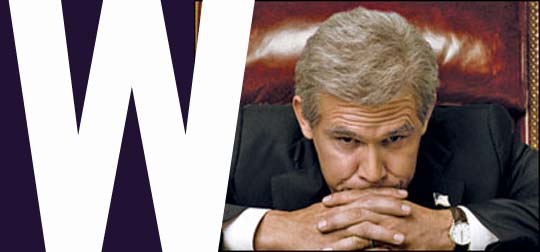
‘Oliver Stone orchestrates the chaos effectively, and he is immeasurably aided by the stalwart presence of Josh Brolin, who nails his outstanding performance of Bush.’
By Wajahat Ali / October 17, 2008
Oliver Stone’s fascinating and entertaining portrait of “W.” depicts George W. Bush as the prodigal son whose desire for paternal validation breeds a paralyzing insecurity that simultaneously drives and suffocates his ambitions.
Stone and company at times veer dangerously close to parody in their depiction of the Magnificent 7 [Bush, Rumsfeld, Cheney, Rice, Rove, Powell and Tenent]: the camaraderie of Bush cronies responsible for the disastrous decision to attack Iraq. However, as we reflect now at the audacious and flabbergasting foreign policy blunders of the post 9-11 Administration, perhaps a Monty Python-esque satirical touch would be the ideal vehicle to fully dilute and appreciate the madness of it all.
Regardless, the movie is structurally anchored by a straightforward – at times overly verbose and familiar – depiction of the buildup to the Iraq War punctuated by a series of quick, erratic flashback vignettes chronicling the rise of the improbable Shrub. Through this narrative, Stone thematically implies that Bush Junior’s entire life until his Presidency was a series of aborted enterprises representative of a well intentioned but aimless man prone to impetuousness and heedlessness. However, this chaotic narrative could also reflect the rushed, streamlined film schedule, which was shot only a few months ago, and aggressively completed for a pre-election release date.
Despite the film’s budget and schedule restraints, Stone orchestrates the chaos effectively, and he is immeasurably aided by the stalwart presence of Josh Brolin, who nails his outstanding performance of Bush. Brolin portrays him as a well intentioned, charismatic, impulsive “gut player.” He is a man whose quest for greatness eventually transforms him into an ultimately semi-sympathetic yet tragically clueless figure who neither achieves self-realization nor personal fulfillment.
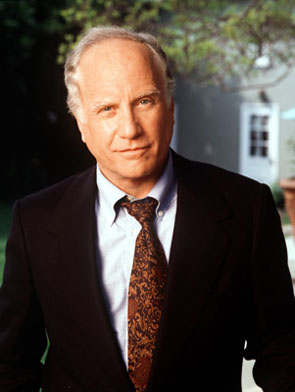
After a blistering back and forth debate amongst the administration about invading Iraq, Bush – who was quietly absorbing the rhetoric – simplifies the complex policy into an easily digestible ideological battle between “good vs. evil” and “us vs. them.” Stone repeatedly highlights Bush’s sincere – if deluded – conviction that his actions are predicated upon ushering “freedom” to a starving population hungry for “democracy.” Throughout the movie, Bush is shown to crystallize nuances and complicated issues into a “Joe 6 Pack” narrative; one that is intensely influenced by his very sincere and passionate “Born Again” Christian beliefs. “God wants me to run for president,” says Brolin’s Bush to his Evangelical Reverend, comparing his ineloquence yet steadfast conviction to that of a persevering Moses carrying out God’s “Divine Plan.” Stone’s depiction is all the more frightening and comical due to its truth as evidenced by the countless articles, interviews and biographies that have painted a similar portrait.
As a counterweight, Colin Powell played with simmering anger and moral indignation by Jeffrey Wright, emerges as one of the movie’s sole voice of wisdom and conscience. The cocky, self-assured Rumsfeld, played by Scott Glen, and assertive Cheney, repeatedly rebuke his pointed critiques at the “Bush Doctrine” and requests for explanations for the pre-emptive strike. Naturally, Stone takes liberties with the dialogue, however Powell’s early resignation and subsequent comments elucidate a ring of truth to his depiction as “the odd man out.” Sadly, Stone and actress Thandie Newton make Condi Rice into a perky, cheerleader caricature. Although the makeup and wardrobe is impeccable, Newton simply mimics Rice, which hardly reflects the reality of her influential involvement.
Aside from Dubya, the central, supporting figure is “Poppy” Bush, the dynasty’s patriarch played exceptionally by veteran character actor James Cromwell. As his thematic foil, “Poppy” Bush represents everything “Junior” is not: a varsity, Yale baseball player, a prosperous businessman, and a respected and savvy politician. The movie’s most fascinating and illuminating aspects evolve from Stone’s psychoanalysis of Dubya as the shameful ne’er do well overshadowed by the towering legacy and failures of his ubiquitous father. Furthermore, Bush Sr.’s juxtaposition of “Junior” to his more intellectual and successful brother Jeb, who is wisely alluded to but rarely shown in the movie, creates another immeasurable adversarial shadow that “Dubya” can never wrestle. The heir apparent, Jeb, loses his rightful, Presidential Bush crown to Mordred, the unwanted, black sheep exemplified by Dubya and his lifetime of screw ups, alcoholism, failed businesses and insecurity complex.
“You think you’re a Kennedy? You’re a Bush! Act like one,” commands elder Bush to his wayward son in 1971 after Dubya’s string of failed enterprises at an investment firm, oilrig, ranch, and the air guard. As with most “Daddy didn’t love me” psychological narratives, the son’s entire existence is propelled simultaneously by a rebellion against anything resembling his father coupled with a painful yearning for his father’s unconditional acceptance. After Bush’s ’92 loss to Clinton, Stone portrays “Poppy” as tired, sentimental and old, weeping in Barbara’s bosom upon hearing his defeat. “Dubya” sees this as weakness and tells his supportive and patient wife [played well by Elizabeth Banks], “I will never let this happen to me!” blaming the loss on his father’s inability to finish the job [killing Saddam] in Desert Storm. After losing his Congressional bid, Dubya vows never to be “Out-Christian’d” and “Out-Texan’d” again, thus fueling his 2000 campaign image molded by Rove.
Throughout the movie, Bush’s motivations stem from endless attempts to one-up his father and prove that he can succeed without his influence and interference: he brags to advisors that he beat his father’s time when running the mile; he boasts he would find and kill Saddam unlike Poppy; and he rebukes Condi’s suggestion that he should consult the seasoned, elder Bush for advice on the Iraq War.
After a temporarily dull and familiar third act with overused images and rhetoric of Bush and the Iraq War [including reenactments of the “Mission Accomplished” speech and his Address to the Union], Stone re-engages his central psychoanalytic theme with an Oval Office dream sequence. Upon realizing the war effort is faltering and that WMD’s are nonexistent, an exhausted Bush dreams of encountering an aggressive and condescending Bush Sr. in the Oval Office. “Poppy” takes the gloves off and challenges Dubya to a “mano – a -mano” fight once and for all proving who’s the man. As with most events in his life, Dubya fronts bravado but ultimately cowers with confusion and fear. The elder Bush looks at him disdainfully and says that Junior’s entire life has been a “fiasco.”
In fact, the movie begins and ends with another symbolic dream sequence in which Dubya imagines himself in an empty, beautiful baseball field on a glorious afternoon. He hears the announcer bellowing from the speakers, the excited murmurs of the animated crowd; he hears the crack of the bat, and he runs to the bleachers making a stunning catch. At first, it doesn’t bother him that’s he’s all alone and simply playing make believe. At the end, we revisit the baseball dream and witness a similar scenario as Bush races to the outfield to make the catch. Only this time, Bush stares perplexedly at a darkened sky waiting for the ball that never drops.
Stone’s symbolism highlights the pathetic sadness of a man who was comically and fortuitously allowed to suit up as a slugger and play in the majors. A man motivated by a paralyzing obsession for vindication ultimately standing alone in the outfield without realizing his moment of greatness has passed him by and was perhaps never meant for him in the first place.
[Wajahat Ali is a Muslim American of Pakistani descent. He is a playwright, essayist, humorist, and Attorney at Law, whose work, “The Domestic Crusaders” is the first major play about Muslim Americans living in a post 9-11 America. His blog is at http://goatmilk.wordpress.com/. He can be reached at wajahatmali@gmail.com]
Source / counterpunch
Thanks to David Hamilton / The Rag Blog
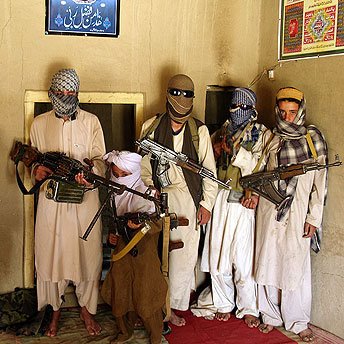
The highway that leads south out of Kabul, the capital of Afghanistan, passes through a craggy range of arid, sand-colored mountains with sharp, stony peaks. Poplar trees and green fields line the road. Nomadic Kuchi women draped in colorful scarves tend to camels as small boys herd sheep. The hillsides are dotted with cemeteries: rough-hewn tombstones tilting at haphazard angles, multicolored flags flying above them. There is nothing to indicate that the terrain we are about to enter is one of the world’s deadliest war zones. On the outskirts of the capital we are stopped at a routine checkpoint manned by the Afghan National Army. The wary soldiers single me out, suspicious of my foreign accent. My companions, two Afghan men named Shafiq and Ibrahim, convince the soldiers that I am only a journalist. Ibrahim, a thin man with a wispy beard tapered beneath his chin, comes across like an Afghan version of Bob Marley, easygoing and quick to smile. He jokes with the soldiers in Dari, the Farsi dialect spoken throughout Afghanistan, assuring them that everything is OK.
As we drive away, Ibrahim laughs. The soldiers, he explains, thought I was a suicide bomber. Ibrahim did not bother to tell them that he and Shafiq are midlevel Taliban commanders, escorting me deep into Ghazni, a province largely controlled by the spreading insurgency that now dominates much of the country.
Until recently, Ghazni, like much of central Afghanistan, was considered reasonably safe. But now the province, located 100 miles south of the capital, has fallen to the Taliban. Foreigners who venture to Ghazni often wind up kidnapped or killed. In defiance of the central government, the Taliban governor in the province issues separate ID cards and passports for the Taliban regime, the Islamic Emirate of Afghanistan. Farmers increasingly turn to the Taliban, not the American-backed authorities, for adjudication of land disputes.
By the time we reach the town of Salar, only 50 miles south of Kabul, we have already passed five tractor-trailers from military convoys that have been destroyed by the Taliban. The highway, newly rebuilt courtesy of $250 million, most of it from U.S. taxpayers, is pocked by immense craters, most of them caused by roadside bombs planted by Taliban fighters. As in Iraq, these improvised explosive devices are a key to the battle against the American invaders and their allies in the Afghan security forces, part of a haphazard but lethal campaign against coalition troops and the long, snaking convoys that provide logistical support.
We drive by a tractor-trailer still smoldering from an attack the day before, and the charred, skeletal remains of a truck from an attack a month earlier. At a gas station, a crowd of Afghans has gathered. Smoke rises from the road several hundred yards ahead.
“Jang,” says Ibrahim, who is sitting in the front passenger seat next to Shafiq. “War. The Americans are fighting the Taliban.”
Shafiq and Ibrahim use their cellphones to call their friends in the Taliban, hoping to find out what is going on. Suddenly, the chatter of machine-gun fire erupts, followed by the thud of mortar fire and several loud explosions that shake the car. I flinch and duck in the back seat, cursing as Shafiq and Ibrahim laugh at me.
“Tawakkal al Allah,” Shafiq lectures me. “Depend on God.”
This highway — the only one in all Afghanistan — was touted as a showpiece by the Bush administration after it was rebuilt. It provides the only viable route between the two main American bases, Bagram to the north and Kandahar to the south. Now coalition forces travel along it at their own risk. In June, the Taliban attacked a supply convoy of 54 trucks passing through Salar, destroying 51 of them and seizing three escort vehicles. In early September, not far from here, another convoy was attacked and 29 trucks were destroyed. On August 13th, a few days before I pass through Salar, the Taliban staged an unsuccessful assassination attempt on the U.S.-backed governor of Ghazni, wounding two of his guards.
As we wait at the gas station, Shafiq and Ibrahim display none of the noisy indignation that Americans would exhibit over a comparable traffic jam. To them, a military battle is a routine inconvenience, part of life on the road. Taking advantage of the break, they buy a syrupy, Taiwanese version of Red Bull called Energy at a small shop next door. At one point, two green armored personnel carriers from NATO zip by, racing toward Kabul. Shafiq and Ibrahim laugh: It looks like the coalition forces are fleeing the battle.
“Bulgarians,” Shafiq says, shaking his head in amusement.
After an hour, the fighting ends, and we get back in the car. A few minutes later, we pass the broken remains of a British supply convoy. Dozens of trucks — some smoldering, others still ablaze — line the side of the road, which is strewn with huge chunks of blasted asphalt. The trucks carried drinks for the Americans, Ibrahim tells me as we drive past. Hundreds of plastic water bottles with white labels spill out of the trucks, littering the highway.
Farther down the road, American armored vehicles block our path. Smoke pours from the road behind them. Warned by other drivers that the Americans are shooting at approaching cars, Shafiq slowly maneuvers to the front of the line and stops. When the Americans finally move, we all follow cautiously, like a nervous herd. We drive by yet more burning trucks. Ibrahim points to three destroyed vehicles, the remains of an attack four days earlier.
A few miles later, at a lonely desert checkpoint manned by the Afghan army, several soldiers with AK-47s make small talk with Shafiq and Ibrahim, asking them about the battle before waving us through. As night falls, we pass a police station. We have reached Ghazni province.
“From now on, it’s all Taliban territory,” Ibrahim tells me. “The Americans and police don’t come here at night.”
Shafiq laughs. “The Russians were stronger than the Americans,” he says. “More fierce. We will put the Americans in their graves.”
It has been seven years since the United States invaded Afghanistan in the wake of September 11th. The military victory over the Taliban was swift, and the Bush administration soon turned its attention to rebuilding schools and roads and setting up a new government under President Hamid Karzai. By May 2003, only 18 months after the beginning of the war, Defense Secretary Donald Rumsfeld all but declared victory in Afghanistan. “We are at a point where we clearly have moved from major combat activity to a period of stability and stabilization and reconstruction,” Rumsfeld announced during a visit to Kabul. The security situation in Afghanistan, in his view, was better than it had been for 25 years.
But even as Rumsfeld spoke, the Taliban were beginning their reconquest of Afghanistan. The Pentagon, already focused on invading Iraq, assumed that the Afghan militias it had bought with American money would be enough to secure the country. Instead, the militias proved far more interested in extorting bribes and seizing land than pursuing the hardened Taliban veterans who had taken refuge across the border in Pakistan. The parliamentary elections in 2005 returned power to the warlords who had terrorized the countryside before the Taliban imposed order. “The American intervention issued a blank check to these guys,” says a senior aid official in Kabul. “They threw money, weapons, vehicles at them. But the warlords never abandoned their bad habits — they’re abusing people and filling their pockets.
By contrast, aid for rebuilding schools and clinics has been paltry. In the critical first two years after the invasion, international assistance amounted to only $57 per citizen — compared with $679 in Bosnia. As U.S. contractors botched reconstruction jobs and fed corruption, little of the money intended to rebuild Afghanistan reached those in need. Even worse, the sudden infusion of international aid drove up real estate and food prices, increasing poverty and fueling widespread resentment.
The government of Pakistan, seeking to retain influence over what it views as its back yard, began helping the Taliban regroup. With the Bush administration focused on the war in Iraq, money poured into Afghanistan from Al Qaeda and other Islamic extremists, who were eager to maintain a second front against the American invaders. The Taliban — once an isolated and impoverished group of religious students who knew little about the rest of the world and cared only about liberating their country from oppressive warlords — are now among the best-armed and most experienced insurgents in the world, linked to a global movement of jihadists that stretches from Pakistan and Iraq to Chechnya and the Philippines.
The numbers tell the story. Attacks on coalition and Afghan forces are up 44 percent since last year, the highest level since the war began. By October, 135 American troops had been killed in Afghanistan this year — already surpassing the total of 117 fatalities for all of 2007. The Taliban are also intensifying their attacks on aid workers: In a particularly brazen assault in August, a group of Taliban fighters opened fire on the car of a U.S. aid group, the International Rescue Committee, killing three Western women and their Afghan driver on the main road to Kabul.
The Bush administration, belatedly aware that it was losing Afghanistan, responded to the violence as it did in Iraq: by calling for more troops. Speaking at the National Defense University on September 9th, the president announced a “quiet surge” of U.S. troops in Afghanistan, saying additional forces are necessary to stabilize “Afghanistan’s young democracy.” But the very next day, testifying before the House Armed Services Committee, Adm. Mike Mullen, chairman of the Joint Chiefs of Staff, offered a sharply different assessment. His prepared testimony, approved by the secretary of defense and the White House, read, “I am convinced we can win the war in Afghanistan.” But when Mullen sat down before Congress, he deviated from his prepared statement. “I am not convinced we are winning it in Afghanistan,” he testified bluntly.
Read all of it here. / Rolling Stone

‘In no other civilized nation, would you, as a sufferer from an illness, have the opportunity to subsidize one of the three most profitable industries in the world.’
By Dr. S.R. Keister / The Rag Blog / October 17, 2008
A special salute to those of you who have the privilege of going to the drug store to have your prescription(s) filled before the election. You are the select, the chosen, who as American citizens have been granted the right to pay the highest prices in the world for your prescription medicines. In no other civilized nation, would you, as a sufferer from an illness, have the opportunity to subsidize one of the three most profitable industries in the world, contribute to the excessive CEO salaries, pay in part the salaries of the hundreds of lobbyists in Washington as they pay baksheesh to many, many congressmen, by-in-large Republican, who work so hard for the pharmaceutical industry.
We as Americans are indeed the select who, by our purchase of pharmaceuticals, pay for the never ending stream of TV commercials, magazine ads, and newspaper ads for medications about which your physician should be familiar without the vulgar publicity. In spite of the propaganda from the pharmaceutical industry regarding “research costs” the industry spends much more on advertising and lobbying than on “research” I would call your attention to the book: The Truth About The Drug Companies by Marcia Angel, M.D.; Random House, Published 2004.
It should be noted that the United States and New Zealand are the only nations in the world that permit TV advertising for prescription medications. In no other nation does one have to sit with an eight-year old grandchild watching a sporting event and parry his questions during Viagra or Cialis ads about what an erection is, or what is better sex? Where are the hypocrites that cry out about sex education in school when there are ongoing ads on TV that tell one to see their doctor if “the erection” lasts more than four hours? I have heard nothing from these God fearing folks about sex education on TV! Remember what Dante wrote about the fate of the hypocrite?
In no other Western nation, nor in the V.A. facilities in the United States, are the ill taken advantage of as we see in the USA. In the European nations, in Canada, Australia, Japan, there is, under their national health plans, regulation of pharmaceutical prices, prohibiting excessive profits to the manufacturers. In the United States we have no price controls. Indeed the Republican Party, President Bush, and Senator McCain have bitterly opposed any price controls, and in fact have encouraged just the opposite in passing “Medicare Part D” several years ago, thus, scamming the elderly even more to the benefit of the pharmaceutical and insurance industries. The monstrous “plan,” passed by the House of Representatives in the middle of the night, awarded billions of Medicare dollars to the pharmaceutical and insurance industries for their “participation,” and further provided for the insurance companies as carriers of the individual policies, resulting in a charge to the participating patient of somewhere around $30 per month for the privilege of “belonging.” This could have been managed by the present Medicare agency, with upgrading, and modification, without involving the insurance industry; however, the Bush/McCain/Republican beholding to the pharmaceutical and insurance industry trumped the interest of the citizen.
It should be noted that many of the Republican leaders in congress responsible for the Medicare Part D bill subsequently ended up working for various pharmaceutical companies or lobbying firms. And, these same folks who pushed the Medicare D Legislation forbid price negotiations by Medicare for price control, and also forbid getting medications from abroad at a more reasonable price. The “reason” for the latter was the administration’s concern that drugs from abroad might be dangerous or inferior. Of course this was pure poppy-cock; of the six or eight major pharmaceutical firms, several are multinationals with offices not only on the United States, but in Switzerland, France, Germany or Sweden. The products they sell in the United States could be made anywhere in the world. Recall several years ago the British subsidiary of one drug company found its flu vaccine supply contaminated and the U.S. government obtained the vaccine from a French subsidiary in the United States. At the same time there was a great concern about bird flu and the government stockpiled TamiFlu made in Switzerland. Happily, in many instances we are able to obtain medications from abroad. For instance, my medication for prostatic cancer costs $400 for 30 tablets in the United States. I can obtain it from Canada at 100 Tablets for $400.
A word about generic drugs. Under U.S. patent laws a drug company looses exclusive patent rights to a specific drug after 17 years, and then theoretically a generic manufacturer can produce the same medication under its chemical name, rather than the original vendor’s trade name. Generics are just as good, and just as safe, as the drug under the original brand name when given Food and Drug Administration approval. Yet the big drug companies can delay that change for some years by various spurious legal actions, thus maintaining the higher prices the consumer must pay. Another ploy is to permit the original drug to become generic, but change the chemical formula a bit and market a “new and better” version of the old drug. As a result of the companies’ huge advertising budgets, the lay public will buy into this nonsense. If you are wise stay with the original in generic form if it is doing the job.
I note that Sen. Obama favors changes in the present consumer punitive system, while his sloganeering opponent, with ruffles and flourishes, suggests he’d bring more of the same. Please note that currently under Medicare Part D, the insurance carriers in many instances are increasing monthly membership rates, increasing co-payments, and decreasing the choice of medications available, while the pharmaceutical manufacturers are increasing prices. A word of caution: your local pharmacist is not responsible for the high price of drugs. He is trapped in the same situation as your local gas station owner. Do not blame the messenger.
This becomes a more and more vital issue in today’s economic meltdown. I sincerely fear that relief may be some time away regardless of who wins the election since problems beyond belief will face the next president. I sincerely believe that Sen. Obama will diligently try to correct a situation that he had no hand in creating, a situation that goes back to the Reagan administration and the concept of “trickle down” economics for which Sen. McCain has been a great supporter, regardless of his politically motivated attempts to publically disengage from what he has helped to create. I note that the U.S. Treasury Department managed to provide the figures for the increase in next year’s social security payments before the November election. A good increase, a necessary increase, but an increase that seems a bit disingenuous in view of the impending decreased taxes available to the U.S. Treasury with the increasing unemployment.
For those with further interest in the machinations of the pharmaceutical industry I suggest the following reading; Critical Condition, Bartlett & Steele, Doubleday, Published 2004 and Health Care Meltdown, Bob Lebow M.D., J.R.I. Press, Boise ID 83703, Published 2002, or indeed my own personal ranting here. Click on position papers.
[Dr Keister is a retired physician who contributes regularly to The Rag Blog.]
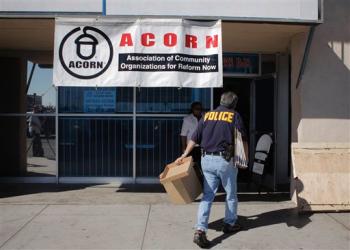
See ‘Evidence points to ACORN’s sloppiness, but not fraud’ by Greg Gordon, Below.
In recent weeks, media outlets have revived the cyclical practice of highlighting allegations by conservatives of voter fraud. In this election cycle, the primary target of those allegations appears to be the Association of Community Organizations for Reform Now (ACORN), over reports that some people hired by ACORN have submitted false or redundant registration forms. Once again, the media are devoting great attention to these charges, even though in past election cycles, charges of voter fraud have largely proven baseless.
Indeed, according to the Nexis news database, in the period October 6-15, the phrase “voter fraud” has appeared in 221 articles in U.S. newspapers, including five Washington Post articles, two New York Times articles, and one USA Today article. Moreover, “voter fraud” has appeared in 43 CNN news transcripts, 31 Fox News transcripts, and four MSNBC transcripts during that time. For example, The Washington Post reported on October 14 that “Republican officials and advisers to Sen. John McCain” accused ACORN of “fomenting voter fraud.” It also reported that “[t]he charges have come repeatedly, in news releases, conference calls to reporters and remarks on the campaign trail. Republican National Committee spokesman Danny Diaz called ACORN a ‘quasi-criminal group’ last week during one of a series of news conferences, charging that the group was committing fraud during its voter-registration drives. ‘We don’t do that lightly,’ RNC chief counsel Sean Cairncross said.”
The media’s focus on these charges just before elections is not new. A Media Matters for America search of Nexis indicates that numerous stories about voter fraud appeared in major newspapers and on television news in the weeks leading up to the 2000, 2002, 2004, and 2006 elections. Yet the U.S. Department of Justice crime statistics cast doubt on the existence of widespread voter fraud. On April 12, 2007, The New York Times reported, “Five years after the Bush administration began a crackdown on voter fraud, the Justice Department has turned up virtually no evidence of any organized effort to skew federal elections, according to court records and interviews.”
In an April 1 American Prospect article, U.S. News & World Report and Washington Monthly contributing editor Art Levine wrote:
Using various tactics — including media smears, bogus lawsuits, restrictive new voting laws and policies, and flimsy prosecutions — Republican operatives, election officials, and the GOP-controlled Justice Department have limited voting access and gone after voter-registration groups such as ACORN. Which should come as no surprise: In building support for initiatives raising the minimum wage and kindred ballot measures, ACORN has registered, in partnership with Project Vote, 1.6 million largely Democratic-leaning voters since 2004. All told, non-profit groups registered over three million new voters in 2004, about the same time that Republican and Justice Department efforts to publicize “voter fraud” and limit voting access became more widespread. And attacking ACORN has been a central element of a systematic GOP disenfranchisement agenda to undermine Democratic prospects before each Election Day.
In fact, while a 2005 Senate Republican Policy Committee paper claimed, “[v]oter fraud continues to plague our nation’s federal elections, diluting and canceling out the lawful votes of the vast majority of Americans,” Justice Department statistics indicate that few actual instances of voter fraud have been prosecuted in recent years. According to a report by the Justice Department’s Criminal Division of prosecutions between October 2002 and September 2005, the Justice Department charged 95 people with “election fraud” and convicted 55. Among those, however, just 17 individuals were convicted for casting fraudulent ballots; cases against three other individuals were pending at the time of the report. In addition, the Justice Department convicted one election official of submitting fraudulent ballots and convicted five individuals of registration fraud, with cases against 12 individuals pending at the time of the report. Thirty-two individuals were convicted of other “election fraud” issues, including people convicted of offenses arising from “a scheme to block the phone lines used by two Manchester [New Hampshire] organizations to arrange drives to the polls during the 2002 general election” — in other words, these convictions were connected to voter suppression efforts, not voter fraud. Several other people listed in the report were convicted of vote buying.
Additionally, a 2007 report by New York University’s Brennan Center for Justice stated:
There have been several documented and widely publicized instances in which registration forms have been fraudulently completed and submitted. But it is extraordinarily difficult to find reported cases in which individuals have submitted registration forms in someone else’s name in order to impersonate them at the polls. Furthermore, most reports of registration fraud do not actually claim that the fraud happens so that ineligible people can vote at the polls. Indeed, we are aware of no recent substantiated case in which registration fraud has resulted in fraudulent votes being cast.
Nevertheless, media outlets continue to report on allegations of possible voter fraud in advance of elections. For instance, between October 14, 2004, and the November 2 election that year, two USA Today articles, 49 CNN transcripts, and 37 Fox News transcripts containing the term “voter fraud” appear in Nexis. Media Matters searched Nexis for news reports containing the term “voter fraud” in the weeks leading up to the 2000, 2002, 2004, and 2006 elections in The New York Times, The Washington Post, the Los Angeles Times, The Wall Street Journal, and USA Today, and in news transcripts from CNN, Fox News, MSNBC, ABC, CBS, and NBC. (Media Matters did not examine the substantive content of these reports). Results of the search were as followed:
October 14-November 7, 2000
Los Angeles Times: 5
The New York Times: 1
The Washington Post: 1
CNN: 6
Fox News: 2
MSNBC: 1
October 14-November 5, 2002
Los Angeles Times: 8
The Washington Post: 5
USA Today: 1
Fox News: 7
CNN: 6
MSNBC: 1
October 14-November 2, 2004
The Washington Post: 10
Los Angeles Times: 8
The New York Times: 8
USA Today: 2
CNN: 49
Fox News: 37
NBC: 10
MSNBC: 9
ABC: 3
CBS: 3
October 14-November 7, 2006
The New York Times: 6
Los Angeles Times: 2
The Washington Post: 2
USA Today: 2
CNN: 16
Fox News: 9
MSNBC: 4
ABC: 2
CBS: 2
From the April 12, 2007, New York Times article:
Five years after the Bush administration began a crackdown on voter fraud, the Justice Department has turned up virtually no evidence of any organized effort to skew federal elections, according to court records and interviews.
Although Republican activists have repeatedly said fraud is so widespread that it has corrupted the political process and, possibly, cost the party election victories, about 120 people have been charged and 86 convicted as of last year.
Most of those charged have been Democrats, voting records show. Many of those charged by the Justice Department appear to have mistakenly filled out registration forms or misunderstood eligibility rules, a review of court records and interviews with prosecutors and defense lawyers show.
In Miami, an assistant United States attorney said many cases there involved what were apparently mistakes by immigrants, not fraud.
In Wisconsin, where prosecutors have lost almost twice as many cases as they won, charges were brought against voters who filled out more than one registration form and felons seemingly unaware that they were barred from voting.
One ex-convict was so unfamiliar with the rules that he provided his prison-issued identification card, stamped “Offender,” when he registered just before voting.
A handful of convictions involved people who voted twice. More than 30 were linked to small vote-buying schemes in which candidates generally in sheriff’s or judge’s races paid voters for their support.
A federal panel, the Election Assistance Commission, reported last year that the pervasiveness of fraud was debatable. That conclusion played down findings of the consultants who said there was little evidence of it across the country, according to a review of the original report by The New York Times that was reported on Wednesday.
—J.H.
Source / County Fair / Media Matters
Evidence points to ACORN’s sloppiness, but not fraud
By Greg Gordon / October 15, 2008WASHINGTON — Republicans and their allies in the media and on the Internet are ramping up allegations that the liberal-leaning nonprofit voter registration group ACORN is trying to steal next month’s presidential election for Democrat Barack Obama.
Conservative media outlets and Web sites are focusing on ACORN, the Association of Community Organizations for Reform Now. According to TVeyes.com, Fox News alone has mentioned ACORN stories 342 times in recent days.
In nearly a dozen states, county registrars have found phony voter registration applications submitted by canvassers for ACORN; criminal investigations are under way in Nevada, Ohio and elsewhere; and a racketeering suit was filed in Ohio this week. The mounting evidence of ACORN’s sloppy management and poor supervision, however, so far doesn’t support the explosive charges that the group is trying to rig the presidential election.
Larry Lomax, the registrar in Clark County, Nev., said he would estimate that 25,000 of the 90,000 applications submitted by ACORN this year were duplicates or phony.
However, Lomax said in a phone interview with McClatchy Newspapers: “I don’t think ACORN consciously sets out to turn in fraudulent forms. I just think the people they hire find it incredibly easy to rip off their bosses and turn in fake forms.”
While he criticized ACORN’s quality control, Lomax said he doubted that any of the fake filings would result in fraudulent votes.
Election officials say that registrations under names such as Mickey Mouse or Dallas Cowboys quarterback Tony Romo suggest that ACORN workers were trying to fill their quota of 20 applications to get paid, not to steal the presidency. They say that county registrars or poll workers would flag such obvious pranks, and that anyone who signed a poll book in another person’s name would risk being prosecuted for a felony.
ACORN, which boasts that it has registered 1.3 million mostly poor African-Americans this year, said that it’s alerted authorities to many of the suspicious applications. ACORN officials said the group has fired numerous workers who filled in forms with names from the phone book or the Dallas Cowboys starting lineup rather than trekking from door to door.
Moreover, said ACORN spokesman Scott Levenson, state laws in most of the 21 states where the group is active require it to turn all new registrations over to election officials. The group follows that policy even in states where it’s not required, but ACORN notifies election officials of suspect registrations in all states. “It is our policy to turn in them all,” Levenson said.
Nevertheless, Republicans have seized on the reports to attack Obama, who led a voter registration drive on Chicago’s South Side in 1992 for Project Vote, a group that later hired ACORN to register voters. They also pointed to the Obama campaign’s hiring of an ACORN affiliate for get-out-the-vote efforts and to his role, while on the board of two Chicago charities, in approving hundreds of thousands of dollars in grants for ACORN.
On Tuesday, the conservative-leaning Buckeye Institute filed a racketeering suit against ACORN in Warren County, Ohio, a Republican stronghold in the southwestern part of the state. The suit, nearly identical to a 2004 suit that was withdrawn after the election, seeks to avoid the dilution of legitimate votes, but doesn’t contend “that the election is going to be stolen,” said attorney Maurice Thompson, who filed it.
Ohio ACORN spokeswoman Kati Gall called the suit “a political stunt.”
Republican Sen. George Voinovich of Ohio followed the suit Wednesday with a letter asking U.S. Attorney General Michael Mukasey to work with Ohio Secretary of State Jennifer Brunner “to investigate swiftly any allegations of fraud in Ohio’s voter registration process.” Separately, a Republican National Committee lawyer argued that convicted felons who work for ACORN shouldn’t be allowed to register voters in Milwaukee.
ACORN has long been a target of Republicans, including the Justice Department under former Attorney General Alberto Gonzales. Five days before the 2006 election, interim U.S. Attorney Bradley Schlozman of Kansas City trumpeted the indictments of four ACORN voter registration workers, despite a department policy discouraging politically sensitive prosecutions close to elections. Schlozman is now facing a criminal investigation into the veracity of his congressional testimony about that and other matters.
Wade Henderson, the president of the Leadership Conference on Civil Rights, said he thinks that the Republican attacks on ACORN “are part of a concerted effort to … discredit the registration of many new voters who may well determine the outcome of the presidential election.”
Source McClatchy / Miami Herald
ACORN, in its own words.
ACORN is the nation’s largest grassroots community organization of low- and moderate-income people with over 400,000 member families organized into more than 1,200 neighborhood chapters in 110 cities across the country. Since 1970, ACORN has been building community organizations that are committed to social and economic justice, and won victories on thousands of issues of concern to our members, through direct action, negotiation, legislative advocacy and voter participation. ACORN helps those who have historically been locked out become powerful players in our democratic system.
To learn more about ACORN, go here.
And see ACORN and Voting Rights Groups Respond to Partisan Attacks / ACORN / Oct. 15, 2008
Also see Who Gets to Vote? / by Amy Goodman / truthdig / Oct. 16, 2008
And Conyers Says Of ACORN: Voter Fraud Allegations ‘A Right-Wing Cottage Industry’ / AHN / Oct. 17, 2008
And ACORN cracked open: Thieves hit Hub office / by O’Ryan Johnson / Boston Herald / Oct. 17, 2008

This piece appears in the New York Review of Books’ election issue, on sale this week. Novelist Didion is the author of “The Year of Magical Thinking” and “We Tell Ourselves Stories in Order to Live: Collected Nonfiction” (November 2008).
Midway through August, before the Democratic and Republican conventions, Chris Matthews made an offhand judgment on MSNBC that pretty much summed up the political mood in which the country found itself: “I’ve seen this election before, I think it was 1988.” He was referring of course to what was supposed to have been the certain 1988 victory of Michael Dukakis over George H.W. Bush, and to the ways in which a political party, most reliably the Democratic, can get overtaken by its own enthusiasm for being victimized; but what he said resonated beyond the concerns about Senator Obama’s candidacy just then beginning to surface.
It resonated because what seemed striking about the long and impassioned run-up to this election was not how different it had been — but precisely how similar it had been to previous such seasons.
We had kept talking about how different it was, but it wasn’t.
On a single mid-September morning these phrases would appear on the front page of The Washington Post: “stocks plummet,” “panic on Wall Street,” “as banks lost faith in one another,” “one of the most tumultuous days ever for financial markets,” “giant blue-chip financial institutions swept away,” “banks refusing to lend,” “Russia closing its stock market,” “panicked selling,” “free fall,” and “the greatest destruction of financial wealth that the world has ever seen.”
These were not entirely unpredictable developments.
For at least some months it had been clear that we were living in a different America, one that had moved from feeling rich to feeling poor. Many had seen a mandate for political change. Yet in the end the old notes had been struck, the old language used. The prospect for any given figure had been evaluated, now as before, by his or her “story.” She has “a wonderful story” we had heard about Condoleezza Rice during her 2005 confirmation hearings. “We all admire her story.” “I think she’s formidable,” Senator Biden said about Governor Palin a few weeks ago. “She has a great story. She has a great family.”
Senator Biden himself was said to have “a great story,” the one that revolved around the death of his first wife and child and taking the train from Washington to Wilmington to be with his surviving children. Senator McCain, everyone agreed, had “a great story.” Now as then, the “story” worked to “humanize” the figure under discussion, which is to say to downplay his or her potential for trouble. Condoleezza Rice’s “story,” for example, had come down to her “doing an excellent job as provost of Stanford” (this had kept getting mentioned, as if everyone at Fox News had come straight off the provost beat) and being “an accomplished concert pianist.”
Now as then, the same intractable questions were avoided and in the end successfully evaded. The matter of our continuing engagements in Iraq and Afghanistan and our looming engagements throughout the region had been reduced to bickering over who had or had not exhibited “belief in the surge.” “Belief in the surge” had been equated with the “success” of the surge, and by extension of our entire engagement in Iraq, as if that “success” were a fact rather than a wish. Such doublespeak was rampant. The increasing destabilization of the economy was already clear — an average of 81,000 jobs a month were lost all through the summer — but discussion of how to resolve the bleeding still centered on such familiar favorites as tort reform. This word “reform” kept resurfacing, but the question of who exactly was to be reformed was left to be explored mainly on “The View,” by Barbara Walters.
The leading candidates duly presented their “health care solutions,” not one of which addressed the core problem, which is the $350 billion a year it costs, according to a Harvard Medical School study, to cut in the commercial insurance industry. Fannie Mae and Freddie Mac, we were assured, had run into trouble not because of the systematic deregulation of the financial industry, the delinking of loans from any imperative to get them paid off — but because, according to Governor Palin (who had apparently missed the briefing at which it was explained that neither entity received government funding until the recent necessity for bailing them out), Fannie Mae and Freddie Mac were “too big and too expensive to the taxpayer.”
Time got wasted in the familiar ways. The presence of Barack Obama in the electoral process allowed us to talk as if “the race issue” had reached a happy ending. We did not need to talk about how the question of race has been and continues to be used to exacerbate the real issue in American life, which is class, or absence of equal opportunity. Instead we could talk about what Barack Obama meant by “lipstick on a pig,” and whether it was appropriate for him to go off on vacation “to some sort of foreign, exotic place.” The “foreign, exotic place” in question was of course Hawaii.
We could argue over whether “intelligent design” should be taught in our schools as an alternative to evolution, and overlook the fact that the rankings of American schools have already dropped to twenty-first in the world in the teaching of science and twenty-fifth in the world in the teaching of math. We could argue over whether or not the McCain campaign had sufficiently vetted its candidate for vice-president, but take at face value the campaign’s description of that vetting as “an exhaustive process” including a “seventy-question survey.” Most people in those countries where they still teach math and science would not consider seventy questions a particularly taxing assignment, but we could forget this. Amnesia was our preferred state. In what had become our national coma we could forget about Fannie Mae and Freddie Mac and Bear Stearns and Lehman Brothers and Merrill Lynch and AIG and Washington Mutual and the 81,000 jobs a month and the fact that the national debt had been approaching $10.6 trillion even before Henry Paulson and Ben Bernanke mentioned the imperative need to spend, which is to say to borrow, $700 billion for securities backed by bad mortgages, a maneuver likely to raise the debt another trillion dollars. (“We need this to be clean and quick,” Paulson told ABC.)
We could forget the 70 percent of American eighth graders who do not now and never will read at eighth-grade levels, meaning they will never qualify to hold one of those jobs we no longer have. We could forget that we ourselves induced the coma, by indulging the government in its fantasy of absolute power, wielded absolutely. So general is this fantasy by now that we approach this election with no clear idea where bottom is: what damage has been done, what alliances have been formed and broken, what concealed reefs lie ahead. Whoever we elect president is about to find some of that out.
Source / salon.com
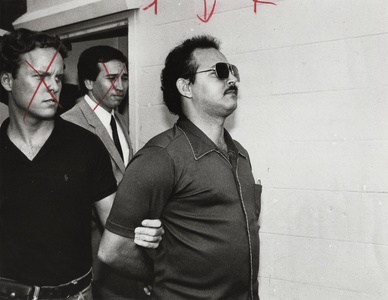
The campaign of John McCain has made much of Barack Obama’s relationship with Weather Underground bomber-turned-university professor Bill Ayers, whom Republicans call an “unrepentant terrorist.” Indeed, the Obama-Ayers connection has become a centerpiece of the McCain-Palin campaign. V.P. nominee Sarah Palin mentions Ayers in practically every public appearance, and John McCain has all but promised to bring up Ayers in tonight’s debate. [And, indeed he did.]
McCain’s campaign, however, has its own questionable connections to terrorists. Since John F. Kennedy’s failed Bay of Pigs invasion, Florida’s Cuban-Americans have been regarded as a reliable Republican voting block. And from 1960 until Sept. 11, 2001, some exile hard-liners in Miami endorsed a double standard on terrorism in which anti-Castro militants and bombers were judged to be “freedom fighters,” regardless of the civilian deaths and collateral damage they caused in Cuba and the United States, as well as elsewhere. While the Cuban-American community has undergone dramatic changes—with the majority now supporting dialogue with Cuba and an end to restrictions on travel and remittances—hard-liners still control the major levers of power in Miami. Such is their clout in turning out reliable voters that McCain dropped his stance of 2000, when he said he would support normalizing relations with Cuba even under Fidel Castro. (“I’d be willing to do the same thing we did with—with Vietnam.”) McCain has allied his campaign with the Cuban Liberty Council, an uncompromising anti-Castro group that has all but dictated policy to George W. Bush. Two of the council’s most prominent members, media personality Ninoska Perez-Castellon and her husband, Roberto Martin Perez, have been among McCain’s most dedicated campaigners and champions in Miami.
As a result, McCain’s campaign and advisers find themselves allied with and/or supporting militants who have committed acts that any reasonable observer would define as terrorism. On July 20, while campaigning for McCain in Miami and just prior to speaking at a McCain event, Sen. Joe Lieberman met with the wife of convicted serial bomber Eduardo Arocena and promised to pursue a presidential pardon on his behalf. Arocena is the founder of the notorious Cuban exile militant group Omega 7, renowned for a string of bombings from 1975 to 1983. Arocena was convicted of the 1980 murder of a Cuban diplomat in Manhattan. In 1983, Arocena was arrested and charged with 42 counts pertaining to conspiracy, explosives, firearms, and destruction of foreign government property within the United States. He is currently serving a life sentence in federal prison in Indiana. His targets included:
* Madison Square Garden (he blew up an adjacent store);
* JFK airport (Arocena’s group planted a suitcase bomb intended for a TWA flight to Los Angeles—in protest of the airline’s flights to Cuba. The plane would have exploded if not for the fact that the bomb went off on the tarmac prior to being loaded);
* Avery Fisher Hall at Lincoln Center (causing damage to three levels of the theater and halting the performance of a music group from Cuba);
*the ticket office of the Soviet airline Aeroflot;
*and a church.
He also attempted to assassinate the Cuban ambassador to the United Nations.
Arocena was also convicted of the 1979 murder of New Jersey resident Eulalio José Negrín. The 37-year-old Negrín, who advocated diplomacy with Cuba, was machine-gunned down as he stepped into his car, dying in the arms of his 13-year-old son.
Nevertheless, Lieberman, who at the time was McCain’s first choice for vice president and is said to top McCain’s list for secretary of state, was caught on video promising Miriam Arocena he would petition Washington to grant a pardon to her husband. “It’s my responsibility; it’s my responsibility. I will carry [the pardon request] back. I will carry it back,” Lieberman told Arocena just before addressing a group at a McCain event. “I think of you like you were my family. … I’ll bring it back. I’ll do my best.”
Queried on the matter, a Lieberman spokesman demurred, telling the AP, “Sen. Lieberman does not intervene in criminal proceedings including requests for pardons. The correspondence was merely forwarded without any comment, endorsement or support whatsoever.”
Another vocal champion of an Arocena pardon is CLC member Roberto Martin Perez, who narrates a McCain commercial about Castro that has played in South Florida. His wife, radio host Ninoska Perez-Castellon, says that the McCain campaign has queried them about making a television spot as well.
Miami attorney Alfredo Duran, Bay of Pigs veteran and a leader of the Cuban Committee for Democracy, explains the GOP strategy: “They think that the Arocena campaign will energize a certain segment of the ultra-conservative exile community that will deliver for McCain and the Republican Party.”
Arocena is not the only militant who’s received help from McCain’s team. In September, McCain announced he was choosing Lincoln Diaz-Balart, a Republican congressman from Miami, as his senior adviser and spokesman on Latin America. Rep. Diaz-Balart is a fierce hard-liner on Cuba, advocating, at various times, a blockade of the island, even military action if needed, to unseat Fidel Castro (his former uncle, once married to Diaz-Balart’s aunt). He, too, has been a supporter of certain kinds of terrorists who have struck on American soil. Since 2000, Diaz-Balart and his colleague Rep. Ileana Ros-Lehtinen have lobbied for and helped win the release of several convicted exile terrorists from U.S. prisons. Among the most notorious were Omega 7 members Jose Dionisio Suarez Esquivel and Virgilio Paz Romero, both convicted for their roles in the 1976 assassination of Chilean diplomat Orlando Letelier and his American colleague Ronni Moffitt with a car bomb in Washington, D.C. According to four agents I interviewed, the FBI also suspects the pair were involved in other bombings and attacks. (Suarez is known by the nickname “Charco de Sangre”—Pool of Blood.)
Diaz-Balart also pushed for the release of Valentin Hernandez, who gunned down Miami resident and Cuban émigré Luciano Nieves in February 1975 for speaking out in support of a dialogue with Cuba. Nieves was ambushed by Hernandez in a hospital parking lot in Miami after visiting his 11-year-old son. Hernandez also went on to kill a former president of the Bay of Pigs Association in an internecine feud. Hernandez was captured in Puerto Rico in 1977 and sentenced to life in prison. Today, Hernandez is living freely in Florida.
Nor has McCain’s senior adviser Diaz-Balart ever wavered in seeking “due process” for legendary bombers and would-be Castro assassins Luis Posada Carriles and Orlando Bosch. Both were charged with the bombing of a Cuban airliner in 1976, killing all 73 civilian passengers—the first act of airline terrorism in the Americas. In 2005, when I asked him about those who died—many of them teenage athletes—Bosch responded, “We were at war with Castro, and in war, everything is valid.”
After serving nine years, Posada “escaped” from prison in Caracas, Venezuela, thanks to a bribe paid to the warden. Posada gives effusive thanks in his memoir, Los Caminos del Guerrero, to at least two members of the Cuban Liberty Council for their help in resettling him during his early fugitive days. After serving 11 years, Bosch won an acquittal (following death threats to several judges hearing the case). However, hundreds of pages of memorandum of the FBI, CIA, and State Department, released by the National Security Archives, leave no doubt that U.S. authorities fully concurred with Venezuelan, Trinidadian, and Cuban intelligence that the two men had masterminded the airplane bombing.
Former Attorney General Richard Thornburgh described Bosch, who spent four years in federal prison for firing a bazooka into a Polish freighter bound for Havana in Miami’s harbor, as an “unreformed terrorist” and recommended immediate deportation when he showed up in Miami in 1988. But there were political considerations in Miami. Ros-Lehtinen, then running for Congress and now the Republican leader of the House foreign-affairs committee, lauded Bosch as a hero and a patriot. After she personally lobbied then-President George Bush (with her campaign manager Jeb Bush at a meeting noted in the Miami media), Bush overruled the FBI and the Justice and State departments, and Bosch was granted U.S. residency.
In 1998, I interviewed Luis Posada in Aruba for an investigative series for the New York Times in which he claimed to have orchestrated numerous attacks on both civilian and military targets during his 50-year war to topple Castro. Most notably, Posada took credit for masterminding the 1997 bombings of Cuban hotels that killed an Italian vacationer and wounded 11 others.
Posada made his last failed attempt to eliminate Fidel Castro at the Ibero-America Summit in Panama in November 2000. After his trial and conviction in 2004, Diaz-Balart (along with his brother, Rep. Mario Diaz-Balart, and Ros-Lehtinen), wrote at least two letters on official U.S. Congress stationery to Panamanian President Mireya Moscoso seeking the release of Posada and his collaborators. “We ask respectfully that you pardon Luis Posada Carriles, Guillermo Novo Sampol, Pedro Crispin Remon and Gaspar Jimenez Escobedo,” went one missive. On Aug. 24, 2004, Posada and his fellow conspirators—all with colorful rap sheets—received a last-minute pardon from the outgoing Moscoso.
Posada’s supporters tell me that he had been quietly assured by several Miami exile leaders that he would be allowed to live free in the United States like Bosch. While still a fugitive, Posada slipped into Miami in 2005. But following international outrage over his release, a federal grand jury was impaneled in Newark, N.J., in January 2006 to hear evidence against Posada for the Havana hotel bombings. FBI investigators testified that Posada had smuggled plastic explosives in shampoo bottles and shoes into Cuba a few weeks prior to the bombings. At the cost of millions of dollars, dozens of witnesses have testified to the grand jury over two and a half years. On Sept. 19 and 20, 2007, two witnesses, compelled to turn state’s evidence, offered damning evidence implicating Posada and his confederates. (Disclosure: The New York Times and I were subpoenaed in the matter but have not appeared before the grand jury, citing First Amendment protections.)
But election year politics seem to have interfered with the case. One of the attorneys representing Posada’s comrades in the case told me that the defendants received target letters last year and were warned by the FBI that they would be indicted by the end of 2007. Now he says it is certain nothing will happen because of the 2008 elections and the damage that could be done to the McCain ticket, the Diaz-Balarts, and Ros-Lehtinen. Another Posada attorney told me that he had been assured that Posada’s case “is being handled at the highest levels” of the Justice Department.
In the meantime, Posada has resettled in Miami. In November 2007, the Big Five Club, an elite watering hole for Miami’s movers and shakers, hosted an art show and fundraiser to benefit Posada and his comrade-in-arms, Letelier assassin José Dionisio Suárez. On May 2, 2008, there was another gala fundraiser in honor of Luis Posada at the Big Five Club. Lincoln Diaz-Balart and Ros-Lehtinen were both invited.
A few months earlier, a relaxed and expansive Posada attended a tribute for a well-known Cuban dissident. Just a few feet away from him, amid the ding of clinking glasses, were Reps. Lincoln Diaz-Balart and Ros-Lehtinen. Should McCain-Palin prevail in November, those pesky, pending indictments against Posada are very likely to get tossed.
[Ann Louise Bardach has written the “Interrogations” column for Slate and is the author of Without Fidel: A Death Foretold in Miami, Havana, and Washington, to be published in April, and Cuba Confidential: Love and Vengeance in Miami and Havana.]
Source / Slate
Thanks to Alice Embree / The Rag Blog

Around the time that Barack Obama and John McCain bent over backwards to show that they commiserated with the “hurtin’” middle class, two anti-war activists were physically hurt protesting outside of the debate held at Hofstra University. One, Nicholas Morgan, fractured a cheekbone when trampled by a Mounted Unit horse. In the end, fifteen protestors who identified themselves as Iraq War veterans were arrested.
The West / College on the Record
Fifteen arrested, two hurt at demonstrations before presidential debate.
By David Mathison / October 15, 2008
See video of protest, Below.
HEMPSTEAD, N.Y. — Pandemonium erupted outside Hofstra University tonight at around 8pm, an hour before the final presidential debate of the 2008 campaign was scheduled to begin there, when mounted police charged protesters and spectators.
Fifteen people were reportedly arrested and three injured. Protesters included a contingent of the group Iraq Veterans Against the War. Members of the group intended to submit questions to the the candidates but never had the chance. Local police on horseback drove the protesters away from the university’s David S Mack Sports and Exhibition Complex, where the debate was held, knocking some to the ground and in at least one case trampling them.
Source / Off the Bus / The Huffington Post
Earlier in the day, Jean Stevens of Manhattan, a spokeswoman for peace group Code Pink, said the anti-war protesters were “here to bring our message to both candidates and both parties to stop the war.” — Newsday.
Video of protest by David Mathison
Also see 15 protesters arrested at presidential debate by Patrick Whittle / Newsday / Oct. 16, 2008
Thanks to Jesse James Retherford / The Rag Blog
Thorne Webb Dreyer, Editor