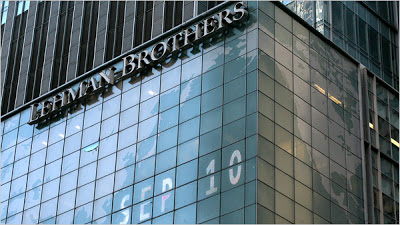
And the Dow Dropped More Than 500 Points, Too

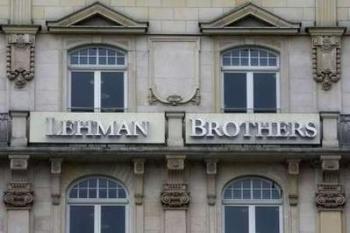
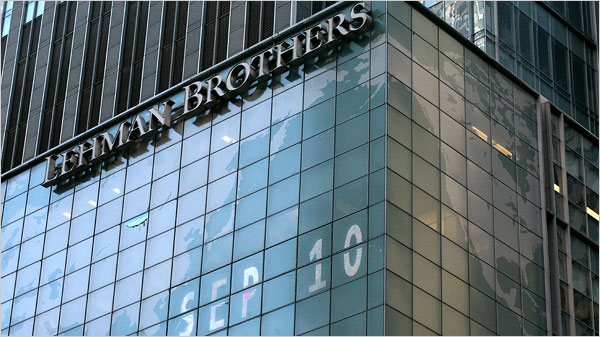
The Frankfurt branch of the Lehman Brothers bank is pictured in Frankfurt September 15, 2008. Global markets plummeted on Monday after investment bank Lehman Brothers filed for bankruptcy protection, rival Merrill Lynch agreed to be taken over and the Federal Reserve threw a life line to the battered financial industry. REUTERS/Alex Grimm (GERMANY)

More Financial Turmoil To Come
September 15, 2008

The collapse of Lehman Brothers, and attendant weakness of other major financial institutions, has now produced perhaps the worst U.S. financial crisis since the banking panic that faced former President Franklin Roosevelt at the beginning of his administration in March 1933.

The uncertainty created by the reluctance of the Treasury and Federal Reserve to subsidize the acquisition of Lehman (along the lines of JPMorgan Chase’s March takeover of Bear Stearns), and the process of unwinding Lehman’s huge portfolio of securities and derivatives trades, is likely to produce a major surge in counter-party risk aversion. The resulting unwinding of leverage and flight to quality threatens to destabilize the global financial system, which may thus be facing a period of rapid change and re-regulation.

Regulatory response. Market anxiety has been heightened by the government’s unwillingness to prevent the failure of such a large investment bank. Measured by assets, Lehman is larger than Bear Stearns before its March 16 collapse. This has increased uncertainty, as Wall Street has been left to guess how large an institution must be before regulators deem it to be “too big to fail.”

Treasury Secretary Henry Paulson, a former chief executive officer of Goldman Sachs, understands the risks posed by such uncertainty. However, with other, much larger U.S. thrifts and insurers in an increasingly precarious financial position, he has been increasingly reluctant to put taxpayers’ dollars at risk backstopping less than indispensable institutions.

Spreading contagion. The bankruptcy of Lehman Brothers , combined with the potential insolvency of the insurer American International Group threatens to saddle financial institutions around the world with new losses. Those could come if Lehman’s creditors dump its poorer-quality investments onto markets, forcing investors who own similar securities to write-down their value, or AIG’s contracts in credit default swaps, a type of insurance for securities, become worthless. Another concern is that financial regulators outside of the United States may lack resources to bail out institutions in their jurisdictions.

Back to basics? Undoubtedly, the financial sector is likely to see important mergers and acquisition activity as the crisis persists. A larger question is whether more traditional banking interests with access to retail deposits will acquire independent broker dealers, such as Goldman Sachs and Morgan Stanley–the two remaining independent players. In the last decade, investment banks have increasingly become hedge-fund-like entities, utilizing high degrees of leverage and making significant income from proprietary operations. With more traditional banking interests retaking the lead, major players are likely to be seen taking less risk. High-risk/high-leverage activity will continue, but in the boutique market (i.e., hedge funds).

Shadow banking? The bigger worry is the state of the shadow-banking sector– hedge funds and structured investment vehicles. These entities tend to have short-term liabilities, while their assets are long-term, and in many cases illiquid. As primary brokers continue to have their own difficulties, it will be harder and harder for them to service this sector. In the short-term many of these will likely fail. Whether their counter-party risk is enough to cause further knock-on effects remains uncertain.

Coordinated response? The toolkit for monetary and fiscal policy remains relatively constrained at the moment. A continuation of the crisis might manifest more policy coordination among major central banks, though a coordinated fiscal response remains unlikely. Given inflation pressures have eased as commodity prices continue their decline, central banks may feel inclined to lower interest rates sooner. It appears likely that the Fed may lower rates following its decision to relax its the collateral quality requirements associated with its existing term-auction facility. The ECB and Bank of England could also reduce interest rates, having today already injected close to $50 billion into the financial system.

Wither recovery? Even if the immediate systemic risks posed by Lehman’s failure are contained, a U.S. (and global) economic recovery is not a near-term prospect. Stabilization of the U.S. housing market is a necessary condition for the end of the global credit crisis–given that most of the problematic assets that trouble the balance sheets of major financial institutions are linked to U.S. housing. However, there is little indication that U.S. housing prices will stabilize until mid-2009, at the earliest. This means that banks and financial firms face further write-downs, greatly increasing the chances of additional failures.

To read an extended version of this article, log on to Oxford Analytica’s Web site.

Source / Forbes.com

The Rag Blog

Posted in RagBlog | Tagged , , | Leave a comment

Junior and Sarah Won’t Be Happy About This

Sections of Church likely to be dismayed by Darwin move

Charles Darwin to receive apology from the Church of England for rejecting evolution
By Jonathan Wynne-Jones / September 14, 2008

The Church of England is to apologise to Charles Darwin for its initial rejection of his theories, nearly 150 years after he published his most famous work.

The Church of England will concede in a statement that it was over-defensive and over-emotional in dismissing Darwin’s ideas. It will call “anti-evolutionary fervour” an “indictment” on the Church”.

The bold move is certain to dismay sections of the Church that believe in creationism and regard Darwin’s views as directly opposed to traditional Christian teaching.

The apology, which has been written by the Rev Dr Malcolm Brown, the Church’s director of mission and public affairs, says that Christians, in their response to Darwin’s theory of natural selection, repeated the mistakes they made in doubting Galileo’s astronomy in the 17th century.

“The statement will read: Charles Darwin: 200 years from your birth, the Church of England owes you an apology for misunderstanding you and, by getting our first reaction wrong, encouraging others to misunderstand you still. We try to practise the old virtues of ‘faith seeking understanding’ and hope that makes some amends.”

Opposition to evolutionary theories is still “a litmus test of faithfulness” for some Christian movements, the Church will admit. It will say that such attitudes owe much to a fear of perceived threats to Christianity.

The comments are included on a Church of England website promoting the views of Charles Darwin to be launched on Monday.

Source / The Telegraph

The Rag Blog

Posted in RagBlog | Tagged , | Leave a comment

Addicting You to Your Drinking Water

I facetiously used to say that they put heroine in chapstick because it seemed to be so addicting. Now the over-regulation of the disposal of medical “controlled substances” endangers us with our drinking water. Good one, government !!

Richard Jehn / The Rag Blog

A nurse uses a syringe filled with water to demonstrate how the many hospitals and nursing homes dump leftover medications into sinks. Tightly controlled narcotics, stimulants, depressants and steroids are often emptied into sinks and toilets. Jim Mone, AP

Controlled Drugs Dumped Into Water
By Jeff Donn / September 15, 2008

MINNEAPOLIS — In a frustrating quirk in government policy, the most tightly controlled drugs — like painkilling narcotics prone to abuse — are the ones that most often elude environmental regulation when they become waste.

Federal narcotics regulators impose strict rules meant to keep controlled pharmaceuticals out of the wrong hands. Yet those rules also make these drugs nearly impossible to handle safely as waste, say hospital environmental administrators.

Many would like to send controlled substances to landfills or incinerators to keep them out of waterways as much as possible. Instead, they are nearly always dropped into sinks and toilets by hospitals, nursing homes and other long-term care facilities.

The problem is huge, because more than 365 medicines are controlled by the U.S. Drug Enforcement Administration — almost 12 percent of all prescriptions, the agency says. They include widely used narcotics, stimulants, depressants and steroids — drugs like codeine, morphine, oxycodone, diazepam (often sold as Valium) and methylphenidate (often sold as Ritalin).

At Abbott Northwestern Hospital here, nurse Keri Osborne recently was opening a locked room at a spine surgery unit, where a machine must check her fingerprints before she pours unused controlled drugs into the sink.

“Back pain, so there’s a lot of narcotics here,” she explains. Much of the waste consists of liquid in syringes that aren’t completely emptied when used to treat patients.

Though a leader in incinerating drug waste, this hospital still puts four gallons of controlled substances down the drain each year, says hazardous waste manager Steven Waderich.

It would be very expensive to do otherwise. “Managing controlled substances, the cost goes up just through the roof,” he says.

In nearby Robbinsdale, North Memorial Medical Center pours 50 gallons of controlled substances into its drains annually rather than pay $25,000 to handle and haul it away for safer disposal, says regulated waste coordinator Jerry Fink.

Part of the cost is due to federal rules that state anyone who handles controlled substances, other than a user, must be certified as a police officer or registered with the DEA. That goes for pharmacists, distributors, even waste handlers.
State waste regulators take their cue from federal law and regulations.

Thus, typical assisted-living centers, which are not registered with the DEA, cannot collect unused controlled drugs of residents for offsite disposal.

Even the destruction of controlled drugs must be meticulously documented, so they aren’t diverted to addicts. Medical facilities typically send a second staffer to bear witness when controlled substances are poured into sinks or toilets.

Many waste experts now want to rewrite the rules so a broader range of professionals can handle leftover controlled drugs. “And DEA — truth be told — has not been very cooperative and responsive in that regard,” says waste consultant Catherine Zimmer at the University of Minnesota.

That could change. The DEA declined requests for an on-the-record interview, but in a statement, spokeswoman Rogene Waite said: “DEA is currently developing regulations to allow for the safe and effective destruction of controlled substances.”

Ben Grumbles, the Environmental Protection Agency’s water administrator, confirmed his agency has participated in these discussions. He would not provide details, but called the talks productive.

Source / America On Line

The Rag Blog

Posted in RagBlog | Tagged , | Leave a comment

Similar to What Occurred in Cambodia During the Vietnam War

Click to enlarge

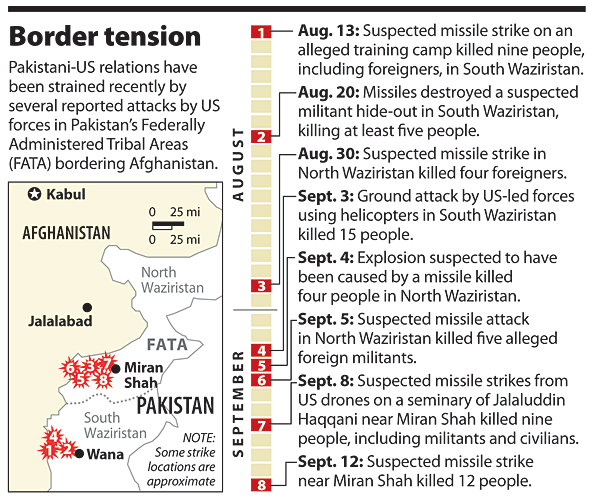
Raids into Pakistan: What U.S. authority?
By Howard LaFranchi / September 15, 2008

Bush’s orders to send special forces after Taliban militants have roots in previous presidencies. Reporter Howard LaFranchi talks about the US military’s raids inside Pakistan, looking for terrorists.

WASHINGTON – Orders President Bush signed in July authorizing raids by special operations forces in the areas of Pakistan controlled by the Taliban and Al Qaeda and undertaking those raids without official Pakistani consent, have roots stretching back to the days following the 9/11 terrorist attacks.

In an address to a joint session of Congress nine days after 9/11, President Bush said, “From this day forward any nation that continues to harbor or support terrorism will be regarded by the United States as a hostile regime.”

But even before that declaration, two key steps had been taken: One, Congress had authorized the use of US military force against terrorist organizations and the countries that harbor or support them. Two, Bush administration officials had warned Pakistan’s leaders of the dire consequences their country would face if they did not unequivocally enlist in the fight against radical Islamist terrorism.

What Mr. Bush’s July orders signify is that, after seven years of encouraging Pakistan to take on extremists harbored in remote areas along its border with Afghanistan and subsidizing the Pakistani military handsomely to do it, the US has become convinced that Pakistan is neither able nor willing to fight the entrenched Taliban and Al Qaeda elements. Indeed, recent events appear to have convinced at least some in the administration that parts of Pakistan’s military and powerful intelligence service are actually aiding the extremists.

“We’ve moved beyond the message stage here. I think the US has had it with messages that don’t get any action, and that is why the president authorized this,” says Kamran Bokhari, director of Middle East analysis for Stratfor, an intelligence consulting firm in Washington. “This says loud and clear, ‘We’re fed up.’ “

Even before the July order, the US had undertaken covert operations in Pakistan’s tribal areas. Moreover, the CIA over the past year has stepped up missile attacks by the unmanned Predator drones it operates to hit targets in the region. That increase has coincided with a deterioration of the war in Afghanistan, where the Afghan Army and NATO forces have come under increasing attack from militants crossing over the rugged and lawless border from Pakistan.

But Bush’s orders, first reported in The New York Times Thursday, mean that operations against insurgent sanctuaries will become overt and probably more frequent. A Sept. 3 ground assault involving US commandos dropped from helicopters targeted a suspected terrorist compound. Missile attacks by the CIA’s unmanned drones, including one Friday reported by Pakistani officials to have killed at last 12 people, are also on the rise.

Precedence for the orders authorizing the attacks on terrorist havens can be found in President Bill Clinton’s authorization of retaliatory attacks in 1993 (against Iraqi intelligence facilities) and in 1998 (against terrorist camps in Afghanistan and Sudan), and in President Ronald Reagan’s bombing of Libya, legal scholars say.

The administration has debated the use of commando raids in Pakistan for years, but the tipping point came in July, as relations with Pakistan’s civilian and military leaders deteriorated, intelligence sources say. The “kicker,” according to one source who requested anonymity over the sensitivity of the issue, was two July events: the bombing of India’s embassy in Afghanistan’s capital, Kabul, an act that US intelligence officials concluded was aided by Pakistani intelligence operatives; and a July 13 attack on a US military outpost in eastern Afghanistan that killed nine US soldiers. The outpost attack was carried out by Taliban militants who had crossed over the nearby border from Pakistan. Raids into Pakistan: What U.S. authority?

The evolution of operations in Pakistan from covert to overt actions is reminiscent of a trajectory followed in some aspects by the Vietnam War, some analysts note.

Patrick Lang, a former Middle East analyst for the Defense Intelligence Agency, says the evolution in Pakistan is similar to what occurred in Cambodia during the Vietnam War, when US operations against Vietcong sanctuaries there were initially covered up.

“We initially crossed into Cambodia as covert forces, but that changed,” says Mr. Lang, who was part of special forces that carried out the Cambodia operations. By 1970, cross-border operations against enemy sanctuaries were being carried out in the open. Looking at the evolution in operations in Pakistan, the national security analyst says, “We are letting [Pakistanis] know this could evolve into bigger things.”

Adds the intelligence source who requested anonymity, “The message is to the new civilian leadership and the military, ‘We have bought all these toys for you – if you don’t use them and do things in these areas that are causing us problems, we’ll do them for you.’ “

The new orders reflect flagging confidence in Pakistan’s civilian and military leadership to address the problem of the Taliban and terrorist havens, which are thought to harbor Al Qaeda leader Osama bin Laden and his deputy, Ayman al-Zawahiri. For seven years the Bush administration focused its Pakistan policy on President Pervez Musharraf and his assurances that he was battling the militant sanctuaries. But Mr. Musharraf was forced to resign last month after suffering a crushing electoral defeat earlier in the year, and the US appears to have little confidence in the new civilian and military leaders.

“Musharraf was a one-stop shopping center for US relations with Pakistan, but that no longer exists,” says Stratfor’s Mr. Bokhari. Senior State Department officials have met with Pakistan’s new civilian leaders, he notes, while top Pentagon officials have met with the military leadership including Army chief of staff Gen. Ashraf Parvez Kayani, the top military commander.

“The sense I get is they were given the runaround, and they came away from all these meetings convinced the leadership structure has become much more complex at a time when the Taliban are becoming stronger and the situation in Afghanistan is deteriorating,” Bokhari says. “The feeling was the US couldn’t sit by and see how the leadership sorts itself out.”

Bush’s orders authorizing cross-border incursions into Pakistan mean in a sense that the rules governing US special operations have shifted from yellow to green. The military will no longer need a presidential “finding” for each operation – and that, military analysts say, means the handling of forays into Pakistan will fall increasingly into military rather than CIA hands.

That has some intelligence officials worried that the consequences of stepped-up US operations in Pakistan – in terms of Pakistani public opinion and the stability of the government – will get short shrift. According to intelligence sources, officials from the National Intelligence Council recently briefed the Bush administration’s national security team on the potentially dire consequences of US actions that could destabilize the government of a country with nuclear weapons.

Source / Christian Science Monitor

The Rag Blog

Posted in RagBlog | Tagged , , | Leave a comment

Lehman Declined to Comment on the Talks

Just two short days ago, we posted this. No need to say much more, although I reiterate this is going to get really bleak before it gets any better. We just bet Lehman doesn’t have too much to say about the talks.

Please see the breaking developments below.

Richard Jehn / The Rag Blog

Bleak Outlook for Lehman Brothers
By Joe Bel Bruno and Marty Crutsinger / September 14, 2008

NEW YORK — As the outlook for Lehman Brothers dimmed Sunday, U.S. and foreign banks were pressed to create a plan aimed at inoculating the global financial system against the investment bank’s failure, a top investment banking official said.

Banks were in tense talks to create a pool of money worth up to $100 billion to lend troubled financial companies, the official said on condition of anonymity because the discussions were ongoing. And officials at the U.S. Treasury and the Federal Reserve were expected to announce they are prepared to be more generous in the Fed’s emergency lending program for commercial and investment banks.

The plan comes as top government officials and Wall Street executives held marathon, but so far fruitless, meetings to save Lehman Brothers, and amid signs that the 158-year-old investment bank might be forced to seek bankruptcy protection and liquidate. The company’s shares have plunged 95 percent in the past year over worries that it does not have enough money to cover losses from its massive real estate holdings.

The official also said the Treasury Department and the Fed were pushing Bank of America Corp. to buy Merrill Lynch & Co. On Friday, Merrill Lynch’s shares fell as investors fretted it might be the next investment bank to come under pressure from its portfolio of risky mortgage-backed securities.

Expectations that the 158-year-old Lehman would survive dimmed Sunday afternoon after Barclays PLC withdrew its bid to buy the investment bank. Barclays and Bank of America were considered front-runners to buy Lehman, which is foundering under the weight of $60 billion in soured real estate holdings.

The Lehman talks originally were aimed at selling the investment bank in whole or in part. The deal was tripping on the potential buyers’ insistence that they receive the same kind of help that Bear Stearns Cos. got last March when JPMorgan Chase & Co. bought the securities firm with a $29 billion Fed-backed loan.

Treasury Secretary Henry Paulson has said the government will not help close a Lehman deal, and it was clear late Sunday he was not budging.

Lehman declined to comment on the talks.

If no deal were reached, it raised the specter of a bankruptcy and liquidation of the investment bank, which in turn could have a tumultuous effect on world markets. Late Sunday, Dow Jones industrial average futures were down 276 points, or 2.4 percent, at 11,182.

Traders and bankers across Wall Street came into the office Sunday to prepare their departments for what is expected to be a brutal day in the market. JPMorgan employees who work trading desks were asked to come in at 7 a.m. EDT, way before the market’s 9:30 a.m. open.

An employee at Lehman Brothers, who spoke on condition of anonymity, said employees were briefed of the situation earlier Sunday afternoon via conference call. Lehman executives did not explicitly say the company was filing for bankruptcy protection, but essentially confirmed the bank was planning to liquidate its assets.

There were other signs that Lehman was moving closer to a bankruptcy filing, with several reports that it has hired Weil, Gotshal & Manges, the law firm that handled the collapse of investment firm Drexel Burnham Lambert in 1990.

Moreover, there was also an emergency trading session held at the International Swaps and Derivatives Association to “reduce risk associated with a potential Lehman Brothers Holdings Inc. bankruptcy.” The ISDA, which arranges trades for derivatives, said it was allowing customers to make trades and unwind positions linked to Lehman — but that those trades would be voided if no filing occurred before midnight.

Paulson, Timothy Geithner, president of the New York Fed, and Securities and Exchange Commission Chairman Christopher Cox were among those taking part in the Lehman meetings. Federal Reserve Chairman Ben Bernanke is actively engaged in the deliberations but wasn’t in attendance.

Paulson’s tough bargaining stance received support from outside observers Sunday, who argued that the government had no choice but to draw a line in the sand.

“If Treasury put money into the Lehman deal, then going forward no deal would get done without Treasury help,” said Mark Zandi, chief economist at Moody’s Economy.com. “Every potential buyer would wait until Treasury stepped in and that would mean Treasury would be on the hook for a lot more bailouts.”

The current situation is different from Bear Stearns’ situation six months ago.

In Lehman’s case, financial markets have been aware of the company’s problems for a much longer period and have had time to prepare. Investment banks also now have the ability to obtain emergency loans directly from the Fed, a crucial support that they did not have back in March when Bear Stearns was rescued.

Bankers and government officials were also trying to tackle a broader agenda that includes problems at American International Group Inc. and Washington Mutual Inc., said the investment bank officials, who were briefed on the talks.

AIG , the world’s largest insurer, and WaMu, the nation’s biggest savings bank, have taken steep losses during the past year from risky investments. There were reports that AIG plans to disclose a restructuring by early Monday that’s likely to include the disposal of major assets including its aircraft-leasing business and other holdings.

Lehman put itself on the block earlier last week. Bad bets on real-estate holdings — which have factored into bank failures and caused other financial companies to founder — have thrust the firm in peril. It has been dogged by growing doubts about whether other financial institutions would continue to do business with it.

Richard S. Fuld, Lehman’s longtime CEO, pitched a plan to shareholders Wednesday that would spin off Lehman’s soured real estate holdings into a separately traded company. He would then raise cash by selling a majority stake in the company’s unit that manages money for people and institutions. That division includes asset manager Neuberger Berman.

AP Business Writers Stephen Bernard in New York and Raphael Satter in London contributed to this story.

Source / America On Line

And then there’s this, even more dramatic development:

Frantic day on Wall Street as banks teeter
By Andrew Ross Sorkin, Ben White and Jenny Anderson / September 15, 2008

In one of the most extraordinary days in Wall Street’s history, Merrill Lynch is near an 11th-hour deal with Bank of America to avert a deepening financial crisis while another storied securities firm, Lehman Brothers, hurtled toward liquidation, according to people briefed on the deal.

Bank of America has offered $50 billion or $29 a share for Merrill Lynch, people briefed on the negotiations said. Merrill shares closed at $17.05 on Friday.

The dramatic turn of events was prompted by the cataclysm of losses that has shaken the American financial industry over the last 14 months.

The moves came after a weekend of frantic negotiations between federal officials and Wall Street executives over how to avert a downward spiral in the markets. Questions still remain about how the market will react and whether other firms may still falter like AIG, the large insurer, and Washington Mutual, both of whose stocks fell precipitously last week.

Coming just a week after the government took control of mortgage lenders Fannie Mae and Freddie Mac, the magnitude of the industry’s reshaping is staggering: two of the most powerful firms on Wall Street, Merrill Lynch and Lehman, will disappear.

The weekend’s once unthinkable outcome came after a series of emergency meetings at the Federal Reserve building in downtown New York in which the fate of Lehman hung in the balance. In the meeting, Federal Reserve officials and the leaders of major financial institutions were trying to complete a plan to rescue the stricken investment bank.

But as the weekend unfolded, Barclays and Bank of America, which had both considered buying all or part of Lehman, decided that they could not reach a deal without financial support from the federal government or other banks.

As a result, people briefed on the matter said late Sunday that Lehman Brothers would file for bankruptcy protection, in the largest failure of an investment bank since the collapse of Drexel Burnham Lambert 18 years ago.

Lehman will seek to place its parent company, Lehman Brothers Holdings, into bankruptcy protection, as its subsidiaries remain solvent while the parent firm liquidates, these people said. A consortium of banks will provide a financial backstop to help provide an orderly winding down of the 158-year-old investment bank. And the Federal Reserve has agreed to accept lower-quality assets in return for loans from the government.

Lehman has retained the law firm Weil, Gotshal & Manges. The firm’s restructuring head, Harvey Miller, also spearheaded Drexel’s bankruptcy filing in February 1990.

As efforts to acquire Lehman faltered, Bank of America turned to Merrill Lynch.

Merrill’s chief executive, John Thain, and Kenneth Lewis, Bank of America’s chief executive, initiated talks on Saturday, prompted by the reality that a Lehman bankruptcy would ripple through Wall Street and further cripple Merrill Lynch, people briefed on the negotiations said.

Merrill’s 15,000 brokers will be combined with Bank of America’s smaller group of wealth advisers. The entity will be run by Robert McCann, the head of Merrill’s global wealth management business.

Fleming, Merrill’s president, will be president of the combined bank’s corporate and investment bank while Thomas Montag, a former Goldman executive who started at Merrill in August, will head all the merged company’s all risk, trading and institutional sales.

The leading proposal to rescue Lehman had been to divide the bank into two entities, a “good bank” and a “bad bank.” Under that last scenario, Barclays would have bought the parts of Lehman that have been performing well, while a group of 10 to 15 Wall Street companies would agree to absorb losses from the bank’s troubled assets, according to two people briefed on the proposal. Taxpayer money would not be included in such a deal, they said.

But that plan fell apart on Sunday, all but assuring that Lehman would be forced to liquidate.

The overarching goal of the weekend talks had been prevent a quick liquidation of Lehman, a bank that is so big and so interconnected with others that its abrupt failure would send shock waves through the financial world. Of deep concern is what impact a Lehman failure would have on other securities firms, insurance companies and banks, which have come under mounting pressure in the markets.

Even as Lehman and Merrill played out, the insurance company, the American International Group, was planning a major reorganization and a sale of its aircraft leasing business and other units to stabilize its finances, a person briefed on the company’s strategy said on Sunday.

AIG became one of the focuses at an emergency gathering of Wall Street executives over the weekend, and was trying to arrange a capital infusion in the face of possible credit downgrades.

It was unclear whether AIG would succeed in its capital search, but a person briefed on the discussions said it was seeking more than $40 billion even as it tried to sell assets to shore up its financial footing.

Among the businesses likely to be sold is AIG’s aircraft leasing business, the International Lease Finance Corporation. Founded in 1973, the business has nearly 1,000 planes in its fleet.

Investors, afraid that AIG would have to absorb further write-downs in its already damaged mortgage securities and collateralized debt obligations, have driven down the company’s shares in recent days. The stock closed Friday at $12.14 a share, a decline of 46 percent for the week.

Eric Dash, Louise Story and Michael de la Merced contributed reporting.

Source / International Herald Tribune

The Rag Blog

Posted in RagBlog | Tagged , , | Leave a comment

Nixon: "Our Hand Doesn’t Show On This, Though"


35 Years After Original 9/11: New Transcripts of Kissinger’s Role in Chilean Coup
By Peter Kornbluh / September 13, 2008

When Henry Kissinger began secretly taping all of his phone conversations in 1969, little did he know that he was giving history the gift that keeps on giving. Now, on the 35th anniversary of the September 11, 1973, CIA-backed military coup in Chile, phone transcripts that Kissinger made of his talks with President Nixon and the CIA chief among other top government officials reveal in the most candid of language the imperial mindset of the Nixon administration as it began plotting to overthrow President Salvador Allende, the world’s first democratically elected Socialist. “We will not let Chile go down the drain,” Kissinger told CIA director Richard Helms in a phone call following Allende’s narrow election on September 4, 1970, according to a recently declassified transcript. “I am with you,” Helms responded.

The “telcons”–telephone conversations transcripts made by Kissinger’s secretary from audio tapes that were later destroyed–captured for posterity all of Kissinger’s outgoing and incoming phone calls during his tenure as national security advisor and secretary of state. When Kissinger left office in January 1977, he took more than 30,000 pages of the transcripts, claiming they were “personal papers,” and using them, selectively, to write his memoirs. In 1999, my organization, the National Security Archive, initiated legal proceedings to force Kissinger to return these records to their rightful owner–the government. At the request of Archive senior analyst William Burr, telcons on foreign policy crises from the early 1970s, including four previously unknown conversations on Chile, were recently declassified by the Nixon Presidential library.

‘The Big Problem Today Is Chile’

September 15, 1970, when Richard Nixon ordered the CIA to “”prevent Allende from coming to power or to unseat him,” has been considered, the starting point of the covert operations that eventually helped topple the socialist government, until now. According to the transcripts, however, Nixon and Kissinger set in motion plans to roll back Allende’s election three days earlier on September 12. At noon on that day, Kissinger called Helms to schedule an urgent meeting of the “40 Committee”–an elite group that oversaw covert operations. And approximately 35 minutes later, in the middle of briefing Nixon on a major terrorist hijacking/hostage crisis in Amman, Jordan, Kissinger is recorded as telling the President: “The big problem today is Chile.”

The transcript of their conversation, kept secret for 35 years, reveals just how focused the U.S. president became on overseeing the effort to block Allende. In that call, Nixon demanded to see all instructions being sent to U.S. ambassador Edward Korry in Santiago; indeed, he ordered that the State Department be alerted that “I want to see all cables to Chile.”

“I want an appraisal of what the options are,” Nixon told Kissinger. When Kissinger told him that the State Department’s position was to “let Allende come in and see what we can work out,” Nixon immediately vetoed the idea: “Like against Castro? Like in Czechoslovakia? The same people said the same thing. Don’t let them do that.”

But Nixon cautioned: “We don’t want a big story leaking out that we are trying to overthrow the Govt.”

Secretary of State William Rogers, who Nixon and Kissinger largely excluded from deliberations over Chile, was similarly sensitive to such a story leaking out. Indeed, the transcript of his conversation with Kissinger two days later underscored just how concerned the State Department was to the possibility that Washington might get caught trying to undermine Chile’s electoral democracy. In their September 14th discussion, Rogers accurately predicted that “no matter what we do it will probably end up dismal.” He also cautioned Kissinger to cover up any paper trail on U.S. operations “to be sure the paper record doesn’t look bad.”

“My feeling–and I think it coincides with the President’s–is that we ought to encourage a different result from the [censored reference],” Rogers conceded to Kissinger, “but should do so discretely so that it doesn’t backfire.” Their conversation continues:

Kissinger: The only question is how one defines ‘backfire.’

Rogers: Getting caught doing something. After all we’ve said about elections, if the first time a Communist wins the U.S. tries to prevent the constitutional process from coming into play we will look very bad.

Kissinger: the President’s view is to do the maximum possible to prevent an Allende takeover, but through Chilean sources and with a low posture.”

The next day, during a 15 minute meeting at the White House attended by Kissinger, Nixon instructed CIA director Helms that Allende’s election was “not acceptable” and ordered the agency to “make the economy scream” and “save Chile,” as Helms recorded in his notes. The CIA launched a massive set of covert operations–first to block Allende’s inauguration, and, when that failed, to undermine his ability to successfully govern. “Our main concern in Chile is the prospect that [Allende] can consolidate himself and the picture projected to the world will be his success,” Nixon told his National Security Council on November 6, 1970, two days after Allende took office.

‘That Chilean Guy Might Have Some Problems’

So far, the declassification of Kissinger’s telcons has not yielded much evidence of phone discussion on Chile as CIA operations to destabilize Allende evolved over the next several years. But at 11am on July 4, 1973, Kissinger’s clandestine tape recorder captured another previously unknown conversation with President Nixon. Two weeks after an aborted coup in Santiago, Nixon phoned Kissinger from his summer home in San Clemente, California, to chat about Allende and the prospects that he might be soon overthrown.

Nixon: You know, I think that Chilean guy might have some problems.

Kissinger: Oh, he has massive problems. He has definitely massive problems.

Nixon: If only the Army would get a few people behind them.

Kissinger: And that coup last week – we had nothing to do with it but still it came off apparently prematurely.

Nixon: That’s right and the fact that he just set up a Cabinet without any military in it is, I think, very significant.

Kissinger:. It’s very significant.

Nixon: Very significant because those military guys are very proud down there and they just may – right?

Kissinger: Yes, I think he’s definitely in difficulties.

Only ten weeks later, the military did move to overthrow Allende in a bloody coup on September 11, 1973. On September 15, Nixon called Kissinger again. They commiserated about what Kissinger called “the bleeding [heart] newspapers” and the “filthy hypocrisy” of the press for focusing on the Chilean military’s repression and the condemnations of the U.S. role. In this telcon–which was declassified in May 2004–Nixon noted that “our hand doesn’t show on this, though.” “We didn’t do it,” Kissinger replied on the issue of direct involvement in the coup. I mean we helped them. [Deleted] created the conditions as great as possible.”

As Kissinger told the President: “In the Eisenhower period we would be heroes.”

You can see all the new Kissinger documents at www.nsarchive.org.

Copyright © 2008 HuffingtonPost.com, Inc

Source / Information Clearing House

The Rag Blog

Posted in RagBlog | Tagged , , , | Leave a comment

This Is About Building a More Secure World

I want to know what sort of cynic can possibly tell us that “This is not about being gunrunners. This is about building a more secure world.” We have watched as the evidence accumulated over the past 8 years (actually, thousands of years if one wishes a realistic view) that arming the world does not bring a more secure world – it brings a more violent world and always will. This man should be thrown out onto the battlefield with some of his arms. Let him learn firsthand what security is.

Richard Jehn / The Rag Blog

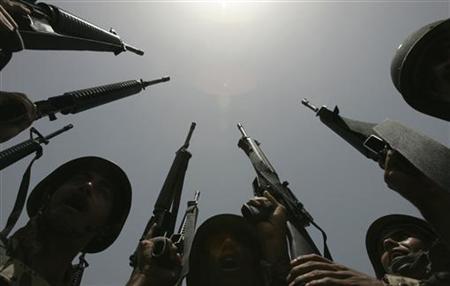
Iraqi soldiers hold their new rifles from the U.S. forces in the Taji U.S. military camp in Baghdad May 13, 2007. REUTERS/Ceerwan Aziz

U.S. in push for foreign arms deals: report
September 14, 2008

NEW YORK — The Bush administration is pushing through a wide range of foreign weapons deals in a bid to rearm Iraq and Afghanistan and contain North Korea and Iran, The New York Times reported.

The deals range from tanks, helicopters and fighter jets to missiles, remotely piloted aircraft and warships, the Times said in its Sunday editions. The weapons and other military equipment foreign sales have totaled more than $32 billion this year, compared with $12 billion in 2005.

While the focus has been on the Middle East, sales extend to northern Africa, Asia, Latin America, Europe and Canada, the Times said.

“This is not about being gunrunners,” the Times quoted Bruce Lemkin, the Air Force deputy undersecretary who has coordinated many of the largest sales, as saying. “This is about building a more secure world.”

In the past two years, Iraq has signed agreements worth more than $3 billion, and also said it planned to buy as much as $7 billion more in U.S. equipment, the Times said. Over the past three years, Washington, the world’s top arms supplier, had agreed to buy more than $10 billion in military equipment and weapons on behalf of Afghanistan, according to Defense Department records, the newspaper said.

Pentagon spokeswoman Lt. Col. Almarah Belk said such deals served the interests of Iraq and the United States because they cut the risk of corruption and helped Iraq “in getting around bottlenecks in their acquisition processes.”

Much of the rearmament in the Gulf has been driven by fears of Iran. The Times said the United Arab Emirates were considering U.S.-made missile defense systems worth as much as $16 billion, while Saudi Arabia had agreed this year to at least $6 billion in weapons purchases from Washington, the most since 1993, and Israel was increasing its orders.

U.S. allies in Asia have also been buying more U.S. equipment as North Korea conducts long-range missile tests. South Korea alone signed sales agreements this year worth $1.1 billion.

Rep. Howard Berman, chairman of the House Foreign Affairs Committee, said that while he backed many of the weapons sales such as those that helped Iraq defend itself, he worried the spike “could turn into a spiraling arms race that in the end could decrease stability,” the Times said.

The Times, citing Defense Department sales data through the end of August, reported that countries newly reliant on the United States as a primary major weapons source included Argentina, Brazil, India, Iraq, Morocco and Pakistan and former Soviet republics Azerbaijan and Georgia.

Together the countries signed $870 million worth of arms deals with the Bush administration from 2001 to 2004, but in the past four fiscal years the total had increased to $13.8 billion.

© Thomson Reuters 2008

Source / Reuters

Thanks to Diane Stirling-Stevens / The Rag Blog

Posted in RagBlog | Tagged , , | Leave a comment

Newpapers Distribute Fear DVD : Delivering Propaganda, As If It is Toothpaste


‘Dozens of local newspapers in “swing” election states — from Altoona to Las Vegas (and my own Charlotte Observer) — have been paid to distribute a film designed to spread fear about our national security.’
By William E. Jackson, Jr. / September 13, 2008

DAVIDSON, N.C. — Bundled into my Charlotte Observer on this Saturday morning, and this week into approximately 100 newspapers located overwhelmingly in battleground states across the country, there is a kind of 527-fund contribution to the presidential campaign of John McCain.

Under the cloak of an advertising supplement, a one-hour edition of a DVD entitled “Obsession: Radical Islam’s War Against the West” had been attractively packaged and inserted into some 200,000 copies of the McClatchy-owned newspaper. The same happened at the other major McClatchy paper in North Carolina, the Raleigh News & Observer.

Dozens of local newspapers — from Altoona to Las Vegas and selected regional editions of the New York Times) — have been paid to distribute a film designed to spread fear about our national security.

Anyone can see an electoral vote pattern to the targeted areas, with almost all of the battleground or “swing” states represented. (The daily newspapers in only one such state appear to have refused the ad, Minnesota.) These papers have allowed themselves to be caught up in a “neo-con” propaganda scam in the context of the presidential campaign, and during 9/11 week.

As of Saturday, September 13, the rationalizations of the publishers and ad personnel at the two N.C. newspapers were either beggarly excuses for new sources of revenue, or politically naïve in the extreme.

In the Raleigh News & Observer, Jim McClure, vice president of display advertising for the N&O, was quoted as saying that the “ultimate decision” to distribute the DVDs had been made by the publisher. McClure compared the propaganda to harmless household samples: “Obviously, we have distributed other product samples, whether it’s cereal or toothpaste.” He dismissed allegations that it is inflammatory: “In the beginning of the DVD it clearly states it’s not about Islam. It’s about radical Islam.”

N&O publisher Orage Quarles III said in a statement: “As a newspaper we tend to shy away from censorship. In cases of controversial topics, if we err, we tend to do so on the side of freedom of speech,” a theme that must have been in talking points guidance from company headquarters.

Charlotte Observer publisher Ann Caulkins said paid ads represent the client’s opinions, not the newspaper’s. Moreover, she claimed that the DVD met Observer guidelines: “We’re all for freedom of expression, freedom of speech. This is in no way reflecting our opinions, but it is something we allow.” What wouldn’t be allowed? She identified material that’s racist or contains profanity or offers graphic images of body parts. One has to wonder if she has watched the film her paper has foisted upon readers.

All in all, the propaganda campaign is a shameful episode for the Fourth Estate.

[William E. Jackson, Jr. is a longtime contributor to E&P. He is a former top legislative aide in Congress and arms control expert.]

Source / Editor & Publisher

The Rag Blog

Posted in RagBlog | Tagged , , , , , | Leave a comment

Afghanistan: It’s Acknowledged to Be a Failed State

Kabul, 2008: “Resurrecting the previous Afghan state under current conditions may be doomed to failure.” AP

Borderline state
By Barnett Rubin / September 12. 2008

Afghanistan, which served for so many years as a buffer between warring nations, is today riven by conflicts imported from abroad. Barnett R Rubin weighs the obstacles to restoring stability.

The past 35 years in Afghanistan have seen the end of the country’s status as an isolated buffer state. In the past, agreement among neighbours and great powers not to intervene in Afghanistan meant that the state served to limit the spread of conflicts; but today virtually the entire international community is involved in Afghanistan, and all the conflicts and disputes among its member states and organisations are playing out within its borders.

Ten years ago Afghanistan was home to a low-intensity conflict between the Taliban and Northern Alliance, but it was also the scene of Indo-Pakistan and Sunni-Shia conflicts and, to a certain extent, US-Iranian-Russian competition over pipeline routes. These conflicts have become more intense at the same time that Afghanistan has become the theatre for the War on Terror, the ill-defined confrontation of the US and global Islamist movements; the conflict between Nato and Russia; the confrontation between the US and Iran; the struggle within Pakistan over that country’s future; and a key theatre of a transnational insurgency spanning Afghanistan and Pakistan and linked to al Qa’eda. All of this alongside an intensification of the ethnic, tribal, regional and sectarian cleavages that have always marked Afghan politics.

If it seems unlikely that Afghanistan can return to its days of isolation, that is because all of the elements that enabled it to survive in relative stability for nearly a century have disappeared: a population largely isolated in remote valleys with few links to the outside world, some small arms and no organisation above the local level; a government subsidised by great powers and accepted as legitimate by all its neighbours; and an economy largely based on subsistence farming, pastoralism, limited pockets of commercial agriculture and trade.

The territory of today’s Afghanistan has never sustained a state without international aid to its security forces, and it has repeatedly collapsed in the face of invasion or contestation. The stability of such a state would require a level of income and legitimacy sufficient to recruit and maintain security forces adequate to defend against any threats to the state; in the current environment, that is a tall order indeed.

Three key elements ensured Afghanistan’s stability after it was first demarcated as a buffer between the British and Russian empires in the 19th century. First and foremost, the great powers themselves agreed not to interfere inside Afghanistan or use Afghanistan’s weakness against each other, ensuring few international challenges to the Afghan state and the separation of rival powers by a neutralised Afghanistan. Second, the population remained disarmed, demobilised and isolated, without political organisation and largely engaged in subsistence activities, resulting in few domestic demands on the state or challenges to its legitimacy. And third, international subsidies to the state enabled it to finance security forces adequate to the low-threat environment.

The events of September 11 made it clear that the Afghan state was weak and no longer integrated into the global community, and that its territory was home to the leadership of a highly organised global network of political violence. The American response was to destroy the weak government of the Taliban and call on the UN to try to rebuild the Afghan state. But resurrecting the previous Afghan state under current conditions may be doomed to failure.

Afghanistan’s relationship to the international system has changed decisively. Virtually every major international organisation and influential state has become involved there. But the result has been to import innumerable other conflicts into the country. First, of course, is the War on Terror, which as defined by the Bush administration includes not only the destruction of al Qa’eda, but also the destruction of organisations or states that harbour or support “terrorists”. Second, the conflict between India and Pakistan; Pakistan seeks to exclude Indian influence from Afghanistan, which it considers part of its security perimeter; India considers a presence in Afghanistan important to gain a back window into Pakistan. Third, a Sunni-Shia conflict, since Saudi Arabia and Iran, which still compete for the leadership of the Islamic world, both have proxies in Afghanistan. The situation in Afghanistan is also straining American relations with its Nato allies – who, though they opposed the war in Iraq, agreed to deploy troops to Afghanistan – and increasing already high tensions between America and Russia, which supports the war and sanctions against the Taliban, but does not want a permanent Nato deployment in its backyard. Finally there is the conflict between the US and Iran; the two countries worked together to overthrow the Taliban and bring the current Afghan government to power, but the Bush administration rebuffed Iran’s overtures. Iran has furnished support to insurgents as a warning of the consequences that might follow an American attack. In short, the number of stakeholders is now prohibitively high to secure agreement on who will hold power.

The Afghan population is no longer isolated and quiescent. Every group has been mobilised militarily and politically and enjoys some patronage from foreign powers or movements. Afghans have been heavily politicised and listen incessantly to international news. At least half of Afghans have suffered war displacement and perhaps a third travelled abroad (largely as refugees). The subsistence economy has been largely destroyed, and Afghanistan relies on imports of food and exports of a cash crop – narcotics. Afghans are participating in global labour, commodity and capital markets and in global politics and warfare. The expansion of cash transactions has empowered ideological groups, including the ulama and Islamists, that do not own or control physical assets, but can assert rights to their share of this income. Without a cash economy, the Taliban regime would not have been possible.

As community coping mechanisms have become less reliable, families and communities increasingly look to the state for income and services. Afghanistan has become the most rapidly urbanising society in Asia, and demands for public services and political participation have risen accordingly. The demands placed on the state are far greater and the task of legitimation far more difficult than at any time in the past. Hence the type of weak state that functioned with a quiescent Afghan society is no longer feasible or effective; yet the state is still structured and resourced to maintain control, not provide services.

Under these conditions stability would require a state and security forces with substantially more resources and capabilities than at any time in the past. Currently the Afghan government extracts about seven per cent of licit GDP in revenues. The entire defence and development budget is paid for by foreign assistance; an even greater amount is spent by donors outside of the government budget. The size of the armed forces and police that Afghanistan needs to maintain its own security continues to rise, and there is no scenario under which the country would be able to finance such costs. Hence the Afghan state is now on an unsustainable trajectory.

Of the three trends outlined above, the increase in mobilisation, politicisation, education and urbanisation of the Afghan population is least likely to be reversed. It is difficult but not impossible to imagine the mounting external tensions becoming less threatening: if the top leadership of al Qa’eda in Pakistan is neutralised, a political settlement with insurgents might become more feasible. US-Iran relations might warm slightly. If an elected government led by civilians with a primarily economic program remains in power in Pakistan, we might see a shift in in Pakistan-India relations from confrontation to competition and even economic co-operation. The reduction of the level of threat would also favour investment and economic activity. Such growth might make it possible to increase the tax base as well as the government’s share of GDP to pay for public services.

These do not, however, seem to be the most likely trends. While the next US administration is likely to seek less confrontational and militaristic ways of coping with global challenges, the persistence of al Qa’eda in Pakistan could create pressure for broader intervention there, destabilising that country and its neighbour further. Any number of unpredictable events – another major al Qa’eda attack in the US leading to reprisals in Pakistan; a riot in Kabul or another Afghan city; the collapse of a regional centre (most likely Kandahar) under Taliban assault – could precipitate a rapid crisis.

There are several policy approaches that might begin to address these threats, including a renewal of regional diplomacy and economic co-operation to lower present tensions; the development of a plan to properly finance the Afghan security forces; phasing out the most intrusive aspects of the counter-terrorism campaign in the country; expanding Afghan higher education and employment to provide opportunities to educated young people; and strengthening the legitimacy of the central government by taking strong action against corruption.

But there is still no foreseeable trajectory under which the Afghan state will become a self-sustaining member of the international community at peace with its neighbours in the coming decade. It might be possible, however, to approach rather than recede from that goal.

Barnett R Rubin, Director of Studies at the Center on International Cooperation at NYU, is the author of The Fragmentation of Afghanistan.

Source / The National

The Rag Blog

Posted in RagBlog | Tagged , | Leave a comment

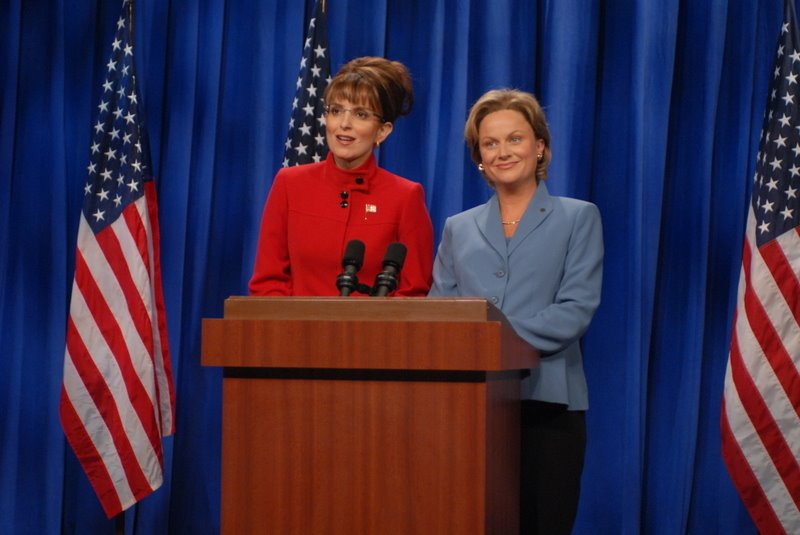
Tina Fey as Sarah Palin on Saturday Night Live


‘Fey stood beside her good friend and fellow castmate Amy Poehler, whose Hillary Clinton has been one of the high points of recent “SNL” history’
By Maureen Ryan / September 14, 2008

See Video and transcript, below.

As it used to be years ago, the word “live” was appropriate.

Ever since Alaska Gov. Sarah Palin was announced as Sen. John McCain’s running mate, people have remarked on her strong resemblance to former “Saturday Night Live” head writer Tina Fey.

Would Fey appear on the show’s season-opener Saturday, sporting Palin’s trademark rimless glasses? Speculation raged about that all week, and of course, “SNL” executive producer Lorne Michaels was coy about whether Fey, who left the show a few years ago for “30 Rock,” would stop by her old stomping grounds. Of course she would… right?

The end result of all the suspense: Forget DVRs, forget on-demand TV, forget YouTube, forget firing up your WiFi connection. All across America, people were parked in front of their TV sets late Saturday night.

As the program came on (at 10:30 p.m. Central time), there was Fey in a bright red blazer. She was the spitting image of Palin (or wait, is Palin the spitting image of Fey?). Even Fey’s flat Palin-esque accent was perfect; Fey had obviously closely studied the interviews that Palin gave to ABC on Thursday and Friday.

TV viewers will have a tough choice this year, as they struggle to decide which is more interesting: The ongoing reality show featuring Sen. Barack Obama, McCain and Palin, or Tina Fey doing her pitch-perfect version of Palin. We should have at least a few more opportunities to observe the latter, as “SNL” exploits the foibles of the election season every weekend and on three “SNL” specials that will air on Thursdays this fall.

On “SNL,” . They slung barbs that took sharp aim at Palin’s experience — or lack thereof — and at the perception that Clinton has been relentlessly ambitious.

“Mine! It’s supposed to be mine!” Poehler-as-Clinton said. “I need to say something. I didn’t want a woman to be President. I wanted to be President and I just happen to be a woman.”

Both women agreed on one thing: That sexism had become an issue in the campaign. It was an issue that “frankly surprised to hear people suddenly care about,” Poehler-as-Clinton deadpanned.

She later warned Fey-as-Palin that she didn’t “want to hear you compare your road to the White House to my road to the White House. I scratched and clawed through mud and barbed wire and you just glided in on a dog sled wearing your pageant sash and your Tina Fey glasses.”

As she spoke, Fey-as-Palin struck sexy poses and pretended to fire a shotgun. “What an amazing time we live in,” she said. “To think that just two years ago, I was a small town mayor of Alaska’s crystal meth capitol.”

Earlier, she talked up her foreign policy credentials: “I can see Russia from my house!”

Host Michael Phelps couldn’t help but be overshadowed by Fey’s terrific turn as Palin. Sketches about a couple’s ugly children (pictured above) and a weird swim coach (below) didn’t come close to the level of the opening sketch. Nothing in the rest of the broadcast did really (and Obama, after reports emerged that he would be a guest, was a no-show on Saturday; he decided not to appear thanks to the destruction Hurricane Ike was causing).

The show’s “Weekend Update” segment featured some Palin comedy as well. As Poehler noted, recent polls show McCain “only six points behind Sarah Palin.” Perhaps there wasn’t enough Palin though — raise your hand if you thought the “Weekend Update” commentary from the comic-strip character Cathy was a good idea.

Minutes after the Clinton-Palin sketch aired on “SNL,” a spokesman for the show sent out a full transcript of the piece, and I’ve reprinted it in full below.

An NBC transcript of “SNL’s” opening sketch:

FEY AS PALIN: “Good evening, my fellow Americans. I was so excited when I was told Senator Clinton and I would be addressing you tonight.”

POEHLER AS CLINTON: “And I was told I would be addressing you alone.”

FEY AS PALIN: “Now I know it must be a little bit strange for all of you to see the two of us together. What with me being John McCain’s running mate.”

POEHLER AS CLINTON: “And me being a fervent supporter of Senator Barack Obama — as evidenced by this button.”

FEY AS PALIN: “But tonight we are crossing party lines to address the now very ugly role that sexism is playing in the campaign.”

POEHLER AS CLINTON: “An issue which I am frankly surprised to hear people suddenly care about.”

FEY AS PALIN: “You know, Hillary and I don’t agree on everything…”

POEHLER AS CLINTON: (OVERLAPPING) “Anything. I believe that diplomacy should be the cornerstone of any foreign policy.”

FEY AS PALIN: “And I can see Russia from my house.”

POEHLER AS CLINTON: “I believe global warming is caused by man.”

FEY AS PALIN: “And I believe it’s just God hugging us closer.”

POEHLER AS CLINTON: “I don’t agree with the Bush Doctrine.”

FEY AS PALIN: “I don’t know what that is.”

POEHLER AS CLINTON: “But Sarah, one thing we can agree on is that sexism can never be allowed to permeate an American election.”

FEY AS PALIN: “So please, stop photoshopping my head on sexy bikini pictures.”

POEHLER AS CLINTON: “And stop saying I have cankles.”

FEY AS PALIN: “Don’t refer to me as a ‘MILF.'”

POEHLER AS CLINTON: “And don’t refer to me as a [flurge]. I Googled what it stands for and I do not like it.”

FEY AS PALIN: “So we ask reporters and commentators, stop using words that diminish us, like ‘pretty,’ ‘attractive,’ ‘beautiful.'”

POEHLER AS CLINTON: “‘Harpy,’ ‘shrew’ and ‘boner shrinker.'”

FEY AS PALIN: “While our politics may differ, my friend and I are both very tough ladies. You know it reminds me of a joke we tell in Alaska…”What’s the difference…

POEHLER AS CLINTON: “Lipstick.”

FEY AS PALIN: “…between a hockey mom…”

POEHLER AS CLINTON: “Lipstick.”

FEY AS PALIN: “…and a pitbull?”

POEHLER AS CLINTON: “Lipstick.”

FEY AS PALIN (AFTER A BEAT): “Lipstick. Just look at how far we’ve come. Hillary Clinton, who came so close to the White House. And me, Sarah Palin, who is even closer. Can you believe it, Hillary?”

POEHLER AS CLINTON: (AFTER A PAUSE)”I can not.”

FEY AS PALIN: “It’s truly amazing and I think women everywhere can agree, that no matter your politics, it’s time for a woman to make it to the White House.”

POEHLER AS CLINTON: “No. Mine! It’s supposed to be mine! I need to say something. I didn’t want a woman to be President. I wanted to be President and I just happen to be a woman. And I don’t want to hear you compare your road to the White House to my road to the White House. I scratched and clawed through mud and barbed wire and you just glided in on a dog sled wearing your pageant sash and your Tina Fey glasses.”

FEY AS PALIN:
“What an amazing time we live in. To think that just two years ago, I was a small town mayor of Alaska’s crystal meth capitol. And now I am just one heartbeat away from being President of the United States. It just goes to show that anyone can be President.”

POEHLER AS CLINTON: “Anyone.”

FEY AS PALIN: “All you have to do is want it.”

POEHLER AS CLINTON: (LAUGHS) “Yeah, you know, Sarah, looking back, if I could change one thing, I should have wanted it more.” (RIPS OFF PIECE OF PODIUM)

FEY AS PALIN: “So in the next six weeks, I invite the media to be vigilant for sexist behavior.”

POEHLER AS CLINTON: “Although it is never sexist to question female politicians credentials. Please ask this one about dinosaurs. So I invite the media to grow a pair. And if you can’t, I will lend you mine.”

FEY AS PALIN: And as we say in Alaska…

POEHLER AS CLINTON: “We say it everywhere…”

FEY/POEHLER: “Live from New York, It’s Saturday Night!!!

Source / Chicago Tribune

The Rag Blog

Posted in RagBlog | Tagged , , , , , , , , , , , , | Leave a comment

Denton, 9/11 : SDS Rallies Students to End War

Denton: Jason Netek, far left, and a U.S. Marine Corps Reservist identified as ‘Chad’ argue about the war in Iraq as members of the Denton chapter of Students for a Democratic Society prepare for an anti-war march starting at the University of North Texas campus.

Protesters ‘carried signs with messages such as “Iraq Never Attacked US,” “Expose the 9/11 Cover-up” and “War is Terrorism”’
By Lowell Brown / September 12, 2008

College students marched through downtown Denton on Thursday afternoon to protest U.S. foreign policy and promote peace on the seventh anniversary of the Sept. 11 terrorist attacks.

An estimated 150 to 250 students walked down Hickory Street from the University of North Texas campus to Quakertown Park for a rally organized by the Denton chapter of Students for a Democratic Society. Many carried signs with messages such as “Iraq Never Attacked US,” “Expose the 9/11 Cover-up” and “War is Terrorism.”

At one point during the mile-long walk, marchers chanted “9/11 was an inside job!” and “Expose the truth!” — although some participants later said they believed al-Qaida was behind the attacks.

UNT senior Andrew Teeter said he and fellow march organizers want a new inquiry into the events of Sept. 11, 2001, an end to the “occupations” of Iraq and Afghanistan and “truth in military re­cruitment” in Denton.

“So this brings all sorts of people out with different passions,” Teeter said.

At Quakertown Park, gatherers heard protest songs and cheered as speakers condemned U.S. foreign policy, especially under the Bush administration.

“This is really an important day,” said state Rep. Lon Burnam, director of the Dallas Peace Center, a nonprofit volunteer group. “A lot of people all over this country are going to be commemorating the seventh anniversary [of Sept. 11] with a sense of tragedy for what happened on that day. I think we are all here commemorating that date with a sense of tragedy for what we have allowed to happen since that day.”

“There were horrible crimes committed by terrorists seven years ago,” said Burnam, a Fort Worth Democrat. “But for seven years there have been horrible war crimes committed by our government.”

Burnam encouraged the students to pressure U.S. Rep. Michael Burgess, R-Lewisville, to work to end the Iraq war.

Aron Duhon, a UNT graduate student, said he marched to highlight the failure of the United States to withdraw troops from Iraq since the 2003 invasion.

“I support an immediate withdrawal of our troops without conditions, which is something neither of the [major-party presidential] candidates are talking about,” Duhon said. “I feel like this is a way to make our voices heard.”

Police officers escorted the marchers on bicycles and patrol cars, stopping traffic as the students passed through the Square.

Passing cars sometimes honked in support, drawing cheers from the crowd.

Three counter-protesters followed the parade chanting “USA! USA!” and “Go back to MySpace!”

The men said they were U.S. Marines and Iraq war veterans, but they would only identify themselves by their first names, citing military policy.

“It’s their right to protest and I fight for that,” said Jonathan, one of the men. “But it just seems a little disrespectful” to protest on the Sept. 11 anniversary.

Police said an estimated 150 people took part in the march, but organizers said the number was closer to 250.

Police reported no disturbances.

Other groups involved with the event included Peace Action Denton and the Campaign to End the Death Penalty.

Source / Denton Record-Chronicle

The Rag Blog

Posted in RagBlog | Tagged , , , , , , , | Leave a comment

British Jury : Threat From Global Warming Justifies Protesters’ Breaking Law

Five of the ‘Kingsnorth Six’ at the top of the 200m chimney of power station.

Jury cleared six Greenpeace activists of £35,000 worth of criminal damage to a coal-fired power station
By Michael McCarthy / September 11, 2008

The threat of global warming is so great that campaigners were justified in causing more than worth of damage , a jury decided yesterday. In a verdict that will have shocked ministers and energy companies .

Jurors accepted defence arguments that the six had a “lawful excuse” to damage property at Kingsnorth power station in Kent to prevent even greater damage caused by climate change. The defence of “lawful excuse” under the Criminal Damage Act 1971 allows damage to be caused to property to prevent even greater damage – such as breaking down the door of a burning house to tackle a fire.

The not-guilty verdict, delivered after two days and greeted with cheers in the courtroom, raises the stakes for the most pressing issue on Britain’s green agenda and could encourage further direct action.

Kingsnorth was the centre for mass protests by climate camp activists last month. Last year, three protesters managed to paint Gordon Brown’s name on the plant’s chimney. Their handi-work cost £35,000 to remove.

The plan to build a successor to the power station is likely to be the first of a new generation of coal-fired plants. As coal produces more of the carbon emissions causing climate change than any other fuel, campaigners claim that a new station would be a disastrous setback in the battle against global warming, and send out a negative signal to the rest of the world about how serious Britain really is about tackling the climate threat.

But the proposals, from the energy giant E.ON, are firmly backed by the Business Secretary, John Hutton, and the Energy minister, Malcolm Wicks. Some members of the Cabinet are thought to be unhappy about them, including the Foreign Secretary, David Miliband, and the Environment Secretary, Hilary Benn. Mr Brown is likely to have the final say on the matter later this year.

During the eight-day trial, the world’s leading climate scientist, Professor James Hansen of Nasa, who had flown from American to give evidence, appealed to the Prime Minister personally to “take a leadership role” in cancelling the plan and scrapping the idea of a coal-fired future for Britain. Last December he wrote to Mr Brown with a similar appeal. At the trial, he called for an moratorium on all coal-fired power stations, and his hour-long testimony about the gravity of the climate danger, which painted a bleak picture, was listened to intently by the jury of nine women and three men.

Professor Hansen, who first alerted the world to the global warming threat in June 1988 with testimony to a US senate committee in Washington, and who last year said the earth was in “imminent peril” from the warming atmosphere, asserted that emissions of CO2 from Kings-north would damage property through the effects of the climate change they would help to cause.

He was one of several leading public figures who gave evidence for the defence, including Zac Goldsmith, the Conservative parliamentary candidate for Richmond Park and director of the Ecologist magazine, who similarly told the jury that in his opinion, direct action could be justified in the minds of many people if it was intended to prevent larger crimes being committed.

The acquittal was the second time in a decade that the “lawful excuse” defence has been successfully used by Greenpeace activists. In 1999, 28 Greenpeace campaigners led Lord Melchett, who was director at the time, were cleared of criminal damage after trashing an experimental field of GM crops in Norfolk. In each case the damage was not disputed – the point at issue was the motive.

The defendants who scaled the 630ft chimney at Kingsnorth, near Hoo, last year were Huw Williams, 41, from Nottingham; Ben Stewart, 34, from Lyminge, Kent; Kevin Drake, 44, from Westbury, Wiltshire; Will Rose, 29, from London; and Emily Hall, 34, from New Zealand. Tim Hewke, 48, from Ulcombe, Kent, helped organise the protest.

The court heard how, dressed in orange boiler suits and white hard hats bearing the Greenpeace logo, the six-strong group arrived at the site at 6.30am on 8 October. Armed with bags containing abseiling gear, five of them scaled the chimney while Mr Hewke waited below to liaise between the climbers and police.

The climbers had planned to paint “Gordon, bin it” in huge letters on the side of the chimney, but although they succeeded in temporarily shutting the station, they only got as far as painting the word “Gordon” on the chimney before they descended, having been threatened with a High Court injunction. Removing the graffiti cost E.ON £35,000, the court heard.

During the trial the defendants said they had acted lawfully, owing to an honestly held belief that their attempt to stop emissions from Kingsnorth would prevent further damage to properties worldwide caused by global warming. Their aim, they said, was to rein back CO2 emissions and bring urgent pressure to bear on the Government and E.ON to changes policies. They insisted their action had caused the minimum amount of damage necessary to close the plant down and constituted a “proportionate response” to the increasing environmental threat.

Speaking outside court after being cleared yesterday, Mr Stewart said: “This is a huge blow for ministers and their plans for new coal-fired power stations. It wasn’t only us in the dock, it was the coal-fired generation as well. After this verdict, the only people left in Britain who think new coal is a good idea are John Hutton and Malcolm Wicks. It’s time the Prime Minister stepped in, showed some leadership and embraced the clean energy future for Britain.”

He added: “This verdict marks a tipping point for the climate change movement. When a jury of normal people say it is legitimate for a direct action group to shut down a coal-fired power station because of the harm it does to our planet, then where does that leave Government energy policy? We have the clean technologies at hand to power our economy. It’s time we turned to them instead of coal.”

Ms Hall said: “The jury heard from the most distinguished climate scientist in the world. How could they ignore his warnings and reject his leading scientific arguments?”

Source / The Independent, U.K.

Also see Breaking News: Kingsnorth Six Found Not Guilty / Greenpeace, U.K.

Thanks to S.M. Welhelm / The Rag Blog

Posted in RagBlog | Tagged , , , , , , , , , , | Leave a comment