Sez It All : Homescholers [Sic] for Perry [Sicker]

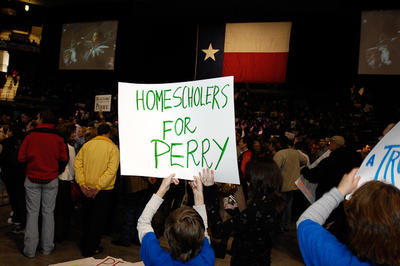
Photo by Bryan Fotographer / Houston Press. See slideshow here.

Rick Perry and Sarah Palin rally their troops

HOUSTON — The much awaited Perry-Palin rally (with extra special guest Ted Nugent) visited the Rick Berry Center in Cypress on Sunday afternoon, February 7, but made sure to wrap things up before the Big Game. Football trumps politics in Texas, of course, even if Sarah Palin comes to town. — Houston Press

Thanks to Kenneth Huey / The Rag Blog

Posted in RagBlog | Tagged , , , , | 4 Comments

Obama’s Change and the Bush Mess : Have We Forgotten to Remember?

Photo montage by Larry Ray / The Rag Blog.

Remembering why we voted for change:
The Bush mess and the blame game

Eight years of Bush, Cheney, and the cynical political puppetry of Karl Rove, succeeded in driving a deep polarizing wedge into the heart of this country.

By Larry Ray / The Rag Blog / February 8, 2010

The montage of photos above is not a cheap humorous poke at George W. Bush. It is, instead, a montage of reminders of who ran this country into the ground for eight years as our president leaving a Gordian mess for someone else to deal with.

How could we so quickly forget those almost daily blunders, gaffes, petulance, and national disgraces we endured? George W. Bush has all but disappeared inside his tony gated community in Dallas. The mess he is responsible for has not disappeared and blame for it should not be craftily assigned to the new occupant of the White House.

It seems to be human nature for us to want to forget times that were embarrassing, damaging, and disappointing. And after the Bush legacy turned out to be a jaundiced irresponsible house of cards, it seems easier for many to develop near hysterical rage at the mess itself rather than at those responsible for it.

Bush’s historic damage could be a national rallying point, like the ruins of the twin towers, pulling us together to work for national change with patience, sacrifice, and understanding. Instead the damage itself has turned into a cheap political blame game. A kick-me sign for the angry and deluded.

Eight years of Bush, Cheney, and the cynical political puppetry of Karl Rove, succeeded in driving a deep polarizing wedge into the heart of this country. Bush projected to the entire world an “our way or the highway” tough guy attitude. Great sound bites, but his “way” made a mockery of truth, reason, and the law.

Sadly, that “join the posse and let’s go shoot up the bad guys” invitation was simple and appealing to lots of Americans. And it still is to a certain group. Suddenly it seemed, we were off to round up and hang Saddam Hussein before you could say “there ain’t no weapons of mass destruction.”

Unfortunately, the Bush folks with their “shock and awe” invasion had not gotten around to figuring out how to pay for that war. They later decided the U.S. would use its big credit card, expecting the Chinese and other foreign buyers to buy our debt to pay for it. Mission accomplished… again.

At the end of the eight year commute from Crawford, Texas, to Washington D.C., huge piles of lifeless post-Bush toxic fat cat Wall Street gambling debt began to smell and grow. Leaders of the party that happily allowed it to happen began to deny they caused the problem — that somehow it was all the new administration’s fault for recklessly spending so much money and trying to “do too much.”

The funereal visage of Republican minority leader, Senator Mitch McConnell, sternly casting the blame on the new president is pure Republican looking glass politics. Obama and and his political HAZMAT team hit the ground his first day in office trying to deal with a sea of red ink and the fiscal flotsam swirling around in it. A grave potential for another great depression loomed. Welcome to the Oval Office.

But those who sanctioned their party’s role in letting Wall Street bring our nation to the brink of a major depression immediately began loudly blaming the new leadership for all the problems. That kind of old, cheap political role-reversal tactic should make concerned Americans very angry. But chaos, loss of income, and an almost adolescent expectation of some sort of instant fix makes many reassign blame somewhere, anywhere.

A large majority was eager to welcome the new “Change We Can Believe In.” But before the outgoing tenants could leave town, eight years of hidden party trash and dirty Wall Street linen that had been stuffed out of sight burst the seams of the White House for all to see. It was important to the outgoing leadership that the new tenant somehow be blamed for the irresponsible, out of control problems.

Kentucky Senator McConnell and the unified “No” vote chorus he conducts began immediately to try to fix the new horse race. Using latent and not so latent racism present in so many of their party, as well as so-called independents, they began a steady attack on the messenger, Barack Obama. Easier to blame the black president whom so many already refuse to accept as “their president” for not having cleaned up everything his first year in office than to pitch in and help with the clean-up. Just say no.

Americans who had been unconcerned about buying things with money they did not have, and who gleefully bought expensive houses for nothing down like there was no tomorrow, were now suddenly losing homes, jobs, savings. Suddenly they are all upset and concerned about the economy and want someone to blame. Memories of eight years of suffering Bush and Cheney abuses have drifted to the edges of today’s short memory span, it seems.

The new guy and all his highly intelligent advisers are telling Americans how tough things are with no sugar coating. Obama explains, in detail, the depth of the problems and calls for tough change. Instead of using vapid four word sound bites that sound so good, Obama tackled the unexpected problems he inherited head on, while also repairing America’s tattered international image. The harsh reality of it all seems to many to be “change they don’t want to believe in.” Everything is now grim and uncertain.

Those in a blind state of denial include many of Obama’s own majority party Democrats who, much like Senator McConnell, want to ignore reality so they can fight for their narrow political interests just like the elephant was not in the room.

Playing a blame game will not haul us out of the huge mess we are in. Taking a minute to reflect on the montage of photos above might, however, help us remember where a majority of this mess came from and why a majority voted for change.

But change rather than sound bites requires a lot more of Americans. Health care for all Americans has been shoved aside for more than 70 years because it requires dedicated support and buy-in. Genuine Republican support in drafting a National Heath Insurance plan could have made that a reality. But it was easier to vote no and play like we are on an all expense paid weekend in Oz. But the curtain has been pulled back.

President Obama clearly believes that a positive American spirit will ultimately prevail. A majority of Americans clearly still want the change they voted for and should not let a small but loud populist uproar from pontificating short-sighted dour losers drown out reason and resolve.

The natural instinct has always been for progressive and truly involved Americans to pitch in and be part of a solution to tough problems. Throwing blind tantrums and brewing up more anger at feel good tea-parties is good only to fill the endless dead space of side-show cable TV.

[Retired journalist Larry Ray is a Texas native and former Austin television news anchor. He also posts at The iHandbill.]

The Rag Blog

Posted in Rag Bloggers | Tagged , , , , , | 4 Comments

Mexico City Legalizes Gay Nuptials : Catholic Clergy Aghast

Gay rights activist cheer after a session at the city’s assembly in Mexico City last December. Photo by Daniel Aguilar / Reuters.

Mexico City sanctions gay marriage:
Catholic Church warns of Sodom and Gomorrah

In Morelia, Michoacan, Bishop Alfredo India added to the homophobic frenzy by avowing that even dogs did not engage in same sex fornication.

By John Ross / The Rag Blog / February 8, 2010

MEXICO CITY — As Valentine’s Day approaches, stationary stores in the old quarter of this megalopolis are awash with Cupids and hearts and the effusive iconography of romance. Ten-tiered wedding cakes spire to the chandeliers in the windows of the Ideal, the palace of such confectionary extravaganzas.

Down the block, beribboned classic cars are lined up outside La Profesa, a colonial church much favored for high society weddings. Marriage is merchandise for the Roman Catholic Church — priests charge sumptuous (30,000 pesos) fees for tying the knots.

Meanwhile, Church and State, ancient rivals for the affections of the Mexican people, are nose-to-nose over who exactly can marry whom.

The Princes of the Catholic Church are aghast at the recent vote of the Mexico City Legislative Assembly to legalize same sex marriage that in their jaundiced vista has transformed this megalopolis into one monstrous Sodom and Gomorrah. This past December 21, local legislators, led by the left-center Party of the Democratic Revolution (PRD) which holds a lopsided majority in the Assembly voted 39 to 20 to amend the city’s civil code by modifying the definition of marriage, striking down language that restricted such coupling to a man and a woman, and upgrading civil unions (“societies of conviviality”) between lovers of the same sex to matrimony.

The new law also specifically stipulates that same sex couples can adopt children, a right they previously enjoyed — any Mexican can adopt a child so long as they are 17 years older than the adoptee — but which has the Church’s testicles in a major uproar.

In the aftermath of passage, the scene in the old, ornate chambers of the Legislative Assembly was one of widespread jubilation — with pockets of bitter recrimination. Up in the balconies, gays and lesbians smooched and waved enormous rainbow flags. Down on the Assembly floor, the right-wing PAN party delegation led by Mariana Gomez, cousin of first lady Margarita Zavala, stomped out, threatening to take the notorious changes in the civil code straight to the Supreme Court.

Like with passage of such liberalizing social measures as free abortion on demand, a right to die act that promotes euthanasia, and the aforementioned civil unions, both the PAN and its perpetual allies in the Catholic hierarchy have gone ballistic at the prospect of homosexual nuptials.

Under the vaulting arches of the ancient Metropolitan Cathedral, Cardinal Norberto Rivera, the shepherd of the most populous archdioceses in Christendom, condemned same sex marriage as an “aberration” that “will invariably lead to the ruin of society” and called upon Mexico’s Catholics to disobey the new law, an edict that spurred threats by “Jacobins” as secularists are quaintly maligned by Holy Mother Church, to take the Cardinal to court on charges of “treason.” Grievously offended, Rivera protested that leftists are “trying to prohibit us from speaking in the name of Jesus Christ.”

Such Church-State conflicts have stippled the history of this neighbor republic since it declared its independence from the Spanish Crown 200 years ago this year, a bicentennial that is being celebrated with much hoopla here and which the Church demands a piece of despite separation from the Mexican State that has been defined as a secular institution by three of its Constitutions.

Writing in the Archdioceses’ weekly From the Faith, Cardinal Rivera’s mouthpiece, Father Hugo Valdemar, advocated for excommunication of all legislators who had voted up same sex marriage and suggested that couples who adopted children would do so to abuse the youngsters or exploit them for kiddie porn.

If a child has two fathers which one would be his role model, inquisitioned Father Valdemar? Would he emulate his parents by wearing make-up and mini-skirts? In Morelia, Michoacan, Bishop Alfredo India added to the homophobic frenzy by avowing that even dogs did not engage in same sex fornication.

The Catholic Church was hardly alone in its vivid vindictiveness. Both Antonio Chaudruhi, Patriarch of the Orthodox Church, and Arturo Favela, president of the Confraternity of Christian Churches, joined in denouncing such “sinfulness.”

The Mexico City Archdioceses’ hypothesis that same sex couples are child molesters is a textbook exhibition of the Church’s malignant hypocrisy. Recent scandals involving pederast priests have stained the hierarchy’s reputation and depleted its coffers. The Legionnaires of Christ have paid out millions USD to compensate victims of the order’s founder and serial sodomist Macial Marcial. (The omnisexual priest also fathered children with three different women.)

Cardinal Norberto himself has been implicated in multiple imbroglios — as Bishop of Tehuacan Puebla and Mexico City, Rivera personally shielded Father Nicolas Aguilar, accused of as many as 600 incidents of pedophilia by moving him from parish to parish, ultimately shipping him off to Los Angeles where Cardinal Roger Mahoney continued the subterfuge. Mahoney and Rivera have been called to account for their cover-up by authorities in both countries.

Separation of Church and State as mandated by the Mexican Constitution has narrowed dramatically in the 10 years that the PAN has held the presidency. Vicente Fox, the first opposition party candidate to take power, campaigned literally wrapped in the banner of the Virgin of Guadalupe and stunned so-called Jacobins by kneeling to kiss Pope John Paul II’s ring during the late pope’s last visit to Mexico. His successor, Felipe Calderon, whose Catholic zealot father was a hero of the “Cristero War” against the federal government that took 30,000 lives between 1925 and 1929, shares the podium with high Church officials at Vatican-sponsored venues such as the 2008 Catholic Families Congress in Mexico City.

The PANista governor of Jalisco lavishes state funds to refurbish churches that served as sanctuaries for the “Cristeros” and the governor of Mexico state Enrique Pena Nieto, the frontrunner for the once and future ruling PRI party’s nomination in 2012 presidential elections, just returned from a pilgrimage to Rome to obtain Pope Benedict’s blessing for his impending marriage to soap opera mega-star Angelica Rivera (no relation) AKA “La Gaviota” (“the Seagull”).

Pope Benedict used the occasion to rail against same sex marriage in Mexico as “a crime against creation that will destroy the differences between sexes…”

When Mexico City legalized abortion in the first 12 weeks of gestation, Cardinal Rivera ordered the capital’s churches to ring their bells in mourning. Collaboration between the PAN and the PRI has resulted in the criminalization of abortion in 18 states and the two parties are expected to soon announce the introduction of a constitutional amendment to outlaw the procedure everywhere in Mexico, including the capital.

Despite raging homophobia in the provinces, Mexico City remains an oasis of sexual liberation. Men holding hands and women soul kissing women in public no longer invoke horrified stares in this cosmopolitan capital where every June since the Stonewall riots convoked the movement for gay, lesbian, and transgender rights, tens of thousands march and party to celebrate their sexual orientation.

Despite the PAN’s and Cardinal Norberto’s obstreperous recriminations, in a recent survey of the right-wing party’s own base in preparation for an upcoming lawsuit to nullify same sex marriage when it kicks in March 4, half of those polled supported the new law — although 70% vehemently opposed adoption.

As the tide shifts north of the border where six U.S. states, the nation’s capital, and one Canadian province now provide legal cover for same sex marriages and unions, in Latin America, a bastion of virulent Machismo, the times too are a-changing. Uruguay and Colombia have put a legal stamp on such arrangements, as have three provinces of Buenos Aires and a Brazilian state. Cuba, led by President Raul Castro’s daughter Mariela, is moving in the same direction. Mexico City was not even Mexico’s first jurisdiction to approve such legislation — Coahuila in the north held its first same sex wedding three years ago.

This Valentine’s Day all over the Latin continent, gays and lesbians will be exchanging hearts and flowers and vows of undying love as they hand out slices of wedding cake to celebrate unholy matrimony.

[John Ross is touring Obamalandia from sea to stinking sea with his latest cult classic El Monstruo: Dread and Redemption in Mexico City (“a gritty, pulsating read” — NY Post). This week he will be in Los Angeles at Cal State L.A. (Feb 9, 4:20 p.m., Student Union), Eso Won Books (Feb 10, 7 p.m.), Pomona College in Claremont (Feb. 11 — noon lecture, Oldenborg Center), and the Urban Survival art space (Feb 13, Boyle Heights 4-7 p.m.)

Here are John’s upcoming Texas visits: Austin: Feb. 15, 7 p.m., Resistencia Bookstore; Feb. 16, 2 p.m., UT Journalism School (Talk: “Five decades of Journalism in Latin America”); Feb. 16, 7 p.m., MonkeyWrench Books; Houston: Feb. 17, 7 p.m., Sedition Books; Feb. 18, 11:30 a.m., University of Houston, with John Mason Hart; Edinburgh: Feb. 19, 7 p.m., Pan American University (Talk: “1810-1910-2010: Cycles of Mexican Revolution”); San Benito: Feb. 20, 7 p.m., Narciso Martinez Cultural Center.]

The Rag Blog

Posted in Rag Bloggers | Tagged , , , , , , , , | 2 Comments

Congress : Health Care on Life Support

Cartoon by Matson / St. Louis Post-Dispatch / The Moderate Voice.

Good riddance to Senate bill;
Some encouraging words from the President

By Dr. Stephen R. Keister / The Rag Blog / February 8, 2010

The word emanating from Washington regarding health care has become a mere trickle since the President’s State of The Union address. It would appear that Mr. Obama is making an effort to reestablish some of his rapport with his progressive base in an effort to offset much of the Democrat Party’s lethargy and Rahm Emanuel’s attack on the progressives in which he called them “F—ing retarded.” (Perhaps Rahm had best be set adrift and allowed to take his proper place as an adviser to the Likud Party.)

Mr. Obama has said some encouraging words regarding health care at several of his town hall meetings, although his comments have lacked specifics. He has been stressing the unemployment situation as he should in view of the widespread public anger throughout the nation and the seeming repudiation of the Democratic Party in Massachusetts.

His emphasizing regulation of the banking industry and taxing the excessive salaries and bonuses should play well with our disenchanted citizenry. He has faced up to the corporate control of Congress, but again has avoided specifics such as the fact that the American Health Insurance Plans and PhARMA have spent $10 to $20 million funneled through the U.S. Chamber of Commerce to fight health care legislation.

In my opinion, as I have noted in prior Rag Blog articles, it is no doubt a good thing that the Senate health care plan appears to be fading into oblivion. Encouraging is the fact that Speaker Pelosi has scheduled a vote on revoking the health care industry’s half-century-old exemption from antitrust laws. The vote, according to Politico, is part of a new two-track strategy to tackle things that will not be included in a more sweeping bill — if Congress ever passes one — while giving her members something popular to vote on. The move also puts pressure on Republicans, the industry, and wavering Democrats, who wish their leaders would abandon the push altogether.

Physicians For A National Health Plan have seemingly regained the initiative and are pushing HR 676, or Medicare for All (see Bill Moyers’ interview with Dr. Margaret Flowers) and other proposals that can be reviewed in detail on the PNHP website, including Dr. Quentin Young’s letter to The New York Times and Dr.Flower’s letter to the President.

These initiatives indicate that HR 676, which is merely 30 pages in length (the Senate bill exceeds 1,000 pages) will save the nation 30-40% in health care costs and provide nearly immediate coverage, unlike the Senate bill that defers coverage for 3-4 years and forces individuals by fiat to buy private health insurance, while making no effort to control costs of private insurance.

The administration and the Senate have essentially ignored the wishes of those who provide health care — the doctors and the nurses — and have ceded their allegiance to the insurance and pharmaceutical industries. However, there is encouragement out of the House of Representatives. See “The Public Option May Live Again” at the Daily Kos.

Representatives Jared Polis and Chellie Pingree have sent a letter to Harry Reid calling for the Senate to pass a public option through reconciliation. At the time of this article there were 31 other Democrats who had signed the letter. [Subsequent reports indicate that the number of co-signers has grown considerably, especially among those freshmen who seek reelection this coming autumn.] Polls of 10 front-line freshmen’s districts show that 68% of voters want a public insurance option and that by 5 to 1 voters would prefer for their representatives to fight to add the public option instead of simply passing the Senate bill.

Other problems relative to health care are on the horizon and involve those of us on Medicare. The Los Angeles Times reports that spending on health care was 17.3% of the economy last year. The share paid by the U.S. will soon exceed 50%, a study says. In considering legislation regarding health care we must take heed of what lies ahead. This underlines the urgent need for Congress to work to do away with Medicare Advantage Plans and Medicare Part D’s outlandish largesse to the insurance and pharmaceutical industries — and to tighten up on Medicare fraud and abuse.

These programs are rapidly draining the Medicare Trust Fund. It is, however, critical that we increase fees to primary care physicians as has been repeatedly called for by the American College of Physicians. We cannot leave our elderly citizens without doctors while the health insurance and pharmaceutical industries flourish.

Medicare recipients should be aware of two new websites at the Medicare Rights Center, a national nonprofit consumer service organization that works to ensure access to affordable health care for older adults and people with disabilities through counseling and advocacy, educational programs, and public policy initiatives. Go to Medicare Interactive, and for more detailed information go to Asclepois. There are changes in the Medicare programs about which many of us are totally unaware, such as pending caps on physical therapy and occupational therapy.

I have previously discussed the excessive intensive care for the dying that increases costs of Medicare to an unsustainable level for those of us who would prefer to die peacefully in our own beds, surrounded by our loved ones, with our pain and discomfort relieved by compassionate hospice care. It is barbaric that we subject those for whom the handwriting is already on the wall to the tortures of multiple intubation, multiple intravenous lines, and isolation an ICU, rather than allowing them to die in peace and dignity with family and loved ones.

The United States is a unique culture which cannot accept or face death. James F. Drane, the retired Russel B. Roth professor of bioethics at Edinboro University of Pennsylvania, discusses this phonemenon in a recent op-ed in The Erie Times News. It would behoove the Obama Administration to include Dr. Drane in any pending panel instituted to review Medicare and its future.

I fear for our country’s future, especially when I read the recent poll of Republican thinking published by Daily Kos. If indeed the Democrats fail to reach the general public with messages based on truth and fulfilled by action, we are going to be faced with some very alarming situations in the not so distant future.

Whatever we do, we must act swiftly and without equivocation, because I fear that the effect of the Supreme Court’s decision on corporate contributions will become overwhelmingly evident come the fall elections of 2010.

[Dr. Stephen R. Keister, a regular contributor to The Rag Blog, lives in Erie, PA. He is a retired physician who is active in health care reform. His previous articles on The Rag Blog can be found here.]

The Rag Blog

Posted in Rag Bloggers | Tagged , , , , | 3 Comments

Austin and Texas : Economic Slump Finally Hitting Home


Texas unemployment up;
Austin’s tech economy fading

Since Texas has borrowed all it can, and since a state can’t print money like the federal government, the feds are now under enormous political pressure to function as the job creators of last resort.

By Roger Baker / The Rag Blog / February 7, 2010

The Texas Employment Commission, which closely monitors such things, recently announced an increase in Texas’ unemployment from 8% to 8.3%. This jobless increase says that Texas, a traditionally poor state, is now strongly feeling the effects of the national economic slump.

Note that the Texas unemployment rate is mostly rising due to private jobs continuing to disappear. The numbers for the various Texas jobs sectors seem to indicate that average folks are trying to restructure their spending by cutting back as much as they can on discretionary spending; things like travel and utility costs.

Despite the gain of 50,000 jobs in the past three months to the Texas economy, unemployment levels are still on the rise.

The unemployment rate in Texas has risen from 8 percent to 8.3 percent between the November to December, even with employment gains. This is greatly due to the reduction of 23,900 jobs from various Texas employers.

“Texas continues to feel the effects of this serious national recession with unemployment in our state now at 8.3 percent,” said Texas Workforce Commission chairman Tom Pauken. “Nonetheless, unemployment in Texas remains well below the national level of 10 percent.”

Education and health services in the past 12 months have received around 60,400 jobs, specifically 4,800 just in December. Logging and mining even showed signs of growth with an addition of 300 jobs.

“December job losses offset some of the gains from the last couple of months,” said TWC Commissioner Representing Labor Ronny Congleton.

Job markets hit with the the most losses include: Trade, transportation and utilities – accounting for a total loss of 7,400 jobs just in December. Other notable job losses for December include: Leisure/hospitality with 6,500 and professional/business services with 5,300.

Down at the micro-economic level, in Texas as elsewhere, the consumer economy seems to be restructuring in a sensible way, given the hard times. We don’t really need as many malls and salesman as last year, now that more folks shop over the Internet for things they really need. Families, perhaps jobless and struggling to live on food stamps, cast what is arguably the most meaningful vote they still have, when they decide whether or not to buy some seductive item they see advertised on TV.

Clean energy and the Austin economy

How does this outside situation affect the Austin area economy? As economic background, Austin lost about 2600 jobs in 2009. Austin unemployment rate rose from about 5.2% to 6.9%. Austin-Round Rock’s registered jobless worker numbers rose from 43,000 to 63,000.

There is always reason to be skeptical of perennial optimism. Take those who point to the Austin area as one of the nation’s strongest metropolitan economies.

Nowadays, we see that computers, high tech, semiconductors, and construction have all mostly faded as lucrative sources of profitable investment for the Austin economy. It is now frequently less expensive to develop software abroad, except for fine tuning local user needs and service requirements. With energy prices less a concern than in 2008, the investment impetus for clean energy has considerably faded.

What is Austin’s next big thing? In the past few years, the Austin business community, Sen. Kirk Watson, and a constellation of influential movers and shakers have been energetically promoting Austin as a clean energy research hub. The “Pecan Street Project” is being promoted by Austin ex-city council member, Brewster McCracken, with the goal of making the Austin area into “America’s clean energy laboratory.”

Just in the last month, we have had access to another opinion that is widely accepted by the local business community. A local economic forecasting group, AngelouEconomics Inc., led by long time Austin economist Angelos Angelou, has just issued its Austin area 2010-2011 Economic forecast; a sort of a report card on Austin’s economic future, concluding as follows:

For Austin to maintain its competitiveness, it must continually build upon these great assets. In today’s struggling financial environment, this translates into increased local government support. Effective economic development policy must be bolstered by strategic incentives and inducements that are competitive with other cities’ attraction packages.

In addition to government support that attracts companies and people, Austin’s success will also be determined by its capacity to grow jobs from within. To do so, the Austin area must cultivate entrepreneurism and attract additional early-stage capital. If people migrating to the region cannot find work, they must find the tools in place to create their own. Austin area residents are very entrepreneurial, and the region needs to continually assess and improve its infrastructure to keep entrepreneurism flourishing.

AngelouEconomics expects the current economic conditions to extend through the second quarter of this year, as the embattled technology sector and real estate markets struggle to rediscover their footing. In the meantime, Austin’s traditional economic base, the public sector, will continue to provide stability. While this
“recession-proof” sector is incapable of supplying the region with an abundance of new jobs, gradual employment gains will persist through the end of the year.

The region’s economy will continue its path of improvement with the addition of 9,200 jobs in 2010 and another 17,100 jobs in 2011.

As a rule, it is probably a fact that presidential advisors, fortune tellers, and economists do not thrive on delivering bad news. This new report is not cheery, but it does deliver a whiff of guarded optimism by predicting a modest resumption of job growth for the Austin area. But this is not through the creation of many of the kinds of jobs envisioned by Austin’s clean energy development promoters.

China is now aggressively using its mountain of accumulated U.S. treasury debt to acquire the means to surge ahead on green energy manufacturing, from electric cars, to PV, to wind turbines. Contrast this with the slow progress at Austin-subsidized PV startup Heliovolt. Venture capital, which has been the lifeblood of advanced technology development efforts, is down since even last year, both locally and nationally. The Angelou report regards Austin’s clean energy research efforts as lagging in the face of international competition.

The new thinking is that the health, education, and government sectors will likely be the big job gainers in the Austin economy, to somewhat match the steady decline in Austin area manufacturing over the last decade. It is no coincidence that these are the same economic sectors that thrive on public spending by federal and state governments. For lack of an alternative, the solid job creation burden will increasingly fall on state and or federal government.

Statewide, as we can see from the Texas Workforce report, it is primarily government-subsidized jobs sectors like health and education and government that are increasing. Presumably, Austin should be able to fit into this kind of picture. But now we see spending cutbacks and hiring freezes at the Texas state level, and also at the University of Texas, requiring shutting down the iconic Cactus Cafe, and more.

The state of Texas is broke, at least in the sense that it has slashed state expenses about as far as it can. Since Texas has borrowed all it can, and since a state can’t print money like the federal government, the feds are now under enormous political pressure to function as the job creators of last resort.

The mortgage and credit-card-debt burdened U.S. consumers spend about 70% of all the money spent in the U.S. Such debt-ridden consumers are not currently regarded as a good source of profit; the consumer sector seems to be in a deflationary spiral of uncertain duration. Yet it is only the expectation of profit that can encourage banks to lend money, leading to the creation of jobs which depend on these same consumers as customers.

The big picture

With the decline of Austin’s past economic drivers, Austin’s future is now more closely linked to conditions in both the Texas and national economies. Looking at the big picture as it affects most states, they have to depend on the feds.

Meanwhile, federal deficits are now pretty much out of control, meaning that the dollar is almost certainly going to have to be devalued in terms of its buying power. Either devalued through a messy collapse or more gradually, which is much preferable.

This means we are likely to see the U.S. consumer’s spending ability continue to deteriorate over the next few years. Here is quite a good quantitative analysis explaining the background to this uncomfortable conclusion.

Wrapping up, what does this all imply for the regional Austin economy? In general, the feds appear to be attaching more strings, in ways that often seem to be sensibly restrained compared to the past, assuming they are still spending. They are tightening up on the ozone limits affecting transportation planning, tightening up federal loan requirements, targeting energy conservation, etc.

As a trend, it looks like the feds will increasingly have to be the source of public funds needed to relieve Austin’s growing unemployment problem. The Austin area will continue to rely on state government and higher education for its traditional and reliable economic base of support, but if so, it will have to be through increasing federal participation.

Accordingly, Austin should figure out how best to play ball with the federal administrators who will be funding Austin’s future jobs programs. Let us hope that this message reaches the Texas Legislature — the fact that we are probably entering a new leaner and more practical and populist era, a time when the luxurious inefficiency of the traditional Texas good-old-boy politics probably isn’t going to work. Need proof? Just ask Gov. Rick Perry whatever happened to his Trans-Texas Corridor plan.

Conclusion: For lack of a better alternative, it probably makes good sense to let the feds guide the way toward Austin’s new industrial future. This necessarily implies political competition with the other needy areas of the USA, already impatiently waiting in line for federal help.

[Roger Baker is a long time transportation-oriented environmental activist, an amateur energy-oriented economist, an amateur scientist and science writer, and a founding member of and an advisor to the Association for the Study of Peak Oil-USA. He is active in the Green Party and the ACLU, and is a director of the Save Our Springs Association and the Save Barton Creek Association. Mostly he enjoys being an irreverent policy wonk and writing irreverent wonkish articles for The Rag Blog.]

The Rag Blog

Posted in Rag Bloggers | Tagged , , , , , , | 9 Comments

Redefining History : Howard Zinn Challenged the Paradigm

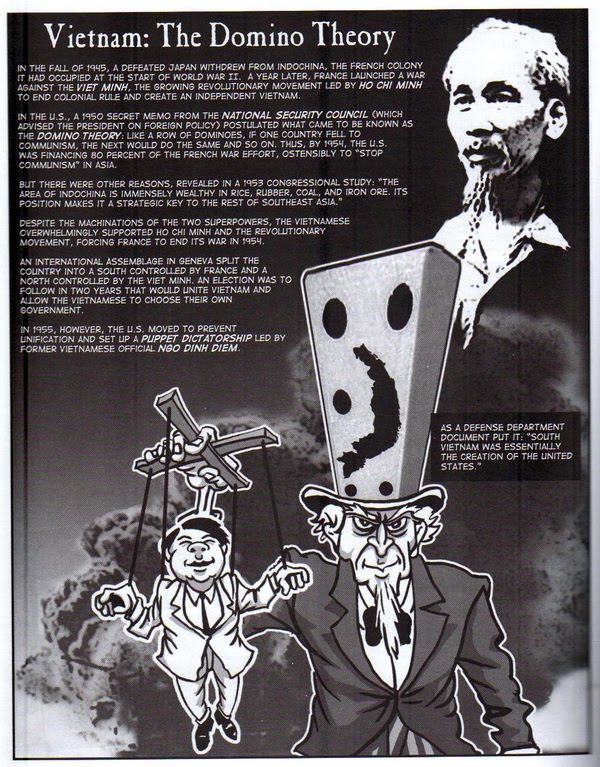
The “Domino Theory” was a prevailing historical paradigm at the time of the Vietnam War. Image from A People’s History of American Empire, by Howard Zinn, Paul Buhle and Mike Konopacki.

CLICK ON IMAGE TO ENLARGE

Rejecting the dominant paradigm:
How Howard Zinn helped us redefine history

By Harry Targ / The Rag Blog / February 6, 2010

In 1962 Thomas Kuhn published a book, The Structure of Scientific Revolutions, suggesting that the development of scientific research was grounded in social structures. A set of scientific ideas, what he called a “paradigm,” become established in disciplines — chemistry, physics, biology — and this set of ideas, if they explain significant features of the field, become dominant. Most chemists, physicists, or biologists do scientific research from the standpoint of the fundamental ideas of the paradigm.

Kuhn said that newer generations of researchers and educators then work from within the paradigm. They do what he labeled “normal science.” Their publications, their theories, maintenance of their jobs, depend on them doing science from within the framework of the paradigm.

Kuhn then suggested that occasionally the dominant paradigm raises so many questions that it gets challenged. There is a “revolution” in the science and a new paradigm begins to dominate the discipline.

To me this view of science was fascinating. Studying any discipline, Kuhn seemed to be saying, involved the institutionalization of a way of thinking about a subject, making sure that way of thinking becomes part of the “power structure” of the discipline and only gets changed by “revolutions” in the field. The development of ideas, he implied, parallels domination and subordination in societies and stability challenged by radical change.

Some scholar/activists in the 1960s and beyond began to look at other fields, such as the social sciences and humanities, through the lens of Kuhn, whether or not it was his intention. These scholar/activists began to see that in virtually every field of study dominant paradigms were created that enshrined certain ideas including economics, history, politics, and culture.

For the most part, these paradigms celebrated capitalism, the United States in the world, American democratic institutions, and artistic works that ignored social problems and concentrated on the personal. However, increasing numbers of a new generation began to argue that key ideas were left out of these paradigms. Prominent among these suggestions was that understanding the United States and the world required considering the roles of class, race, and gender.

As a result of the turmoil on and off campuses in the 1960s, these scholar/activists were emboldened to critically revisit the dominant paradigms in their fields. They began to do research that looked at the underside of capitalism; the U.S. role in the world from an anti-imperialist lens; the connection between class, race, and U.S. political institutions; and the one-sidedness of excluding certain writers and artists for their political subjects from the study of literature and the visual arts.

Perhaps no paradigm was more enduring and institutionally self-serving than the consensus view of United States history. Students from K-12, college, and graduate school were educated to believe that American history was driven by the quest for assimilation, democratization, economic growth, and global leadership. That historic evolution was shaped by wise elites who were white, male, and wealthy; educated at the finest institutions of higher learning; and inspired by various humane religious faiths. It was a history of the rise to the top of expertise, compassion, wisdom, and the perfectibility of a people.

In Kuhn’s terms, young scholar/activists began to reflect more on the “anomalies” in the paradigm. Millions of indigenous people who had established vibrant and stable societies were massacred as Europeans and their descendants moved across the North American continent. The development of modern capitalism was based on hundreds of years of the accumulation of wealth produced by peoples kidnapped from Africa.

After slavery, racism continued to influence political and economic life throughout the United States. And, despite traditional claims, reforms in the work process, guarantees of health and welfare, and political rights resulted not from the benevolence of elites but through class struggle.

As anomalies in all the social sciences and humanities were uncovered, activists, students, young scholars, and even some older scholars realized that all knowledge reflects economic and political interests. There is no such thing as “academic objectivity.”

They discovered that the dominant ideas that were disseminated in elementary and high schools, college, graduate programs, and media punditry, reflected the paradigms that served the interests of the United States, particularly in the context of a struggle against ideas, movements, and nations that represented different paradigms and interests.

Those coming to newer perspectives also realized that the development of knowledge required not a distancing of the “scholar” from the people but the embedding of the research in political activity. Many realized that “theory and practice” were intimately connected.

Why all this discussion? Well Howard Zinn, a creator and product of the intellectual turmoil of the 60s presented us with a new paradigm for examining U.S. history, indeed all history. His classic text, A People’s History of the United States, which has been read by millions, compellingly presented a view of history that highlighted the roles of indigenous people, workers, women, people of color, people of various ethnicities, and all others who were not situated at the apex of economic, political, or educational institutions.

He taught us that we needed to be engaged in the struggles that shaped people’s lives to learn what needs to be changed, how their conditions got to be what they were, and how scholar/activists might help to change the world.

Perhaps most important, Zinn demonstrated that participants in people’s struggles were part of a “people’s chain,” that is the long history of movements and campaigns throughout history that have sought to bring about change. As he wrote in his autobiography, You Can’t Be Neutral on a Moving Train: A Personal History of Our Times:

What we choose to emphasize in this complex history will determine our lives. If we see only the worst, it destroys our capacity to do something. If we remember those times and places — and there are so many — where people have behaved magnificently, this gives us the energy to act, and at least the possibility of sending this spinning top of a world in a different direction.

And if we do act, in however small a way, we don’t have to wait for some grand utopian future. The future is an infinite succession of presents, and to live now as we think human beings should live, in defiance of all that is bad around us, is itself a marvelous victory.

[Harry Tarq is a professor in American Studies who lives in West Lafayette, Indiana. He blogs at Diary of a Heartland Radical.]

The Rag Blog

Posted in Rag Bloggers | Tagged , , , , , , | 3 Comments

Marc Estrin : On Mozart and Auschwitz


THE WHITE DOT IN THE MIDDLE OF

By Marc Estrin / The Rag Blog / February 5, 2010

The calendar offers up some provocative coincidences — provocative and tartly instructive. January 27th, for instance, has given us both Mozart’s birthday, and the liberation of Auschwitz.

Mozart and Auschwitz. Could there be two poles further apart? Two poles at the blazing core of German-speaking culture, that playing field for the possibilities of the human.


Those familiar with Mozart know that his writing is not all sweetness and light. The late works, especially, peer unflinchingly into that wildness and pain that was his life, that led him, at 35, to a pauper’s grave, whereabouts unknown. So to find the dark moments in Mozart is not hard.

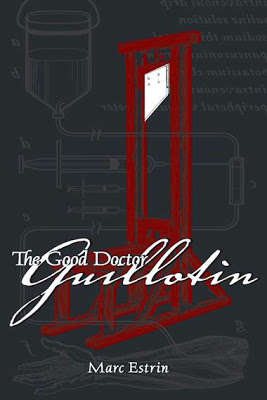
One of the characters in my recent novel, The Good Doctor Guillotin, Tobias Schmidt, the German piano-maker who wound up building the first guillotines during the French Revolution, describes a concert in Paris by the 22-year old Austrian visitor in which he played a set of his variations on the bawdy folk tune “Ah je vous dirai, Maman.” (We know the melody as that of “Twinkle, Twinkle, Little Star.”) He talks about how

“in the middle of the unending C major of this trivial folk tune, Mozart had thrown himself and his listeners into a precipitous C minor variation which ripped open the pleasant, clever world, and exposed the darkest forces lurking in the background.”

Yes. Fairly standard, even in Haydn, and more to come in Beethoven. Yin and yang: the black dot in the middle of the white. High German culture — and then Auschwitz.

But then, there is the other dot — the white one in the middle of the black. The paradox is that this one can prove even more painful.

In another scene in the novel, Schmidt is accompanying Dr. Guillotin’s violin in a room in the captured king’s prison palace:

“Why are you crying?” Schmidt asked.
Guillotin had put down his violin.
“Why are you crying?” he asked his pianist.
“I’m not crying. That’s sweat,” Schmidt said, wiping away a tear.

I’ll tell you why they were crying. They were crying because in the E minor violin sonata there is a moment too beautiful to play — the trio in E major, haunting, unbearably poignant and lovely.

Guillotin had gulped at the key change, started to tear up at the first rising sixth of the theme, and by the repeat of the first phrase had to lower his instrument.

Schmidt was crying because — like the C minor moment in the Ah, vous dirais-je variations he had heard Mozart play — this moment, too, seemed to open a trapdoor revealing all those lurking dark forces, then shut it quickly again — but in reverse and inside out. Here it was a trapdoor not into darkness but into a universe of light, of the possible, of all that could be but isn’t.

They were crying because they understood this: That such a world is hidden from us, unattainable, glimpsed only in Mozart’s cruel caress. A dark E minor minuet: the dance par excellence of the aristocracy. Grace, beauty, decorum. Delicate but controlled and controlling. And then the intolerable knife thrust of the exquisite trio — revealing the old order for all its implications, its unsuspected possibilities of disaster.

Is that what we’re crying about?” Guillotin demanded. “An exposé of the old order? I thought we knew that. I thought we were trying a new order.”

“That’s what I, at least, am crying about,” the piano-maker said. “It’s not the ghastly court and the canting nobility I’m mourning, it’s the stability and structure, the placidity and contentment, the state of grace they would pretend. I’m crying because I understand the loss. I fear it; I fear such transience, fear mortality—in this context of most beauty. I’m crying because we will now have to face the great trembling — at hand — and inescapable.”

Guillotin dried his eyes, wiped the rosin off his strings, and, taking this cue, Schmidt closed the piano, an instrument he had built for the music room of the Tuileries palace.

The awfulness of beauty. The unbearable face of unattained, unattainable possibility. The white dot in the middle.

I wonder if those who are having so much difficulty giving up their dreams of the Obama-they-would-have are paralyzed by the same awful contrast between the dot and its matrix.

cover of the book The Good Doctor Guillotin by Marc Estrin
[Marc Estrin is a writer and activist, living in Burlington, Vermont. His novels, Insect Dreams, The Half Life of Gregor Samsa, The Education of Arnold Hitler, Golem Song, and The Lamentations of Julius Marantz have won critical acclaim. His memoir, Rehearsing With Gods: Photographs and Essays on the Bread & Puppet Theater (with Ron Simon, photographer) won a 2004 theater book of the year award. He is currently working on a novel about the dead Tchaikovsky.]

The Rag Blog

Posted in Rag Bloggers | Tagged , , , | 1 Comment

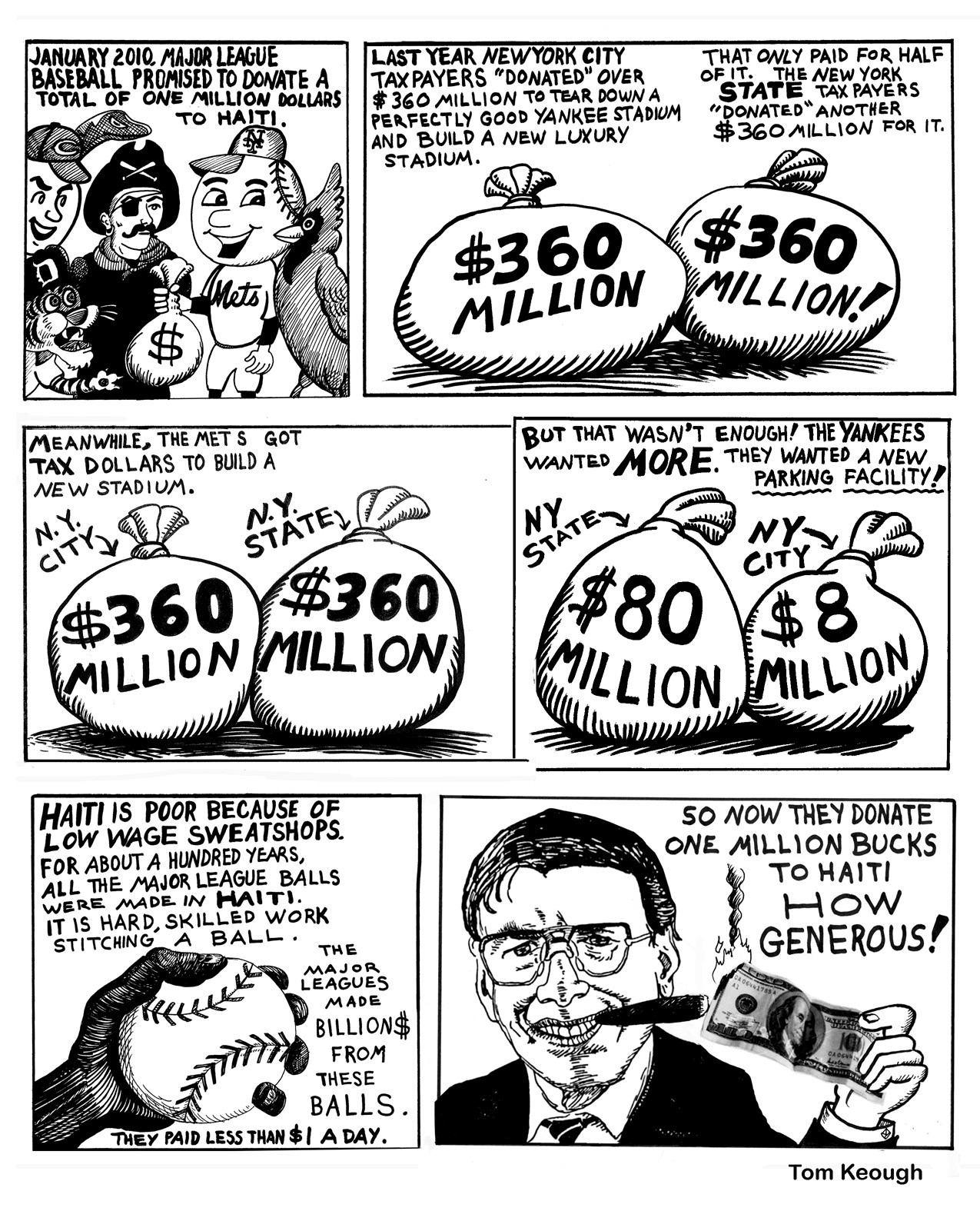
COMIC / Tom Keough : Baseball’s Handout to Haiti

CLICK ON IMAGE TO ENLARGE

Political cartoon by Tom Keough / The Rag Blog / February 5, 2010

The Rag Blog

Posted in RagBlog | Tagged , , , , | 1 Comment

Jim Hightower : Republican Hypocrites Rag on the Poor

Image from Grub Street.

Madcap schtick of Bauer and Linder:
Republicans out of touch as middle class sinks

By Jim Hightower / February 4, 2010

American politics is a hoot! Where else can raw ignorance rise to such high places — and then flaunt itself shamelessly for all to see?

For example, who needs Jay Leno or Conan O’Brien for comic relief, when we’ve got Andre Bauer? He’s the Lieutenant governor of South Carolina (a state, by the way, that really is a comer on the political comedy circuit — especially after Gov. Mark Sanford’s madcap schtick last year involving his disappearance, the Appalachian Trail and an Argentine mistress.

But Sanford is leaving office, and Bauer, who is now a Republican contender for governor, is the state’s new star joker. He had ’em rolling in the aisles recently when he did a wild, slapstick routine on food stamps at a town hall meeting. Andre proclaimed that much of his political thinking was shaped by his grandmother and that he had learned a valuable lesson from her.

“She told me as a small child to quit feeding stray animals. You know why?” he asked, pausing for comedic effect. “Because they breed! You’re facilitating the problem if you give an animal or a person ample food supply. They will reproduce.”

I tell you, Andre Bauer is an absolute scream!

But here’s the real punch line: The need for food stamps has been soaring as more and more Americans are falling out of the middle class into poverty. From 2000 to 2008, 5 million more were added to the poverty rolls, and that was before the economic collapse of the last two years. In fact, check this out Andre, and laugh if you feel like it: About 6 million Americans today are living entirely on food stamps — they’ve lost their jobs and have no other income. That’s one out of every 50 of us, and their numbers are growing rapidly. Now, isn’t that a hoot?

Georgia Congressman John Linder: irked about food stamps.

Well, one who’s not laughing is Republican member of Congress John Linder. This far-out Georgia right-winger is irked that America’s food stamp program will grow to more than $60 billion this year. “This is craziness,” Linder barked to a New York Times reporter. “We’re at risk of creating an entire class, a subset of people, just comfortable getting by living off the government.”

Comfortable? When was the last time this pampered lawmaker experienced the “comforts” of the food stamp life? Linder himself has been “living off the government” for 18 years, but at the high end — drawing $174,000 a year in pay, plus subsidized health care, a fat pension and generous perks of office.

Hypocrisy aside, Linder is an anti-government, laissez-faire extremist who buys into Bauer’s fantasies about lazy, good-for-nothing strays getting food stamps.

“You don’t improve the economy by paying people to sit around and not work,” he grumps, adding, “You improve the economy by lowering taxes.”

Really? Perhaps the gentleman from Georgia has forgotten that he and the whole Washington insider crowd tried that scam again and again throughout the past decade, slashing all sorts of taxes for corporations and the wealthy. Since Linder is a multimillionaire, that economic “plan” undoubtedly worked out splendidly for him.

For the middle class, however, the 10 years since January 2000 are known as “the lost decade.” In that period, the U.S. economy lost more jobs than it created — zero job growth. That’s the first decade since the end of the Depression that our country has had less than a 20 percent rise in job creation.

Also, after the 10-year frenzy of tax-cutting, middle-class families are earning less today, in real dollars, than they did in 1999. Add in skyrocketing health care costs and the plummeting value of people’s homes, and we get the harsh reality of mushrooming poverty.

So that “subset of people” on food stamps whom Linder so callously denigrates are his own spawn! The food stamp program has had to grow because the tinkle-down economy that he pushed has wrecked America’s middle class.

Does knocking poor people make these guys feel better about themselves? How pathetic. Bauer and Linder are living proof that when it comes to leadership, America has too many 5-watt bulbs screwed into 150-watt sockets.

Copyright 2010 Creators.com.

Source / truthout

The Rag Blog

Posted in RagBlog | Tagged , , , | 8 Comments

Nuke Industry Chaos : Obama and the Reactor Wars

Image from Follow the Money.

Trials of the nuclear ‘renaissance’:
Will Obama guarantee a new reactor war?

By Harvey Wasserman / The Rag Blog / February 4, 2010

Amidst utter chaos in the atomic reactor industry, Team Obama is poised to vastly expand a bitterly contested loan guarantee program that may cost far more than expected, both financially and politically.

The long-stalled, much-hyped “Renaissance” in atomic power has failed to find private financing. New construction projects are opposed for financial reasons by fiscal conservatives such as the Heritage Foundation and National Taxpayers Union, and by a national grassroots safe energy campaign that has already beaten such loan guarantees three times.

New reactor designs are being challenged by regulators in both the U.S. and Europe. Key projects, new and old, are engulfed in political/financial uproar in Florida, Texas, Maryland, Vermont, New Jersey and elsewhere.

And 53 years after the opening of the first commercial reactor at Shippingport, Pennsylvania, Department of Energy Secretary Steven Chu is now convening a “Blue Ribbon” commission on managing radioactive waste, for which the industry still has no solution. Though stacked with reactor advocates, the commission may certify the death certificate for Nevada’s failed Yucca Mountain dump.

In 2005 George W. Bush’s energy bill embraced appropriations for an $18.5 billion loan guarantee program, which the Obama administration now may want to triple. But the DOE has been unable to minister to a chaotic industry in no shape to proceed with new reactor construction. As many as five government agencies are negotiating over interest rates, accountability, capital sourcing, scoring, potential default and accident liability, design flaws, and other fiscal, procedural and regulatory issues, any or all of which could wind up in the courts.

In 2007, a national grassroots uprising helped kill a proposed addition of $50 billion in guarantees, then beat them twice again.

When Obama endorsed “safe, clean nuclear power plants” and “clean coal” in this year’s State of the Union, more than 10,000 MoveOn.org members slammed that as the worst moment of the speech.

The first designated recipient of the residual Bush guarantees may be at the Vogtle site in Waynesboro, Georgia, where two reactors now operate. Georgia regulators have ruled that consumers must pay for two proposed new reactors even as they are being built.

But initial estimates of $2-3 billion per unit have soared to $8 billion and more, even long before construction begins. Standardized designs have not been certified. On-going technical challenges remind potential investors that the first generation of reactors cost an average of more than double their original estimates.

The Westinghouse AP-1000 model, currently slated for Vogtle — and for another site in South Carolina — has become an unwanted front runner.

Owned by Japan’s Toshiba, Westinghouse has been warned by the Nuclear Regulatory Commission of serious design problems relating to hurricanes, tornadoes, and earthquakes.

The issues are not abstract. Florida’s Turkey Point plant took a direct hit from Hurricane Andrew in 1991, sustaining more than $100 million in damage while dangerously losing off-site communication and power, desperately relying on what Mary Olson of NIRS terms “shaky back-up power.” Ohio’s Perry reactor was damaged by a 1986 earthquake that knocked out surrounding roads and bridges. A state commission later warned that evacuation under such conditions could be impossible.

Long considered a loyal industry lapdog, the NRC’s willingness to send Westinghouse back to the drawing board indicates the AP-1000’s problems are serious. That they could be expensive and time-consuming to correct means the Vogtle project may prove a losing choice for the first loan guarantees.

South Texas is also high among candidates for loan money. But San Antonio, a primary partner in a two-reactor project there, has been rocked by political fallout from soaring cost estimates. As the San Antonio city council recently prepared to approve financing, it learned the price had jumped by $4 billion, to a staggering $17-18 billion. Angry debate over who-knew-what-when has led to the possibility that the city could pull out altogether.

In Florida, four reactors have been put on hold by a plummeting economy and the shifting political aims of Governor Charlie Crist. Crist originally supported two reactors proposed by Florida Power & Light to be built at Turkey Point, south of Miami, and two more proposed near Tampa by Progress Energy. State regulators voted to allow the utilities to charge ratepayers before construction began, or even a license was approved.

But Crist is now running for the U.S. Senate, and has distanced himself from the increasingly unpopular utilities. With votes from two new appointees, the Public Service Commission has nixed more than $1 billion in rate hikes. The utilities have in turn suspended preliminary reactor construction (though they say they will continue to pursue licenses).

At Calvert Cliffs, Maryland, financially tortured Constellation Energy has committed to the French AREVA’s European Power Reactor, now under serious challenge by regulators in France, Finland, and Great Britain. An EPR under construction in Finland is now at least three years behind schedule, and more than $3 billion over budget.

Meanwhile, at Entergy’s 30-year-old Yankee reactor in Vermont, a series of radiation and information leaks has severely damaged prospects for re-licensing. The decision will soon be made by a deeply divided state legislature. “It would be better for the industry to let Vermont Yankee die a quiet death in the Green Mountain state,” says Deb Katz of the grassroots Citizens Awareness Network. “With radioactive leaks, lies and systemic mismanagement, Entergy is no poster child for a new generation of nukes.”

Meanwhile, New Jersey may require operators of the aging Oyster Creek reactor to install sizable towers to protect what’s left of the severely damaged Barnegat Bay, which the plant uses for cooling. Though the requirement may not be enforced for as much as seven years, the towers’ high cost could prompt a shut-down of the relatively small plant.

This unending stream of technical, financial and political downfalls could doom the “reactor renaissance” to history’s radioactive dump heap. “President Obama needs to remember what Candidate Obama promised: no more taxpayer subsidies for nuclear power,” said Michael Mariotte, executive director of the Nuclear Information and Resource Service. “Renewables and energy efficiency provide both greater carbon emissions reductions and more jobs per dollar spent than nuclear. Unlike nuclear power, they are relatively quick to install, and are actually safe and clean.”

Indeed, despite Congressional and White House support for these latest proposed loan guarantees, the grassroots fight over both old and new nukes grows fiercer by the day.

In the long run, this alleged “nuclear renaissance” could prove to be little more than a rhetorical relapse.

[Harvey Wasserman’s Solartopia! Our Green-Powered Earth is at www.harveywasserman.com, along with his History of the United States. He is Senior Advisor to Greenpeace USA and the Nuclear Information & Resource Service, and Senior Editor of www.freepress.org, where this article also appears.]

The Rag Blog

Posted in Rag Bloggers | Tagged , , , | 2 Comments

VERSE / Larry Piltz : The Sage, the Sophist, and Some Populists

“The Wise Man” by Jim Warren / Jim Warren Studios.

New Perfection
(The Sage, the Sophist, and Some Populists)

The sage says
the world is perfect
already arrived
yet arriving still
and drifts back
into meditation

The sophist explains
that perfection is the standard
by which we need measure
all earthly pursuits
and that if we fall short
it must be our fault
because the world is perfect
and then moves on
to scold the next town

I say perfection is a concept
by which sophists earn a living
and forego responsibility
to think deeply enough
about anything more meaningful
than their own ambitions
and that sages have it right
that what is will have to do
but could use worldly experience
to further prove their theory
and to help improve perfection
and its lagging reputation

Some populists say
don’t let the perfect
be the enemy of the good
but they might should consider
making the good a reality
so as not to be the enemy
of either

Larry Piltz / The Rag Blog

Indian Cove
Austin, Texas
February 3, 2010

The Rag Blog

Posted in Rag Bloggers | Tagged , , | Leave a comment

‘Trickle Down’ Folly : Cutting Taxes Doesn’t Create Jobs

The “trickle down” theory: how it works.

How NOT to create jobs:
Cut business taxes and lower wages?

Money does not trickle down in a capitalist economy — it flows upward, and that has always been true.

By Ted McLaughlin / The Rag Blog / February 3, 2010

For years now, the corporate-owned Republicans have been telling us that the way to create more jobs in America is to cut business and corporate taxes and lower wages for workers. They would like to do away with the minimum wage completely, which would put downward pressure on all wages (except for corporate executives).

Even President Obama has recently jumped on this dubious bandwagon by recommending business tax cuts as a part of his jobs creation program. On the surface, this sounds like it might work. After all, if business owners got to keep more money from reduced taxes, they would be able to afford to hire more workers — right?

The real question is whether a businessman being able to afford more workers would actually translate into that businessman hiring more workers. I submit it would not. Answer this question — is a person in business to create new jobs or to make as much profit as possible?

Any sentient being knows the answer to that question. Nobody goes into business to create jobs. Most business owners work very hard, and they do it to make as much profit as possible so they can make life better for themselves and their families (and there’s nothing wrong with that as long as it’s done legally).

So what would happen to the extra money a business owner would get to keep from lower taxes or lower wages? Unless he/she chose to donate it to some charity (and a few might), it would go in the owner’s bank account to maximize profits (and the same thing would happen in a corporation). This is understandable, but it does nothing to create new jobs.

There are a couple of ways to cut taxes and stimulate job growth, but they are cumbersome and expensive and nobody is proposing them. One way would be to legally tie a business tax cut to the creation of new jobs at that business ($X in cuts=X number of new jobs). The problem with this approach is that the tax cut would have to equal or exceed the actual salaries of the new jobs in order to create more than a miniscule amount of jobs.

That would be a very expensive solution. It would probably be cheaper for the government to hire workers directly for a depression/recession program like Roosevelt’s CCC or WPA.

So if a business tax cut will not work, what kind of tax cut will work? A consumer tax cut like lowering sales taxes or income taxes (for those making less than $100,000).

Republicans want us to think the American economy works in a “trickle down” manner. In other words, if you give the rich businesses enough money some of it will trickle down to workers. That is total nonsense. The economy has never worked that way. Money does not trickle down in a capitalist economy — it flows upward, and that has always been true.

Just look at our history. The best times for our economy were when consumers had money to spend. Take the 1950’s for example. Consumers had it good because it was a time of educational achievement (thanks to the GI Bill) and union expansion. This gave consumers more money to spend, and because of that businesses (both large and small) thrived as that money flowed upward.

There is only one reason for a business owner to hire more workers (create jobs), and that is because he/she needs more workers to handle an increase in demand for that business’s goods or services. That increased demand can only happen when consumers have money to spend.

This same argument is true whether we are talking about tax cuts or lower wages. Lower wages would let the business owner keep more of his money, but it would also shrink the amount of money consumers have to spend. And in the long run, that would hurt both workers and businesses. Instead of costing jobs (as Republicans want us to believe), higher wages actually create jobs as businesses must hire workers to handle increasing demand created by the higher wages.

Cutting business taxes and/or lowering wages is only a short-term solution for a long-term problem. This recession has cost America over 7 million jobs, and this economy will not really start moving again until we recover most or all of those jobs. The only way to do that is to aim the recovery money at workers and consumers — not at businesses.

Cutting business taxes and/or lowering wages will give businesses a little short-term profit, but will not create jobs or help the economy. Cutting taxes for consumers and directing recovery money at workers will not only create jobs and put our economy back on track, it will help business even more in the long-term. It is the only solution.

(A tip of my hat goes to Badtux the Snarky Penguin for his humorous and very astute take on this situation.)

[Rag Blog contributor Ted McLaughlin also posts at jobsanger.]

The Rag Blog

Posted in Rag Bloggers | Tagged , , , , , | 12 Comments