America: Happy, Happy, Happy !!


Happy, Happy, Happy !!
By Diane Stirling-Stevens / The Rag Blog / November 4, 2008

Boy, what a wonderful day I had! My back was killing me; took my pain medication, and finally headed over to the casino to gamble; eat lunch, and watch the election as it unfolded.

I ‘placed my numbers’ – always use #44 since it’s Hank Aaron’s number, and he was my favorite baseball player (it is also the number of the president who was elected today). I was ‘up and down’ – hit $100; then down – then hit another $100, and after going up and down with about $75 still in the machine, I nailed it for $4,700.00 shortly after 4 this afternoon. I broke into tears of happiness; gave out $300 for a tip – handed out a few hundred to those who were seated near me (and hadn’t had a bite/good luck), and told a couple people ‘now if only Obama wins I’ll have had the best day’.

I went home to get my husband to treat him to dinner; that was wonderful, and when we came out Obama was ‘over the top’ – the casino and restaurant was in an uproar of happiness, and we spent the rest of the time having ‘good cheer drinks’, and celebrating.

I’m happy my family in Ohio; California, Michigan and Florida all ‘chimed in’ at the last, and agreed Obama was the ‘pick’, and I see he carried all of those states as well as my state of Nevada – now that was just the ‘topping’ on a wonderful election day/night cake for me.

I loved Obama’s speech; he was clearly happy and grateful, but still that wonderful reserved and poised individual that I admire so much.

I can hardly wait to ring our neighbor’s door-bell tomorrow; they are a lovely black family, and they all were so unsure of Obama’s success – I bet they are celebrating now, but I don’t want to interfere with their family gathering, so tomorrow is soon enough.

It’s more than an election to me; it’s an acceptance that not just a ‘white man’ is qualified to be president, but that anyone with the right education, desire, and commitment should be eligible to become a leader for our country (or our state), in a capacity where they can represent our dreams and goals because they share them, too.

I don’t think I’ll sleep easily tonight; it’s just too wonderful. I must say coming home with a wad of $100 bills made it just a bit more delightful ….

The Rag Blog

Posted in Rag Bloggers | Tagged , , , | 3 Comments

Talking to Afghans About the US/NATO Presence

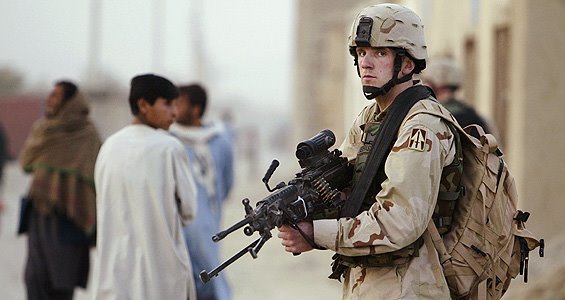
Many Afghans are critical of the US mission in Afghanistan. Photo: GALLO/GETTY.

Afghans uneasy over US relationship
By Aunohita Mojumdar / November 4, 2008

As a managing director of Radio Killid, a radio station dedicated to socially relevant programming, Najiba Ayubi keeps a keen eye on international political developments and is well aware of public opinion in Afghanistan.

Like many Afghans, the position of the US presidential candidates on and their rhetoric towards Afghanistan do not impress her.

“They are tools to come to power with,” she says.

Unlike the focus on talk of a so-called “surge” in the number of troops in Afghanistan which dominates US talk shows and occupies American political pundits, Afghans are concerned on what the troops will do, the nature of the military operations and the rules of engagement.

The increase in both the violence and the number of Afghan civilians being killed, continuing poverty and a loss of hope are making Afghans’ relationship with the foreign presence in their land more complicated.

Anger over casualties

Many Afghans continue to view foreign troops on their land as a necessary evil, but even those supporting them want fundamental changes in the conditions of their presence.

“We have got some good things from the US – the laws, the new constitution, the parliament – but we would like the international military presence here to be under a framework which includes a date for its withdrawal,” says Ayubi.

Ayubi is no traditionalist. Her radio programming raises social awareness and tackles difficult subjects such as violence against women.

However, she feels Afghans have become very critical of the US because of the increasing civilian casualties in military operations.

She says: “In 2001, we would have welcomed anyone who came to deliver us from the Taliban. But now that feeling is changing.

“The US does not consult anyone. It decides, unilaterally, to do whatever it wants.”

Civilian casualties, for example, could be prevented if there was greater consultation with locals “since the foreign troops do not know the customs or culture”.

What the soldiers take for a militant gathering may just be the Afghan tradition of setting up open kitchens for weddings which go on for several days,” she says.

Occupation anger

Khalid Dawari, a young man who works in an architect’s firm, shares Ayubi’s lack of interest in the impact of the US elections on Afghanistan.

Khalid says little will change under a new US administration

“The foreign policy of the US doesn’t depend on one individual. It will not change.” he says but, unlike Ayubi, he feels civilian casualties are part of any conflict.

He is more strident in his criticism of the western presence.

“Afghanistan has been occupied or captured by Americans or other European countries,” he says, explaining that the very presence of foreign soldiers denotes occupation.

“It is fine for now. But they are doing it for their own benefit. Bush is in the oil and gas business isn’t he?”

A ‘tortured’ relationship

Khalid’s remarks reflect the tortured relationship of many Afghans to the presence of the West which is something they cannot live with, nor without.

He believes his country’s president, Hamid Karzai, has been selected by the US and not the Afghans.

“Who is he? We never heard of him earlier. He was not a leader. He has been selected by Mr Bush,” he said.

He sees a substantive portion of the country’s aid going back to the donor countries but sees no way out.

“Afghanistan is not in a situation where it can help itself. We are hopeless from every side. If they withdraw, the Taliban may come and capture Kabul.”

Dawari is clear that the western intervention in Afghanistan is dominated and led by the US.

As for other countries, he says “the rest are just members of the party”.

Taliban memories

US dominance of the foreign intervention in Afghanistan is overwhelming.

It has contributed approximately half of the troops there and, between 2002 to 2008, provided one-third of the entire aid to Afghanistan.

The large presence of US consultants, contractors and aid workers has spawned its own economy, services and goods for the expatriate market.

The Kabul Coffee House, for example, is an American style cafe that is frequented largely by internationals.

Haseebullah Fayez, 20, is grateful for his work there as a cashier.

Haseebullah does not want to go back to life under the Taliban

He was living in Kabul during the rule of the Taliban and has strong memories of what life was like.

“I went to school, but got no education. There was no work,” he says.

“After they [the Taliban] left I could study. I learnt English. Now at least we can find some work. I support my family. My father’s salary as a school teacher is only $60 a month and not enough for our family of five,” he said.

Haseeb has been in the cafe for three years and along the way has acquired a taste for cheeseburgers, Bob Dylan’s music and Arnold Schwarzenegger movies.

He regularly hears the criticism of the foreign reconstruction effort in his country.

He agrees that civilians get killed in military operations and that a substantial portion of the money Afghanistan receives goes back to the donor countries.

But his anger is not directed towards them.

“I wonder why it [war and destruction] had to happen to Afghanistan,” he says.

He says that lives do get lost in a war but “they [US forces] don’t want to kill them. It happens by mistake”.

No ‘nation building’

Aziz Hakimi, the country director of the charity Future Generations, digs much deeper than his compatriots, questioning not just the US role but the entire idea of “nation building” by the West.

Aziz feels that the West has abandoned Afghanistan

The mistakes made in the initial days of the US intervention – such as putting in power ‘warlords’ and “the very people who are a threat to security” has cost dearly, he feels.

“The Afghans welcomed the intervention as they welcomed change each time. However, just as in the past, they were disappointed again,” he said.

The change in Afghan society must be rooted in the community, he feels.

Decisions must be made by local communities “rather than being dictated by budgets in Brussels or Washington” he says.

Hakimi does not buy into the popular notion that the foreign aid has not been enough.

“It’s dangerous to assume that throwing dollars at the problem will solve it. It will compound the problem. You cannot use development dollars and military might to deal with a political problem.”

While he agrees that the Western presence is dominated by the US, he blames, at least partially, the Europeans who have contributed to Nato’s Afghan troop force, for it, and echoes the feelings of many Afghans who believe the West has abandoned them repeatedly.

“The West abandoned us after they got what they wanted in the Cold War. They are here now to fight the ‘war on terror’,” he says.

He insists: “They will abandon us again if the al-Qaeda is routed. Afghans should think about this.”

Source / Al Jazeera English

The Rag Blog

Posted in RagBlog | Tagged , , | Leave a comment

Rag Blog Report from Berlin : The Whole World is Watching


Reflections on the US elections and the possibilities for a better world
By David MacBryde / The Rag Blog / November 4, 2008

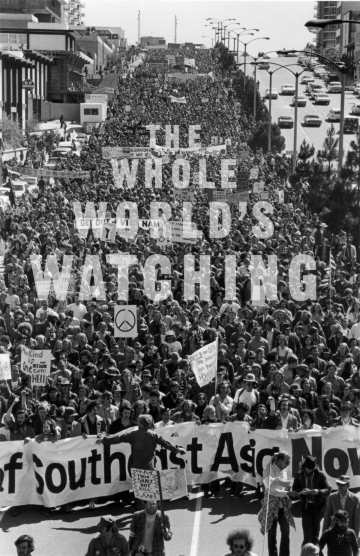
BERLIN — You are not alone today. The whole world is watching.

In Berlin tonight we are having a “Party With Us Into the Sunrise” election party. We named it that with the hope that the results will enable a “sunrise” out of dire times, and because it will be sunrise here by the time polls close across the United States. The traditional venue here for US election watching is the Amerika Haus — formally a cultural center run by the US State Department. (Personal disclosure: father Duncan helped initiate it at the end of WW II.) The building is now owned by the city of Berlin. The city has made it available for the event. The place can hold some 300 people.

As the election got closer we thought more space might be needed, and a movie theater offered an additional venue, with room for 800 people. But there have been over 6,000 requests for reservations so far, and climbing. We will set up an outdoor screen and beamer.

Let us hope we can indeed beam.

I voted by mail at my parents last address, in North Carolina. Will be watching the senate race there too.

We will see what happens. The whole world is watching. In addition to the “global electoral college” unscientific readers poll by The Economist (UK), there is an experimental site by three young Icelanders.

After you vote check out On Day One. What do you think the next US President should do on day one?

In 1999, looking to the new millennium, Ted Turner (not without influence from Jane Fonda) donated $1 billion (US) to the United Nations to create the non-profit Better World Foundation for United Nations educational work. On Day One is a current project of the Better World Foundation Add your comments to that campaign. See what others are advocating. It is a long-term project.

For one current United Nations effort, go to Global Green New Deal .

London/Nairobi, 22 October 2008 – Mobilizing and refocusing the global economy towards investments in clean technologies and ‘natural’ infrastructure such as forests and soils is the best bet for real growth, combating climate change and triggering an employment boom in the 21st century.

The call was made today by the United Nations Environment Programme (UNEP) and leading economists as they launched the Green Economy Initiative aimed at seizing an historic opportunity to bring about tomorrow’s economy today. Achim Steiner, UN Under-Secretary General and UNEP Executive Director, said: “The financial, fuel and food crises of 2008 are in part a result of speculation and a failure of governments to intelligently manage and focus markets”.

“But they are also part of a wider market failure triggering ever deeper and disturbing losses of natural capital and nature-based assets coupled with an over-reliance of finite, often subsidized fossil fuels,” he said.

“The flip side of the coin is the enormous economic, social and environmental benefits likely to arise from combating climate change and re-investing in natural infrastructure – benefits ranging from new green jobs in clean tech and clean energy businesses up to ones in sustainable agriculture and conservation-based enterprises,” he added.

That fits with the United Nations Millennium Goals, especially overcoming poverty. See September-October action (while Palin and US media were doing what at the United Nations?)
Or more generally at the UN.

In the US, the Nation has an article by Van Jones posted Oct. 29 titled “Working Together for a Green New Deal,” about forming alliances, locally and globally, to deal with economic justice, energy and the environment.

And, on the current investment decision crisis, the recession/depression and issues of what future “growth” can be:

Will the excitement, anger and hope around the elections collapse after election day? I think not.

BREAKING NEWS in Germany: first private bank applies for “umbrella” help — will know more in a few days. There is a meeting of European finance ministers on the crisis on Nov. 7. The German approach to dealing with the banks and investment disasters is different from the Paulson plan. Here there is huge pressure against misallocation of public funds. AND the concern here is less with the local banking system than with the real economy and recession. IG Metal, the big machinists and engineers union, went out on a warning strike today. Much pressure to transform the real economy.

Evidently the pressures on Paulson are growing: Here’s a little from the Nov. 4 Wall Street Journal by y Deborah Soloman:

“Treasury’s planning could be complicated by Tuesday’s election. Mr. Paulson has said he wants to involve the next administration in major decisions between now and January. Both Sen. John McCain, the Republican nominee, and Sen. Barack Obama, the Democratic nominee, voted for the $700 billion rescue plan, but a new administration is certain to have its own ideas about how best to use the remaining $450 billion.”

The Rag Blog

Posted in Rag Bloggers | Tagged , , , , , , | Leave a comment

Progress Toward a Ban on Cluster Munitions

Cbu97 Cluster Bomb

Movement to Ban Cluster Bombs Gains Momentum
By Lisa Schlein / November 3, 2008

Activists are urging governments to sign an international treaty to ban the use, production and stockpiling of cluster bombs one month from now in Oslo. The Cluster Munition Coalition says global momentum is growing to put an end to these weapons, which the group says mainly maim and kill civilians. Lisa Schlein reports for VOA from Geneva.

A Group of Governmental Experts is meeting at the United Nations to negotiate a treaty on cluster munitions. The agreement aims at striking, what it calls, a balance between military and humanitarian considerations.

The Cluster Munition Coalition calls the process flawed. It says the draft text being discussed will do nothing to stop the death and destruction from cluster bombs. It says the text proposes a 13 to 20-year transition period in which States would be able to continue to use, produce, stock pile and trade these weapons.


On the other hand, Coordinator of the Coalition, Thomas Nash, says the Oslo treaty offers a holistic solution because it will ban an entire category of weaponry before it gets out of control.

“It has been largely preventive in nature,” he said. “Unlike the landmine problem, which spread to around 80, 90 countries before an international treaty was agreed to prohibit that weapon. So far, cluster munitions have only affected-I say only, it is already too much of a problem, but, only around 32 States or territories have been affected. So, in many ways, we are acting before the problem gets to the scale of landmines. Far too many people have been killed or injured by this weapon. ”

The Coalition says about 76 countries have stockpiled cluster bombs. It says it is the billions of sub-munitions contained within these weapons that create all the damage. It says the U.S., with nearly one billion sub-munitions, possesses the biggest arsenal in the world.

It says 34 countries produce cluster bombs. The biggest producers are the United States, Russia and China. Others include Britain, Germany, France, Israel and Brazil. It says the number of victims is unknown, but may be in the hundreds of thousands.

About 100 countries are expected to sign the Oslo Treaty next month. The U.S., Russia and China are major holdouts. Co-Chair of the Coalition, Steve Goose, agrees this is problematic. But, says it will not lessen the impact of the agreement.

“We believe in the power of the stigma against the weapon,” said Steve Goose. “We have seen this very clearly with anti-personnel landmines. That same litany of States that we just ran through-U.S., Russia, China, India, Pakistan, Israel-none of those States are part of the landmine treaty either 10 years later. And, yet, we see that the stigma of the weapon has had a very powerful deterrent affect on those States.”

Goose says the United States has not used, produced and traded in landmines since the treaty was signed. And, it has destroyed millions of its stockpiles.

He says almost none of the 39 countries that did not join the agreement have used this weapon. He says Burma was the only State that used landmines in any significant way last year.

He says even those States that stay outside the treaty have to bend to the new standard of behavior that is being established internationally.

Source / Voice of America News

The Rag Blog

Posted in RagBlog | Tagged , | Leave a comment

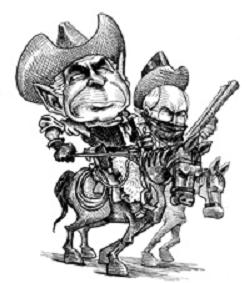
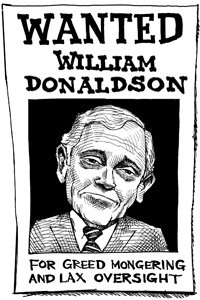
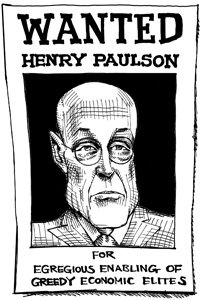
Jim Hightower : The Five Most Wanted Men from Wall Street and Washington


Our economy didn’t melt down, it was taken down by ideological extremists.
By Jim Hightower / November 3, 2008

What the hell’s happening here?

Why is my bank in the tank? And my house and job? And my retirement money? Even my state’s teetering on the brink of broke! Who did this to us?

Fair questions, but we’re not getting honest answers. Last year, at the first signs of the global financial slide toward the abyss, we were told that it’s just a little hiccup caused by something called subprime mortgages. Not to worry, the Powers That Be declared confidently, for we have the damage contained. And rest assured that “the fundamentals of our economy are sound.”

Then, this spring, Bear Stearns cratered, requiring an emergency federal subsidy to cover billions in bad loans. Okay, admitted those in charge, that subprime stuff actually is leveraged on up the financial system, and maybe there’s been a bit of greed among a few of the big players, but we really do have the problem contained now, and, hey, “the fundamentals of our economy are sound.”

But in September–Omigosh!–there went Lehman Brothers, Freddie Mac and Fannie Mae, AIG, Merrill Lynch, Goldman Sachs, Citigroup, WaMu, Wachovia, and others. Well, yes, conceded the now-frazzled financial establishment, but gollies, we’re throwing hundreds of billions of your tax dollars into sandbags to contain the problem, and remember: “The fundamentals of our economy are sound.”

In October, the contagion rolled through Britain, Canada, and Europe; it spread to Brazil and across to China and Japan; and–Holy Schmoly–suddenly all of Iceland was melting in bankruptcy! Stay calm, cried an openly panicked chorus of Washington officials, for we’re holding some big summit meetings soon and consulting our Ouija boards, and…uh…ah…um…y’all just keep clinging to the thought that “the fundamentals of our economy are sound.”

Laissez Fairies

You don’t have to be in Who’s Who to know What’s What, do you? The fundamentals are NOT sound.

Wall Street and Washington (excuse the redundancy there) want us commoners to believe that this viral spread of economic grief was caused by those lower-income homeowners who couldn’t pay their subprime loans–merely an unforeseeable glitch in a complex and otherwise healthy financial system. Hogwash. The source of today’s pain is the same as it was in America’s previous financial collapses: the unbridled greed of economic elites, enabled by their political courtesans in Washington.

This unbridling has been the long-sought goal of a cabal of deregulation ideologues who dwell in laissez-fairyland. During the past two decades, they have relentlessly pushed their economic fantasies into law. Their theory was that (to use Ronald Reagan’s simple construct) “the magic of the marketplace” would create an eternal rainbow of prosperity through financial “innovation”–if only the market was unshackled from any pesky public regulations. What the dereg theorists missed, however, is that magicians don’t perform magic. They perform illusions.

Let’s meet some of the illusionists who are directly responsible for hurling you, me, America, and most of the world into this dark and as-yet unplumbed economic hole.


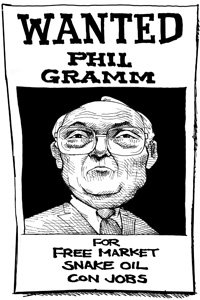
Snide, sour, and sanctimonious, this former senator from Texas is now head lobbyist for the Swiss-based banking giant, UBS, as well as chief economic adviser for his old chum John McCain. A bathed-in-the-blood, footwashing, free-market absolutist, Gramm advocates a virulent brand of antigovernment, market-knows-best, Rambo capitalism.

In 1999, as chair of the Senate Banking Committee, he had the power to implement some of his cockamamie dogmas. First, he pushed through a bill to dissolve the 1933 Glass-Steagall Act, a New Deal reform that prohibited banks, investment houses, and insurance companies from combining into one corporation. By keeping these components of our financial system separate, Glass-Steagall made sure that the crash of one of them would not bring down the other two. But a number of Wall Street banks, led by what would become Citigroup, saw a profit windfall for themselves if only they could scuttle the old law and merge banking, investment, and insurance into huge financial conglomerates. The senator was their ideological soul mate, and he was delighted to rig the system for them.

On November 12, 1999, a gloating Gramm celebrated having sledgehammered the regulatory walls that separated the three financial functions:

“We are here today to repeal Glass-Steagall because we have learned that government is not the answer. We have learned that freedom and competition are the answers. We have learned that we promote economic growth and we promote stability by having competition and freedom. I am proud to be here because this is an important bill; it is a deregulatory bill. I believe that’s the wave of the future, and I am awfully proud to have been a part of making it a reality.”

But repealing Glass-Steagall was only step one for this free-market holy roller. In literally the dead of night, just before Congress’s Christmas break in 2000, Chairman Gramm snuck a short provision into an 11,000-page appropriations bill. The item, which only a few lobbyists and lawmakers knew had been inserted, became law when the larger bill was signed by then-President Bill Clinton. Gramm’s little legislative sticky note decreed that a relatively new, exotic, and inherently risky form of investments called “derivatives” were not to be regulated–or even monitored–by the government.

It should be noted here that Democrats were also butt-deep in the dereg orthodoxy. Such Wall Street sycophants as Sen. Chuck Schumer (D-NY) had drunk deeply from the holy cup of derivatives deregulation, and Clinton’s top economic advisors Robert Rubin (formerly with Goldman Sachs and now with Citigroup) and Lawrence Summers (also a veteran of Wall Street) were in harness with the Republicans on this effort.

By 2008, the freewheeling derivatives market, including derivatives based on those lowly subprime housing loans, bloated to a stunning $531 trillion. That’s 531 followed by 12 zeroes! These little-understood, essentially secret investment schemes came to dominate our entire financial system–and when thousands of regular folks began defaulting on their subprime loans, the derivatives based on them essentially became worthless. Investment houses, which were up to their corporate keisters in these funny-money subprime derivatives, began collapsing, and the now-interlocked banks and insurance companies began tumbling down with them. Gramm’s deregulatory “wave of the future” had become a financial tsunami.


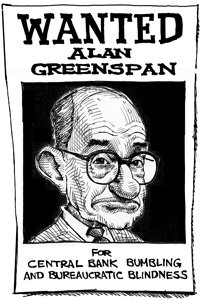
This guy’s mug should be on wanted posters in every post office in America. As Federal Reserve chairman from 1987 to 2006, he held the regulatory power to prevent the irrational inflation of the huge derivatives bubble that has now burst– yet he fought fiercely through four presidencies to prevent even the meekest oversight by the Fed or any other agency. Nicknamed “The Oracle,” Chairman Greenspan was inscrutable and arrogant, but he also possessed a detailed knowledge of financial minutiae and an air of superiority that simultaneously bedazzled and intimidated presidents, lawmakers, and other public officials.

However, not everyone was sanguine about the chairman’s reliance on derivatives [see below] as the pillar of Wall Street’s financial strength. Many wise heads viewed these financial “products” as speculative mumbo-jumbo. Billionaire financier George Soros says his firm never invested in them “because we don’t really understand how they work.” Investment banker Felix Rohatyn described them as “hydrogen bombs.” Back in 2003, investment guru Warren Buffett called them “financial weapons of mass destruction” that were “potentially lethal” for our economy.

But Greenspan’s voice was the most powerful, and he was both a determined bureaucratic protector and an exuberant cheerleader for derivatives. Meanwhile, wealthy investors worldwide were making a killing from their investments in these bizarre pieces of paper, and few in Washington were willing even to question The Oracle.

“I always felt that the titans of our legislature didn’t want to reveal their own inability to understand some of the concepts that Mr. Greenspan was setting forth,” said Arthur Levitt, a well-regarded Wall Street regulator under Clinton. “I don’t recall anyone ever saying, ‘What do you mean by that, Alan?'”

So the bubble kept expanding.

Why was Greenspan so insistent on no regulation? Because he is the hardest of hardcore laissez-faire ideologues, holding a blazing disdain for government. An avowed worshiper of libertarian novelist Ayn Rand, he views public oversight of business as an evil force that deters the creativity of smart elites. He is so psyched by his religious-like faith in the “free market” that he fervently believes in what he considers to be the innate good will and moral superiority of investors and bankers. He asserts that these self-interested individuals can simply be trusted to do the right thing, and that government should not second-guess their decisions.

Even the faith of snake handlers is not as devout as Greenspan’s. Unfortunately, however, he was able to hitch our nation’s economic well-being to his own absurdist ideological fancy. The guy who was lionized as the smartest, most- stable economic thinker in the land essentially turns out to have been a quasi-religious nut.


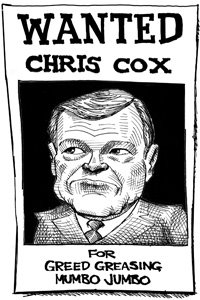
A GOP member of Congress for 17 years, Cox was another deregulation diehard and a reliable advocate for Wall Street’s pampered CEO class–a role he continued to play after Bush chose him in 2005 to succeed Donaldson as SEC chair. At the commission, he weakened the ability of the enforcement staff even to investigate securities violations by Wall Street firms, much less prosecute them. Also, in an act of pure ideological folly, he eliminated an office that had been set up specifically to watch out for future problems with such high-risk investments as derivatives.

In essence, he took the cops off the beat at the very time more cops were needed. In October, when the stuff was hitting the fan, a chagrined Cox offered this brilliant insight: “The last six months have made it abundantly clear that voluntary regulation does not work.” Thanks, Chris.


The Securities and Exchange Commission supposedly regulates investment banks, and in 2004 it was headed by–guess who?–a Wall Street investment banker, Bill Donaldson. On April 28 of that year, he presided over a little-noticed SEC meeting held in the commission’s basement to consider an obscure rule change urgently requested by the Big Five investment banks (including Goldman Sachs, then headed by Henry Paulson–yes, the same treasury secretary who just designed George W’s Wall Street bailout). The bankers wanted an exemption from a sensible requirement that they keep a sizeable pool of money on hand to cover potential losses. Turn these reserve funds loose, pleaded the bankers, so we can put more of our investors’ money into this opaque but lucrative area known as derivatives.

After less than an hour of discussion, Donaldson and his four SEC colleagues voted unanimously to do this favor for the bankers. As a bonus, the generous commissioners also decided to let the banks themselves monitor the level of risk they were putting on investors–and ultimately on the backs of taxpayers.

In this one meeting, which was not covered by the media, the dereg geniuses had struck another major blow for banker recklessness, and the likes of Bear Stearns, Lehman Brothers, Merrill Lynch, and others were sent further down the giddy path to their–and our–ruin. “The problem with such voluntary [regulations],” said Roderick Hills, Gerald Ford’s former SEC chairman, “is that, as we’ve seen throughout history, they often don’t work.” Duh!


As honcho of Goldman Sachs, Hank drew a $37 million paycheck the year before Bush waved him into the Treasury Department to oversee the whole U.S. economy. At Goldman, he was considered one of Wall Street’s “smart guys” who had figured out how to make billions in brokerage fees by packaging and selling these wondrous pieces of wizardry called derivatives, and he came into government as an unquestioning believer in deregulatory doctrine. Now that deregulated derivatives have turned out to be so much hokum, Hank’s in charge of the bailout–and his former firm is in line to get at least $10 billion from it.

The Paulson bailout plan is flawed in many awful ways, but start with this basic one: the money (some estimates now put the total taxpayer cost above $2 trillion) is being handed to the same schemers and finaglers who caused the crash. The public gets to contribute the funds, but it gets no seat at the table to decide how the system (and who in it) will be “rescued.”

With typical antigovernment extremism, Paulson’s plan makes the public passive investors in the banks we’re saving, leaving all the say-so to the banks’ current executives and directors. Our money is being given away by the Bush ideologues with no strings attached–not even a requirement that it go into new loans so credit can quickly flow into the American economy again! Excuse me? Unclogging that credit flow was Paulson’s rationale for giving $125 billion to nine giant banks (Bank of America, Citigroup, JPMorgan Chase, Wells Fargo, Goldman Sachs, Morgan Stanley, Bank of New York, and State Street). He now says he “hopes” the banks will use the money to make loans, but he refuses to require them to do so.

Meanwhile, bankers themselves say they are more likely simply to sit on the money for awhile or–get this–use it to buy up smaller competitors! Yes, that means that our tax dollars will go toward eliminating competition in America’s banking market. Not only will this leave consumers and businesses with fewer choices, but this will also increase the size of poorly managed megabanks that have already been designated by the Bush-Paulson regime as “too big to fail.”

Laissez-faire follies

One positive to come from this collapse is that it exposes the bankruptcy of several core ideas that have been pushed by free-market illusionists. For example, market infallibility–the notion that Wall Street investors, analysts, and bankers know more than anyone else, and the government (aka the public) should just get the hell out of the way and behold unfettered genius at work. So, behold. (And, by the way, these are the exact same people who only months ago were insisting that Americans would be so much better off if they would move their Social Security money from government hands to the more adventuresome wizards of Wall Street.)

Yet, those bankers and politicos who pushed this antigovernment ethos to today’s disastrous conclusion remain delusional. They cry for trillions of our tax dollars, but they insist that the profiteers must control the bailout and remain free of public supervision. George W himself still sticks with fantasy over reality, claiming that the fundamentals of the system are sound and that it is “essential” that any reforms not interfere with the “free market.”

It’s been a scream to hear these devout market ideologues explain how they’ve just become Wall Street socialists. Having big, bad government buy up the failed investments, then partially nationalize America’s financial system, is an unwelcome choice for Bush. “I frankly don’t want the government involved,” he said. “It was necessary.” Bailout chief Paulson (dubbed “King Henry” by Newsweek) said, “We regret having to take these actions”–but they’re necessary.

Why necessary? Because laissez-faire ideology is a crock. It failed. Americans are not being told the blunt truth, which is that the financial mess we’re in today is a direct result of the laissez-faire fraud that Wall Street and Washington willfully imposed on our nation. CEOs and banking lobbyists, presidents and treasury secretaries, regulators and lawmakers (of both parties) failed to protect America from money-grubbing bankers, hedge-fund speculators, and other big players.

As we’ve learned in the past few weeks, there is no “free” market. Indeed, it’s quite pricey when it trips and falls over the inevitable outcroppings of greed. That’s why strong, vigilant, and aggressive public regulation is essential. Don’t be fooled by claims that just throwing money at the hucksters will fix the problem. The only way to make America’s financial system trustworthy is to return to the sound fundamentals of public oversight–starting with the bailout itself.

Derivatives: What are these things?

Derivatives amount to a casino game. They are pieces of paper whose only real value is derived from the anticipated value of some other tangible asset–such as mortgages on people’s homes. Wall Street banks buy up millions of these pieces of paper from local lenders, package them into inscrutable securities called derivatives, add a nice profit margin, and sell them to wealthy individuals, foreign governments, pension funds, etc.

The derivatives sold by Wall Street are actually bets that something will happen. Thus, in the case of mortgage-based derivatives, investors placed bets that the value of the homes underlying the pieces of paper they had bought would keep increasing and that homeowners would keep making their monthly mortgage payments. Millions weren’t able to, and BLAMMO!–the bubble burst.

But the financial crash wasn’t the fault of struggling, low-wage working folks who weren’t able to meet their obligations. That’s a cynical lie now being pushed by right-wing corporate apologists. Note also that the derivatives game created by Wall Street smarties is based not only on mortgages, but also–and much more–on the future value of everything from commodities like oil and pork bellies to shares of stock and the weather (yes, there are even derivatives based on which way the wind will blow).

Jim Hightower

Source / Hightower Lowdown

Thanks to David Hamilton / The Rag Blog

Posted in RagBlog | Tagged , , , , , , , | Leave a comment

Would John McCain Re-establish the Draft?


The Coming McCain Military Draft
By Juan Cole / November 3, 2008

There has been almost no discussion in the press about the broader implications of John McCain’s military policies.

McCain wants to keep a large military contingent in Iraq for some years to come.

He agrees that more US troops should be sent to Afghanistan. (Obama wants more troops for Afghanistan but will draw down the ones in Iraq so that is a wash).

McCain has joked about bombing Iran, accuses Iran of sending insurgents into Iraq, and pledges to stop Iran’s nuclear research program. McCain has said, “There is only one thing worse than a military solution, and that, my friends, is a nuclear-armed Iran.”

McCain has all but pledged a war on Iran. (In contrast, Obama says he will conduct direct tough diplomacy with Tehran).

McCain is also a hawk on Georgia in the Caucasus and if he is to remain credible he’d have to increase US troop presence in the Greater Middle East.

Although US military re-enlistments in the ten combat divisions have not fallen in the way some observers had feared, that statistic only speaks to the ability of the US military to maintain the status quo. Even that ability is in long-term question, as African-American enlistments, traditionally a significant proportion, slip.

But McCain is not about the military status quo. He is ambitious for further conflicts. The current US military is too small to handle yet another front, and to maintain, as McCain insists they must, the current ones.

My friends, there is only one way for McCain to make good on his hawkish foreign policy and his virtual pledge of more wars.

McCain will need to institute a draft for young American men (and, given the times, maybe for women as well).

McCain has been frank about this issue (see youtube):

The argument that Congress would have to approve the draft does not reckon with the executive’s power in modern practice to begin military conflicts that then dragoon the legislature into funding and supporting them (look at the Pelosi Congress, which wanted out of Iraq as of Jan. 2007 but was blocked by the Republican plurality in the Senate). Bush discussed with Blair getting up a phony provocation that looked like it was coming from Iraq, as a way of getting into a war. The executive, with its legion of black ops units, can always get up a Gulf of Tonkin incident and stampede the the legislature into emergency measures. It could even start with a “temporary” draft, analogous to the “temporary” Bush tax cuts for the billionaires, which McCain now insists must be permanent.

As for the argument that the USG can’t afford a draft, uh, I’ve got news for the civilians who say this. They don’t pay draftees anything to speak of, and they have plenty of cots and plenty of barracks and old blankets. If it happens, you’ll see what a good deal it is for the USG, especially compared to the $200,000 a year they pay the mercs.

If you are in your late teens and early twenties, or if you are a parent of a person that age, and you have strong views on a renewed draft, it should come into your decision about whether to vote on Tuesday and for whom.

Source / Informed Comment

The Rag Blog

Posted in RagBlog | Tagged , , , | 1 Comment

A Great Idea: Give the Baghdad Embassy to Iraqis


A bold step for US good will in Iraq: Convert the huge US Embassy into a university.
By Adil E. Shamoo / November 4, 2008

Baltimore – Here’s a bold proposal for the next US president: Issue an order to convert the controversial US Embassy in Baghdad into a university for the Iraqi people. This powerful message from our new leader would convey to the Iraqi people in particular a new direction for US policy.

Reports suggest that US combat troops will be on their way out by 2011. But the larger question of what gets left behind remains unanswered. The negotiations between Iraq and the United States on the long-term presence of US combat troops haven’t touched on the issue of the gigantic Green Zone and the US Embassy inside it. What we leave behind will have a lasting effect on Iraq, the Iraqi people, and the rest of the Muslim world.

Currently, the sprawling embassy reminds Iraqis of their occupation by an alien nation. It reminds them of the power and wealth of the United States while they live in squalid conditions, in part, as a result of this occupation.

Even after US troops leave Iraq, the embassy, in its current form, could remain a source of indignity to the Iraqi people. It could easily become the focus for all those who hate America for any reason and remain a target of violence.

Transforming it into a university, however, would be a striking symbol of American good will toward Iraq.

Why would the embassy make a fine university? It’s outsized dimensions make it ideal for a university campus in a downtown urban area.

It’s located in the heart of Baghdad on the banks of the Tigris River among Saddam Hussein’s former palaces. The embassy complex sits on 104 acres with 27 buildings and facilities, costing more than $700 million. It can house about 5,000 staff. The Romanesque structure and fortress-like compound is the largest US embassy in the world. And it is actually more like a small town than a diplomatic outpost. It’s self-contained with water, electricity, power, a food court, a swimming pool, a gym, and other forms of recreation – amenities well suited to school the next generation of Iraqis.

The university could draw hundreds of faculty volunteers from the United States and Europe, including many of the thousands of expatriate Iraqi professors now residing in those countries, as well as Iraqi professors. (The US volunteers would teach for short stints and wouldn’t be paid except for travel, lodging, and meals. The Iraqi professors would earn a regular salary.)

This transformation would signal a dramatic change. More important, this new university would annually train thousands of Iraqis in all disciplines essential to rebuilding the Iraqi infrastructure.

The university could be modeled after the outstanding American universities in Beirut and in Cairo, as well as the one under construction in Iraq’s Kurdish region. It could be called the American University in Iraq.

These universities are primarily grant-funded and the recipients of donations from individuals. They’re accredited in similar fashion to American universities. This accreditation would give the graduates access to further education anywhere in the world. This advantage would make the university very attractive to Iraqi students. The payment for the building cost could be negotiated between the US and Iraq, and the Iraqi government could shoulder some of the operating costs.

The US could then build a far smaller embassy that would be more appropriate for a country Iraq’s size. And the Iraqi government, as in any other country, would take responsibility for protecting it.

Recently, Secretary of Defense Robert Gates, Admiral Michael Mullin (chairman of the Joint Chiefs of Staff), and General David Petraeus have stated that economic reconstruction for Iraq and Afghanistan is crucial. Transforming a symbol of military occupation into a symbol of good will is part of that reconstruction. It’s the right thing to do – and it’s consistent with American values.

Converting the US Embassy in Baghdad into a university would mark a gigantic step toward reconciliation with Iraq. It would convey not only our long-range peaceful intentions towards Iraq, but also that our power resides in the talents of the American people and their values. Having our legacy in Iraq be symbolized by a university that helps Iraqis prepare for the future would be far better than letting it be defined by an American-occupied fortress.

Adil E. Shamoo, a senior analyst for Foreign Policy In Focus, is an Iraqi-American and a professor at the University of Maryland School of Medicine. He writes on ethics and public policy.

Source / Christian Science Monitor

The Rag Blog

Posted in RagBlog | Tagged , | Leave a comment

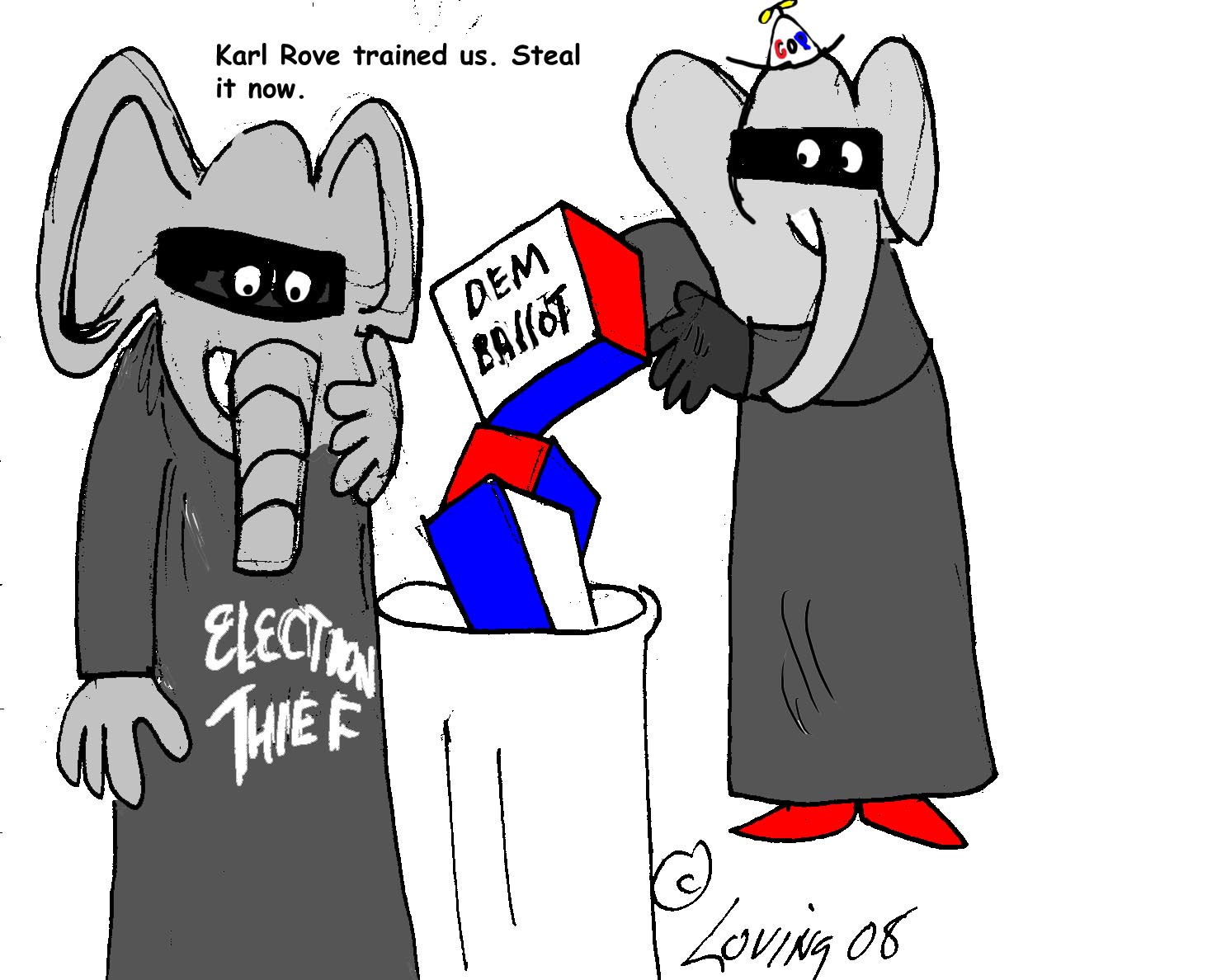
Thief of Hearts 2008

Cartoon by Charlie Loving / The Rag Blog

The Rag Blog

Posted in Rag Bloggers | Tagged , , , | 1 Comment

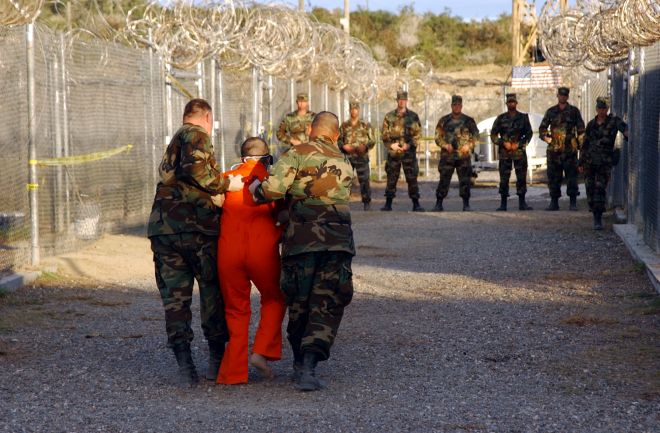
Guantanamo: A US Government Desperate Not to Accept Responsibility for Its Mistakes


More treachery at Guantanamo
By Andy Worthington / November 03, 2008

For many of the prisoners at Guantanamo, the forthcoming US presidential election holds little promise of change. Although both Barack Obama and John McCain have pledged to close Guantanamo, the problem for at least 50 of the 261 prisoners still held at the prison is not that the US government is unwilling to release them, but that there is nowhere for them to go.

These men are from countries including Algeria, China, Libya, Tunisian and Uzbekistan. Although they have been approved for release after multiple military review boards – some for at least three years – they cannot be repatriated because of international treaties preventing the return of foreign nationals to countries with poor human rights records, where they face the risk of torture. Attempts to find other countries willing to take them have also failed (with the exception of Albania, which accepted eight former prisoners in 2006), in part because, although they are approved for release, the government insists on maintaining that they are still “illegal enemy combatants.”

Generally ignored by the media, which focuses instead on the few prisoners chosen to face special “terror trials” (the Military Commissions), these men receive no special favors, in spite of their status, and are mostly held in conditions of strict solitary confinement for up to 23 hours a day.

Recently, however, some of these men have received extensive media coverage, Seventeen Uyghurs – Chinese Muslims who were sold to US forces after fleeing a settlement in Afghanistan where they had sought refuge from Chinese oppression – were allowed to present their case to a US court on October 7. The judge, Ricardo Urbina, ruled that their continued imprisonment was unconstitutional, and that, because no other country would take them, they should be rehoused in the United States.

This prompted a frantic appeal from the government, which is desperate not to accept responsibility for its mistakes by welcoming any former prisoners into the United States. The appeal was accepted, and arguments on both sides are scheduled to take place on November 24. If the appeals court upholds Judge Urbina’s ruling, this might bring an end to some of the other prisoners’ extensive legal limbo, but in the meantime the silence surrounding their predicament masks a darker truth, which has only just come to light.

Since June 2007, the administration has been stealthily attempting to repatriate various North African prisoners, under the cover of “diplomatic assurances” with the governments of Algeria, Libya and Tunisia. These are supposed to guarantee that, if returned, the prisoners will be given “humane treatment,” but as various human rights organizations have reported, the “diplomatic assurances” are worthless.

After two Tunisians were repatriated last June, the “diplomatic assurance” with the government of Zine al-Abidine Ben Ali melted away when the men faced show trials on trumped-up charges (extracted through the torture of other prisoners) and received jail sentences of three and seven years.

Fearing that other cleared prisoners would receive similar treatment, several lawyers sought help from the US courts to prevent their clients’ forcible return. A District Court blocked the return of a third Tunisian, and lawyers for at least two other prisoners petitioned to prevent their clients’ forced repatriation.

One was Abdul Rauf al-Qassim, a Libyan with an Afghan wife and a daughter he has never seen, and another was Ahmed Belbacha, an Algerian who had sought asylum in the UK in 1999. Belbacha, who was seized and sold by bounty hunters in Pakistan, had fled Algeria because he had been working for a government-controlled oil company and had been threatened by militants, but the British government refused to accept his return to the UK because he was kidnapped while his asylum claim was still pending. Terrified of being returned to Algeria, he told his lawyers that he would rather stay in Guantanamo, even though his cell was “like a grave.”

For most of this year, it appeared that the lawyers’ attempts to prevent their clients’ return to torture had been successful, but last month, during a visit with Cori Crider, staff attorney at the London-based legal action charity Reprieve, Ahmed Belbacha explained that in July he had been taken aside by a group of US soldiers who had ordered him to sign papers approving his release from Guantanamo. Knowing that a court had put a stay on his repatriation, Belbacha refused, but his lawyers did not hear about it until Crider’s latest visit with him last month.

Although lawyers for other prisoners are not at liberty to speak about similar cases (because their cases are sealed before the US courts), it appears that this was not an isolated case. The only conclusion that can be drawn is a bleak one: In an attempt to clear out unwanted prisoners from Guantanamo – and also, no doubt, to prevent them from seeking asylum in the United States if Judge Urbina’s ruling stands – the authorities at Guantanamo are deliberately undermining rulings made in courts on the US mainland to prevent the forced repatriation of vulnerable prisoners.

This is shocking, of course, but it is unsurprising given that those who established Guantanamo have consistently expressed disdain for the law, and have sought nothing less than unfettered executive power.

Andy Worthington is the author of “The Guantanamo Files: The Stories of the 774 Detainees in America’s Illegal Prison” (published by Pluto Press). Visit his website at: www.andyworthington.co.uk. He wrote this commentary for THE DAILY STAR.

Source / Daily Star Lebanon

The Rag Blog

Posted in RagBlog | Tagged , , | Leave a comment

Ernest McMillan and Stoney Burns : Dallas 60s Activists Revisited

The Rag Blog was inspired by an underground newspaper we published in the 1960s in Austin. We called it The Rag. When Carol Neiman and I were editing The Rag — and many more whose bylines you see here from time to time were also involved with that heady undertaking — we also worked with SDS and were totally immersed in the sixties New Left uprising, organizing against social injustice and the War in Vietnam.

At the same time, Stoney Burns was editing a fellow underground paper in Dallas and Ernest McMillan was a leader in the civil rights struggle there, working with the Student Nonviolent Coordinating Committee (SNCC). SNCC and SDS were fraternal organizations. And for those of us active in the movement in Texas — where we were the underdogs! — you can bet we were all brothers and sisters in the struggle.

You know where we are now. Here’s an update on Ernie McMillan and Stoney Burns.

Thorne Dreyer / The Rag Blog / November 4, 2008
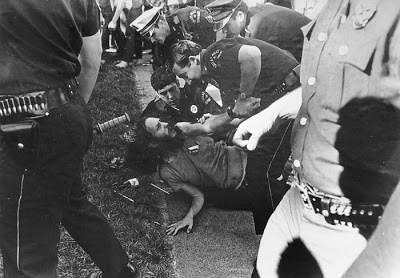
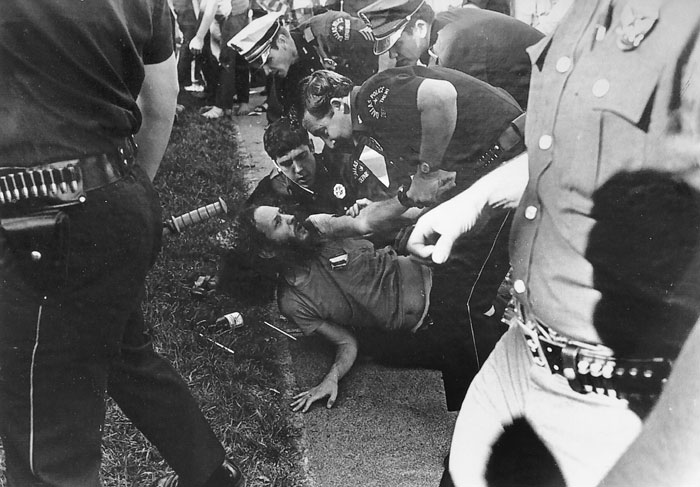
Brent Stein, aka ‘Stoney Burns,’ is arrested April 12, 1970 by Dallas Police officers at Lee Park. The Dallas Morning News at the time reported that ‘a clash between law officers and young people occurred when police tried to arrest several hippie-types’ at the park. DMN file photo.
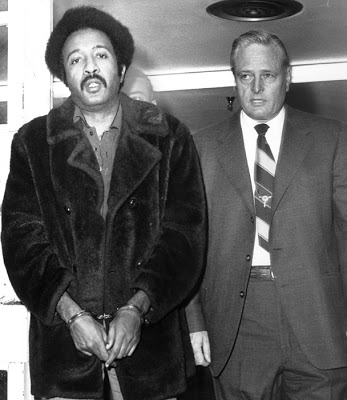
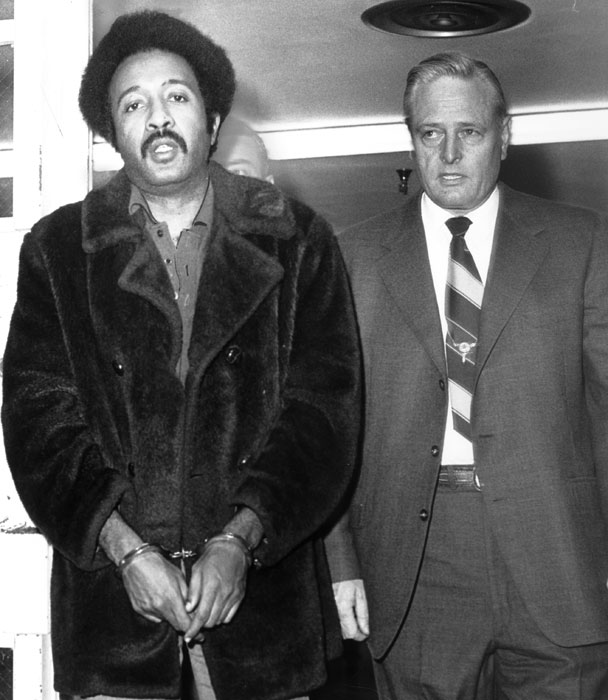
Ernest McMillan and a deputy U.S. Marshal leaving the Dallas County Jail in January 1972 for a federal hearing. McMillan was a leader of the civil rights movement in Dallas in the late 1960s. He received a 10-year prison sentence for his role in a disturbance at a South Dallas grocery store. Photo courtesy Dallas Public Library.

SNCC activist McMillan and underground newspaper editor Burns reflect on those days of turmoil and change.
By Roy Appleton

“Is this Stoney?” says the smiling man, crossing the threshold to hug his guest. “Hey, brother.”

“I bet you didn’t expect the gray,” says Stoney Burns.

“I got it too,” replies Ernest McMillan, leading the pony-tailed visitor into his East Dallas apartment and back to the past. Living now less than a mile apart, they hadn’t seen each other since those restless times. Not since the days of war in Vietnam, protests and assassinations, culture clashes and civil rights struggles, of Black Power, Flower Power and women’s liberation. When something not exactly clear was happening.

Tightly ruled, convention-numbed Dallas — still stung by the tragedy of Nov. 22, 1963 — was relatively tame for a big city in the 1960s. A vigilant police force helped see to that.

But as the peace and justice movements gained momentum elsewhere, they found voices here as well.

As in young Ernie McMillan, passionate foe of prejudice and war. And Stoney Burns, one playfully aggressive, seriously stimulated newspaper editor.

On separate paths, they would rouse and rattle in ways their hometown had never seen.

“Dallas was just outraged by Stoney,” said David Richards, one of his attorneys. “He represented everything they perceived to be evil.”

While Mr. McMillan set a tempo for activism to come.

“We owe a priceless debt to him,” said the Rev. Zan Holmes, a longtime Dallas pastor and social activist. “He stood up and spoke up. He called attention to the problems and became our inspiration.”

Cutting the head off the beast

“Seems like there was a lot more life. This is depressing,” says Mr. McMillan, soaking up some South Dallas sights and sounds near Martin Luther King and Malcolm X boulevards.

He has returned to a center of the action back when he led the local front of the national Student Nonviolent Coordinating Committee.

“We’ve got Freedom Fashions, not freedom and justice,” he says, driving through a land long waiting to bloom.

He sees stability along Meadow Street and fondly remembers Dr. Charles Hunter and his Hope Presbyterian Church, home now to a service agency for girls.

“We had a lot of mass meetings, community meetings here.”

Blocks away, at the corner of Pine and Malcolm X, he parks outside an abandoned building, long-ago home of an OK Supermarket.

“Looks a lot smaller than it did then,” he chuckles, standing near a rotting overhang. “Man, I don’t remember this.”

He talks of his group’s protests and boycott of the white-owned grocery chain, says it stocked inferior products at bloated prices.

“We would have people marching around the building with signs,” he says. “People would get off the bus and join us.”

He doesn’t talk much about the night of July 1, 1968, when he and an associate, Matthew Johnson, led a group into the store and left behind $211 worth of destruction. “We just went in to send them a message,” he says.

In less than two months, the two young African-Americans were arrested, tried and dealt 10-year prison terms by an all-white jury. The charge: Destroying private property worth more than $50.

The store owner’s son testified he saw Mr. McMillan drop a gallon bottle of milk and Mr. Johnson smash bottles of grape juice and a watermelon. Jurors heard a defense attorney liken them to the American patriots who dumped English tea in Boston harbor.

“They were making a political statement,” said attorney Vincent Perini, recently explaining his analogy. “They were standing up for the folks in South Dallas.”

Jurors also heard a prosecutor call the pair “revolutionists” helping rush civilization “to hell at a hundred miles an hour.”

The rush was on Mr. McMillan, said Don Stafford, a retired Dallas assistant police chief, at the time a police lieutenant in South Dallas. “He was a thorn in their side, and they needed to get rid of him.”

And they did, says Dr. Hunter, visitation pastor at Oak Cliff Presbyterian Church. “They were cutting the head off what they thought was the beast.”

Going against the grain

For the budding Ernest McMillan, a 1963 honors graduate of Dallas’ Booker T. Washington High School, war and racism were beasts.

After withdrawing from Morehouse College in Atlanta, he registered voters and demonstrated in the South before bringing his passion and training back to North Texas in 1965.

After briefly enrolling and protesting at Arlington State College (now the University of Texas at Arlington), he established a Dallas chapter of SNCC, then growing more militant.

“It was the way I was raised, to not abide injustice, to not be quiet in the face of wrongdoing,” said the son of a family steeped in ministry, medicine and teaching, reared near the Dallas Freedman’s Cemetery.

The SNCC cadre was hardly the first or last to oppose racism and discrimination in Dallas. The Progressive Voters League began organizing black voters in the 1930s. Protesters challenged segregation at the State Fair of Texas in 1955. Freedom rallies in 1961 called for boycotts of department stores and movie theaters.

Demonstrators picketed the whites-only Piccadilly Cafeteria in 1964 and marched for civil rights in 1965. It took a lawsuit and the courts to establish the current city election system. The fight for Dallas school desegregation lasted almost 50 years.

The efforts and influence of Felton Alexander, Juanita Craft, Richard Dockery, Kathlyn Gilliam, Elsie Faye Heggins, J.B. Jackson Jr., Al Lipscomb, Maceo Smith and the Revs. Peter Johnson and S.M. Wright and other local African-Americans have long been recognized.

The Revs. Wilfred Bailey, Mark Herbener, William McElvaney and Rabbi Levi Olan were among local clergy working for peace and equality in the Sixties and later, while attorneys Ed Polk, Frank Hernandez, Fred Time, Mr. Perini and Mr. Richards have been leading defenders of civil rights.

But few local black leaders had a radical, confrontational — edge in the late Sixties, Dr. Hunter and others say.

“There was definitely a sense that you stay in your place. You’ve got yours,” he said.

That wasn’t a concern for Mr. McMillan and his group of 30 or so. He, Matthew Johnson, Edward Harris, Michael Dodd, Fred Bell and the others would organize, mobilize and speak out with a fervor jolting to some. Beholden to none.

And working outside the system, they drew the system’s attention.

Mr. McMillan tells of traffic stops and searches. He smiles about the police officer seen going through his trash, and the one found eavesdropping in his back yard.

“They were trying to disrupt us, keep us off balance,” he said, recalling how his guys joined in, following officers and recording their actions.

The young agitators were hassled “no doubt about it,” said Mr. Stafford, the former police officer. “If you were against the establishment you were going to get harassed.”

No, police just tried to “keep the peace” and contain troublemakers during and after the SNCC years, said Paul McCaghren, a patrol captain in 1968 and later the department’s intelligence director.

“We didn’t want any problems, and we were really sensitive because of President Kennedy being assassinated” here, he said.

But some officers weren’t sensitive enough, Mr. McCaghren said. “Could we have done a better job? Oh, yeah,” he said. “We were reverting to the old police theory that fear is the best deterrent you have against violence. So we weren’t using dialogue and we made a lot of mistakes.”

In time Mr. McMillan was gone and his group fractured. Three weeks after his grocery conviction, he was indicted for draft evasion. Authorities said he refused to take an induction oath, an allegation he denies.

“I was cursing, belligerent, all this stuff. A lieutenant pulled me out of the line, said look now we’re going to let you go home, cool off. We’ll send you another [induction] letter.”

Freed after posting bond, he traveled to Connecticut in June 1969 to address a church group. While there his attorney told him he could be arrested for leaving North Texas. He fled, was captured in Cincinnati in late 1971, returned to Dallas and sentenced to three years in federal prison after pleading guilty to violating terms of his release.

Before his sentencing, and until stopped by the judge, Mr. McMillan read part of a statement in court, saying the draft charge “reflected … the systematic attempt to remove me, by any means necessary, from the political activities” of his group.

The draft charge was dismissed. An appeal of the supermarket case was rejected. And he spent three years and two weeks behind bars.

An era of tension and change

Dallas didn’t have the riots, destructive firebombings and mass arrests. Not even a tank in the streets. Still, the late Sixties was an eventful time in the city.

Residents in 1968 began loosening the business community’s grip at City Hall. The Dallas Citizens Council had selected and successfully backed City Council candidates for years. But voters changed the city charter, adding two new council seats. Months later George Allen would fill one of them, representing South Dallas, as the council’s first elected African-American.

In 1968, marchers in South Dallas, including Mr. McMillan, supported the Rev. Martin Luther King’s Poor People’s Campaign. Downtown, Ruth Jefferson, Mr. McMillan and other and protesters occupied the state welfare office demanding better benefits; others picketed the selective service center.

Dallas police opened neighborhood police centers to promote racial harmony, and the city’s Block Partnership program began connecting poor families and churches. A human relations commission would convene in 1969.

Groups such as the Dallas Committee for a Peaceful Solution in Vietnam, sponsor of Saturday vigils at Dealey Plaza, kept speaking out against the war.

“It was pretty heady stuff. We were trying to save the country,” the late Ken Gjemre, an organizer of the vigils, said in a 1999 interview.

City leaders and police braced for rioting after Dr. King’s assassination on April 4, 1968.

“We were expecting trouble. We had a lot of people on the street, and we didn’t want them to get a jump,” Mr. McCaghren recalled.

He had an officer keep a log of police activity during those times. It tells of heightened alerts throughout the city, anonymous calls about suspicious behavior and unfounded threats to bomb Love Field and city hall. It also reports that two lighted beer bottles with kerosene were thrown at a white-owned convenience store in South Dallas: “One started a small fire. … Both fell about 20 feet short of the building.”

Four months after the assassination, the City Council gave the mayor authority to impose curfews and other actions against civil disturbances, a move denounced by ministers and black leaders.

With the city preparing for mass detentions, the Dallas Bar Association asked members to help with any legal proceedings, recalled Vincent Perini, who said he offered his services.

“They wanted people to serve as prosecutors, defense attorneys, judges,” he said. “It was going to be a sort of makeshift tribunal. It was a wild time.”

Concerned about decorum downtown, the City Council in 1967 restricted gatherings at Stone Place, the walkway between Main and Elm streets — now home to mostly restaurants, then a hangout for street preachers and those hippie types.

So the peace people and others began gathering at Lee Park, near the counter-culture’s Oak Lawn center of gravity, for music, rallies, the high life and perhaps a dip in Turtle Creek.

Their looks and outlooks drew scorn from the mainstream, including the city’s two daily newspapers’ editorial pages. Their “pot parties” and illicit economy made news. As in this January 1968 report in The Dallas Morning News:

“Police raided a hippie pad in North Dallas shortly before midnight Saturday, rounded up 13 booted and unbarbered boys and girls,” and “enough marijuana to make 140 cigarettes worth $1 apiece.”

Other stories told of stiff prison sentences for drug convictions, such as a Dallas man’s 50-year term for selling $3 worth of marijuana.

And the News tried to help readers with a series of articles – Drug Peril in Big D – “outlining the problem in all its startling aspects.”

Dallas Notes

“Free Ernie.” A poster in Ernest McMillan’s apartment delivers those words with a drawing of his smiling, bearded face.

“I believe I took the photograph that this was taken from,” says Stoney Burns, eyeing the memento, as the reunion takes another turn.

He also splashed the drawing across the cover of Dallas Notes, for his newspaper’s Sept. 18, 1968, issue. An accompanying story, headlined SNCC Members Shafted, told of the OK Supermarket convictions.

It wasn’t the first or last article about Ernest McMillan or courtrooms to appear in what would bring Mr. Burns local celebrity and notoriety.

Launched in March 1967 to “tell the truth” about Southern Methodist University, Notes from the Underground — first produced on a Texas Instruments copy machine — would mushroom into Dallas Notes. And for almost four years, the biweekly paper’s alternative news services and ever-evolving staff would tear into those swirling times with a clear bias against war, intolerance and hypocrisy.

“Notes is the boss, the only fearless, wide awake, red-hot newspaper in town,” crowed an early advertisement for a publication that would peak with street sales of about 12,000 copies per issue.

The paper’s anti-war stories included “profit and loss” statements listing area companies’ war contracts and names of the local dead. Its reports on politics and dissent often had an editorial ring. “Elections Don’t Mean [expletive],” headlined an elections issue. “Our Power is in the Streets.”

Notes tried to mobilize its readers, calling in early 1968 for the boycott of an Oak Lawn Avenue waffle shop. People “with long hair, beads, boots, flowers, beards, etc.” weren’t being served, the paper reported, urging readers to “mark the date on your calendar: Flower Power can work in Dallas.”

The paper covered the area music scene and printed reviews, letters, cartoons, short stories and poetry. It kept tabs on the local drug trade, from arrests to user-friendly how-to’s.

And with a spicing of four-letter words and porcine portrayals, it wrote about the men in blue. Such as those who showed up at Stone Place on May 20, 1967:

“Over a hundred Dallas hippies tried to have a love-in last Saturday,” Mr. Burns wrote in his first bylined story. “Unfortunately, about twenty paranoid cops had a hate-in and, baby, they had the guns.”

That article “plunged Dallas into the sixties,” wrote James McEnteer in his book Fighting Words, Independent Journalists in Texas.

A graduate of Hillcrest High School and the University of Arizona, Mr. Burns – then known by his given name, Brent Stein – joined the newspaper while working for his father’s Dallas printing company and advising an SMU fraternity.

Introductions to marijuana and LSD had engaged him. He offered to help editors Doug Baker and Nancy Lynne Brown with their graphics. And while photographing a peace vigil at Dealey Plaza, the obscene taunts of American Nazi Party members moved him.

“I didn’t like seeing people abused like that,” he recalled, wiping a watery eye. “I definitely wasn’t an activist until then. But that was the breaking point.”

He wrote for the paper as Stoney Burns, the name he goes by today. “I had a straight job and didn’t want my customers to know,” he said.

His battles with police began when he was removed from downtown for selling the paper. SMU banned it in October 1967. He became editor two months later. And as Notes turned up the heat, so did authorities.

An October 1968 cover story about Dallas’ pornographic movie industry featured a photograph with bared female breasts.

Twice the next month, police raided Mr. Burns’ communal home and Notes office at 3117 Liveoak St., arresting him and others there, while hauling away newspapers, typewriters, cameras, telephones — everything used to produce the paper. With rented equipment, the staff kept publishing.

“That was the ploy used to shut down his newspaper,” said lawyer David Richards, who sued the police chief and others on Mr. Burns’ behalf.

Federal judges in Dallas decided the state obscenity law being used against the newspaper was unconstitutional. On appeal, the U.S. Supreme Court ruled federal courts had no place in the dispute. But by then the obscenity law had been rewritten and the charges against Mr. Burns dismissed.

“We had a great day, sitting on his porch, watching these angry police officers having to return his stuff,” Mr. Richards said.

Court orders later targeted two other supposedly obscene issues — after they had been widely circulated. One featured the frontal photo of a nude male at a Dallas parade of miniskirted women. A particular cartoon aroused some outrage as well.

“We got a lot of mileage out of that. It was fun,” said Mr. Burns, telling of the time television cameras documented officers ripping the cartoon from papers. Its most explicit panel dominated the next issue’s cover, but with numbered dots in place of lines and an invited headline: “Hey Kids! Just connect the dots and you too can be arrested.”

Mr. Burns was among those arrested at what Notes dubbed the Lee Park Massacre, a melee involving police and “hundreds of boisterous youngsters and hippies” (as The Dallas Morning News put it) on April 12, 1970.

Witnesses say a crackdown on swimmers in Turtle Creek started the ruckus, and officers blamed Mr. Burns for inflaming passions with obscenities and police death calls, a charge he did and does deny. “Too bad they didn’t kill you,” a prosecutor reportedly told him in court before his conviction for “interfering with a peace officer.” Sentenced to three years in prison, he was cleared on appeal.

Mr. Burns quit the paper in September 1970. It would fold early the next year. “There was too much pressure — my court date, making payroll,” he recalled. “I had to get rid of it.”

Months later, he was art director of another Dallas underground paper, the Iconoclast, and soon back in trouble, for helping photograph an undercover narcotics officer outside a Dallas courtroom. He received six months in jail for contempt of court but again was cleared on appeal.

He ran for Dallas County sheriff in 1972, leaving the race after being busted with marijuana. A jury gave him 10 years and, at prosecutors’ request, one day in prison for the almost one-tenth ounce of pot police found after stopping his van. That extra day made him ineligible for probation, but after changes in state law made possession of small amounts of marijuana a misdemeanor, his sentence was commuted.

Mr. Burns served 19 days and was freed in December 1974 — in the same week as Ernest McMillan.
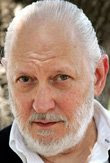
Stoney Burns today.
Just the messenger

Mr. Burns returned to the print shop and his music magazine Buddy, ditching the dissent, but not his humor. He sold the magazine years ago, but now publishes a business advertising booklet.

Never married, 65 and Medicare-free, he lives in a house near Lower Greenville Avenue, where his days include music (mostly bluegrass), some television and friends. The wild curly black hair of youth is now a silvery gray, the once-scraggly beard trim and white. His underwear-only Frederick’s of Hollywood parties are long gone, but he will hit a bar or concert or (as Notes would hail it) “that harmless, non-addictive herb known as marijuana.”

“When I do I always say, ‘Why don’t I do this more often,’” he says with a smirk over a soft drink at a neighborhood dive.

Mr. Burns says he hasn’t cast a ballot since weighing in for Lyndon Johnson in 1964 and won’t break his streak this year. He attended an anti-war rally in Dallas before the Iraq invasion, but has no interest in firing up the outrage — or even messing with police.

“I just can’t do what I could then. It’s just too much trouble,” he says.

Still, he offers up remembrances from the days when he was, like it or not, the face of the local hippies.

“Stoney was a quiet, mild Jewish guy,” said Fred Time, his lawyer in the Lee Park case, who employed him for a spell as an investigator. “He had this underground paper and somebody labeled him king of the hippies. He was just a pot-smoking young guy trying to find a niche.”

Back then the rush of change and sense of possibility liberated some, threatened others.

Notes tried to inform and energize the young, “get Dallas to loosen up” and have a good time in the process, the editor says.

And to those ends, the effort was an unregrettable success, he says, shrugging off his part in it all.

“I was young and dumb and thought I was bulletproof,” he says. “But I wasn’t that much different from a lot of people in the movement. I was just the messenger.”

Still, “it was fun to see the straights freak out,” he said during a return visit to the SMU campus, where he recalled being routed by police for selling newspapers. “They said I was inciting to litter.”

Room for improvement
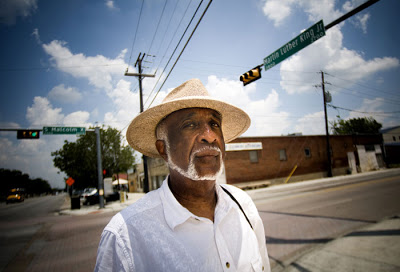
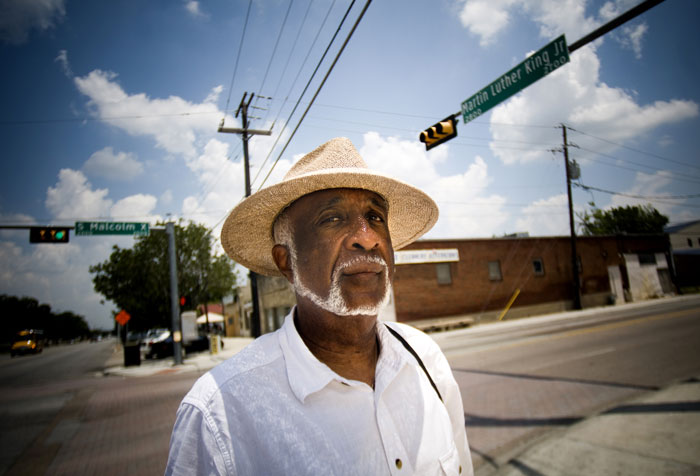
Ernest McMillan, a leader of the civil rights movement in Dallas in the late 1960s, stands at the corner of Malcolm X Blvd. and Martin Luther King Jr. Blvd. Photo by Brandon Thibodeaux / Special to DMN

After prison, Ernest McMillan became an aide to then-state, now U.S. Rep. Eddie Bernice Johnson. He organized a prison-justice project before moving to Houston, where he founded a program to empower young inner-city males.

Back in Dallas, the 64-year-old grandfather remains an adviser to the Houston program. He volunteers at his church, Munger Place United Methodist, the Dallas Peace Center and with Pastors for Peace, among other gifts of time.

“I’m still evolving, trying to aim my arrow at the mark,” he says during a morning break.

He is not bitter about his clashes with the law. And he gives his SNCC days an OK — not a KO.

“We turned on some switches and lights, got some people off their butts and into voting booths and off their knees praying and into the city hall chambers, fighting for justice,” he said. “I’m not regretting it, and I’m not beating my chest about it.”

He and his group deserve credit, said Ms. Johnson.

“Those young people had the nerve to talk about it publicly.” And by bringing “attention to the inequities” facing local blacks, she said, “open access came much smoother than it might have.”

Despite “some positives,” much work remains in South Dallas, she said. “When you come home you don’t see a whole lot of changes. It’s depressing to see that as we move in, often the quality moves out,” she said.

Mr. McMillan barely recognizes the neighborhood of his youth, now Dallas’ upscale Uptown. He sees some advances in southern Dallas, but much room for improvement.

African-American families and neighborhoods are more fragmented, he said, but “there’s been no fundamental change from when I was around in 1968.”

What’s needed are organizations that “can sustain themselves and carry on the struggle” — groups always drawing in youth, he says.

“I want young people to know they have tremendous power, tremendous energy, tremendous resources within them, and they just have to flip the switch on and use it.”

Source / Dallas Morning News / Posted Oct. 25, 2008

The Rag Blog

Posted in Rag Bloggers | Tagged , , , , , , , , , , , , , | 3 Comments

Obama, and Our Sixties Dreams of Peace


‘While we will never realize the utopian dreams of our youth, the imminent election of Barack Obama is likely to serve as a catalyst that will lead to an impressive series of reforms…’
By Ken Brociner / November 2, 2008

I have been doing a lot of soul searching as this momentous election has drawn closer. Of all the hopes and fears that have passed through my mind, one of the most powerful has been the sense that that the clock is winding down for my generation — the “‘60s generation.”

By the time you reach late middle age, facing your own mortality is nothing new. But what has been gnawing at me in recent months is how loudly the clock is now ticking for my generation in a political sense.

I’ve long since let go of my youthful dreams of creating a world of peace, love and harmony based on social and political egalitarianism. Like many people who came of age in the 1960s or early 1970s, I now understand I once believed in the unattainable—a completely unrealistic variant of utopianism.

For some of us, this wildly romantic vision of the future came from reading Marx or Marcuse. For others, it came while marching and chanting in unison with hundreds of thousands of our contemporaries in the national movements to achieve civil rights for all Americans or to end the slaughter in Vietnam.

Since that time, the seemingly never-ending cycle of cruelties, crimes and tragedies in the United States and elsewhere has sadly convinced me that human nature is just too much of a mixed picture to provide the building blocks for the kind of a world that so many from my generation once thought was possible. Nonetheless, I still absolutely believe that if enough people work together, we can make the world a far better place than it is today.

But will my generation live to see the day when America at least comes close to living up to its great promise? Will we live long enough to see the day that social justice—in the United States and the rest of the world—becomes more the norm rather than the exception it is today?

Yes, the clock is winding down on the “‘60s generation.” But it hasn’t run out yet. While we will never realize the utopian dreams of our youth, the imminent election of Barack Obama is likely to serve as a catalyst that will lead to an impressive series of reforms during the next (hopefully) eight years – and beyond.

With Obama in the White House and the Democrats firmly in control of the Congress, the United States can become a key part of the solution to the global warming crisis – rather than the major obstacle it has been these last eight years.

As president, Obama will finally begin the process of ending U.S. involvement in Iraq, while placing a much greater emphasis on multilateral diplomacy than the Bush administration ever did.

On the issue of world poverty, Obama has pledged to help lead the struggle to achieve the UN’s Millennium Development Goal of ending extreme poverty by the year 2015.

On the economic front, Obama seems quite serious about placing meaningful regulations on Wall Street in order to help get us out of the current mess as and prevent similar meltdowns in the future. And his stress on revitalizing the economy by creating millions of good-paying new jobs while converting the U.S. to an environmentally sustainable society is a breath of fresh air after eight years of being ripped off by the oil industry and their pals in the Bush administration.

Obama is also strongly committed to enacting universal health care as well as to passing the labor-backed Employee Free Choice Act. The E.F.C.A. would provide important new protections for workers who might otherwise be fired for organizing, while also facilitating the formation of local unions. As the labor movement continually points out, the single most important factor in determining whether or not a worker is being paid a living wage is whether or not they belong to a labor union.

On so-called social issues, Obama’s election will almost certainly lead to America becoming a more decent and fair society by ensuring equal rights for women, African Americans, Latinos and gay people.

But in a curious and ironic way, these last few days of the presidential campaign have also served to highlight the limits of what we can expect from an Obama presidency. Obama’s off-hand remark to the now legendary “Joe the Plumber” about the need to “spread the wealth around” was music to the ears of every progressive and fair-minded person in the country. Or at least it should have been.

However, the Obama campaign’s explanation of what the senator meant by that comment makes it clear that he is only talking about an extremely mild form of economic redistribution.

And this is where we come in. In a world of such obscene wealth, misery and inequality, the progressive movement needs to support Obama’s agenda against the resistance it will face from big business and their allies in the Republican Party. At the same time, we need to push him to take bolder steps to tackle economic injustice than his program now calls for.

But we also need to significantly expand the reach of the progressive movement so that in 2016, we can help elect a president who really might be what the McCain campaign has falsely charged Obama of being – “the Redistributionist in Chief.”

While the sixties generation will never see “the revolution” that so many of us once felt was practically around the corner, Americans of all generations are about to enter an era that almost no one thought possible just a few short years ago.

It’s now up to all of us to make the most of this historic opportunity–both between now and Election Night, and then in the weeks, months and years that lie ahead.

[Ken Brociner’s essays and book reviews have appeared in Dissent, In These Times and Israel Horizons. He also has a biweekly column in the Somerville (Mass.) Journal.]

Source / In These Times

Thanks to Carl Davidson / The Rag Blog

Posted in RagBlog | Tagged , , , , , | Leave a comment

Austin : 20 Men Exonerated by DNA call for Death Penalty Moratorium

Former Florida death row inmate Juan Melendez, left, greets former Texas death row inmate Clarence Brandley at a news conference Friday, Oct. 31, in Austin. Photo by Rudolfo gonzalez / Austin American-Statesman.

‘The exonerated men, members of Witness to Innocence, want Texas to create a commission to search for wrongful convictions.’
By Grits for Breakfast / November 3, 2008

Twenty men exonerated by DNA evidence all gathered in Austin on Friday to call for a moratorium on Texas’ death penalty in light of the state’s recent slew of long-time inmates proven innocent by applying modern forensics to old evidence, including most recently the exoneration by DNA of Michael Blair who’d been sitting on Texas’ death row. Reported the Austin American-Statesman:

The exonerated men, members of Witness to Innocence, a Philadelphia-based organization that is holding its annual meeting in Austin, want Texas to create a commission to search for wrongful convictions. And while the commission works, they want a moratorium on executions in the busiest death penalty state — with 419 executions since 1982 and six more scheduled this month. …

Sam Millsap, former Bexar County district attorney, said he slowly came to believe that the death penalty must be abolished because of the growing number of exonerated death row inmates — 130 since 1973, including nine in Texas, according to the Death Penalty Information Center. “I am no longer convinced that our courts will in fact guarantee the protection of the innocent,” Millsap said.

Millsap said he has taken responsibility for the 1993 execution of Ruben Cantu , a San Antonio man who Millsap said might have been innocent of a 1984 murder. The conviction was based on one eyewitness who later recanted, and no physical evidence tied Cantu to the crime, he said. “My decision to seek the death penalty was a mistake.”

The most recent Texas exoneration was in September , when a Collin County court dismissed the capital murder case against Michael Blair , sentenced to die for the 1993 murder of 7-year-old Ashley Estell.

However, the reporter (perhaps rightly) warned the exonerees:

any bill to halt executions stands no chance of passing the Texas Legislature, [Austin state Representative Elliott] Naishtat said. Capital punishment has substantial support in Texas. The 2007 Texas Crime Poll by Sam Houston State University found 74 percent of Texans support the death penalty. And 66 percent said they were confident that innocent people are protected from execution.

Research underlying DNA forensics began in Houston

The Houston Chronicle published a story commemorating the 20th anniversary of a Harris County case that launched the international boom in the use of DNA in forensic science and interviewing Dr. Tom Caskey, whose patents on the early technology still fund research positions at the Baylor College of Medicine:

“Don’t ever say crime doesn’t pay. Crime does pay,” quipped Caskey, who now directs the Brown Foundation Institute of Molecular Medicine for the Prevention of Human Diseases, a part of the University of Texas Health Science Center at Houston.

Caskey’s early work on a Houston homicide case became the foundation for today’s national network of criminal DNA sampling, reported the Chronicle’s Eric Berger:

Caskey’s primary scientific interest at the time involved the identification of genes linked to human disease. But, during the course of his research, he identified short segments of DNA — called short tandem repeats, or STRs — that vary widely from person to person.

His lab developed an STR identification technique that soon became the gold standard for criminal cases.

The method underlies the U.S. Combined DNA Index System, or CODIS, which contains DNA information on more than 6 million offenders. The system also forms the basis of Interpol’s criminal database and that of most governments.

A constitutional right to DNA testing?

The US Supreme Court will soon decide whether a federal right exists to have DNA evidence tested that could prove a long-ago convicted defendant’s innocence, even if he confessed to the crime:

William Osborne was accused of raping a prostitute at gunpoint, beating her with an ax handle and leaving her for dead in the snow. His lawyer declined a DNA test of the evidence, thinking that it would confirm his guilt.

Osborne was convicted, spent more than a decade in prison and gave a detailed confession to a parole board. But after recanting that confession, the Alaska man won a federal lawsuit seeking new DNA tests that he now says can clear him, a judgment that was affirmed by the U.S. Court of Appeals for the 9th Circuit. It is the first time an appellate court has ruled that an inmate has a federal constitutional right to such testing.

Now, the Supreme Court is being asked to evaluate that ruling in a case that pits the administration of Alaska Gov. Sarah Palin, the Republican vice presidential nominee, against a Republican-appointed judge who accuses her state attorney general of being “obstinate” in blocking Osborne from getting to test the evidence used to convict him. The high court debated Alaska’s request to take the case in a private conference on Friday and could announce its decision as early as today.

Touch DNA evidence could overwhelm crime labs

Finally, if you’re not yet familiar with the concept of “touch DNA,” be sure to check out this piece from the back pages of Scientific American which answers the question:

So what’s touch DNA?

The touch DNA method—named for the fact that it analyzes skin cells left behind when assailants touch victims, weapons or something else at a crime scene—has been around for the last five years. In fact, the prosecutor in the Ramsey case, Boulder County District Attorney Mary Lacy, learned about touch DNA when she attended a course here at the West Virginia University Forensic Science Initiative in the summer of 2007.

The technique has dramatically increased the number of items of evidence that can be used for DNA detection. In the 1980s, in order to perform DNA analysis on a crime scene or victim, forensic investigators needed a blood or semen stain about the size of a quarter. The sample size fell in the 1990s to the size of a dime and then became: “If you can see it, you can analyze it.”

Touch DNA doesn’t require you to see anything, or any blood or semen at all. It only requires seven or eight cells from the outermost layer of our skin.

Here’s how it works: Investigators recover cells from the scene, then use a process called polymerase chain reaction (PCR) to make lots of copies of the genes. Next, scientists mix in fluorescent compounds that attach themselves to 13 specific locations on the DNA and give a highly specific genetic portrait of that person. The whole process takes a few days, and forensic labs are often backed up analyzing data from other cases.

These cautionary asides about touch DNA, backed up labs and evidence retention problems echo concerns voiced recently to the Court of Criminal Appeals “Criminal Justice Integrity Unit that:

The advent of “touch DNA” … threatened to overwhelm agencies’ storage capacity. Potentially lots of new items could be stored for touch-DNA testing, even though labs already have tremendous backlogs. That means long lag times during which the evidence must be securely stored despite limited space.

Texas’ DNA labs right now are backed up and understaffed, but the trend will be for their caseloads to dramatically expand in the near term as these techniques become more widely used (especially considering the range of possible uses to which it could be subjected). For these reasons, ironically, demand for DNA lab services will inevitably increase regardless of whether crime rates go up or down.

Forensic science errors and the introduction of junk science as evidence are responsible for up to a quarter of false convictions among Texas DNA exonerees. The focus on DNA forensics in Texas has been to bring existing labs up to snuff quality-wise, but nobody’s planning pro-actively, to my knowledge, how the state will make the labs independent, much less eliminate current backlogs, or meet the inevitable, expanded future demand for forensic capacity.

The advent of touch DNA is an amazing and wonderful thing evidence-wise, but it exacerbates an already problematic situation with regard to lab backlogs and DNA-related forensic errors.

Source / Grits for Breakfast

The Rag Blog

Posted in RagBlog | Tagged , , , , , , , , , | Leave a comment