Oaxaca : Indigenous People Saying ‘NO’ to Migration

The FIOB is a political organization of indigenous communities and migrants, with chapters in Mexico and the U.S. It advocates for the rights of migrants, and for the right not to migrate — for economic development which would enable people to stay home. Indigenous Triqui women prepare meat and their traditional large tortillas. Photo by David Bacon.

The Right to Stay Home
By David Bacon / July 14, 2008

JUXTLAHUACA, Oaxaca, Mexico — For almost half a century, migration has been the main fact of social life in hundreds of indigenous towns spread through the hills of Oaxaca, one of Mexico’s poorest states. That’s made the conditions and rights of migrants central concerns for communities like Santiago de Juxtlahuaca.

Today, the right to travel to seek work is a matter of survival. But this June, in Juxtlahuaca, in the heart of Oaxaca’s Mixteca region, dozens of farmers left their fields, and women weavers their looms, to talk about another right: the right to stay home.

In the town’s community center, two hundred Mixtec, Zapotec and Triqui farmers, and a handful of their relatives working in the US, made impassioned speeches asserting this right at the triannual assembly of the Indigenous Front of Binational Organizations (FIOB). Hot debates ended in numerous votes. The voices of mothers and fathers arguing over the future of their children echoed from the cinder block walls of the cavernous hall.

In Spanish, Mixteco and Triqui, people repeated one phrase over and over: the derecho de no migrar – the right to not migrate. Asserting this right challenges not just inequality and exploitation facing migrants, but the very reasons people have to migrate to begin with. Indigenous communities are pointing to the need for social change.

About 500,000 indigenous people from Oaxaca live in the US, 300,000 in California alone, according to Rufino Dominguez, one of FIOB’s founders. These men and women come from communities whose economies are totally dependent on migration. The ability to send a son or daughter across the border to the north, to work and send back money, makes the difference between eating chicken or eating salt and tortillas. Migration means not having to manhandle a wooden plow behind an ox, cutting furrows in dry soil for a corn crop that can’t be sold for what it cost to plant it. It means dollars arrive in the mail when kids need shoes to go to school or when a grandparent needs a doctor.

In Oaxaca, the category of extreme poverty encompasses 75 percent of its 3.4 million residents, according to EDUCA, an education and development organization. For more than two decades, under pressure from the World Bank and US loan conditions, the Mexican government has cut spending intended to raise rural incomes. Prices have risen dramatically since price controls and subsidies were eliminated for necessities like gasoline, electricity, bus fares, tortillas and milk.

Raquel Cruz Manzano, principal of the Formal Primary School in San Pablo Macuiltianguis, a town in the indigenous Zapotec region, says only 900,000 Oaxacans receive organized health care, and the illiteracy rate is 21.8 percent. “The educational level in Oaxaca is 5.8 years,” Cruz notes, “against a national average of 7.3 years. The average monthly wage for non-governmental employees is less than 2,000 pesos [about $200] per family [per month], the lowest in the nation. Around 75,000 children have to work in order to survive or to help their families.”

“But there are no jobs here, and NAFTA [the North American Free Trade Agreement] made the price of corn so low that it’s not economically possible to plant a crop anymore,” Dominguez asserts. “We come to the US to work because we can’t get a price for our product at home. There’s no alternative.”

Without large-scale political change, most local communities won’t have the resources for productive projects and economic development that could provide a decent living. Towns like Juxtlahuaca don’t even have wastewater treatment. Rural communities rely on the same rivers for drinking water that are also used to carry away sewage. “A typical teacher earns about 2,200 pesos every two weeks [about $220],” says Jaime Medina, a reporter for Oaxaca’s daily Noticias. “From that they have to purchase chalk, pencils, and other school supplies for the children.”

Because of its indigenous membership, FIOB campaigns for the rights of migrants in the US who come from those communities. It calls for immigration amnesty and legalization for undocumented migrants. FIOB has also condemned the proposals for guest-worker programs. Migrants need the right to work, but “these workers don’t have labor rights or benefits,” Dominguez charges. “It’s like slavery.”

At the same time, “we need development that makes migration a choice rather than a necessity – the right to not migrate,” explains Gaspar Rivera-Salgado, a professor at UCLA. “Both rights are part of the same solution. We have to change the debate from one in which immigration is presented as a problem to a debate over rights. The real problem is exploitation.” But the right to stay home, to not migrate, has to mean more than the right to be poor, the right to go hungry and homeless. Choosing whether to stay home or leave only has meaning if each choice can provide a meaningful future.

In Juxtlahuaca, Rivera-Salgado was elected FIOB’s new binational coordinator. His father and mother still live on a ranch half an hour up a dirt road from the main highway, in the tiny town of Santa Cruz Rancho Viejo. There, his father Sidronio planted 300 avocado trees a few years ago, in the hope that someday their fruit would take the place of the corn and beans that were once his staple crop. He’s fortunate – his relatives have water, and a pipe from their spring has kept most of his trees, and those hopes, alive. Fernando, Gaspar’s brother, has started growing mushrooms in a FIOB-sponsored project, and even put up a greenhouse for tomatoes. Those projects, they hope, will produce enough money that Fernando won’t have to go back to Seattle, where he worked for seven years.

This family, perhaps, has come close to achieving the derecho de no migrar. For the millions of farmers throughout the indigenous countryside, not migrating means doing something like it. But finding the necessary resources, even for a small number of families and communities, presents FIOB with its biggest challenge. This was the source of the debate at its Juxtlahuaca assembly.

Rivera-Salgado says, “we will find the answer to migration in our communities of origin. To make the right to not migrate concrete, we need to organize the forces in our communities, and combine them with the resources and experiences we’ve accumulated in 16 years of cross-border organizing.” Fernando, the greenhouse builder and mushroom farmer, agrees that FIOB has the ability to organize people. “But now we have to take the next step,” he urges, “and make concrete changes in peoples’ lives.”

Organizing FIOB’s support base in Oaxaca means more than just making speeches, however. As Fernando Rivera-Salgado points out, communities want projects that help raise their income. Over the years, FIOB has organized women weavers in Juxtlahuaca, helping them sell their textiles and garments through its chapters in California. It set up a union for rural taxis, both to help farming families get from Juxtlahuaca to the tiny towns in the surrounding hills, and to provide jobs for drivers. Artisan co-ops make traditional products, helped by a co-operative loan fund.

The government does have some money for loans to start similar projects, but it usually goes to officials who often just pocket it, supporters of the Institutional Revolutionary Party, which has ruled Oaxaca since it was formed in the 1940s. One objective debated at the FIOB assembly was organizing community pressure to win some of these resources. But any government subsidy is viewed with suspicion by activists who know the strings tied to it.

Another concern is the effect of the funding on communities themselves. “Part of our political culture is the use of regalos, or government favors, to buy votes,” Rivera-Salgado explains. “People want regalos, and think an organization is strong because of what it can give. But now people are demanding these results from FIOB, so do we help them or not? And if we do, how can we change the way people think? It’s critical that our members see organization as the answer to problems, not a gift from the government or a political party. FIOB members need political education.”

Political abstention isn’t an option, however, warns Juan Romualdo Gutierrez Cortez. “We aren’t the only organization in Oaxaca – there are 600 others. If we don’t do it, they will.” But for the 16 years of its existence, FIOB has been a crucial part of the political opposition to Oaxaca’s PRI government. Gutierrez, a schoolteacher in Tecomaxtlahuaca, was FIOB’s Oaxaca coordinator until he stepped down at the Juxtlahuaca assembly. He is also a leader of Oaxaca’s teachers union, Section 22 of the National Education Workers Union, and of the Popular Association of the People of Oaxaca (APPO).

In June of 2006, a strike by Section 22 led to a months-long uprising, led by APPO, which sought to remove the state’s governor, Ulises Ruiz, and make a basic change in development and economic policy. The uprising was crushed by federal armed intervention, and dozens of activists were arrested. According to Leoncio Vasquez, an FIOB activist in Fresno, “the lack of human rights itself is a factor contributing to migration from Oaxaca and Mexico, since it closes off our ability to call for any change.” This spring, teachers again occupied the central plaza, or zocalo, of the state capital, protesting the same conditions that sparked the uprising two years ago.

Gutierrez himself was not jailed during the uprising, although the state issued an order for his detention. But he’s been arrested before. In the late 1990s, he was elected to the Oaxaca Chamber of Deputies, in an alliance between FIOB and Mexico’s left-wing Democratic Revolutionary Party (PRD). Following his term in office, Gutierrez was imprisoned by Ruiz’s predecessor, Jose Murat, until a binational campaign won his release. His crime, and that of many others filling Oaxaca’s jails, was insisting on a new path of economic development that would raise rural living standards, and make migration just an option, rather than an indispensable means of survival.

Despite the fact that APPO wasn’t successful in getting rid of Ruiz and the PRI, Rivera-Salgado believes that “in Mexico we’re very close to getting power in our communities on a local and state level.” He points to Gutierrez’s election as state deputy, and later as mayor of his hometown San Miguel Tlacotepec. Other municipal presidents, allied with FIOB, have also won office, and activists are beginning to plan a FIOB campaign to elect a Federal deputy.

FIOB delegates agreed the organization would continue its alliance with the PRD. Nevertheless, that alliance is controversial, partly because of the party’s internal disarray. “We know the PRD is caught up in an internal crisis, and there’s no real alternative vision on the left,” Rivera-Salgado says. “But there are no other choices if we want to participate in electoral politics, so we’re trying to put forward positive proposals. We’re asking people in the PRD to stop fighting over positions, and instead use the resources of the party to organize the community. We can’t change things by ourselves. First, we have to reorganize our own base. But then we have to find strategic allies.

“Migration is part of globalization,” he emphasizes, “an aspect of state policies that expel people. Creating an alternative to that requires political power. There’s no way to avoid that.”

Source. / truthout

The Rag Blog

Posted in RagBlog | Tagged , , , , , | Leave a comment

Denver : Under the Big Top


Progressives have a big tent at the Dem Convention
By Steven Rosenfeld / July 14, 2008

A tent for 800 journalists, bloggers and activists will be set up at Denver’s Democratic Convention site.

Few activities are more filled with political insiders than national political party conventions. But this August in Denver, a coalition of progressive groups hopes to broaden the coverage and conversation surrounding the Democratic Convention by hosting 800 bloggers, nonprofit leaders and independent journalists.

ProgressNow.org, the largest online community in Colorado; the Alliance for a Sustainable Colorado; and Daily Kos will put up a big tent next to the Pepsi Center, where writers, bloggers and activists can cover the convention and showcase a progressive agenda.

“There are two things we want to accomplish,” said Bobby Clark, ProgressNow deputy director. “The first is to give access to people who are often left out, who don’t have a seat at the table. This is not just bloggers, but independent media and nonprofit leaders. It’s about access.”

“We also want to broaden the conversation during the convention,” he said. “We will be hit over the head by the mainstream media with political process stories. Lost in that coverage will be the fact that 48 million Americans don’t have health insurance and issues like that. So we want to generate content that can get out that week.”

An estimated 15,000 members of the media are expected to go to Denver, with approximately 5,000 receiving credentials to attend the official proceedings. Only 125 bloggers will be credentialed.

The solution is called “the big tent,” a 9,000-square-foot, two-story, fully wired platform for alternative coverage and a stage for newsmakers that will be a counterpoint to the usual convention activities such as the adoption of the party platform; nomination of both a vice presidential and presidential candidate; speeches and rallying of campaign workers by party leaders; and a not-insignificant amount of elbow-rubbing by political insiders.

“There is a bigger conversation we want to have,” Clark said. “The political process is one way to accomplish change. But that is not the only way to do it. A blogger spending 20 hours a week above their day job doing work that is not in the press is another way. Another is solutions from the country’s progressive leaders.”

The air-conditioned tent will accommodate 800 people, Clark said. It will be on a lot next to the Alliance Center, a green building that is home to a range of nonprofits such as Common Cause, the Sierra Club, Center for Native Ecosystems and others. It is walking distance from the convention site. Sponsors also include Digg.com, Google.com and YouTube.com.

Many bloggers and independent journalists have complained that the convention press credential process (like the GOP, the Democratic Party stopped accepting applications this past April 15) excluded them and suppressed voices that were not from mainstream media organizations. Clark said the big tent idea, which is new to national political conventions, created a solution that the party supports.

“There has been some dialogue on the blogs,” he said, referring to frustration with official credentials. “One reason we wanted to do this was we anticipated that not as many bloggers would be accommodated. The convention committee is happy that we are doing this. They wanted there to be more bloggers who are coming. There is so much pressure on everyone. We also have way more requests than we can accommodate.”

The big tent site is outside the convention’s security perimeter, which has been the focus of other recent reports concerning how the city’s police will allow protests and other First Amendment activities. In Denver, local police have reportedly allocated $5 million to buy new weapons for convention security. While law enforcement has voiced concerns about possible terrorism, activists who are planning anti-war and immigrant rights demonstrations in Denver are wary of police intentions.

In Denver, like in cities that have hosted previous national political conventions, there have been confirmed reports of spying by police on activists and organizations who want to express their views while the nation is focusing on the presidential nominee. One disturbing twist this year is reports that local police will be equipped with weapons designed for use in the war in Iraq.

Police will not comment; however, news organizations have reported that police may be buying exotic equipment such as pepper-ball rifles to control unruly crowds and guns that fire a rubbery mass that keeps people and vehicles from moving. Congress has appropriated $100 million to assist with security at the Democratic and Republican conventions.

Clark said he did not know what law enforcement officials’ plans were.

“I hope that everyone is able to exercise their free speech rights,” he said, referring to anti-war, immigrant rights and other groups that reportedly were planning demonstrations in Denver.

[Steven Rosenfeld is a senior fellow at Alternet.org and co-author of What Happened in Ohio: A Documentary Record of Theft and Fraud in the 2004 Election, with Bob Fitrakis and Harvey Wasserman (The New Press, 2006).]

Source. / AlterNet

The Rag Blog

Posted in RagBlog | Tagged , , , , , | Leave a comment

There’s A Man Going ‘Round Taking Names


ACLU: Million on terrorist watch list
by Michael Grabell / July 14, 2008

There won’t be any balloons dropping from the ceiling to mark this milestone. And if there are any bells and whistles, it will only be from the metal detector.

The American Civil Liberties Union held a news conference this morning to commemorate what it says is the addition of the millionth name to the nation’s terrorist watch list. The number is a calculation based on a 2007 Justice Department inspector general report, which said the database had 700,000 records and was growing by an average of 20,000 a month.

Since then, the ACLU has dutifully kept a tally on its Web site. The event and the counter are mostly symbolic — a theatrical way for the ACLU to call attention to “bloated watch lists” that have caused traveling trouble for Nelson Mandela, Sen. Ted Kennedy, federal air marshals and lots of people named Robert Johnson.

“Members of Congress, nuns, war heroes and other ‘suspicious characters,’ with names like Robert Johnson and Gary Smith, have become trapped in the Kafkaesque clutches of this list, with little hope of escape,” Caroline Fredrickson, director of the ACLU Washington Legislative Office, said in a statement.

But are there really a million people on the terrorist watch list?

“No,” says Chad Kolton, spokesman for the FBI’s Terrorist Screening Center, which manages the list.

There are only 400,000 on it, and 95 percent are not U.S. “persons.” (Persons = citizens plus others with a legal right to be in the U.S.)

The “million” number refers to records. The difference is a result of listing several different aliases or spellings for a suspected terrorist.

“That is not the same as 1 million names or 1 million individuals,” Mr. Kolton said. “It’s a little bit frustrating because I feel like they are getting away with muddying up the terms.”

The ACLU’s focus on the number clouds the success of the program, he added. Screening and law enforcement agencies encountered the actual people on the watch list (not false matches) more than 53,000 times from December 2003 to May 2007, according to a Government Accountability Office report last fall.

“The watch list has enhanced the U.S. government’s counterterrorism efforts by (1) helping frontline screening agencies obtain information to determine the level of threat a person poses and the appropriate action to take, if any, and (2) providing the opportunity to collect and share information on known or appropriately suspected terrorists with law enforcement agencies and the intelligence community,” the auditors wrote.

The addition of 20,000 names a month is a sign of increased military and intelligence efforts in the Middle East and Southeast Asia in the past few years, Mr. Kolton said. He noted that with 6.7 billion people in the world, “the small fraction of a fraction that are involved in terrorist activities still yield very large numbers.”

Still, 400,000 names. That’s one terrorist for every 16,775 people in the world.

That large net ensnares many innocent travelers, leading to an erosion of civil liberties, the ACLU argues. People flagged by the watch list have reported having to go through extra screening or having to answer numerous questions to prove they are who they say they are. Others have been prevented from getting on planes.

Akif Rahman, a computer consultant who spoke at the press conference, said he has been repeatedly detained at airports and border crossings when trying to re-enter the country, according to a copy of his comments provided by the ACLU.

Once, after visiting relatives in Canada, “I was detained for more than five hours – extensively questioned, physically manhandled by a federal officer and shackled to a chair,” he said. “I was afraid, angry and humiliated. I simply could not believe this – I was born a U.S. citizen, simply re-entering my own country.”

The FBI and the Transportation Security Administration, which handles security at airport checkpoints, say they recognize passengers’ frustration and are doing what they can to stem false hits.

Frequently-stopped passengers who want to clear up the confusion about their identity can log on to a Department of Homeland Security Web site, where they can provide more information about themselves.

In addition, after three false matches, the Terrorist Screening Center checks the record in the watch list to see if the information is correct, if there’s any new information and if the person needs to be on the list at all, Mr. Kolton said.

Source. / ProPublica

Go here to see ACLU Watch List terrorist counter.

The Rag Blog

Posted in RagBlog | Tagged , , , , , | Leave a comment

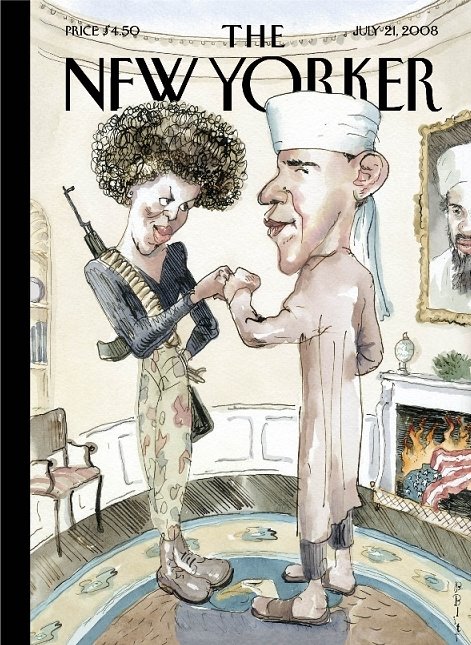
The Great New Yorker Obama Fist-Bump Cover Controversy of 2008

I think the idea that the Obamas are branded as unpatriotic [let alone as terrorists] in certain sectors is preposterous. It seemed to me that depicting the concept would show it as the fear-mongering ridiculousness that it is.

Cover artist Barry Blitt, The New Yorker

A Fist-Bump for the New Yorker
By John McQuaid / July 14, 2008

I’m a little late to the party, but here is an absurd decorousness in the denunciations — from the Obama and McCain campaigns and across the liberal blogosphere — of the current New Yorker cover.

The top-line objection is to accuse the New Yorker of poor taste. In the limited context of campaign discourse this is true. But magazines and other journalistic enterprises would be crazy to buy into the notion that abitrary etiquette of American campaigns (which encourages candidates to lie baldly, and surrogates to spin and smarm and swift-boat, while prohibiting frank talk to a host of issues from race to religion to terror itself), should govern their decisions.

Underneath that are liberals’ more practical fears about the cover’s impact on Obama’s campaign. This line of thinking goes: Obama is so new and different, his image so unformed in the public mind, and U.S. opinion still so anxious on the matter of terrorism, with Democrats perceived as weak — that the Obama campaign, and we as a nation, just can’t handle images like this, because they might be interpreted the wrong way.

Really? No one worries that TNY’s readership will take it literally. Fox will show it and chortle, but hey — it will likely only confuse conservative viewers inclined to think of Obama as a Muslim terrorist dupe. Why are the liberal elites advertising Obama’s subversion, mocking it? The image itself is an absurd jumble of terrorist iconography — Black Power, al Qaeda, flag burning, etc.

Seven years after 9/11, after an onslaught of bad-faith political manipulation over terror, and with the threat of al Qaeda now quite debatable, Americans can certainly handle a little jokey imagery about terrorism and politics. Free expression is a bulwark of American liberalism, part of what makes it what it makes it superior to political philosophies that rigidly enforce what words can be uttered and images can be shown. When liberals start policing the “poor taste” of cartoons so that some people don’t get the “wrong idea,” it only reinforces the notion that all the fearmongering was effective, and perhaps right — and also shows how weak and tenuous Democrats fear their position on terrorism remains.

Source. / The Huffington Post

A WorldNetDaily.com poll asked the website’s readers to “[s]ound off on the New Yorker’s cover with turban-wearing Obama, gun toting wife,” but while the New Yorker said in a press release that the cover “satirizes the use of scare tactics and misinformation in the Presidential election to derail Barack Obama’s campaign,” for a majority of respondents to WND’s poll, the cover apparently provided support for their false perceptions of Obama’s religion and patriotism: A majority of respondents selected the option stating that “[t]he image isn’t too far from the dangerous truth about the Obama family.”

Media Matters / July 14, 2008

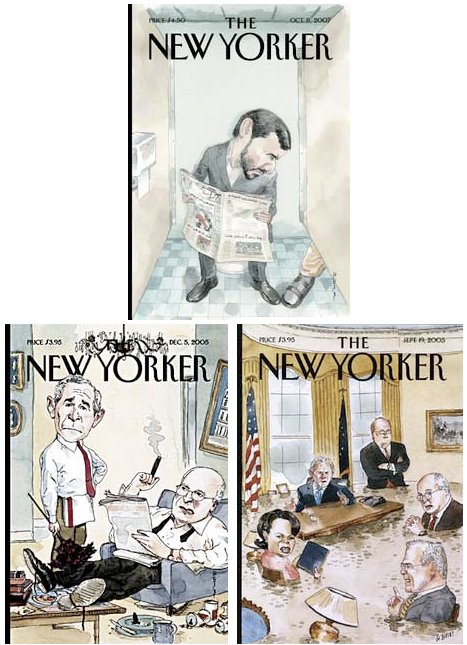
Other New Yorker covers by Barry Blitt:

Why The New Yorker’s Obama Cover is a Lousy Cartoon
By Daryl Cagle / July 14, 2008

Cable news channels and bloggers are buzzing about The New Yorker magazine cover featuring Barack Obama dressed in Muslim garb and Michelle Obama with an afro and machine gun, doing a “terrorist fist bump” in the Oval Office, while an American flag burns in the fireplace. The cartoon by Barry Blitt drew immediate condemnation from the Obama and McCain camps.

In an interview on the Huffington Post Web site, New Yorker Editor David Remnick argues, “Obviously I wouldn’t have run a cover just to get attention — I ran the cover because I thought it had something to say. What I think it does is hold up a mirror to the prejudice and dark imaginings about … both Obamas’ … it combines a number of images that have been propagated, not by everyone on the right but by some, about Obama’s supposed ‘lack of patriotism’ or his being ‘soft on terrorism’ or the idiotic notion that somehow Michelle Obama is the second coming of the Weathermen or most violent Black Panthers. That somehow all this is going to come to the Oval Office.

“The idea that we would publish a cover saying these things literally, I think, is just not in the vocabulary of what
we do and who we are… We’ve run many many satirical political covers. Ask the Bush administration how many.”

Cartoonist Barry Blitt defends the cover by saying, “It seemed to me that depicting the concept would show it as the fear-mongering ridiculousness that it is.” So the cover cartoon is simply an exaggeration of the allegations against the Obamas.

There are rules to political cartoons that allow cartoonists to draw in an elegant, simple, shorthand that readers understand. Exaggeration is a well worn tool of political cartoonists; we use it all the time. I’ve drawn President Bush as the King of England, to exaggerate his autocratic tendencies. I’ve drawn the president as a dog, peeing all over the globe to mark his territory. I exaggerate every day, and I don’t expect my readers to take my exaggerations seriously — but when I draw an absurdly exaggerated political cartoon, I’m looking for some truth to exaggerate to make my point. A typical stand-up comedian will tell jokes about things the audience already knows or agrees with, “it’s funny because it’s true,” or true as the comedian sees it. It is the same for cartoonists — our readers know that we’re exaggerating to make a point we believe in.

Source / The Cagle Post

Thanks to Harry Edwards / The Rag Blog

Also see Obama slams New Yorker portrayal / Politico

And Yikes, controversial New Yorker cover… by Rachel Sklar / The Huffington Post

And Was the New Yorker Cover Gutsy? The New Republic

And The Bad Frame: Why Are the New Yorker, Salon and Other Liberal Media Doing the Right’s Dirty Work? truthout

And Media Response to ‘Terrorist Obama’ New Yorker Covers / Editor and Publisher

And check out this interview with New Yorker publisher David Remnick / The Huffington Post

The Rag Blog

Posted in RagBlog | Tagged , , , , , , , , , , , | Leave a comment

HEALTH CARE : Do Cholesterol Drugs Do Any Good?

Graphic courtesy of Pharma Marketing.

Statins: Looking at the stats
By Duncan Echelson
/ The Rag Blog / July 14, 2008

Statin pharmaceuticals are marketed ferociously on TV ads and by many MD’s. The statins are major money makers for the pharmaceutical companies. For relatively small groups of specific types of patients the real research shows some benefit but for most of the patients taking statins it is based on conjecture, not research.

Not only is there no proven benefit for many of the people taking
statins, there are some rather significant side effects such as severe
muscle pain, memory loss and sexual dysfunction.

There are more than 18 million Americans taking statins and worldwide sales totaled more than 33 billion dollars in 2007.

The history of statins and cholesterol theory make a very interesting
case study of the pharmaceutical and medical industries and is well
worth studying, in order to learn how we can avoid being manipulated
for power and profit.

Just as interesting is learning how medical science can be led into
taking positions that are based on political maneuvering and sloppy
data analysis rather than science.

You might be one of the 18 million people taking statins and if not, I
am sure that you know people who are (friends, siblings, parents). If
so, then please read the series of pieces so you can ask questions,
find answers and make decisions as to whether taking statins is really
a benefit or if it is a danger waste of your health dollars and
efforts.

For step one, in our investigation, I offer you a very well written and referenced article from the Jan. 17, 2008 issue of Business Week magazine. Please note this is only step one of a series of articles and documents to help us understand. The source of this article is surprising but I guarantee you will find it very interesting.

Duncan Echelson is a licensed Acupuncturist/Herbalist who can be found at Oak Hill Oriental Medicine in Austin. His focus is helping people become healthier. He particularly enjoys teaching people simple ways to maintain and improve their health.

He has great respect for those physicians who truly live by the Hippocratic oath and for those researchers who are dedicated to understanding their study subjects without fear or favor.

In addition, he knows of many cases where the judicious use of pharmaceuticals and medical procedures have been very important for treating disease and trauma.

It is the misuse of pharmaceuticals, medical techniques, and research studies that he finds deeply offensive and drives him to keep up with news and analysis of these fields.

He welcomes comments, favorable or critical. Leads to stories in medicine and pharmaceutical are also welcome.

You can reach him at duncanechelson@gmail.com.

Do Cholesterol Drugs Do Any Good?

Research suggests that, except among high-risk heart patients, the benefits of statins such as Lipitor are overstated
By John Carey

Martin Winn’s cholesterol level was inching up. Cycling up hills, he felt chest pain that might have been angina. So he and his doctor decided he should be on a cholesterol-lowering medication called a statin. He was in good company. Such drugs are the best-selling medicines in history, used by more than 13 million Americans and an additional 12 million patients around the world, producing $27.8 billion in sales in 2006. Half of that went to Pfizer (PFE) for its leading statin, Lipitor. Statins certainly performed as they should for Winn, dropping his cholesterol level by 20%. “I assumed I’d get a longer life,” says the retired machinist in Vancouver, B.C., now 71. But here the story takes a twist. Winn’s doctor, James M. Wright, is no ordinary family physician. A professor at the University of British Columbia, he is also director of the government-funded Therapeutics Initiative, whose purpose is to pore over the data on particular drugs and figure out how well they work. Just as Winn started on his treatment, Wright’s team was analyzing evidence from years of trials with statins and not liking what it found.

Yes, Wright saw, the drugs can be life-saving in patients who already have suffered heart attacks, somewhat reducing the chances of a recurrence that could lead to an early death. But Wright had a surprise when he looked at the data for the majority of patients, like Winn, who don’t have heart disease. He found no benefit in people over the age of 65, no matter how much their cholesterol declines, and no benefit in women of any age. He did see a small reduction in the number of heart attacks for middle-aged men taking statins in clinical trials. But even for these men, there was no overall reduction in total deaths or illnesses requiring hospitalization—despite big reductions in “bad” cholesterol. “Most people are taking something with no chance of benefit and a risk of harm,” says Wright. Based on the evidence, and the fact that Winn didn’t actually have angina, Wright changed his mind about treating him with statins—and Winn, too, was persuaded. “Because there’s no apparent benefit,” he says, “I don’t take them anymore.”

Wait a minute. Americans are bombarded with the message from doctors, companies, and the media that high levels of bad cholesterol are the ticket to an early grave and must be brought down. Statins, the message continues, are the most potent weapons in that struggle. The drugs are thought to be so essential that, according to the official government guidelines from the National Cholesterol Education Program (NCEP), 40 million Americans should be taking them. Some researchers have even suggested—half-jokingly—that the medications should be put in the water supply, like fluoride for teeth. Statins are sold by Merck (MRK) (Mevacor and Zocor), AstraZeneca (AZN) (Crestor), and Bristol-Myers Squibb (BMY) (Pravachol) in addition to Pfizer. And it’s almost impossible to avoid reminders from the industry that the drugs are vital. A current TV and newspaper campaign by Pfizer, for instance, stars artificial heart inventor and Lipitor user Dr. Robert Jarvik. The printed ad proclaims that “Lipitor reduces the risk of heart attack by 36%…in patients with multiple risk factors for heart disease.”

So how can anyone question the benefits of such a drug?

For one thing, many researchers harbor doubts about the need to drive down cholesterol levels in the first place. Those doubts were strengthened on Jan. 14, when Merck and Schering-Plough (SGP) revealed results of a trial in which one popular cholesterol-lowering drug, a statin, was fortified by another, Zetia, which operates by a different mechanism. The combination did succeed in forcing down patients’ cholesterol further than with just the statin alone. But even with two years of treatment, the further reductions brought no health benefit.

Doing the Math

The second crucial point is hiding in plain sight in Pfizer’s own Lipitor newspaper ad. The dramatic 36% figure has an asterisk. Read the smaller type. It says: “That means in a large clinical study, 3% of patients taking a sugar pill or placebo had a heart attack compared to 2% of patients taking Lipitor.”

Now do some simple math. The numbers in that sentence mean that for every 100 people in the trial, which lasted 3 1/3 years, three people on placebos and two people on Lipitor had heart attacks. The difference credited to the drug? One fewer heart attack per 100 people. So to spare one person a heart attack, 100 people had to take Lipitor for more than three years. The other 99 got no measurable benefit. Or to put it in terms of a little-known but useful statistic, the number needed to treat (or NNT) for one person to benefit is 100.

Compare that with, say, today’s standard antibiotic therapy to eradicate ulcer-causing H. pylori stomach bacteria. The NNT is 1.1. Give the drugs to 11 people, and 10 will be cured.

A low NNT is the sort of effective response many patients expect from the drugs they take. When Wright and others explain to patients without prior heart disease that only 1 in 100 is likely to benefit from taking statins for years, most are astonished. Many, like Winn, choose to opt out.

Plus, there are reasons to believe the overall benefit for many patients is even less than what the NNT score of 100 suggests. That NNT was determined in an industry-sponsored trial using carefully selected patients with multiple risk factors, which include high blood pressure or smoking. In contrast, the only large clinical trial funded by the government, rather than companies, found no statistically significant benefit at all. And because clinical trials themselves suffer from potential biases, results claiming small benefits are always uncertain, says Dr. Nortin M. Hadler, professor of medicine at the University of North Carolina at Chapel Hill and a longtime drug industry critic. “Anything over an NNT of 50 is worse than a lottery ticket; there may be no winners,” he argues. Several recent scientific papers peg the NNT for statins at 250 and up for lower-risk patients, even if they take it for five years or more. “What if you put 250 people in a room and told them they would each pay $1,000 a year for a drug they would have to take every day, that many would get diarrhea and muscle pain, and that 249 would have no benefit? And that they could do just as well by exercising? How many would take that?” asks drug industry critic Dr. Jerome R. Hoffman, professor of clinical medicine at the University of California at Los Angeles.

Drug companies and other statin proponents readily concede that the number needed to treat is high. “As you calculated, the NNT does come out to about 100 for this study,” said Pfizer representatives in a written response to questions. But statin promoters have several counterarguments. First, they insist that a high NNT doesn’t always mean a drug shouldn’t be widely used. After all, if millions of people are taking statins, even the small benefit represented by an NNT over 100 would mean thousands of heart attacks are prevented.

That’s a legitimate point, and it raises a tough question about health policy. How much should we spend on preventative steps, such as the use of statins or screening for prostate cancer, that end up benefiting only a small percentage of people? “It’s all about whether we think the population is what matters, in which case we should all be on statins, or the individual, in which case we should not be,” says Dr. Peter Trewby, consultant physician at Darlington Memorial Hospital in Britain. “What is of great value to the population can be of little benefit to the individual.” Think about buying a raffle ticket for a community charity. It’s for a good cause, but you are unlikely to win the prize.

Statin proponents also argue that when NNTs are calculated after the drugs have been taken for just three or five years, they’re misleadingly high. Pfizer says that even though only one heart attack was prevented per 100 people in its trial, “it may be a possibility that several or even all [100] benefit” by reducing their risk of a future heart attack. And the benefit grows when the drugs are taken for more years, backers believe. “It does not make sense to take a statin for five years,” says Dr. Scott M. Grundy, chair of the NCEP committee that called for more aggressive statin treatment and director of the Center for Human Nutrition at the University of Texas Southwestern Medical Center at Dallas. “When you take a cholesterol-lowering drug, it is a huge commitment,” he says. “You take it for life.” Grundy figures the chances of having a heart attack over the course of a lifetime are about 30% to 50% (higher for men than women). Statins, he argues, reduce that risk by about 30%. As a result, taking the drugs for 30 years or more would bring 9 to 15 fewer heart attacks for every 100 people. So only 7 to 11 people would have to take the drugs for life for one to benefit.

Critics reply that this rosier picture requires several leaps of faith. A 30% reduction in heart attacks “is the best-case scenario and not found in many of the studies,” says Wright. What’s more, statins have been in use now for 20 years, and there’s little evidence yet that the NNT decreases the longer people take the drug. Most important, the statin trials of people without existing heart disease showed no reduction in deaths or serious health events, despite the small drop in heart attacks. “We should tell patients that the reduced cardiovascular risk will be replaced by other serious illnesses,” says Dr. John Abramson, clinical instructor at Harvard Medical School and author of Overdosed America.

Read the rest of this article here. / Business Week

The Rag Blog

Posted in Rag Bloggers | Tagged , , , , | 1 Comment

He Took Office Despite Our Derision


Hail to the Member (thank God for November)

There once was a man from Connecticut
who ran for the office of President
Though he said he’s from Texas,
just like some Mex’s,
he’s really a permanent resident.

He won by Supreme Court decision,
and caused a huge public division.
With an arrogant stride
his Dick at his side,
he took office despite our derision.

Now it is time that he leave us.
Eight years he has tried to deceive us.
He’s left us in debt,
and mothers have wept.
He really is quite a big penis.

Shane O’Neal / The Rag Blog

Posted in Rag Bloggers | Tagged , | Leave a comment

LITERATURE : Road Fatigue


The Beat Generation in the rearview mirror
By A.G. Mojtabai / July 11, 2008

Even from a distance, it was easy to guess that the clerk with the bowed head at BookPeople was reading behind the counter. Face to face, she was eager to share the title: Poetry As Insurgent Art by Lawrence Ferlinghetti. Had I seen the Ransom exhibit on the Beats? she asked. Wasn’t it “awesome?”

A chorus of “awesome … simply awesome” greeted me from the visitors book at the entrance to the Ransom exhibit, but also a scattering of distinctly dissonant notes (on behalf of the Beats’ abandoned wives and children), along with a murmur of bemused bewilderment: “Yes … But is it Art?” and “Funny

My own feeling turned out to be a mix of all of the above, although proportioned differently and differently named. People of my generation use “awesome” sparingly, if at all, the word reserved to signify epic magnitudes or profoundest depths—not what we find here. Such an inflation of message and response strikes me as typical of the Beat phenomenon, though.

“On the Road with the Beats” has been on exhibit at the Harry Ransom Humanities Research Center at the University of Texas in Austin since February and will continue to August 3. The scroll manuscript of Jack Kerouac’s On the Road, on loan from March until June 1, will have departed by the time of this printing. The occasion for the exhibit is the recently celebrated 50th anniversary of the publication of On the Road.

“A generation in motion” is the exhibit’s organizing theme. According to the brochure:

“Pilgrims in search of a destination, [the Beats] crisscrossed the globe, from New York to San Francisco, Los Angeles to Mexico City, Tangier to Paris, Calcutta to London. … Motion, improvisation, and process are driving concepts … Experimental jazz and bebop prompted writers to stretch prose and the poetic line to rhythmic extremes. … The painters known as the New York School inspired influential collaborative projects.”

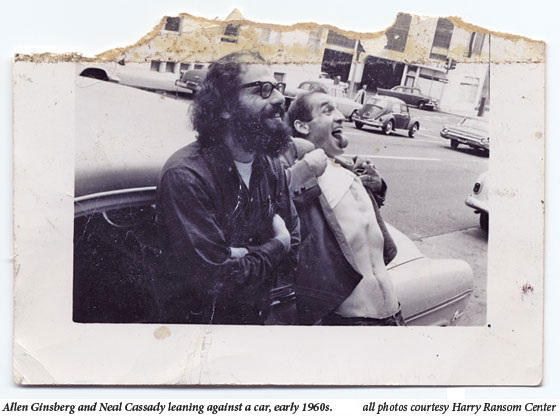
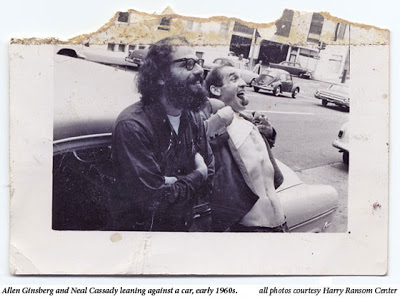
Originally a junkie term, “Beat” meant many things: desperate, wasted, down-and-out (beaten-down)—to which Kerouac added “beatific,” which he defined as being subject to bursts of “ragged and ecstatic joy.” To most people, mention of the Beats conjures up the small founding group of friends: Jack Kerouac, William Burroughs, Neal Cassady (better known as the fictional Dean Moriarty in On the Road), and Allen Ginsberg.

Much on the model of Ezra Pound’s relationship with the early modernist writers, Ginsberg served as editor, literary agent, and promoter for his friends. Ginsberg’s letters provide a guiding thread through their lives and the exhibit. The far fewer letters of Cassady are no less valuable. As love-focus and muse for both Kerouac and Ginsberg, Cassady was a pivotal figure in the movement. His letters were the inspiration for what Kerouac called “bop prosody”—his signature extemporaneous style.

Nowhere is the Beats’ self-mythologizing more blatant than in their depictions of Cassady. For Kerouac, his friend’s energies were beyond the natural, his countless transgressions proof of his superabundant life, “everything about him larger than life,” Kerouac wrote in one of his journals, published in Road Novels 1957-1960. Through Kerouac’s eyes, Cassady became saint, angel, archangel, “the holy con-man with the shining mind. … the Holy Goof.” When Cassady stole a tankful of gas they needed to move on, it was a theft “that saved us, a divine theft … Prometheus at least,” according to Kerouac’s journal entry. And, as Kerouac confessed, he always “shambled after [Cassady] as I’ve been doing all my life after people who interest me, because the only people for me are the mad ones, the ones who are mad to live, mad to talk, mad to be saved, desirous of everything at the same time.”

Ginsberg added to this aggrandizement: “I have finally taught Neal,” Ginsberg wrote, “that he can do anything he wants, become mayor of Denver, marry a millionaire or become the greatest poet since Rimbaud. But he keeps rushing out to see the midget auto races.”

Cassady, however, was not unanimously liked or trusted by the other Beats. Having graduated from reform school into the streets, he was a consummate con-man, hustler, druggie, drunk, car thief (but only for joy rides and “kicks”), petty thief, and a sometimes-violent, indefatigable sexual adventurer with both men and women. Abandoned by his alcoholic father as a youngster, he had a sad start in life. On the Road repeatedly reminds the reader that the narrative is an account of the search for Neal’s lost father—a would-be archetypal quest for “the father we never found.” In point of fact, it does not seem that they searched very hard. Perhaps the father did not want to be fou

I visited the Ransom exhibit in April. Upon entering, I was immediately confronted with Kerouac’s famous scroll manuscript of On the Road lying in state. It was an attention-grabber—“This is the longest book I have ever seen,” in the words of an awed fifth-grader—and a visually arresting artifact in an exhibit that skillfully blends textual, visual, and aural elements. Sepia-toned and crumbling, venerable in its decrepitude and in the care expended on its preservation, it reminded more than one visitor of one of those ancient Dead Sea Scrolls.

A continuous stream of paper nearly 120 feet in length (the first 48 feet are unfurled in the Ransom display), the scroll was formed by taping pieces of tracing paper together. The idea was to facilitate continuous motion on the part of the writer. Typed at white heat speed during three weeks in 1951, the scroll offered Kerouac (stoked on massive doses of caffeine) a way to get the story out with maximum speed and without overmuch reflection. The tail end of the scroll manuscript was allegedly eaten by a friend’s dog, but it is possible that the scroll lacked an ending at the time. There was a long trek yet to come: The book as we know it took more than 10 years, counting Kerouac’s note-taking before hitting upon the scroll method, and six years of revision afterward as he struggled to get it published.

The scroll is a nonfictional account of five road trips taken by Kerouac with Cassady from 1947 to 1951. Real names are used. In the finally published novel, names are changed, sexual exploits are toned down, and some self-conscious flourishes are added.

“First thought, best thought” was Kerouac’s credo in creating the scroll. To which the answer must be: Well, sometimes …

And sometimes not. I have trudged through the scroll, word after word, in a recently published book transcription. Although writing nonstop must have been a liberating breakthrough for the author, it presented a rather different experience for this reader. All five books, five journeys, are jammed together into a seemingly interminable single paragraph. Far from suggesting an open road or flowing river, the scroll creates a clotted, even static, feeling—a sense of congealed motion. Free of later embellishment for literary effect, some passages in the raw scroll version are stronger than in the final book version, though.
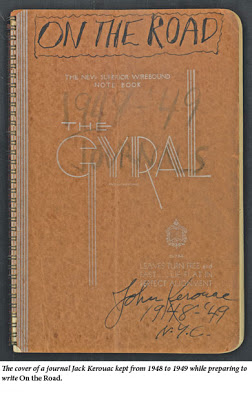

The most interesting artifact in the exhibit, to my mind, is a cheap, lined, spiral-bound notebook, one of Kerouac’s travel journals from 1949. It had been sold for $1,000 to a rare book dealer by the Beat poet Gregory Corso, who needed the money for heroin. The notebook can be leafed through in digital facsimile. What caught my eye were the intense reading lists, and a prayer for good times and bad, composed by Kerouac (a cradle Catholic) upon learning that his first book, The Town and the City, had been accepted for publication. The last page is filled with lists of crops for a farm Kerouac hoped to start up with Cassady, thinking it would provide a source of steady income and a healthful way of life.

On the whole, the exhibit struck me as long on literary developments arising from the Beat movement and wide in its exploration of outreach to other arts, but short on backstory. The Beats did not spring unaided from the ear of Zeus. True enough, as the Ransom’s narrative has it, the Beat movement was reactive to the repressive conformism and complacency of Cold War America. But it was also, and as truly, a continuation of long-standing American tradition. In the case of On the Road, arguably the iconic document of the Beat movement, the continuities are glaring. The open road, and before that the open frontier, had long been part of the American romance. The expansive thrust into unknown territory, adventure, the camaraderie of the open road, were—and are—cherished features of our nation’s traditional vision of itself.

The ancestors of On the Road are legion: Walt Whitman wrote the enabling charter. Twain sent Huck and Jim on a raft down a watery road. Melville had Ishmael and Queequeg light out for the open sea. Emerson counseled self-reliance; Thoreau, marching to a different drummer. And there is the long tradition of the picaresque in world literature.

From Beat to Beatnik to Hippie to Punk. Although the Beats are often conflated with the later hippies and thought of as political, they tended to be apolitical in the ’40s and ’50s. (During the ’60s, the activism of Ginsberg and others made for a somewhat different story.) Far from engaging the world, and despite all their world travel, the Beats remained largely clueless—not simply incurious and insensitive, but insensible: blind to the variety and complexity of lives other than their own. In an instant judgment that was really a prejudgment, Kerouac saw, and admired, Mexicans as “Fellahin … the essential strain of the basic primitive,” brown toilers in the brown earth, “pure and ancient” earth figures, with “slanted eyes and soft ways.”

Even Mexico City was “one vast Bohemian camp. … This was the great and final wild uninhibited Fellahin-childlike city that we knew we would find at the end of the road.”

In a missive to Cassady in 1957, Kerouac wrote of the locals in Tangier: “They are all hi, all wild, hep, cool, great kids, they talk like spitting from inside the throat Arabic arguments.”

This is sheer projection, of course, sweeping generalization that all but obliterates the individuals standing before him, professed admiration bordering on contempt.

A similar incomprehension is found in the Beats’ treatment of women. Women are perks of the road, ripe for the picking, thrilling for the moment, but afterward all too often bitter or clinging. Marriages are contracted, children conceived, and the boys in the club are off to their next great adventure. Escape from the complexities and responsibilities of the adult world, as much as anything else, seems to be the animating force of On the Road. Here are a few of many tip-offs: “Bitterness, recrimination, advice, morality, sadness, it was all behind him…” “Goodbye, goodbye. We roared off…” “Nothing behind, everything ahead…” To which Cassady characteristically added: “Wow! Damn! Whoopee! … Less go, lessgo!”

At one point, even Burroughs was moved to write Ginsberg and explain why he had advised Kerouac against leaving on another jaunt with Cassady. His letter is cited in Jack Kerouac’s American Journey:

“Obviously the ‘purpose’ of the trip is carefully selected to symbolize the basic fact of purposelessness. … To cross the continent for the purpose of transporting Jack to Frisco where he intends to remain for 3 days before starting back to N.Y. [is] a voyage which for sheer compulsive pointlessness compares favorably with the mass migrations of the Mayans … [a] voyage into pure, abstract, meaningless motion …”

Kerouac had a dream, and it surfaced from time to time, of having a home and a stable marriage. “I want to marry a girl,” he wrote, “so I can rest my soul with her till we both get old. This can’t go on all the time … all the franticness and jumping around.” Instead, his marriages quickly dissolved, and he returned repeatedly to his mother’s house (which he disguised as his “aunt’s” house in his fiction). This was the only home he would ever know. He died in 1968 at age 47 from complications of alcoholism. By the late ’60s, the original friends had drifted apart, and Kerouac had dissociated himself from many of his followers.

The social norms that had so constricted the Beats had already begun to change in the ’50s in the aftermath of the Kinsey Reports. The novel Peyton Place was published and reviewed at pretty much the same time as On the Road. The doors to the counterculture had been opened.

The Beats were the heralds of change, though, and loud about it, refusing to lead Thoreau’s “lives of quiet desperation” or, in Kerouac’s words, to “go mad in recognized sanity.”

A Ransom visitor signed “Lady Mariposa” wrote this tribute to Kerouac: “Because of you I can be… Besos, mi Jack.” Today, in large measure because of the Beats, homoerotic love dares to speak its name. Along with all the writers who come after them, I am indebted to the Beats for their invigoration of the arts, for shattering the molds and enlarging the realm of what can be printed, sung, painted, and said. There has been a progression since then, however. Think of gangsta rap, of Bret Easton Ellis and the “brat-pack” writers of the late ’80s and the ’90s; think of Andres Serrano’s crucifix submerged in urine. “Transgression,” sometimes billed as the obligation of a true artist in the contemporary world, has become so widespread and predictable that it seems almost tame—trendy transgressive, if you will.

There is a muted undercurrent running through Kerouac’s writing. It is discernible in the travel notebook of 1949, where he recorded his plans for buying a farm and growing “sturdy” as well as “seasonal” crops, and in his recurrent daydream of finding the right girl, settling down, and resting his soul. It becomes impossible to ignore in the coda to On the Road, a passage so poignant and lyrical that it seems more sung than said:

So in America when the sun goes down and I sit on the old broken-down river pier watching the long, long skies over New Jersey and sense all that raw land that rolls in one unbelievable huge bulge over to the West Coast, and all that road going, all the people dreaming in the immensity of it … the evening star must be drooping and shedding her sparkler dims on the prairie, which is just before the coming of complete night that blesses the earth, darkens all rivers, cups the peaks, and folds the final shore in, and nobody, nobody knows what’s going to happen besides the forlorn rags of growing old, I think of Dean Moriarty, I even think of old Dean Moriarty, the father we never found, I think of Dean Moriarty.

Blesses … darkens … cups … and folds in. The prose slows down. After all that frantic rushing around, all that road going, the completion of Kerouac’s journey comes at a broken-down pier in Hoboken, near where he first set out, where he offers up this hymn to night, friendship, remembrance, and rest.

A.G. Mojtabai is the author of nine books, including the new All That Road Going. She lives in Amarillo.

Source. / The Texas Observer

The Rag Blog

Posted in RagBlog | Tagged , , , , , , , , , | Leave a comment

The Muppets, Me and Public TV…

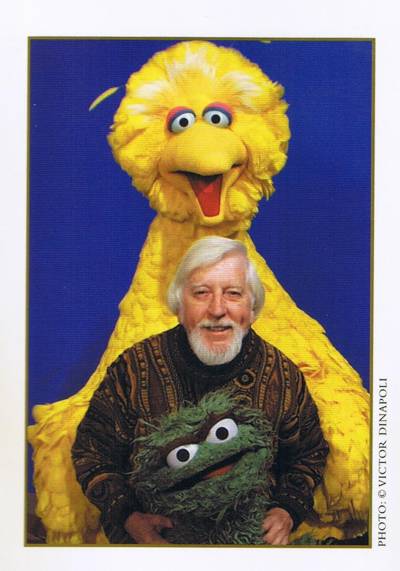
Caroll Spinney with Big Bird and Oscar the Grouch. Photo by Victor Dinapoli.

And the power of popular culture
By Michael Winship / July 13, 2008

Take a moment to forget about politics and the pickle of our worrisome world. A recent dispatch from Kathryn Kolbert, president of People for the American Way, about “the power of culture to shape our society,” triggered thoughts of my deep and abiding joy in the work of the late Jim Henson and the Muppets. It’s a love that goes back to childhood, when the Muppets first started appearing in brief, witty, anarchic vignettes on the old Ed Sullivan and Jack Paar television shows.

I secretly suspect they’re one reason I got involved in public broadcasting; a subliminal urge to associate my career with the network responsible for “Sesame Street.”

Kolbert’s e-mail specifically was relating the power of popular culture to the recent deaths of George Carlin and another great American you may not have heard of, Kermit Love. No relation to the frog of the same name, Kermit, 91, was the man who executed Jim Henson’s designs for Big Bird and Mr. Snuffleupagus, and assisted at the birth of Oscar the Grouch and Cookie Monster; a costume designer who also counted among his clients the Muppet-like Orson Welles, George Balanchine and Jerome Robbins. If you grew up with “Sesame Street,” you’ll remember him wandering among the Sesame denizens as Willy the Hot Dog Man.

I met Kermit Love in 1974, just a few months after I started working for public television in Washington, DC. Decked out in his Santa Claus-like beard and full Willy regalia, he was there in his capacity as Big Bird’s caretaker. The station, WETA, was having an open house with Big Bird as special guest. Unexpectedly, thousands of kids and their parents showed up on a rainy summer Sunday afternoon, patiently waiting out in the drizzle and churning the lawns into a mud mess worthy of Woodstock.

I quickly learned that it’s an endless task taking care of an 8-foot-2 canary (or whatever the hell he is). Bird (Snuffleupagus and I call him that as we consider his genius in the same league as Charlie Parker’s) is, as he always has been, portrayed by the great puppeteer Caroll Spinney, who also performs the role of Oscar the Grouch. Once suited up, his raised right arm is the neck and head, and his left arm becomes the left wing with some fishing line connected to the right for proper double flapping. A TV monitor inside keeps him from blindly walking into manholes. Or birdbaths. Kermit accompanied him on and off the set.

Try standing with your right arm held up like that for any longer than a minute or three and you’ll have some idea of the stamina Caroll has to have to make the whole thing work. Add to that the stuffy confines of the outfit – he can perform for only a short while at a time.

Throughout, Kermit made sure everything was fine, that Caroll was as comfortable as possible, and utmost, that the suit was kept in pristine shape. As Caroll moved about, feathers would frequently fly (some of them were supposed to). Big Birds, you may not be surprised to learn, molt big. Kermit made everything right.

When the long day was done, Caroll climbed out of the suit and we retired to a nearby restaurant. At the table next to us was a family with two small children. Caroll saw them, winked at Kermit and reached into his book bag. Inside was Oscar the Grouch himself. Caroll pulled him out and was immediately in character. The ecstatic look on the faces of those kids was unforgettable, as if they’d just been transported into the pages of the best storybook ever. This, I thought, is a great way to make a living.

Years went by and Kermit’s and my paths crossed again from time to time. I finally did meet Jim Henson when a colleague producing a documentary about the Macy’s Thanksgiving Parade asked the Muppets to host. I was invited to sit in on the first meeting. Henson came into the room wearing a bright paisley shirt and jeans, his long hair anchored by a headband. Following him was an accountant type in suit and tie, clipboard in hand. They watched the rough cut of the film approvingly and Henson agreed to participate, the accountant type dutifully taking down his instructions – change the color of Miss Piggy’s eyes, make sure Fozzie Bear knew his call time, etc.

More years went by and I was working as a writer at the Children’s Television Workshop, home of “Sesame Street.” I was assigned to their series “Square One TV” and “3-2-1 Contact,” which was proximate enough to let a bit of the Sesame Street stardust rub off. A fulfilling experience, writing funny stuff for kids and knowing that maybe you were even teaching them something. Grownups, too.

In 2004, I was at Ben-Gurion Airport in Tel Aviv, finishing up a two-week trip to Israel and the West Bank. Before I could get on my flight home, Israeli security held me for questioning. It was disconcerting – among other places, I had been spending time in Palestinian villages – and the officers knew everywhere I had been, every military checkpoint I had gone through, just about every person to whom I had spoken. They seemed to be trying to see if my account of my daily whereabouts would differ from theirs. Tense.

After quite some time, one of them asked, while you were here, with whom did you stay? I explained that I had been with friends in East Jerusalem, one of whom I had worked with at the Children’s Television Workshop. What’s that, they demanded?

“You know,” I said. “Sesame Street.”

“Sesame Street!” they cried. “Big Bird!”

I was free to go.

That’s how you use culture to change society, a little bit at a time. Thanks, Kermit.

[Michael Winship is senior writer of the weekly public affairs program “Bill Moyers Journal,” which airs Friday night on PBS. Check local airtimes or comment at The Moyers Blog at www.pbs.org/moyers.]

Source. / truthout

The Rag Blog

Posted in RagBlog | Tagged , , , , | Leave a comment

The Death of Reaganomics

Barbara Dane et al / Reaganomics Blues. / Fuse 002

Singing the Capitalism Blues
By E.J. Dionne / July 10, 2008

The biggest political story of 2008 is getting little coverage. It involves the collapse of assumptions that have dominated our economic debate for three decades.

Since the Reagan years, free-market clichés have passed for sophisticated economic analysis. But in the current crisis, these ideas are falling, one by one, as even conservatives recognize that capitalism is ailing.

You know the talking points: Regulation is the problem and deregulation is the solution. The distribution of income and wealth doesn’t matter. Providing incentives for the investors of capital to “grow the pie” is the only policy that counts. Free trade produces well-distributed economic growth, and any dissent from this orthodoxy is “protectionism.”

The old script is in rewrite. “We are in a worldwide crisis now because of excessive deregulation,” Rep. Barney Frank, D-Mass., the chairman of the House Financial Services Committee, said in an interview.

He notes that in 1999 when Congress replaced the New Deal-era Glass-Steagall Act with a looser set of banking rules, “we let investment banks get into a much wider range of activities without regulation.” This helped create the subprime mortgage mess and the cascading calamity in banking.

While Frank is a liberal, the same cannot be said of Ben Bernanke, the chairman of the Federal Reserve. Yet in a speech on Tuesday, Bernanke sounded like a born-again New Dealer in calling for “a more robust framework for the prudential supervision of investment banks and other large securities dealers.”

Bernanke said the Fed needed more authority to get inside “the structure and workings of financial markets” because “recent experience has clearly illustrated the importance, for the purpose of promoting financial stability, of having detailed information about money markets and the activities of borrowers and lenders in those markets.” Sure sounds like Big Government to me.

This is the third time in 100 years that support for taken-for-granted economic ideas has crumbled. The Great Depression discredited the radical laissez-faire doctrines of the Coolidge era. Stagflation in the 1970s and early ’80s undermined New Deal ideas and called forth a rebirth of radical free-market notions. What’s becoming the Panic of 2008 will mean an end to the latest Capital Rules era.

What’s striking is that conservatives who revere capitalism are offering their own criticisms of the way the system is working. Irwin Stelzer, director of the Center for Economic Policy Studies at the Hudson Institute, says the subprime crisis arose in part because lenders quickly sold their mortgages to others and bore no risk if the loans went bad.

“You have to have the person who’s writing the risk bearing the risk,” he says. “That means a whole host of regulations. There’s no way around that.”

While some conservatives now worry about the social and economic impact of growing inequalities, Stelzer isn’t one of them. But he is highly critical of “the process that produces inequality.”

“I don’t like three of your friends on a board voting you a zillion dollars,” Stelzer, who is also a business consultant, told me. “A cozy boardroom back-scratching operation offends me.” He argues that “the preservation of the capitalist system” requires finding new ways of “linking compensation to performance.”

Frank takes a similar view, arguing that CEOs “benefit substantially if the risks they take pay off” but “pay no penalty” if their risks lead to losses or even catastrophe—another sign that capitalism, in its current form, isn’t living by its own rules.

Frank also calls for new thinking on the impact of free trade. He argues it can no longer be denied that globalization “is a contributor to the stagnation of wages and it has produced large pools of highly mobile capital.” Mobile capital and the threat of moving a plant abroad give employers a huge advantage in negotiations with employees. “If you’re dealing with someone and you can pick up and leave and he can’t, you have the advantage.”

“Free trade has increased wealth, but it’s been monopolized by a very small number of people,” Frank said. The coming debate will focus not on shutting globalization down but rather on managing its effects with an eye toward the interests of “the most vulnerable people in the country.”

In the presidential campaign so far, John McCain has been clinging to the old economic orthodoxy while Barack Obama has proposed a modestly more active role for government. But the economic assumptions are changing faster than the rhetoric of the campaign. “Reality has broken in,” says Frank. And none too soon.

Source. / truthdig

The Rag Blog

Posted in RagBlog | Tagged , , , , | Leave a comment

POETRY : True Homeland

Wubbzy in the style of Picasso / Frank Rocco.

Welcome to the USA Patriarch Act
with its spying and break-ins
up its sleeve behind your back
with eavesdropping that’s a crackdown
with character attacks and panic attacks
Oh damn I’m indicted with fiction
though my sentence in fact
can be death or internment
in my homeland

does your brain contain
some interesting thought
from a book you checked out
maybe read or bought
or from some nice tune
you were humming or sought
that’s the heinous crime
that’ll get you caught in the web
of the worldwide homeland

well your mind is free
but what a twist
it lands you smack
on that guest list
now rest assured
you will be missed
when you get out of line
in the homeland

is speaking up
a mortal crime
say the thought
and do hard time
then parables and verse
and rhyme
pardon my grammar
and my paradigm

please just threaten me with jail
or make me watch you hurt a whale
so that I’ll let you read
my personal mail
it’s the law going postal
yet the law’s for sale

better keep your faith
cause you’ll lose your trust
think how you’ll feel
right during your bust
you’ll swear the law’s moved
beyond normal disgust
as it reads you its rights
and insists on your trust

who might it be
who turns you in
your neighbor
mother or best friend
is paranoia
now a sin
the paranoids are
still after me again

the love of truth
it is your code
until persuaded
to implode
your confession due
to electrode ooooh
that’ll be quite the shock
to the homeland

what is the thing
you don’t want to hear
on that midnight ride
we’re conditioned to fear
that you’re being denounced
for being, say, queer
to our butch police
in their bondage gear

are you perplexed
this very night
deciding between
flee and flight
methinks the emperor’s
wound too tight
a drunk with power
and dynamite

in ancient Rome
when it started a war
dictators were chosen
for what was in store
our chosen dictator
has chosen more gore
and has frozen free choice
and then comes back for more

are our laws meant
to constrict and besiege us
with crude ultimatums
both vague and egregious
what’s this lesson someone’s
so desperate to teach us
that freedom’s a threat
and a reason to seize us

my nation has
those recurring dreams
where it divides
into two teams
a moment of silence
and then the screams
it’s winner take all
in freedom’s purges and schemes

then the winners buy states
with their pocket change
while poverty’s strangled
and memory rearranged
with royal dynasties
still becoming deranged
and the headlines still shouting
there’s nothing at all here strange

well in the interest of
my liberal press
I’d like to clear up
this news media mess
by begging someone
to please confess
that rich conservatives own
all the networks, good guess

so you’d better make
that living will
and polish up
your survival skill
the reverends say
there’s a time to kill
oh the thrills and the chill
and watch out for the big spill

the preaching of hate
sanctimonious blather
is working the gullible
into a lather
they think they’re The Beav
when they’re more Cotton Mather
and lust when the
Jackson family gathers
then blow off some steam
while they’re screwing Dan Rather

so work on your
table manners bub
you’re invited to
the big country club
exclusive rights
to that big hot tub
for the boiling in oil
a la homeland

oh say can you see the petroleum
and the rockets red glare crematorium
can you hear it above the delirium
how so proudly we hail
how advanced we’ve become
advanced like dementia
what homeland!?

is this nation in the process
of losing its mind
in compassion and sense
is it lost years behind
does it yearn for respect
only to find
instead the responses
are given in kind

the patriaddict
aren’t like me
they wave the flag
it proves they’re free
they think that the color
of patriarch pee
is red white and blue
then it’s 1-2-3 Go homeland

still the army’s exported
all loaded and locked
as marines and sailors
wave bye to the dock
while the next of kin
are still buying that stock
get your corporate coffins
be the next on your block
no matter how deeply
you and the homeland are in hock

though I try to ignore
all the militarist posers
it’s getting much harder
to keep my composure
Blood Sacrifice it is
of civilians and soldiers
by these leaders who send out
the planes ships tanks and subs
these Predators Cobras Raptors
Tomahawks Hellfires Harpoons
and those Caterpillar bulldozers

their language is smooth
clever verbs suppositions
propagandize at will
but avoid depositions
fight them there freedom’s march
sloganeering addictions
as they crave martial law
to shut down opposition

if you truly believe
in fair or free trade
the flow of ideas
and the progress we’ve made
then tell me why all
this bullshit blockade
of justice and peace
with this homeland charade

if you truly believe
in a spiritual love
as on high so below
not the pushing and shove
then why not remove
your fist from your glove
extending your palm
as below so above

let’s settle now this whole debate
don’t tell me who to love or hate
quit living to discriminate
it’s our tolerance keeping us
hopeful and great

so let’s lift up high
our frosted mugs
our pharmaceuticals
whiskey jugs
and toast the victorious
war against drugs
Oh the euphoria
have another slug

let’s have our real party
on the White House lawn
and celebrate each
liberating dawn
all equal and free
with no class lines drawn
no king and no queen
no rook and no pawn
won’t keep us in check
and we’ll sure give hell heck

now we flow into one
through times hard and fun
with no injustice undone
and our work just begun
under one common sun
all living things run
in the one common band
in our hearts through the land
our promise our stand
for our new homeland
for our true homeland

True Homeland

Larry Piltz
July 4, 2008
Indian Cove / Austin, Texas

The Rag Blog / Posted July 13, 2008

Posted in Rag Bloggers | Tagged , , , , | 1 Comment

U.S. Soldiers No Longer Find Haven in Canada

James Corey Glass, an Army deserter, is appealing an immigration removal order in Canada. Photo by Farah Nosh / Getty Images.

Little sympathy for deserters from Conservative government
By Ian Austen / July 13, 2008

TORONTO — James Corey Glass, apprentice mortician and United States Army deserter, was keeping an unusually close eye on the text messages coming into his cellphone. He was hoping to hear that a court had blocked the Canadian government’s attempt to send him back to the United States.

On Wednesday afternoon, the message came: Mr. Glass, 25, could remain in Canada while he appealed his removal order by the country’s Immigration Department. It was a welcome reprieve, he said, but well short of a guarantee that he and other deserters could make Canada their new home.

The Canadian government’s effort to remove Mr. Glass contrasts with the warm reception given to deserters and draft avoiders from the United States during the war in Vietnam. And although the war in Iraq has very little support among Canadians, the situation of Mr. Glass and others who abandoned their military positions provokes a wide range of responses. For American soldiers seeking an escape, Canada is no longer a guaranteed haven.

“It’s quite clear that the current Canadian government does not want to annoy the U.S. government on this issue and will not give any ground,” said Michael Byers, a professor of politics and international law at the University of British Columbia.

During the Vietnam War, the Liberal prime minister, Pierre Elliott Trudeau, welcomed American deserters and draft dodgers, declaring that Canada “should be a refuge from militarism.” Americans who arrived were generally able to obtain legal immigrant status simply by applying at the border, or even after they entered Canada.

But while the current Conservative government of Prime Minister Stephen Harper has not backed the Iraq war, it has shown little sympathy for American deserters. During a recent parliamentary debate, Laurie Hawn, a Conservative from Alberta, asked, “Why do they not fight it within their own legal system instead of being faux refugees in Canada?”

No American deserter of the Iraq war has been deported by the Canadian government, but that is not for lack of effort. Immigration authorities have ordered about nine deserters to leave Canada, leading to public battles in the courts.

Changes to immigration laws have made it far more difficult for deserters to remain in Canada. Deserters wanting at least temporary legal status must be declared refugees. But refugees in Canada must show that they have, as the government puts it, a “well-founded fear of being persecuted” for religious, racial or political reasons. Alternately, refugees may demonstrate that for them to be returned to their home country would put their lives at risk, or would subject them to torture or “cruel and unusual treatment or punishment.”

As for Mr. Glass, he said he was between low-paying factory jobs in Indiana when he joined the National Guard six years ago.

But he said he had one crucial question for the recruiters before he signed. “They told me I’m not going to fight a war on foreign shores,” Mr. Glass said.

Maj. Nathan Banks, a spokesman for the Army, said, “recruiters would never have made a comment of that sort.”

Not long after Mr. Glass joined, it became clear that he would not be exempt from overseas duty, he said. But he stayed with the Guard and was deployed to Iraq in 2005.

Six months into his 18-month tour, Mr. Glass, a sergeant, said he was sent home on a temporary stress leave. Immediately after returning to the United States, he went on the run, living in a tent in various states, he said. Like many of his counterparts in Canada, Mr. Glass eventually contacted Lee Zaslofsky, who deserted the United States Army for Toronto in 1970 and is now a national coordinator for the War Resisters Support Campaign, which houses and advocates for deserters. As he says he does with all callers, Mr. Zaslofsky, a naturalized Canadian citizen, told Mr. Glass that while he would be beyond the reach of the United States military in Canada, there were no guarantees he could stay in the country. Mr. Glass moved anyway.

A big difference between the current round of deserters and those during the Vietnam War appears to be scale. No precise data exist, but Victor Levant, who wrote “Quiet Complicity: Canadian Involvement in the Vietnam War,” estimated that about 20,000 Americans came to Canada to escape the Vietnam-era draft and 12,000 others in the armed forces deserted and entered Canada. Mr. Zaslofsky said he believed that no more than 200 American deserters from the Iraq war were now in Canada.

While the government does not publish figures, it appears that only about 50 deserters have made refugee applications, with the rest living illegally in Canada.

Exactly what Mr. Glass and others face if they return to the United States is unclear. Major Banks, the Army spokesman, said Mr. Glass had been given “an other-than-honorable discharge” from the California National Guard, but remained a member of the Army Reserve. He declined to say what, if anything, would happen to Mr. Glass if he returned to the United States.

Mr. Glass, however, said he had been advised by a lawyer in the Army’s legal unit, and by an American military law specialist he had hired, that the discharge did not mean that he would avoid desertion charges, which could bring the equivalent of a felony conviction and a prison sentence. “They said it doesn’t change anything,” Mr. Glass said, referring to his lawyers. His Canadian lawyer agreed. The deserters have support among opposition members of Parliament, who have passed a motion asking the government to give deserters and their families legal immigrant status. The measure, however, is not binding, and the Conservatives have ignored it.

Bob Rae, a Liberal member of Parliament, acknowledged that the response of the Canadian public to the deserters’ cause was muted compared with its reaction during the Vietnam War, partly because the current newcomers are volunteers, not conscripts. But, he argued, the public favors giving American deserters special consideration.

“As a country which concluded that the Iraq conflict was not justified under international law, we have to take a position,” Mr. Rae said.

Karen Shadd, a spokeswoman for the Immigration Department, said that no special deals were planned.

“Creating a special and unique channel would undermine the fairness of the system,” she said.

The results under the current system have generally been discouraging for people like Mr. Glass, including a refusal by the Supreme Court of Canada to hear appeals from two deserters.

But deserters have won judgments as well. On July 4, a ordered a refugee board to reconsider the application of Joshua Key, an Army private who said he had witnessed many abuses by American forces in Iraq.

As for Mr. Glass, he said he would return if ultimately ordered.

“I’m going to obey Canadian laws,” Mr. Glass said. “I’m not going to break any laws here.”

But what he would do in the United States is unclear. “I don’t know,” he said. “I don’t know what I’m going to do.”

Source. / New York Times

The Rag Blog

Posted in RagBlog | Tagged , , , , , , | Leave a comment

FILM : John Cusack’s Savage "War, Inc." Playing (and Marketing) To Its Strength

Hilary Duff in John Cusack’s “War Inc.”

John Cusack: Bypassing the Corporate Media
By Joshua Holland / July 12, 2008

Cusack’s anti-war polemic, War, Inc., continues to defy expectations, despite the traditional media’s dismissive reception.

It’s not uncommon for a big-budget Hollywood flick to get mixed reviews and then go on to do gang-busters at the box office. Movie-goers’ desires when looking for a little escapism on a Saturday afternoon don’t always mesh with the critics’ tastes. But it’s almost unheard of for scrappy, independent films to do well without critical raves. Low-budget films live or die according to their reviews, and a so-so write up is usually a quick ticket to the video shelf.

That’s the rule; War, Inc., John Cusack’s dark parable about the rape and pillage of the Iraqi economy — what Antonia Juhasz calls Bush’s “economic invasion” of Iraq – is the exception. While the film wasn’t exactly panned by critics — overall, its writing and acting were well-received — quite a few mainstream reviewers were dismissive of its premise. For many in the commercial media, Iraq, and the rampant war-profiteering that’s marked the adventure from the beginning, is old news, and they greeted it with a collective ‘ho-hum.’

Time called the film, “a great excuse to call up your old liberal pals and relive that dreamy time when war as business was an idea worth satirizing.” The New York Times’ David Carr wrote, “Those who suggest that the movie’s core premise – war as a profit engine – is so five years ago are right in a way” (not that Carr would suggest anything of the sort himself). Reuters’ Frank Scheck predicted that “the First Look release is unlikely to counter the commercial malaise for war-themed films.”

That wasn’t a surprise to Cusack and his production team. “We knew this would be considered an incendiary political statement,” he told me this week from Bankgok, where he’s shooting his next project, Shanghai. “We knew that we’d get some push-back.” Cusack decided to bypass the gate-keepers of the corporate media altogether. “From the beginning we decided to leverage the alternative media — to take the film directly to the anti-war Audience that would support it not only for its subversive entertainment value, but also for the statement it made — for the truth it tries to tell through its absurdist lens.”

War, Inc. was the first theatrical release to have such a marketing strategy. “We did some of the usual interviews to promote the project,” Cusack said. “But we also did dozens of interviews with alternative outlets and leading progressive bloggers. We started a My Space page that has some rabidly active folks down for the cause…. I posted diaries on DailyKos; we did live chats with readers of blogs like Crooks and Liars. The progressive community really got behind the film and any success we have had and will have for the life of the film is due to these sites and the online community.” The film’s advertising budget was next-to-nothing; Cusack said “the project had no corporate backing.” In June, when the release expanded to Massachusetts, New Jersey, Texas, Connecticut, Washington and Illinois, indy journalist Larisa Alexandrova noted that it was “thanks to word-of-mouth, the alternative press and the blogosphere.”

Cusack was playing to a receptive audience. The gap between the dismissive snorts from commercial outlets like The Washington Post and the film’s reception in the alternative media was a mile wide. The Nation’s Jeremy Scahill called the film “this generation’s Dr. Strangelove and “a powerful, visionary response to the cheerleading culture of the corporate media and a pliant Hollywood afraid of its own shadow.” Arianna Huffington wrote that the film found “a savage reality-altering humor amidst the tragedy of Iraq. It delivers a wicked punch in the gut, making you laugh, wince, and get outraged all at the same time.” Naomi Klein, whose work Cusack and his co-writers followed closely while working on the script, told Huffington that the film “cranks up the dial on the state of privatized war just enough that we can finally see our present clearly. As you’re watching it, you can’t help wondering: can these guys really get away with this?”

War, Inc.’s opening weekend — in a limited New York-L.A. release — came in second only to Indiana Jones and the Kingdom of the Crystal Skull in average take per screen (the only way to compare smaller independent films with their big-budget cousins). Now showing in 20 cities and towns, the flick continues to hold its own; in its seventh week of release, it came in 31st in average take per theater last weekend (among films in at least ten theaters), beating block-busters like Iron Man, The Chronicles of Narnia: Prince Caspian and Speed Racer. Dr. Seuss’ Horton Hears a Who! has grossed about three hundred times what War, Inc. has raked in, but its per-theater average was about a quarter of the indy film’s take last weekend.

It’s an impressive showing for a film that almost didn’t get made. Cusack started shopping the project around just as Dixie Chicks’ CDs were being thrown onto bonfires, and not long after White House Spokesman Ari Fleischer warned that “nowadays you have to be careful what you say and do,” and nobody was biting. For the major studios, it was too “anti-corporate”; they feared it’d be seen as “anti-American.” The film was eventually shot on a shoestring budget in Bulgaria, financed with European cash.

What was it that grabbed the attention of progressive audiences? The film is funny, but it’s also a groin-kick to what Klein calls “disaster capitalism” – she defines it as “today’s preferred method of reshaping the world in the interest of multinational corporations [by] to systematically exploit[ing] the state of fear and disorientation that accompanies moments of great shock and crisis.”

It appears that War, Inc. tapped into a deep well of white-hot anger about the ideologically-driven war Bush and his supporters unleashed on the world, an anger that many people hold, but which is rarely reflected in the mainstream discourse about Iraq.

By and large, the commercial media has moved on from the debacle in Iraq — it’s a secondary story. Pollsters tell us that the war — occupation — is no longer the top issue on American voters’ minds; conventional wisdom has gelled around the idea that the “situation on the ground” is improving. It’s a myth; U.S. troop casualties are down because large swaths of Iraq have been turned over to “awakening councils” – local chieftans, many of whom were branded as “terrorists” and “extremists” until they went on the U.S. payroll. Patrols are down; U.S. troops are spending more time in their bases. Moqtada al Sadr’s cease-fire also corresponded perfectly with the drop in attacks. Sectarian violence is down somewhat, because with 4 million Iraqis displaced from their homes — about one in seven — many areas have been thoroughly “cleansed.”

In the meantime, the armed robbery continues unabated. Earlier this month, the New York Times reported that Exxon-Mobil, Shell, Total, BP and Chevron won “unusual no-bid contracts” to develop the country’s vast oil wealth, avoiding competition with “more than 40 other companies, including companies in Russia, China and India.” The U.S. government acknowledged for the first time that a “group of American advisers led by a small State Department team played an integral part in drawing up” the contracts, unique among major oil producers, “to develop some of the largest fields in Iraq.” (Kurdish officials claim the deals are “illegal.”)

Iraq remains a devastated remnant of a state, and its neighbors continue to struggle under the weight of the worst refugee crisis of the young century. According to the International Red Cross, “the humanitarian situation in most of the country remains among the most critical in the world.” Millions of Iraqis “have insufficient access to clean water, sanitation and health care. Despite limited improvements in security in some areas, armed violence is still having a disastrous impact. Civilians continue to be killed … the injured often do not receive adequate medical care.” The Associated Press reports that in Baghdad, even five years after the invasion, “many people still get only three to four hours of city power – and they are bitter.” There’s been virtually no significant reconciliation on the issues that divide Iraq’s warring political factions — the ostensible justification for last year’s troop increase.

The country’s infrastructure remains in shambles, despite tens of billions of U.S. tax dollars being showered on firms like KBR, Halliburton and Bechtel. A New York Times editorial notes that “current war fraud runs into untold billions, including faulty ammunition and vehicles and not-so-bullet-proof vests,” and adds that because of “a gaping hole in the law against war profiteering, companies ripping off taxpayers in the Iraq and Afghanistan wars may never be fully prosecuted.” A Pentagon audit unearthed $15 billion dollars that they can’t account for – poof – vanished into thin air.

All of this should be a national outrage, and for many people it is. There’s a bumper sticker, made popular by the Bush regime, which reads, “if you aren’t completely appalled, then you haven’t been paying attention.” Millions of Americans have been paying attention, many bypassing the mainstream U.S. media, and that is where War, Inc. has drawn its audience. Cusack hopes it will continue to do so. “It’s almost unheard of for an independent film like War, Inc. to do 8 weeks in the theaters during the summer,” he told me. “With a little luck, maybe the film can keep defying expectations and stay in the theaters right through to the election.”

Source. / AlterNet

Also see Film : John Cusack’s War, Inc / The Rag Blog / June 14, 2008

The Rag Blog

Posted in RagBlog | Tagged , , , , , , , , , | Leave a comment