Spies R Us : U.S. Snooped on Tony Blair, Iraqi President

British Prime Minister Tony Blair and Iraq’s first interim president, Ghazi al-Yawer: Pillow talk. ABC News photo illustration.

‘David Murfee Faulk saw and read a file on Blair’s “private life” and heard “pillow talk” phone calls of al-Yawer when he worked as an Army Arab linguist.’
By Brian Ross, Vic Walter and Anna Schecter / November 24, 2008

A former communications intercept operator says U.S. intelligence snooped on the private lives of two of America’s most important allies in fighting al Qaeda: British Prime Minister Tony Blair and Iraq’s first interim president, Ghazi al-Yawer.

David Murfee Faulk told ABCNews.com he saw and read a file on Blair’s “private life” and heard “pillow talk” phone calls of al-Yawer when he worked as an Army Arab linguist assigned to a secret NSA facility at Fort Gordon, Georgia between 2003 and 2007.

Last month, Faulk and another former military intercept operator assigned to the NSA facility triggered calls for an investigation when they revealed U.S. intelligence intercepted the private phone calls of American journalists, aid workers and soldiers stationed in Iraq.

Faulk says his top secret clearance at Ft. Gordon gave him access to an intelligence data base, called “Anchory,” where he says he saw the file on then-British prime minister Tony Blair in 2006.

Faulk declined to provide details other than to say it contained information of a personal nature.

A spokesman for Blair, who stepped down as Prime Minister in 2007, said there would be “no comment” on Faulk’s allegations.

Collecting information on foreign leaders is a legal and common practice of intelligence agencies around the world but under a long-standing agreement, the U.S. and Britain have pledged “not to collect on each other,” according to several former U.S. intelligence officials.

The NSA works extremely closely and shares data with its British counterpart, the GCHQ, Government Communications Headquarters.

“If it is true that we maintained a file on Blair, it would represent a huge breach of the agreement we have with the Brits,” said one former CIA official.

In the case of the former Iraqi president, al-Yawer, Faulk says his “pillow talk” phone calls were to his fiancé, whom he later married. Faulk says the calls were intercepted by operators in the NSA facility at Ft. Gordon, Back Hall, and posted on the computer system for others to read about and hear.

Faulk described the al-Yawer calls as “courting, wooing and pillow talk” with an Iraqi woman he would later marry Nasrin Barwari, the minister of public works in the interim government.

Al-Yawer was the first President of Iraq’s interim government between 2004 and 2005.

At the same time, U.S. intelligence was monitoring his private calls, al-Yawer was flown to Washington to meet President George Bush in the White House.

“I’m really honored you’re here,” said President Bush as he greeted al-Yawer in front of reporters in the Oval Office.

Al-Yawer, now divorced, could not be reached for comment. His ex-wife told ABC News she did not want to comment on the allegation that her private phone calls with her then fiancé were being intercepted by U.S. intelligence.

The NSA declined to comment on the specifics of Faulk’s allegations involving al-Yawer and Blair.

In a statement, a spokesman said the agency follows all laws.

The Inspector General for the NSA is reported to be conducting an investigation into the allegations by Faulk and another former military intercept operator, Adrienne Kinne, about listening to calls between American citizens.

The Senate Intelligence and Judiciary Committees also are investigating the allegations about calls involving American citizens.

Copyright © 2008 ABC News Internet Ventures

Source / ABC News

The Rag Blog

Posted in RagBlog | Tagged , , , , | Leave a comment

Medical Marijuana Vs. Poison Pot (Shudder)


‘The mainstream media remains amazed and, oftimes, inappropriately amused, when yet another study demonstrates that, far from being the brain-and-body-wrecking “weed of the devil,” cannabis has wide-ranging health benefits.’
By Mariann Wizard
/ The Rag Blog / November 24, 2008

Gentle Friends —

News last week of yet more scientific evidence of the potential benefits of compounds in Cannabis sativa, the much-maligned marijuana plant, led me to reflect that I have been reviewing scientific studies of cannabis’ medically-useful effects for 10 years for the American Botanical Council (along with studies of other medicinal herbs and alternative health practices). All of the information I’ve read and reviewed has been publicly available, but the mainstream media remains amazed and, oftimes, inappropriately amused, when yet another study demonstrates that, far from being the brain-and-body-wrecking “weed of the devil”, cannabis has wide-ranging health benefits.

Q: Why does this public stupidity continue, in light not only of the scientific evidence (itself limited by a US government ban on research materials other than its own poor-quality crop) but of a much greater body of so-called “anecdotal” testimony from thousands of cancer, AIDS, multiple sclerosis, intractable nerve pain patients, and others with conditions ranging from arthritis to PMS and palsy that marijuana helps, and that the whole herb helps more than any one chemical component?

A: Eighty years of government and non-hemp industry (pharmaceutical, petrochemical, paper & forestry, cotton and now corn) PROPAGANDA. In support of this, I present for your delectation a little-known set of documents created and distributed in Austin, Texas, and replicated elsewhere, exactly THIRTY YEARS AGO: the Poison Pot Chronicles, when the US government had begun aerially poisoning Mexican marijuana plants with an herbicide, heedless of potential health consequences not only to hippie scum dopers in the US, and Mexican dope “cartel” growers, but to any innocent child, chicken or burro that might accidentally come in contact with sprayed plants. [See link to pdf. below.]

THIS IS HOW MUCH YOUR GOVERNMENT HAS CARED ABOUT YOUR HEALTH, “MY FRIENDS”; YOUR GOVERNMENT THAT IS, EVEN TODAY, “CONCERNED” TO PROTECT YOU FROM THE POTENTIAL CONSEQUENCES OF MAKING YOUR OWN DECISONS, AND TAKING YOUR MENTAL AND PHYSICAL HEALTH INTO YOUR OWN HANDS.

So remember, Kids, no matter how many studies show that cannabinoids can protect against Alzheimer’s disease, until there is a patented pharmaceutical drug you can pay a doctor to prescribe and/or a pharmacist to provide and/or an insurance company to cover, DON’T SMOKE GANJA AT HOME!

For more information, please click here (3.1 mB PDF).

And, go to CannabisResource.

The Rag Blog

Posted in Rag Bloggers | Tagged , , , , | 2 Comments

Justice Bird!

Click to enlarge image.

Thanks to Harry Edwards / The Rag Blog

Posted in RagBlog | Tagged , | Leave a comment

Austin Planetarium Investigating UFOs Caught on Tape

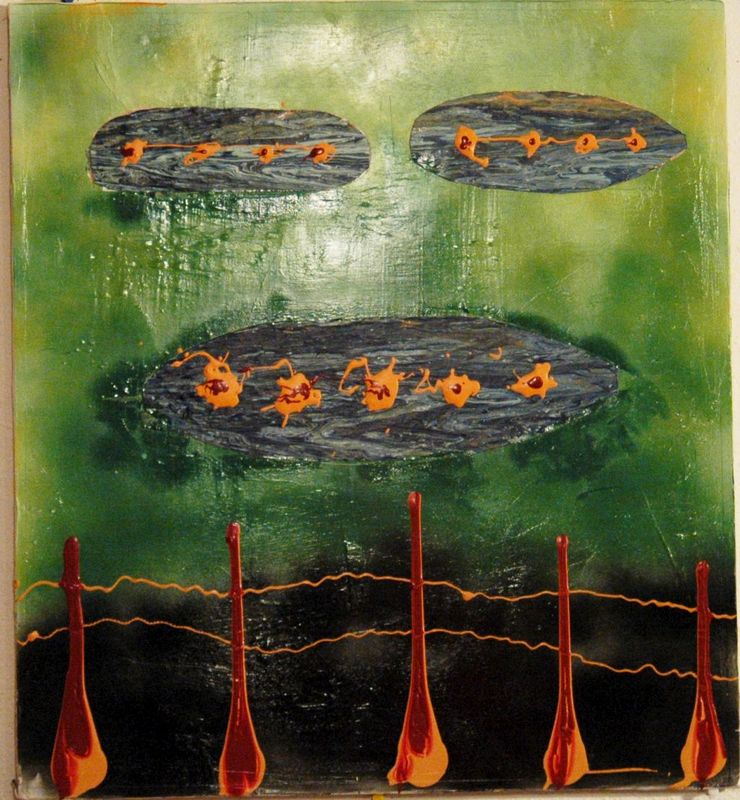
“U.F.O.’s” (2008) / by Marcus / Austin, Texas.
House paint over spray paint over gesso on plywood (20″ x 22″).

‘McCullough and Lancaster aren’t sure what they captured on video. The executive director of the Austin Planetarium doesn’t know either.’
By Alexis Patterson / November 21, 2008

The Austin Planetarium is now investigating some strange sights in the sky – caught on tape. An astronomy expert is calling them unidentified flying objects – UFOs.

Some men who live in a Central Austin apartment building say they’ve seen bizarre things in the sky for months, but lately it’s been more frequent. The men recorded their sightings on home video. Experts from the Austin Planetarium visited the apartment building area Friday night to see if they could also spot the objects.

Nothing appeared in the sky Friday that would convert any skeptics. But the home video show by Carl Lancaster and Doug McCullough may raise questions in some people’s minds.

“Sometimes they go fast, sometimes they go slow. They make no noise,” said McCullough.

McCullough and Lancaster aren’t sure what they captured on video. The executive director of the Austin Planetarium doesn’t know either.

“It doesn’t look like anything I can recognize,” said Torvald Hessel.

Hessel, an astronomer, says the objects don’t move like an airplane.

“There’s a military base close by, so that would be possible, and they are not going to tell you if they’re flying something special,” said Hessel.

But Hessel doesn’t think the shapes are weather balloons, comets, or shooting stars.

“It’s an unidentified flying object,” said Hessel. “I’m not saying it’s little green men at all. It’s just something we see flying in the air, and we don’t know what it is.”

The Austin Planetarium plans to try to enhance the video to see if some answers can be identified. The video enhancement will take a few days at least. In the meantime, Lancaster and McCullough say they’ll keep watching the sky.

Lancaster and McCullough say they first saw the objects back in April, then didn’t see them again until September. They tell CBS 42 they’ve consistently seen the objects since then.

Source / keye tv

The Rag Blog

Posted in RagBlog | Tagged , , | 2 Comments

Austin Works to Maintain its Status as Live Music Mecca

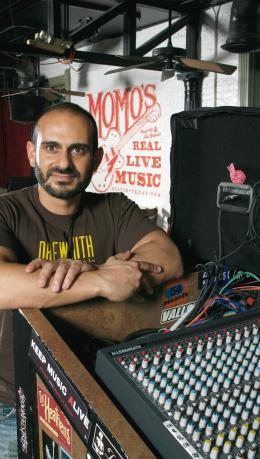
Paul Oveisi, who chairs the 15-member Live Music Task Force created by the Austin City Council, at Momo’s, his live music venue on Austin’s famed Sixth Street. Photo by Harry Cabluck / AP.

‘Today, Austin is defined as much by its high-tech industry as its live music scene, and some say the once laid-back college town is in danger of losing its stage presence.’
By Jay Root / November 23, 2008

AUSTIN — Thriving nightclubs, popular festivals and favorite sons like Willie Nelson and Stevie Ray Vaughan have given Austin a well-deserved, if boastful, moniker: “Live Music Capital of the World.”

But the world has gotten a lot bigger since the days of the Armadillo World Headquarters, when hippies and rednecks joined together in musical harmony and everybody got to park for free. Back then, to hear the old timers tell it, nobody worried much about health insurance or affordable housing, and noise complaints were considered welcome attention.

Today, Austin is defined as much by its high-tech industry as its live music scene, and some say the once laid-back college town is in danger of losing its stage presence. That’s why city leaders are welcoming a plan to promote Austin’s rhythmic heritage, ease the struggles of performing artists and make the town a true music incubator.

“We’re kind of at this pinnacle moment, where we can either continue the status quo and watch a dilution of the music scene, or we can value it and recognize that it’s part of the fabric of who we are as a city,” says Paul Oveisi, an Austin club owner who helped compile a recent series of recommendations about promoting the live music scene.

The Austin music task force Oveisi heads up is now pushing the creation of a city music department, the development of more music venues, an aggressive marketing campaign and incentives designed to lure music industry components such as publishing houses, managers, record labels and digital distributors.

Music enthusiasts also want to crack down on what they say are a handful of fly-by-night outdoor venues that blast high-decibel noise into the night and produce most of the music-related, sound ordinance violations.

City leaders, who received the report from the panel last week, say there’s good reason to protect Austin’s status as a live music hub. Live music and related industries have an estimated $1 billion economic impact on Austin, whose cultural sector generates some $2.3 billion in yearly economic activity. There are an estimated 8,000 working musicians in Austin.

The pulsating music scene has helped give the state capital its enduring reputation as a youthfully hip, fun town. It was here, at the old Armadillo World Headquarters in the early 1970s, that Willie Nelson’s brand of outlaw country was born. Years later, at the famed Antone’s nightclub, blues guitarist Stevie Ray Vaughan roared into the city’s musical conscience.

Since then, internationally acclaimed musical festivals like South By Southwest (SXSW) and Austin City Limits have lured thousands, and thriving venues from 6th Street to South Lamar — places like Antone’s, The Broken Spoke, Momo’s, the Continental Club, Stubbs, La Zona Rosa, The Hole in the Wall — continue to draw big acts and large crowds.

“Live music is a defining characteristic of Austin,” said Austin Mayor Will Wynn. “Many people consider it to be the heart and soul of what makes Austin such a desirable city in which to live, work and play.”

But members of the task force say the city’s rapid expansion, rising health care costs, expensive real estate — even the difficulty of finding a parking spot in the car-choked city center — have made Austin an increasingly tough place to make a living as a performer.

“It’s tough when your take home pay is a hundred bucks and 20 of it is going to pay for the valet guy who parked your car, or 15 of it is going to pay the parking ticket,” said Brandon Aghamalian, one of the 15 task force panelists. Their report recommends that the city give parking vouchers to “certified musicians” in entertainment districts and create loading and unloading areas specifically reserved for them.

It also urges the city to pool public and private funds to help provide affordable housing and bolster health care services for performers, including the possible creation of a musician-only health clinic similar to the one in New Orleans.

Promoting the entertainment business at a time of national economic decline might be a tough sell, but task force members and city leaders alike say Austin’s music scene is a vital job-creating engine that will pay long-term dividends. Plus, legendary guitarist Carlos Santana, who just opened a new restaurant and live music venue in Austin called Maria Maria, says the economic distress will soon seem like “a bad dream that you won’t even remember.”

Appearing at the grand opening of the restaurant earlier this month, Santana fondly recalled playing here with Vaughan and the Fabulous Thunderbirds and said he envisioned performing at his club next year. Santana said Austin’s musical heritage won’t fade because it flows naturally from the musical legends and fans who found their vibe amid the city’s limestone cliffs.

“The thing about music is that if you think about it you missed it. You just have to just, like, trust your heart to feel it. And my favorite story about Austin is that,” Santana said. “There is something really special about Austin.”

Source / AP / Houston Chronicle

Also see New music fest ends in discord by Michael Corcoran / Austin American-Statesman / Nov. 18, 2008

Thanks to Harry Edwards / The Rag Blog

Posted in RagBlog | Tagged , , , , , | 2 Comments

HEALTH CARE / Dr. Stephen R. Keister: The Gauntlet Has Been Tossed

A doctor makes a rare house call to visit patients in Florida. While such house calls are rare in the US, they are commonplace in France. Photo by Gregg Matthews / NYT.

‘The insurance companies are money making businesses that have been on the scene for many years and in the psyche of a well indoctrinated American public are looked at as benevolent institutions, secondary only to one’s place of worship.’
By Dr. Stephen R. Keister / The Rag Blog / November 23, 2008

In view of the election of Sen.Obama as president, and in view of the growing tide to create a system of universal, single payer health care, the Health Insurance Industry entered the fray with a proposal on November 19, 2008, entitled “Health Plans Proposal Guaranteed Coverage for Pre-Existing Conditions and Individual Coverage Mandate” One of the key issues is the “Individual Coverage Mandate,” but more on that later. For the public to really understand the issue of universal care some definitions must be reviewed and certain elements of public confusion clarified.

When we speak of “health care insurance” or indeed of any “insurance,” what are we looking at? Just what is an “insurance company?” These money making businesses have been on the scene for many years and in the psyche of a well indoctrinated American public are looked upon as benevolent institutions, secondary only to one’s place of worship. Wrong, an insurance company is marketed to make money for the owners, the executives, the employees and the stockholders. These ends may be achieved overtly or by connivance in the disallowance of claims or other cupidity. The insurance industry is adept in using scare tactics in turning the public away from alternatives to purchasing insurance, such as, “Do you want socialized medicine?” Or, Do you want your health care managed by “bureaucrats?” Heaven’s to Betsy, what do these folks who propose national health care want to do to us?

I am not sure what “socialized medicine” is, save in the lexicon of those opposed to universal health care. I assume that it has something to do with government “interference” in my health care. The closest we come to that in the United States are the Medicare and Medicaid programs, which merely pay our bills, and have nothing to do with choosing our doctors or hospitals. The Veterans Administration is an excellent example of government provided medicine and it did an excellent job of caring for its patients until the massive funding cuts by the Bush administration in recent years. “Care by ‘bureaucrats?’” Again a nasty name for a government employee.

Why such a nasty designation these folks, some of whom are are relatives or friends? These are merely the employees who do the work for HHS which in turn administer Medicare, Social Security, etc, making sure that we get our checks or that our bills are paid, and they have nothing to do with selection of doctors, hospitals or other medical services. The insurance industry, since the companies colluded to take over medical care some 30 years ago, have taken unto themselves 30% or more of the health care dollar, and intruded on the prerogative of your physician to care for you as he/she sees fit.

Another farce that the insurance industry will foist upon you is that those nations with universal care do not provide the excellence of care we get in the United States. This in spite of the fact that the Commonwealth Fund ranks health care in the United States as #25 an the world, and that of seven nations surveyed regarding the treatment of chronic illness, we here in this country rank #7. You will be exposed on TV to a series of talking heads from conservative think tanks such as the American Enterprise Institute, Heritage Foundation, etc, espousing the cause of the insurance industry and demeaning universal, single payer care. (Wikipedia has an excellent run-down on the various think tanks, rating them as conservative, liberal, or center.) You will see TV ads done by actors indicating that care in other nations is far inferior to that here in the USA.

Before going further, let us take a brief look at health care in France, which in numerous surveys rates best in the world. In January 2003, The American Journal of Public Health, Vol. 93, No.1, did an extensive survey of French national health insurance. This is much too extensive to include herein; however, in New Yorker writer Adam Gopnik’s wonderful little book Paris to The Moon he reviews the life that he, his wife and young child lived in Paris for the period 1995-2000. On page 258 he notes that Luke, his four year old, became violently ill and was immediately seen by their pediatrician , who post haste, obtained a consultation with a surgical colleague, In view of the fact that both physicians were in doubt, they were referred to the Necker pediatrics hospital, where the child was immediately taken care of; blood tests, a sonogram and barium enema were immediately done, and two and a half hours later they were back home with appropriate medicine for Salmonella poisoning.

The author concludes that only then did he realize that in the journey that no one had requested money, requested an insurance card, nor that they fill out various forms or do any of the other humiliating things that our American friends have to do with sick children. In another chapter entitled “Like a King” he discusses the excellent pre- and post-natal care that his wife received in Paris during her pregnancy there. In this chapter he notes that under French regulations a woman after giving birth to a child is guaranteed 4-5 nights in the hospital or clinic.

Steve Weissman in TruthOut discusses his personal encounter with French medical care. For instance, one has free choice of doctors, specialists, hospitals. Doctors make house calls! An office call costs 22 euros, the national health system reimburses 70% of this to one’s bank account. In certain instances the single-payer system pays 100%. Prescriptions are free.

Costs to the average Frenchman? Taxes a shade higher than in the United States. But remember, he is not paying for health insurance, gets free or near free medical care, and education is paid for through university for qualified individuals.

Currently there are various plans for universal health care before Congress. These are discussed by David Sirota in “Tuning Out the Braindead Megaphone on Health Care.” There is a discussion of the current Kennedy/Bauchus plan, which surely is wanting. If one is sincere in working for universal care one must be encouraged to review the extensive website for Physicians for a National Health Program, as well as Health Care-Now. We must keep constant pressure on our elected representatives and review their baksheesh from the insurance industry that is available on line at several web-sites. One might even look at several of my, rather dated, articles. Click on “position papers.”

Finally, let’s return to my initial paragraph regarding the plans of the health care industry. They speak of a “coverage mandate,” in other words, requiring one by law to buy health insurance. In the past I have seen this discussed by constitutional scholars who point out that this is going into the legally unknown. TO REQUIRE BY LAW THAT ONE PURCHASE FROM A PRIVATE CORPORATION. Granted the government can require under various statutes that one pays taxes to the government for Social Security, Medicare, etc, but being required to purchase from a profit making private company is entirely a horse of a different color. Further, it is generally conceded that decent private health insurance for a family of four would cost something like $1200/month. Lesser policies now available have large deductibles (such as the first $5000/year), large co-insurance payments, and exclusions.

The battle has been joined. I several weeks ago noted on TV an ad by AARP for national health care. I emailed a question, not noting that I was a physician, as to whether this was single payer, universal care and the email response was that “this would be too expensive.” Recall that AARP has in recent years become one great purveyor of insurance.

We will be exposed to much hypocrisy during this interlude, calling to mind Hannah Arendt’s statement:

“As witness not of our intentions but of our conduct, we can be true or false, and the hypocrite’s crime is that he bears false witness against himself. What makes it so plausible to assume that hypocrisy is the vice of vices is that integrity can exist under the cover of all other vices except this one. Only crime and the criminal, it is true, confront us with the perplexity of radical evil; but only the hypocrite is really rotten to the core.”

The Rag Blog

Posted in RagBlog | Tagged , , , , , , , | 2 Comments

Top Scientist : Bush Giving Political Hacks Jobs Calling for Technical Skills

Climate scientist James McCarthy, a leader of the group that shared the Nobel Peace Prize with Al Gore, calls Bush on carpet for giving high level civil service jobs to political appointees. Photo by Suzanne Kreiter / Boston Globe.

McCarthy: ‘It’s ludicrous to have people who do not have a scientific background, who are not trained and skilled in the ways of science, make decisions that involve resources, that involve facilities in the scientific infrastructure.’
By Juliet Eilperin and Carol D. Leonnig / November 22, 2008

The president of the nation’s largest general science organization yesterday sharply criticized recent cases of Bush administration political appointees gaining permanent federal jobs with responsibility for making or administering scientific policies, saying the result would be “to leave wreckage behind.”

“It’s ludicrous to have people who do not have a scientific background, who are not trained and skilled in the ways of science, make decisions that involve resources, that involve facilities in the scientific infrastructure,” said James McCarthy, a Harvard University oceanographer who is president of the American Association for the Advancement of Science. “You’d just like to think people have more respect for the institution of government than to leave wreckage behind with these appointments.”

His comments came as several new examples surfaced of political appointees gaining coveted, high-level civil service positions as the administration winds down. The White House has said repeatedly that all gained their new posts in an open, competitive process, but congressional Democrats and others questioned why political appointees had won out over qualified federal career employees.

In one recent example, Todd Harding — a 30-year-old political appointee at the Energy Department — applied for and won a post this month at the National Oceanic and Atmospheric Administration. There, he told colleagues in a Nov. 12 e-mail, he will work on “space-based science using satellites for geostationary and meteorological data.” Harding earned a bachelor’s degree in government from Kentucky’s Centre College, where he also chaired the Kentucky Federation of College Republicans.

Also this month, Erik Akers, the congressional relations chief for the Drug Enforcement Administration, gained a permanent post at the agency after being denied a lower-level career appointment late last year.

And in mid-July, Jeffrey T. Salmon, who has a doctorate in world politics and was a speechwriter for Vice President Cheney when he served as defense secretary, had been selected as deputy director for resource management in the Energy Department’s Office of Science. In that position, he oversees decisions on its grants and budget.

Their recent career moves, along with those of several other Bush appointees, highlight the extent to which personnel who started their federal careers as presidential picks are making the transition into civil service. That practice, known as “burrowing” by career government workers, has been a regular occurrence in the waning days of previous administrations, as well.

White House spokesman Tony Fratto said the administration was not involved in orchestrating any hires of political appointees, and he defended the right of political aides to apply for career positions.

“The White House has no policy on individuals applying for career jobs,” he said. “There is no deliberate effort to shift political staff into career jobs.”

At least one agency yesterday initially referred questions about the personnel moves to the White House, but Fratto said that was because the agency was wary of the media.

“We expect agencies to follow the rules as laid out” by the Office of Personnel Management, he said. “If there is an instance where those rules are not followed, OPM has the obligation and the responsibility to follow up with the career officials at those departments and agencies and take corrective measures.”

But Senate Environment and Public Works Committee Chairman Barbara Boxer (D-Calif.), raised concerns about the shifts in an interview yesterday.

“I believe it’s unethical to do this. Clearly the people voted for change,” Boxer said. She said she had discussed the issue with members of President-elect Barack Obama’s transition team, adding: “They are on top of it.”

Responding to congressional inquiries, Luis A. Reyes, deputy assistant to the president for presidential personnel, sent a letter yesterday to Democratic Sens. Charles E. Schumer (N.Y.) and Dianne Feinstein (Calif.) denying that a concerted effort was taking place.

“In hiring our Nation’s Federal career workforce, the Administration adheres to a rigorous, transparent and competitive process in place at each agency that is managed by career officials and safeguarded by the merit system principles upheld by the Office of Personnel Management (OPM), without White House involvement,” Reyes wrote.

McCarthy at the AAAS specifically questioned Salmon’s and Harding’s qualifications, but DOE spokeswoman Healy Baumgardner said Salmon’s duties include “operational administration and management,” which are “not science-based.” Baumgardner added that Salmon competed for the high-level Senior Executive Service post against “a number of other applicants.”

At NOAA, spokesman Anson Franklin said Harding was selected in “a competitive process by career executives” and “the position did not require a scientific background, but a background in international relations.”

Akers, a former GOP Capitol Hill staffer who did not make the list for the three best-qualified candidates when he initially applied for a GS-15 job at the DEA, got a second chance last month when the agency advertised it was taking applications for two weeks for a soon-to-be-vacant job in the Senior Executive Service.

Acting DEA chief Michele Leonhart announced on Nov. 13 that she had chosen Akers for the career position to help oversee a division called Demand Reduction, a headquarters job that the agency had previously told budget analysts it planned to eliminate.

A source familiar with the situation said the Justice Department raised concerns about the initial plan to hire Akers without opening the position for full competition. A Justice Department spokesman declined to elaborate but said the agency instructed the DEA to make the process fair and open.

Akers’s career path within the DEA over the past three years has yielded considerable financial benefits. For nine years before joining the DEA, he worked for Sen. Charles E. Grassley (R-Iowa) and as the director of the Senate Caucus on International Narcotics Control, where in 2005, his last year on the Hill, he made $39,000, legislative records show.

In his political “Schedule C” job at the DEA, Akers had a salary range of $115,00 to $149,000, depending on his step. His new senior executive position pays from $114,000 to $172,200.

[Staff researcher Madonna Lebling contributed to this report.]

Source / Washington Post

Thanks to Harry Edwards / The Rag Blog

Posted in RagBlog | Tagged , , , | Leave a comment

Whad’Ya Know? Terrellita Maverick’s Still Fighting for the Family’s Good Name

Terrillata Maverick: A real Maverick still fights the good fight.

‘Mother’s interview was priceless! She was funny and quick on the uptake. She talked about the election, ancestral anecdotes, and backpacking around the world.’
By Fontaine Maverick / The Rag Blog / November 23, 2008

After weeks of a whirl of pre-election interviews surrounding my family’s indignant “John McCain, You’re No Maverick” campaign, a period of joy and relief ensued with the November 4 election of Barack Obama. We felt good about what we had accomplished, but I, for one, was glad that I could focus on the emotion that was the result of this marvelous, historical victory.

But there was one more; my 82 year old mother (Terrellita Maverick) told me that she was to be interviewed November 22 on “some NPR radio show” at Trinity University in San Antonio. Turns out, the show was Michael Feldman’s “Whadda Ya Know”, a very popular and venerable (they have been around for over 20 years) quiz show in the format of “Prairie Home Companion” with live audience interaction and musical guests. Those of you who live in parts of the country other than Austin may be familiar with it; we, unfortunately are not.

Anyway here’s a little rundown of what was in store for me and my mom today:

I had a long day; up at dawn to get mother to the beautiful auditorium at Trinity U, got her backstage for her gig as interviewee on “Whadda Ya Know,” and settle myself in the audience with an elderly friend of hers (a lovely woman named Jane). The show was beautifully produced — very regional decor on the big stage — fiesta taco booths and Big Rainbow Colored Papier Mache letters spelling out “NIOSA” (night in old San Antonio). A very fine jazz band opened the show.

Mother’s interview (about 15 minutes long) was priceless! She was funny and quick on the uptake – best I have ever seen her. She talked about the election, ancestral anecdotes, and backpacking around the world in her late forties. You had to be there, but I was very proud of her. She was followed by Feldman’s “quiz show” with an audience member, and a phone in guest, followed by a musical interlude with the Krayolas and Augie Myers, plus the West Side Horns. Then more audience interaction, and a great cooking demo with a local SA mexican chef (yes, you can do a cooking demo on the radio, you just have to talk about everything you are doing – and have fun).

Oh, and a 7 foot tall San Antonio Spur (I forget his name) was another guest. Cute guy!

Looks like you can get a podcast after Monday the 24th on the notmuch.com website — check it out — it’s a hoot.

[The Texas Maverick clan — a venerable pack of political progressives and iconoclasts who inspired the popular usage of the term “maverick” — spoke out during the 2008 campaign about the theft of the family’s good name by John McCain and his (not so) trusty sidekick Sarah.]

More from The Rag Blog on the Maverick family of Texas:

* Hey John : You’re No Maverick. And We Can Prove it! / Brave New World Video / The Rag Blog / Oct. 29, 2008

* Austin’s Fontaine Maverick Tells CNN Why McCain and Palin are no Mavericks / Video / The Rag Blog / Oct. 9, 2008

* McCain a Faux Maverick : Stealing a Texas Tradition by Paul in Austin / The Rag Blog / Sept. 13, 2008

* Fontaine Maverick : John McCain is no Maverick! by Fontaine Maverick / The Rag Blog / August 31, 2008

And * This Maverick The Real Deal by Joe Holley / The Rag Blog / March 1, 2008

Also see Public radio host did his S.A. homework by Amy Dorsett / San Antonio Express-News / Nov. 23, 2008

The Rag Blog

Posted in Rag Bloggers | Tagged , , , , , , , | 3 Comments

Tom Hayden : Frankenstein in Mesopotamia

Frankenstein’s monster, played by Boris Korloff, from the original 1931 movie. The monster the U.S. is leaving behind in Baghdad is a police state.

‘The most important things, some say, are the things left unsaid. If so, the unmentionable thing would be the police state America is leaving behind in Baghdad.’
By Tom Hayden / November 21, 2008

The pact being negotiated between the US and Baghdad governments includes a direct rebuff to president-elect Barack Obama’s promised policy of withdrawing American combat troops in 16-18 months. The pact instead would leave those troops in place until the end of 2011, a doubling of the timeline to which Obama pledged himself. But that’s not all.

The most important things, some say, are the things left unsaid. If so, the unmentionable thing would be the police state America is leaving behind in Baghdad.

Finally, human rights observers agree that there are 40-50,000 Iraqis currently held in detention centers under either US or Iraqi control. Under terms of the pact, “we’re getting out of the detainee business”, says the US military spokesman in Iraq. The US-run camps, known as Bucca and Cropper, hold at least 17,000 detainees under a US-declared “security detention” doctrine that does not exist in either American or Iraqi law. According to Human Rights Watch, they are held “for indefinite periods, without judicial review, and under military processes that do not meet international standards.” Most of them – at least 12,000 – were mistakenly seized in American sweeps or played marginal roles the resistance. Those who are released are often killed by Shi’a death squads.

If the US and Iraqi governments were to seek a renewal of the United Nations reauthorization when it expires on December 31, chances are that accepted human rights standards would be demanded for the Iraqis detainees, such as access to legal council, family members and international observers.

But under the proposed Iraq-US pact, the 17,000 will be shifted from US to Iraqi detention facilities, a transition to even greater darkness. Knowing this, the Sunni parliamentary bloc is demanding amnesty for most of them.

The concerns are deadly serious. I interviewed an American contractor, a former Marine, just returned from Baghdad in 2005, one paid to protect the Sunni delegation in the Green Zone. He bitterly spoke of Sunni bodies, bullets lodged in their heads from short range, lye disfiguring their faces, being dumped in the streets, The 2007 Baker-Hamilton Study group issued a one-sentence confirmation that the Iraqi police “routinely engage in sectarian violence, including the unnecessary detention, torture and targeted execution of Sunni Arab civilians.”

Before the Baker-Hamilton finding, there were other revelations. The Times revealed secret prisons and torture sites in Baghdad which reported directly to the Interior Ministry, itself under sectarian Shi’a control. The Times also described “black sites” at Camp Nama, where an American task force beat, kicked, blindfolded and forced Iraqi inmates to crouch in 6-by-8 cubicles in a prison called Hotel California, where the official motto was “No Blood, No Foul.”

A Congressionally-created law enforcement commission concluded in September 2007 that the Ministry of Interior is “a ministry in name only…widely regarded as dysfunctional and sectarian.”

Even the Bush administration in 2007 confessed “evidence of sectarian bias in the appointment of senior military and police commanders [and] target lists that bypassed operational commanders and directed lower-level intelligence officers to make arrests, primarily of Sunnis.”

Dry language, dry bones

Antiseptic language is sometimes necessary in journalism and law to make objective evaluations. But it also can suppress moral and emotional responses to suffering and serve as a sedative in managing public opinion. Riveting stories of torture dungeons don’t rate much in the media in comparison to domestic violence between white Americans. For instance, clear evidence that Sunni children were being murdered by the Sunni captors, persuasive to a top US military investigator, made it into the Salt Lake Tribune, but not much further. The US Judge Advocate happened to be from Utah, making it a local story.

Counterinsurgency often is framed as winning hearts and minds, not as crushing the alleged insurgents to protect the civilian population. In South Vietnam, that led to “strategic hamlets” and the Phoenix program. In Central America, it was death squads who killed priests, nuns and thousands of civilians. In both cases, American and world opinion was shocked.

In the case of Iraq, there is silence in the West.

For example, there has not been a single Congressional inquiry into the oblique revelations in Bob Woodward’s latest book about secret operations launched in May 2006 to “locate, target, and kill individuals in extremist groups”. The top intelligence adviser on these operations, Derek Harvey, told Woodward that the killings gave him orgasms. These were extra-judicial killings, with the Pentagon acting as judge, jury and executioner. The definition of “extremist” was stretched to include anyone named by an informant as a supporter of the Sunni insurgency, supported by an overwhelming majority of Sunnis.

During Vietnam, the Phoenix program, exposed as killing over 20,000 Vietcong suspects, was closed down after an outburst of ethical fury. In 2004, the Phoenix program’s revival was recommended by Dr. David Kilkullen, described in the Washington Post as “chief adviser on counterinsurgency operations” to Gen. David Petraeus. Kilkullen advocated a “global Phoenix program” to combat global terror in a 2004 article in Small Wars Journal. He later reissued the article without the Phoenix label, having already described the Phoenix project as “unfairly maligned” and “highly effective.” He also advocates applying “armed social science” against the “physical and mental vulnerabilities” of Iraqi detainees. He walks the streets of Washington today, widely accepted in the world of national security advisers. No one in that select establishment has ever criticised his writings.

Americans already pay for this sectarian repression — which even includes the diminishment of Christian seats in parliament — with $22 billion in tax dollars from 2003 through 2007 for American advisers to the Interior Ministry, police and prison guards. In 2007, there were 90 American advisers assigned to the interior ministry, which much of training of police and prison personnel is outsourced to contractors like DynCorps, according to Congressional oversight hearings.

One of the trainers has been Gen. James Steele, a veteran of the Central American counterinsurgency wars, who was with the US Civil Police Assistance Training Team when the sectarian Iraqi militias began operating under official cover. He was quoted in 2006 as “not regretting their creation.”

How has this happened? Presumably the public lacks any sympathy for individuals accused of Islamic terrorism. But there has been ample uproar over torture at Abu Graeb and US foreign policy generally. The public simply doesn’t know much at all about the detention camps in Iraq. Most of the concerned NGOs take up less controversial causes than Iraqi inmates for their fundraising. Human rights insiders accept the paradigm that a democratic, pluralistic Iraq is a work in progress, still lacking an independent judiciary and ACLU watchdogs of their own. The international Red Cross has agrees to keep its findings secret. The peace movement is locked into an exclusive “out now” framework that subordinates police and prison issues to the margins. The Pentagon therefore succeeds in fabricating a new mirage in the desert to replace the discredited one. As our combat troops are replaced by low-visibility advisers, amnesia could take over completely, while shame and hatred beget a new generation of insurgents.

The US administration could do something about this Frankenstein. It could use its remaining leverage to insist on the release of the detainees or the application of enforceable human rights standards and access for the media and human rights workers.

But Congress and the media seem to think that a sectarian police state is the ugly price that must be paid for sharply reducing American casualties and reducing our footprint in Iraq. The hot debate among judge advocates, pro bono lawyers and Congressional investigators, is about a few hundred Guantanamo detainees, not the dark underside of counterinsurgency.

The next stop is Afghanistan, where another 50,000 detainees fester under similar conditions to Iraq, and the British envoy recently recommended an “acceptable dictator.” Instead of addressing the human rights crisis in that country, the envoy suggest that “we should think of preparing our public opinion” for dictatorship as the necessary outcome.#

[Tom Hayden can be reached at tomhayden.com. His recent books are Ending the War in Iraq (2007) and The Tom Hayden Reader (2008).]

Source / Talking Points Memo

For articles by Tom Hayden or referencing Tom Hayden published on The Rag Blog, go here.

Thanks to Carl Davidson / The Rag Blog

Posted in RagBlog | Tagged , , , , , | Leave a comment

Maryland State Police Spying: One Victim’s Story

The most telling fact concerning this story is that it appeared in the UK Guardian and on a quiet Web site for an environmental group in Seattle, Grist.org. This entire matter of the Maryland State Police spying has been routinely suppressed by the mainstream press, not terribly surprising given the ownership of more than 80% of the MSM. Ahhhhh, life in America, land of the free …

Richard Jehn / The Rag Blog

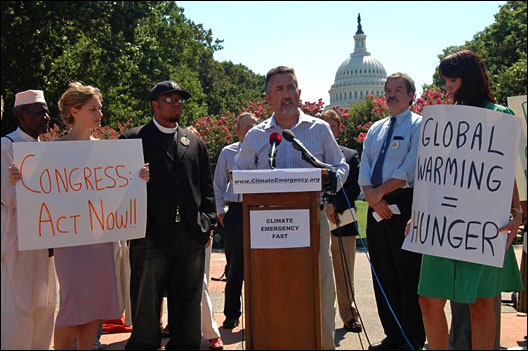
Terrorist Activist Mike Tidwell (at podium) exhibiting clearly threatening behavior. Photo: chesapeakeclimate

Police spy on climate activist while global warming goes unarrested
By Mike Tidwell / November 21, 2008

Police spied on activist Mike Tidwell for months as a ‘suspected terrorist’.

I’m not sure what’s more shocking: the news that the Maryland State Police wrongfully spied on me for months as a “suspected terrorist,” or that, despite surveillance of me, officers apparently wouldn’t recognize me if I walked into their police headquarters tomorrow.

I’m a former Peace Corps volunteer, an Eagle Scout, church member, youth baseball coach, and dedicated father. I also happen to be director of one of the largest environmental groups in Maryland, a nonprofit that promotes windmills and solar panels in the fight against global warming. So imagine my shock to get a police letter last month saying I was one of 53 Maryland activists on a terrorist watch list that has been discontinued because — can you believe it? — there’s “no evidence whatsoever of any involvement in violent crime.”

Matters turned especially Soviet-esque on October 14 when I called the police requesting a full copy of my surveillance file. A spokeswoman told me I could visually inspect the file, but I couldn’t make photocopies, I couldn’t bring an attorney, and the police would be destroying the entire file after I read it.

And bring a valid photo ID, she said, to make sure you’re who you say you are.

A what? Really? You spied on me, for God’s sake.

The mess all began last summer when astonishing evidence surfaced revealing that the Maryland State Police — under former Republican Gov. Robert Ehrlich — posed as activists and infiltrated an anti-death-penalty group, attending the organization’s meetings and taking secret notes to send back to HQ. But what were they doing to me and my organization — the Chesapeake Climate Action Network — during this surveillance program in 2005 and 2006? Bugging our phones? Reading our emails? Monitoring me as I walked my kid to the bus stop?

I still don’t know for sure. Yielding to public pressure, the police finally gave me a printed copy of my “file” on October 29. It raised more questions than it answered. Seven of the 12 pages were withheld without full explanation. And of the pages I did receive, at least half the words were redacted — blacked out with a marker.

There was a photo of me on the last page, lifted from my website. And on the first page, there were these words: “Crime: Terrorism, environmental extremists.”

What terrorism would that be? My file — what little of it I have — makes reference to a morning speech given in Bethesda, Md., by then-governor Robert Ehrlich on November 17, 2005. A small audience of invited guests and journalists attended inside a classroom at Walt Whitman High School. Ehrlich wasn’t doing enough to fight global warming, the Chesapeake Climate Action Network believed, and several of my staff arrived to peacefully demonstrate and hold up signs that said things like, “It’s Getting Hot in Here, Gov!” But troopers with the governor’s “Executive Protection Division” believed this was extreme, according to my file. For example, CCAN staffers invited high school students to hold up protest signs during the governor’s speech. Pretty extreme, huh?

There was no civil disobedience at this event. No one was arrested. No county, state, or federal laws were breached. The entire affair was utterly peaceful, above board, and appropriate. Political demonstrations exactly like this happen a thousand times a day in America. There were no media reports of anything unusual.

Yet Ehrlich’s security team considered this “aggressive protesting.” Afterward, the troopers contacted the Maryland State Police’s Homeland Security and Investigation Bureau. The result was creation of intelligence files on me and three of my staff under the crime category of “terrorism, environmental extremists.” The real motivation, however, appears to be political spying. We were opponents of the governor’s policies. We were organized and vocal about it. We wound up on an intelligence list along with dozens of other innocent, nonviolent opponents of the governor’s policies.

Ironically, I wasn’t even present at the protest in question. I’ve never been to Walt Whitman High School. But a case file was launched on me nonetheless, on November 28, 2005, with my name, photo, job title, “no SMTs” (scars, marks, or tattoos), and the declaration that no charges had been brought against me. Strangely, according to the police papers, there’s no record of any intelligence-gathering related to me after the file was created, just a narrative describing my staff’s protest at the Ehrlich speech.

Meanwhile, the state police say they’ve released everything to me that’s relevant to me, but I don’t believe them. Since July, the state police have made numerous public statements related to this spying controversy that have proved to be factually untrue. They initially said, for example, that the entire surveillance program was limited to anti-death-penalty activists. But we now know activists for peace, immigration, and the environment were spied on too. I believe more of the spying story is yet to come out, however. With the help of a heroic Maryland attorney, David Rocah of the American Civil Liberties Union, and an equally heroic Maryland state senator, Jamie Raskin of Takoma Park, I believe all the facts will soon surface and we’ll see legislation in the state General Assembly in 2009 specifically banning police abuses like this.

The final tragedy here, of course, is how much this whole episode has been a distraction to the public. The real threat of terror to Maryland and the nation is the prospect of up to 23 feet of sea-level rise as the Greenland ice sheet continues to implode from rapid global warming. The violent activity behind this threat is our astonishing over-reliance on fossil fuels, especially coal, to power our economy while suicidally saturating the atmosphere with greenhouse gases. For all our declarations of “never again,” the ground-zero site of the World Trade Center will itself be literally under water from sea-level rise if we don’t switch quickly to 100-mile-per-gallon cars and clean electricity from wind power.

But you can’t have strong and lasting environmental protections without a strong democracy. Most of the transformative, positive change experienced in American history has happened only after significant citizen engagement at a noisy grassroots level. That’s why, ultimately, the objective of almost all environmental groups — from the more liberal Greenpeace to the more conservative Nature Conservancy — is inspiring average citizens to care enough to take action, to make their desires known, to get involved in the system.

But who’s going to get involved and get noisy — in Maryland or elsewhere — if citizens fear that the police are secretly attending the same rallies and meetings, secretly watching and taking notes and keeping lists? Thank God that outraged Marylanders from Ocean City to Cumberland continue to demand full disclosure and reform in the face of this tawdry police spying affair.

The national economy is tanking, we’re bogged down in two wars, and the accelerating impacts of global warming could soon get so severe that Pentagon planners already anticipate security challenges worldwide from the inevitable social unrest spawned by biblical droughts, floods, wildfires, and the rest. History shows that it is precisely during times of war and want that governments tend to overreach and trample liberties. And it’s only in resisting these temptations that certain kinds of governments — democracies — grow stronger.

With a climate disaster looming, I’ve worked very hard for many years to promote clean, renewable energy. But perhaps the greatest contribution I’ll ever make to this cause is the action I’m taking right now: standing up and working hard to keep government itself clean.

[Mike Tidwell is director of the Chesapeake Climate Action Network and author of Bayou Farewell: The Rich Life and Tragic Death of Louisiana’s Cajun Coast.]

Source / The Guardian

The Rag Blog

Posted in RagBlog | Tagged , , , | Leave a comment

Seeing Purple : You Mean McCain DIDN’T Win Florida?

Purple America / Contested South. Graphic from Facing South.

Emerging demographic trends differentiated Florida, Virginia and North Carolina from the rest of the south sufficiently to overcome any ‘Bradley Effect’ and shift them into the Democratic column.
By Jay D. Jurie
/ The Rag Blog / November 22, 2008

On November 3rd I sent out an e-mail predicting that McCain would narrowly take Florida (see below). As we’ve seen, Obama took not only Florida, but also Virginia and North Carolina.

Emerging demographic trends differentiated these three states from the rest of the south sufficiently to overcome any “Bradley Effect” and shift them into the Democratic column.

An article entitled “A New South Rising” on the Institute for Southern Studies Facing South blog [see below] does a good job analyzing the trends, including: urbanization, young white southerners with a different outlook than previous generations, stronger minority voter turn-out, and a growing Latino population.

Other southern states are experiencing these trends. Given the region’s high population growth, the political significance of the south will increase.

I am glad to have been wrong about the election outcome.

My email:

Not to rain on anyone’s parade, and I hope otherwise, but my prediction is that McCain is going to win Florida.

It’ll be close. Maybe not as close as the 2000 election, but very close.

Based on a Mason-Dixon poll, this morning’s Orlando Sentinel shows Obama slightly ahead: 47% to 45%, an error margin of 4%, and 7% undecided. This is a fairly large “undecided” factor with early voting well under way in Florida. 84% of the 7% undecided are white, and I think this is where the so-called “Bradley effect” is hiding.

There are still voter intimidation and suppression shenanigans which may play out on Tuesday as well.

Obama has been waging a very strong and effective campaign in Florida, much stronger than either Gore in 2000 or Kerry in 2004. If Obama loses the state, it won’t be his fault. We’ll see.

A New South Rising
2008 proved that the South is politically competitive and growing in importance. But the pundits are telling a different story.

On the day before Election Day — that final moment when candidates decide where they want to make their last case to the voters they want to win the most — Barack Obama chose to visit three big battleground states: Florida, North Carolina and Virginia.

Since 1968, these Southern states had voted Democratic for president only six times between them. And president-elect Obama was about to ask voters in these states — all members of the old Confederacy — to vote the first African-American ever into the White House.

Obama’s Southern Strategy worked: the states went blue, and history was made.

But just as Southern Democrats were clinking glasses of sweet tea in celebration, the powerhouses of political punditry — especially in the North — made a bizarre move: They turned against the region that had just given one-third of its Electoral College votes to the President-elect.

Ignoring McCain’s dominance in, say, the Great Plains and Upper Mountain states — Obama’s most crushing defeats came in Idaho, Oklahoma, Utah and Wyoming — legions of commentators instead curiously trained their guns on the South, dismissing the region as politically irrelevant, a bastion of red-state conservatism uniquely out of touch with national trends.

Read all of this article here / Facing South: The Online Magazine of the Institute for Southern Studies.

Also by Jay D. Jurie on The Rag Blog: Orlando Homeless Win Big Victory in Federal Court / Sept. 27, 2008

The Rag Blog

Posted in Rag Bloggers | Tagged , , , , | Leave a comment

Mike Davis : Note to Obama: ‘Futurama’ Has to Wait Its Turn


‘We are now at a crash site, and our priority should be to save the victims, not change the tires or repair the fender, much less build a new car.’
By Mike Davis / November 21, 2008

America’s “Futurama” is defunct. The famous walk-through diorama of a car-and-suburb world, imagineered by Norman Bel Geddes for General Motors at the 1939 New York World’s Fair, has weathered into a dreary emblem of our national backwardness. While GM bleeds to death on a Detroit street corner, the steel-and-concrete Interstate landscape built in the 1950s and 1960s is rapidly decaying into this century’s equivalent of Victorian rubble.

As we wait in potholed gridlock for the next highway bridge to collapse, the French, the Japanese, and now the Spanish blissfully speed by us on their sci-fi trains. Within the next year or two, Spain’s high-speed rail network will become the world’s largest, with plans to cap construction in 2020 at an incredible 6,000 miles of fast track. Meanwhile China has launched its first 200 mile-per-hour prototype, and Saudi Arabia and Argentina are proceeding with the construction of their own state-of-the-art systems. Of the larger rich, industrial countries, only the United States has yet to build a single mile of what constitutes the new global standard of transportation.

From day one, Barack Obama campaigned to redress this infrastructure deficit through an ambitious program of public investment: “For our economy, our safety, and our workers, we have to rebuild America.” Originally he proposed to finance this spending by ending the war in Iraq. Although his present commitments to a larger military and an expanded war in Afghanistan seem to foreclose any reconversion of the Pentagon budget, he continues to emphasize the urgency of an Apollo-style program to modernize highways, ports, rail transit, and power grids.

Public works, he also promises, can put the public back to work. His “Economic Rescue Plan for the Middle Class” vows to “create 5 million new, high-wage jobs by investing in the renewable sources of energy that will eliminate the oil we currently import from the Middle East in 10 years, and we’ll create 2 million jobs by rebuilding our crumbling roads, schools, and bridges.” Of course, Bill Clinton entered the White House with a similarly ambitious plan to rebuild the derelict national infrastructure, but it was abandoned after Treasury Secretary Robert Rubin convinced the new president that deficit reduction was the true national priority. This time around, a much more powerful and desperate coalition of interests is aligned to support the Keynesian shock-and-awe of major public works.

Rolling Out the Dozers

Since the Paulson bailout plan has become so much expensive spit in the wind, and with bond spreads now premised on the possibility of double-digit unemployment over the next 18 months, massive new federal spending has become a matter of sheer economic survival. As innumerable influentials — from New York Times columnist David Brooks to House Majority Leader Nancy Pelosi — have argued, a crash program of infrastructure repair and construction, likely to include some investment in the new power grids required to bring more solar and wind energy online, is the “win-win” approach that will garner the quickest bipartisan support.

It has also been portrayed as the only lifeboat in the water for the ordinary steerage passengers in our sinking economy. The emergent Washington consensus seems to be that those five million green jobs can actually come later (after we save GM’s shareholders), but that infrastructure spending — if resolutely pushed through the lame-duck Congress or adopted in Obama’s first 100 days — can begin to pump money into the crucial construction and manufacturing sectors of the economy before the end of next winter.

Unlike Comrade Bush’s “socialist” efforts to save Wall Street, a public-works strategy for national recovery has had broad ideological respectability from the days of Alexander Hamilton and Abraham Lincoln to those of Franklin D. Roosevelt and John F. Kennedy. If Democrats can brag about the proud heritage of the Works Progress Administration and the Public Works Administration from the era of the Great Depression (ah, those magnificent post offices and parkways), there are still a few Republicans who remember the Golden Age of interstate highway construction that commenced in the 1950s with President Dwight D. Eisenhower. Indeed since the national shame of Hurricane Katrina, Americans have become outspokenly nostalgic about competent federal governments and magnificent public achievements.

If one accepts the reasonable principle of supporting the new president whenever he makes policy from the left or addresses basic social needs, shouldn’t progressives be cheering the White House as it rolls out the dozers, Cats, and big cranes? Aren’t high-speed mass transit and clean energy the kind of noble priorities that best reconcile big-bang stimulus with long-term public value?

The answer is: no, not at this stage of our national emergency. I’m not an infrastructure-crisis denialist, but first things first. We are now at a crash site, and our priority should be to save the victims, not change the tires or repair the fender, much less build a new car. In the triage situation that now confronts the president-elect, keeping local schools and hospitals open should be the first concern, rebuilding bridges and expanding ports would come next, and rescuing bank shareholders at the very end of the line.

Inexorably, the budgets of schools, cities, and states are sinking into insolvency on a scale comparable to the early 1930s. The public-sector fiscal crisis — a vicious chain reaction of falling property values, incomes, and sales — has been magnified by the unexpectedly large exposure of local governments and transit agencies to the Wall Street meltdown via complex capital lease-back arrangements. Meanwhile on the demand side, the need for public services explodes as even prudent burghers face foreclosure, not to speak of the loss of pensions and medical coverage. Although the public mega-deficits of California and New York may dominate headlines, the essence of the crisis — from the suburbs of Anchorage to the neighborhoods of West Philly — is its potential universality. Certainly, in such a rich country, wind farms and schools should never become a Sophie’s choice, but the criminal negligence of Congress over the past months should alert us to the likelihood that such a choice will be made — with disastrous results for both human services and economic recovery.

Saving Schools and Hospitals

Congress naturally loves infrastructure because it rewards manufacturers, shippers, and contractors who give large campaign contributions, and because construction sites can be handsomely bill-boarded with the names of proud sponsors. Powerful business lobbies like the National Industrial Transportation League and the Coalition for America’s Gateways and Trade Corridors stand ready to grease the wheels of their political allies. In addition, if the past century of congressional pork-barrel methods is any precedent, infrastructural spending typically resists coherent national planning or larger cost-benefit analyses.

Yet saving (and expanding) core public employment is, hands-down, the best Keynesian stimulus around. Federal investment in education and healthcare gets incomparably more bang for the buck, if jobs are the principal criterion, than expenditures on transportation equipment or road repair.

For example, $50 million in federal aid during the Clinton administration allowed Michigan schools to hire nearly 1,300 new teachers. It is also the current operating budget of a Tennessee school district made up of eight elementary schools, three middle schools, and two high schools.

On the other hand, $50 million on the order book of a niche public transit manufacturer generates only 200 jobs (plus, of course, capital costs and profits). Road construction and bridge repair, also very capital intensive, produce about the same modest, direct employment effect.

One of the most likely targets for a Congressional stimulus plan is light-rail construction. Street-car systems are enormously popular with local governments, redevelopment agencies, and middle-class commuters, but generally they operate less efficiently (per dollar per passenger) than bus systems, and at least 40% of the capital investment leaks overseas to German streetcar builders and Korean steel companies.

Personally, I would love to commute via a sleek Euro-style bullet train from my home in San Diego to my job in Riverside, 100 grueling freeway miles away, but I’ll take gridlock if the cost of rationing federal expenditure is tolerating the closure of my kids’ school or increasing the wait in the local emergency room from two to ten hours.

Obama, unlike his predecessor, has a bold vision, shared with his powerful supporters in high-tech industries, of catching up with the Spanish and Japanese, while redeeming America as the synonym for modernity. Lots of new infrastructure will, however, become so many bridges to nowhere (especially for our children) unless he and Congress first save human-needs budgets and public-sector jobs.

A good start for progressive agitation on Obama’s left flank would be to demand that his health-care reform and aid-to-education proposals be brought front and center as preferential vehicles for immediate macro-economic stimulus. Democrats should not forget that the most brilliant and enduring accomplishment of the Kennedy-Johnson era was Head Start, not the Apollo Program.

If, after saving kindergartens and county hospitals, we someday hope to ride the fast train, then we need to rebuild the antiwar movement on broader foundations. The president-elect’s original proposal for funding domestic social investment through downsizing the empire offers a brilliant starting point for basing economic growth on an economic bill of rights (as advocated by Franklin Roosevelt in 1944) instead of imperial over-reach and Pharaonic levels of military waste.

[Mike Davis is the author of In Praise of Barbarians: Essays Against Empire (Haymarket Books, 2008) and Buda’s Wagon: A Brief History of the Car Bomb (Verso, 2007). He is currently working on a book about cities and poverty.]

Source / Progressives for Obama

Also see Mike Davis : Can Obama See the Grand Canyon? by Mike Davis / The Rag Blog / October 23, 2008

The Rag Blog

Posted in RagBlog | Tagged , , , , , , | Leave a comment